Showing posts with label Malayalam cinema. Show all posts

Sunday, September 05, 2021

On Don Palathara’s Joyful Mystery: an arguing couple, a fixed camera and an 82-minute take

(One of my most pleasing recent discoveries is the cinema of Don Palathara [whose work can be found on Mubi India, for anyone interested]. I have watched three of his five films so far, most recently Everything is Cinema, which I loved for its cold, self-absorbed misanthropy and for the texture of Palathara's voiceover, which dominates much of the film. For now, though, here’s a piece I did for Money Control about Santhoshathinte Onnam Rahasyam)
-----------------------------------------

A tiny moment – lasting barely a couple of seconds – in the new Malayalam film Santhoshathinte Onnam Rahasyam (English title: Joyful Mystery) drew a surprised chuckle out of me. Maria and Jithin – an unmarried couple, not too secure financially, trying to get their careers on track – are on their way back from a clinic. They are facing the possibility that Maria is pregnant (the test result will come later in the day) and are trying to process what this might mean for their future, and what their options are – abortion included. For much of the drive to the clinic they have been arguing, exchanging recriminations or being passive-aggressive in the way couples often are in these situations. The air is thick with tension.

Then something shifts, if only momentarily. Maria – a tabloid journalist – is on a phone interview with a movie director who is pontificating on about his work. Even as he claims to be making “the first feminist Malayalam film by a man”, he decrees that there are some things only women should do since they excel at them. Such as making sambhar. What if my grandmother had become a revenue officer, he asks rhetorically. The whole family would have missed out on her amazing sambhar! As the director says these words (we can hear his voice on Maria’s speaker-phone), there is a split-second exchange of bemused glances between Maria and Jithin. It’s deadpan, not underlined, but very effective and funny.

Another amusing interlude: shortly before this scene, they gave a ride to an elderly woman who revealed that she was at a wedding attended by a hundred people – much to the consternation of Jithin, already displeased about sharing an enclosed space with a stranger in Covid-19 time. After the woman gets off at her destination, he exclaims, “She had primary contact with 100 people.” Maria looks pensively at the departing woman.

In the lead-up to both these moments, Maria and Jithin had been in sullen-silence mode – but now we see them bonding, however briefly. They get to step back from their fraught situation for a moment and become one “unit” again – a couple who is sufficiently attuned to each other (and have enough in common as broadly liberal young people) that they can share a wordless glance at the idiosyncrasies, irresponsible behaviour or posturing of others.

Both these scenes are in the second half of the film, and after all the angry, accusatory talk in the first half this represents the beginning of a return to some order, the calm after the storm. Which is not to say that the film is headed for a conventionally happy ending, or that the couple’s struggles are going to be over soon. But something vital about the relationship has been captured, adding warmth and plausibility to the narrative.

*****

Much of the talk around this film, written and directed by Don Palathara, will understandably focus on the formal device at its centre: it is filmed in a single take that runs more than 80 minutes, with one fixed camera at the front of the car in which Maria (played by Rima Kallingal) and Jithin (Jithin Punthenchery) are travelling.

This means that almost throughout, we watch them up close as they talk or negotiate uncomfortable silences. With a couple of breathers here and there: Jithin stopping the car and getting out to bring Maria a lemon for her nausea, or to smoke for a while after an argument; Maria leaving the car for a few minutes when they reach the clinic.

There are bursts of conversation, explosions of anger, mood swings. And a few long pauses that are always risky in a film like this since all the viewer can do during these periods is to look at the two people on the screen, conjecture what they might be feeling or thinking. Watch Jithin keeping his emotions (mostly) under control and his eyes on the road, making a determined effort to be the Sensitive Male but with his mind probably ticking away under that composed exterior; look at Maria, more agitated and demonstrative, dealing with her current nausea as well as the possible bodily changes to come, worrying about career and societal judgement, frustrated that the man next to her can afford to be so unruffled since he isn’t as directly affected.

With most of the famous lengthy takes in film history (in classics like Orson Welles’s The Magnificent Ambersons and Touch of Evil, Alfred Hitchcock’s Rope and Under Capricorn, or in modern films like Birdman or Russian Ark or 1917), the camera moves with the characters. A twelve-minute-long establishing shot in another recent Malayalam film, Malik, takes us through a large house, up and down stairs, into different rooms, as we meet some of the film’s protagonists.

The single take in Santhoshathinte Onnam Rahasyam is very different from these. On the face of it, the unblinking and unmoving camera makes this film less “cinematic”, more stationary and theatre-like. But the technique works very well visually for the situation. During the driving scenes, Maria and Jithin are in fixed positions in the car, literally strapped in, while the scenery behind them changes subtly: the buildings, the greenery, the shifts in light as they pass under a canopy. They are in a private space – with each of them leaving it occasionally but soon returning – while other things orbit around them. People enter and exit (mostly as voices on a phone), there are conversations – with family, friends – that in subtle ways touch on the subject of what is conventional or unconventional, socially approved or frowned upon, and on aspects of the parent-child relationship; things that are relevant to Maria and Jithin’s current circumstances.

It’s one thing to say that a particular film is for a “patient viewer” – that’s a given in a case like this – but so much here hinges on the performances of the two leads; with the camera scrutinising them so closely, the slightest inadequacy or implausibility would make the whole film lose its moorings. Jithin Punthenchery and Rima Kallingal – who are constantly required to walk a tightrope between the mundane and the dramatic, between improvisation and a scripted narrative – are excellent throughout. Even when there is nothing particularly exciting or novel happening in the conversation, when the whole point of it is its banality, they kept me gripped.

Looked at in one way, this film’s structure is very simple: take a potentially dramatic development and use it to examine the quotidian workings of a relationship over the course of a long car drive. End with a measure of calm having been reached, even a little smile here and there, an affectionate touch. Some might even call it simplistic. But if you accept its slice-of-life approach on its own terms, and also see it as a work that is self-aware about the limitations of this kind of “experimental” cinema (there is a nod to this in the conversation with the pretentious director, who is voiced by Palathara himself), the staging and the performances add up to a lot. This is an absorbing view of how close relationships work; how two people, caught in a particular moment, interact with each other and with the world.

Saturday, August 21, 2021

Helen on the rocks (and other "frozen" women)

[a version of my column for the Sunday Economic Times -- this one about how a gripping Malayalam film subverts the "fridging" theme]  

----------------------------------

When is a woman in a refrigerator more than just a woman in a refrigerator? The answer can vary with your perspective or interpretation – but the reference, in case you’re wondering, is to a term coined by the comic-book writer Gail Simone. Also known as “fridging”, it describes a certain trope in literature and film: an imperilled, murdered or generally non-functional woman character becomes the pretext for the emotional development (or the plot-furthering emotional devastation) of a man.

In many of these cases, a token effort is made to create empathy for the victim, but she’s basically a cipher for plot purposes, and it’s all about the fellow’s journey. (Comatose or dead women are particularly useful; they can’t even complain that a man is man-spreading his way across the narrative.) Formulaic vigilante-revenge films use this frozen woman, and so do more nuanced stories. A recent example I saw was a scene in season one of The Crown: old Winston Churchill has a personal epiphany – leading to a shift in prime-ministerial policy – during the Great Smog of 1952 as he regards the fate of his secretary Venetia (a character created and killed off specifically for the show).

Venetia’s body is laid out on ice in the morgue in that scene, but fridging doesn’t have to involve an actual fridge or ice slab. Even a film like October, written with sensitivity and attention to detail by a woman (Juhi Chaturvedi), can fit the theme for those who like to use such lenses in their assessments: after all, the story is about a young woman (whom we might initially have expected to be the film’s “heroine”) having a terrible accident within the first 15 minutes, and a young man coming of age and gaining in sensitivity and experience because he feels somehow responsible for her in her vegetative state.

Which is to say that one can argue endlessly about what constitutes fridging, whether it fits a particular case, whether it is done well (following a story’s internal logic) or cynically – and whether it should even be required for a victim, woman or man, to have any “agency” in such a narrative, given that this is often not the case in real life. (Or in far-away galaxies: remember Han Solo frozen in carbonite at the end of the second Star Wars film, his mouth open as if someone yelled “Statue!” when he was mid-wisecrack?)

But one of the sharpest takes on fridging that I have seen is in the 2019 film Helen. This is among many recent Malayalam films that do intriguing things with their narrative arcs: just when you think the film is about to settle into a predictable (if engrossing) story “type”, the screenplay takes an unnerving right turn, a new character or complication is introduced – and somehow, all this is pulled off without altering the film’s basic grounded tone.

These shifts in arc make it hard to discuss such films in spoiler-free terms, but I’ll try. For reasons you’ll understand when you watch Helen, the protagonist (played by the very likable Anna Ben), a Christian with a Muslim boyfriend, ends up as a refrigerated woman around 45 minutes into the story. Alive, more or less functional, but in big trouble. What happens to Helen can be viewed in symbolic terms: thanks to a run-in with police a day earlier when she was with her boyfriend Azhar, she is already in a tight spot, feeling trapped and helpless; her father is giving her the cold shoulder (or putting the freeze on her).

But what happens is also presented in realistic terms, with a plausible build-up – one that involves our familiarity with the nature of Helen’s work, the equations between her colleagues, the workplace routine. The circumstances of her life both facilitate the incident and hinder attempts to rescue her. (A callous policeman goes out of his way to delay the investigation because he disapproves of a young woman associating with a boy from another community and keeping late hours at work.)

However, Helen turns out to be the antithesis of the fridged woman as defined by Gail Simone. Though a number of men, including her despairing father and boyfriend, are out looking for her – all primed to become male saviours – she gets the most screen time and her survival is as much a matter of her own resourcefulness, her ability to draw on past experience, to stay in the moment and think things through. And personality: at one point crucial help comes from an anonymous man who remembered her because she was friendly to him.

The result is both a slice-of-life story about regular people and an unusual, nail-biting survival thriller. It’s also a rare example – at a time when too many films wear their social consciousness or political correctness on their sleeve – of a movie that subverts an old motif without coming across as laboured in its progressiveness. It makes one want to tell the more overtly “woke” filmmakers to take a chill-pill, or at least to sit in an icebox for a bit. 

[Last month's Economic Times column -- about Haseen Dillruba -- is here]

Sunday, July 11, 2021

The current Malayalam cinema – some thoughts by an outsider

(As anyone who has talked cinema with me in recent times knows, I have watched more Malayalam films in the last three years than films in any other language. [Well, among *new* films anyway.] The latest issue of Outlook magazine has a special package on Malayalam cinema, and I have contributed a “new entrant to this world” essay. Here it is.)
--------------------------------------------

In a key scene in the 2019 Malayalam film Driving Licence, a popular movie star named Hareendran is in a televised face-off against a motor vehicle inspector. The MVI has long been a big fan of the actor, but things have turned ugly between them over the issuing of a new driving licence. Now Hareendran has to pass a learner’s test that involves a quiz-style Q and A session. Ten questions, and he must answer six correctly.

The scene builds and pulses with tension until, with two questions left, Hareendran needs one correct answer. In almost any such dramatic movie scene, the moment would be milked for all it was worth, taken down to the wire. But it doesn’t happen that way here – the star simply gets the ninth answer right, meaning he has won this bout. Only for now, though. Because this is just one of many unpredictable little moments in the film’s screenplay (by the late KR Sachidanandan, or Sachy) – the narrative, about two people divided by misunderstandings, might be broadly familiar, but the journey is sinuous and clever.

A few days before Driving Licence, I watched the intense action film Kala, co-produced by and starring the hunky Tovino Thomas, one of the industry’s more popular leading men. Without giving away spoilers, around forty-five minutes through this film something happens that shifts the focus away from the Tovino character Shaji (who, to all intents and purposes, was the story’s protagonist) and to another, unnamed person. With this change in perspective, the film roars into a new gear: just as we thought we knew where the narrative was going, our ideas about the characters, their circumstances and what is at stake, are upended. Kala is easily described as a “home-invasion thriller”, but whose home has been invaded? This question hangs over the film.

I mention these two moments because they represent something I have enjoyed about the high-quality Malayalam cinema of the past few years: the willingness of a screenplay to take playful detours, to do unexpected things organically, without making a fuss about it. And also because, on the surface both these films are glossy and relatively commercial – they have pace, masala, visual flourishes (Kala’s second half has some marvellously staged fight scenes), and charismatic leads (Prithviraj Sukumaran, a big star himself, plays the much-worshipped Hareendran in Driving Licence). They are different in tone and texture from the more grounded Malayalam films that get fetishized in some quarters. Yet they have a knack for the counterintuitive moment and for the rupturing of a narrative.
*****

As is the case for many others who don’t know the language, my acquaintance with Malayalam films has been facilitated by greater accessibility on OTT platforms, good subtitling, and occasional context-providing by south Indian friends (though this last factor can be a double-edged one, in the same way that one must be careful not to get bullied by Bengalis who have unshakeable views on Ray or Ghatak!). The journey has been both exhilarating, as a viewer, and a little nerve-wracking as a professional critic. Because encountering a completely new cinematic landscape – and through it, a less familiar culture – when you’re in your forties is very different from doing so as an energetic teenager (which is what I was when I first dived into “world” cinemas). You tend to be more set in your ways, lower on patience; it takes more time to make sense of something new, to work your way into it by identifying recurring themes, tropes, personalities and behaviours, and connecting dots across a variety of films.

But after the initial barriers, it has been smooth going. It helps that the canvas is large and no genre or tone seems to be off-limits; the main requirement seems to be conviction in a project and the ability to execute it whole-heartedly. Thus, on one hand there is the slice-of-life tale that makes for the most unobtrusive type of great film: driven by small incidents and whimsies of character, with the true depth of the storytelling slowly sneaking up on you. The films of Dileesh Pothan – including Maheshinte Prathikaaram (Mahesh’s Revenge), about a photographer determined to regain his dignity after being knocked down during a brawl, and Thondimuthalum Driksakshiyum (The Mainour and the Witness), about a small-time thief crossing paths with a married couple during a bus ride – are good examples, as is the acclaimed Kumbalangi Nights (directed by Madhu C Narayanan), about the intersecting lives of a dysfunctional all-male family and a seemingly “normal” family unit in a fishing village.

Elsewhere in the spectrum are the Big Issue films such as Virus (about the Nipah virus outbreak and those who investigated and contained it) and The Great Indian Kitchen (about a progressive young woman in a patriarchal environment after marriage), as well as the much more formally adventurous, stylised works such as those of Lijo Jose Pellissery (Angamaly Diaries and Jallikattu being among the most feted, though my personal favourite is Ee.Ma.Yau.) – full of showy camerawork, long takes, fast-paced editing, and the use of elaborate animated sequences, even as they retain a storytelling directness.

Looking at all these films through an outsider’s gaze, I get a sense of an ecosystem that is constantly replenishing itself. Producer-directors such as Aashiq Abu, writers like Syam Pushkaran, cinematographers like Shyju Khalid (also a producer), and a number of talented performers have cast a strong influence and multi-tasked across a range of films, and the acknowledgements lists in the opening credits can be very telling. One should be cautious while comparing cinematic cultures, but I am sometimes reminded of the French film industry of the late 50s and 60s, made up of artists who were expressing very distinct visions and sensibilities but also riffing off each other’s work: on the one hand there was an avant-garde Godard, on the other a deliberately verbose Rohmer, and so much in between. Or the American directors – the “kids with beards” – of the early 70s, watching each other’s rough cuts and offering support and suggestions even as they made varied films (from Coppola’s gangster epics to George Lucas’s “space opera” Star Wars).

The creative energies in Malayalam cinema can also be seen in the willingness to do something on the fly, or to seize a moment. Consider the “computer-screen thriller” CU Soon – about a man taking his cousin’s help to digitally track a woman who has gone missing – which was made in the middle of the Covid-19 pandemic and turned the period’s shooting limitations into a virtue; Fahadh Faasil, one of the industry’s biggest names, not only starred in this experimental work but also made his apartment available for the shoot. Another Faasil starrer, the Dileesh Pothan-directed Joji, is actually set during the pandemic, with the plot even affected by it; in the opening scene, a youngster takes delivery of an important package meant for his grandfather by telling the courier boy that the old man is in quarantine.

While there are many things to cherish in these films, for me personally one of the warmest aspects of Malayalam cinema is its depiction of the natural world and the interconnectedness between its different elements. This is explicitly done in films like Jayraj’s Ottaal (about a boy destined to be cruelly separated from his environment, the Kuttanad backwaters), Jallikattu (about a village trying to hunt down a vagrant bull) and Kala, which will turn out to centre on the fate of a dog, and includes many shots of animals and insects in their natural setting, appearing to watch impassively while self-important humans go about their work. But the awareness of our ecology – and our attitude to our ecology – as being inseparable from our existence is a refrain in many other films. Even a story like Virus – which cross-cuts urgently between subplots in portraying a human crisis – manages to end with a lovely, tender, morally complex scene involving an encounter between a man and a baby bat that has fallen off its tree.

In a way, perhaps, this attentiveness to other life forms ties in with the broader theme of otherness – the many ways of being different, and of assimilating different-seeming things. And this theme can extend beyond the natural world, even to the use of a non-living thing as a metaphor. I am thinking of the 2019 comedy-drama-fantasy Android Kunjappan Version 5.25, in which the wonderful actor Suraj Venjaramoodu plays a man nearly twice his age – the crabby Bhaskaran, who finds himself saddled with a robot as nurse and house help.

The idea of a sentient humanoid waddling around making tea, chattering away, and even having a mundu draped around it, can be jarring if you love Malayalam films for their grounded, naturalistic treatment. But Android Kunjappan Ver 5.25 has some wonderfully observed moments enroute to becoming a story about insularity and outsider-ness. While other recent films like the excellent Nayattu or Unda (both about cops in peril) or Sudani from Nigeria (about an African footballer adrift in Kerala when his passport goes missing) deal in direct and “realistic” ways with caste or class prejudice, this one does so tangentially, starting with facile humour – including a joke about the android being an “upper-caste Japanese” – but building up to something more thoughtful. This machine will bring disgrace to the temple, a haughty priest says, barring the robot’s way, much as religious leaders do to lower-caste people or to menstruating women.

In a sort of counterpoint, the android later asks the old man if he would like to live in the future. “There will be no caste or religion in the future,” it says, “So if you stop believing in these things now, you will already be living in the future.” No time machines required. Moments like these are a reminder – among many others – of the possibilities in this dynamic filmmaking world, and how the best of it manages to be simple yet insightful, inclusive, quirky and thought-provoking all at once.

(Also did this long piece on a few favourite Malayalam films for the Cinemaazi website last year. Other related posts: Kumbalangi Nights/men in barbershops; thoughts on Joji; nostalgia and imagination in Ottaal)

Tuesday, April 13, 2021

False faces and Covid masks (quick thoughts on the “Macbeth-inspired” Joji)

When I heard Dileesh Pothan’s new film Joji being described as a “Macbeth adaptation”, I mailed the information to my film-club group (with whom I had discussed cinematic treatments of Macbeth just last month). I hadn’t watched Joji at the time, but had heard good things about it, which wasn’t surprising: it stars Fahadh Faasil, who has been one of the most admired Indian actor-producers of the past few years; Pothan himself had helmed two slice-of-life films I enjoyed greatly – Maheshinte Prathikaaram (Mahesh's Revenge) and Thondimuthalum Driksakshiyum (The Mainour and the Witness) – in addition to being associated with Kumbalangi Nights, Ee.Ma.Yau., and other films that have helped create the huge recent buzz around Malayalam cinema; and Syam Pushkaran, who co-wrote Pothan's earlier films as well as Kumbalangi Nights, also wrote Joji.

When I did get around to watching Joji, there were little moments that struck me immediately as Macbeth homages, e.g. the witty scene where Joji’s sister-in-law Bincy tells him to “put on a mask and come” (outside his room, to participate in a ceremony for his dead father). With the story playing out in a Covid-19 world, “put on a mask”  is a practical instruction — but it is also a nod to the many mask references in the play. (“False face must hide what the false heart doth know.” “…make our faces vizards to our hearts/ Disguising what they are.” And of course: “Your face, my thane, is as a book where men may read strange matters ... look like the innocent flower, But be the serpent under it.”)

And then there’s a wry take on Lady Macbeth’s “Out, damn spot”. Bincy at the washing machine in a pivotal scene – and later issuing another instruction about washing clothes.

Fun as it is to play this connect-the-dots game between Pothan’s film and Shakespeare’s play, and much as I enjoyed Joji on its own terms, I ended up puzzled by how many people were rushing to label this a "Macbeth adaptation" – even if Pothan was inspired by the play and wanted to pay tribute to it. This film doesn’t really play like a spiritual descendant of Macbeth, and I wouldn’t have thought of it in those terms if it hadn’t been for all the publicity (including the pre-credits acknowledgement). Too many little points to mention [with the big differences in plot being the least important], but here’s a relevant one made by one of my film-club members Meet Modi: the Joji character isn't internally conflicted — remorseful or guilt-ridden — in the way that Macbeth is [I think of him as being closer in some ways to the pure psycho Faasil played in Kumbalangi Nights]. And once that conflict, and what it leads to, is taken away, how much of the soul of the play remains?

(Comparisons have also been made, story-wise, to King Lear; and someone on my Facebook post about the film suggested that Joji is more like Richard III in some ways – presumably because Richard is the Shakespearean character who is closest to the coldly amoral protagonist of this film. But this also implies that the film can quickly turn into a Rorschach inkblot where anyone can see any source text.)

All this, of course, brings us back to the old questions of what an adaptation is, and where the "essence" of Shakespeare lies – questions that have been raised even in discussions of films that follow the plot of a particular play much more closely than Joji does. Most of us can agree that the essence doesn’t lie in the plots, which were heavily borrowed from older sources. So is it in the actual language/poetry used in the plays (in which case a question mark hangs over even the canonised non-English adaptations by Kurosawa or Vishal Bhardwaj or Grigori Kozintsev), or in how character arcs and inner conflicts are brought alive through that poetry? Or in the juxtaposing of different tones, with scatalogical/slaptick comedy sharing a throne with deep tragedy?

Also: do we sometimes err by using "Shakespearean" in the most over-generalised sense to describe just about any story that is about a character grappling with strong negative emotions and moral conflicts? I’m not sure what the point of that would be.

All that said, Joji is a fine film with much to recommend it (though I’m not sure I liked it as much as Maheshinte Prathikaaram) – and if it encourages you to enter the particular world of Dileesh Pothan, or the broader world of Malayalam cinema, all the better. It is on Prime Video.

Wednesday, June 10, 2020

Chekhov in the Kerala backwaters: Ottaal

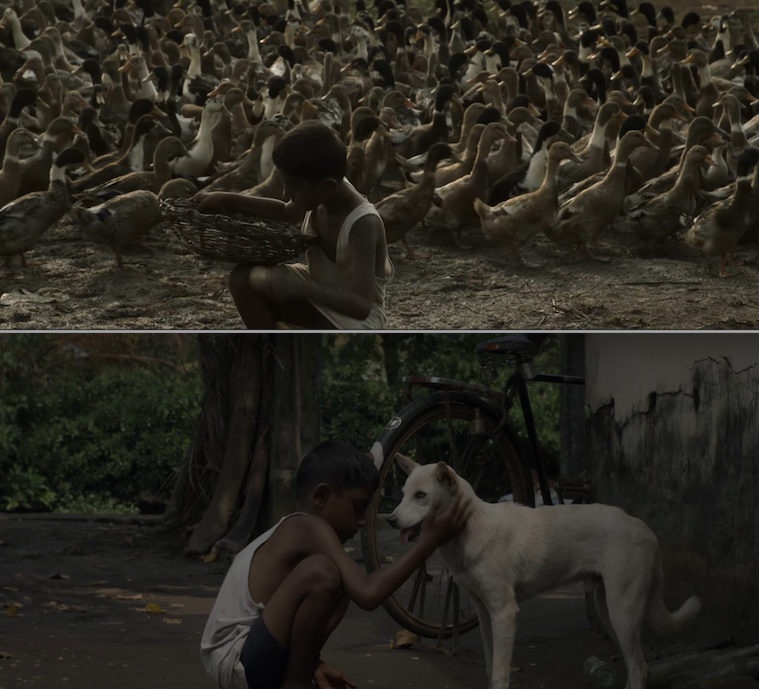
See below for a few images from Ottaal (2015), one of the most haunting films I have watched in a while. (It is playing on Mubi India now. Give it a try.) Directed by Jayaraj, this is an adaptation of the Chekhov short story “Vanka”, about a sad little boy writing a letter. You can read the English translation of that story online, but really, in my view the source text is incidental. Because this film’s beating heart is the very particular terrain in which it unfolds: the Kuttanad backwaters where the child spends much of his time minding ducks with his grandfather. 

The many beautiful images – of the place, the people in it, a boat rowing across a breath-taking network of canals, a friendly “nameless dog” running alongside the shore – are markers of a childhood that is about to come to an end. They help you see how much this boy is part of his setting, and what he is going to be separated from; they are pictures he desperately needs to preserve in his mind, and fittingly the film does everything it can to make these images unforgettable. 


(The setting also reminded me of S Hareesh’s sprawling novel Moustache, which I reviewed earlier this year. Ottaal is a much sparer work, though, and might be my favourite of the many splendid Malayalam films I have watched in the past year – certainly up there with Ee. Ma. Yau and Kumbalangi Nights. Here is an earlier piece about current Malayalam cinema.)

Sunday, May 17, 2020

A beginner's guide to the best of contemporary Malayalam cinema

[A couple of weeks before the first lockdown was announced, I was to begin a video series for the recently launched Cinemaazi project. That is obviously up in the air now, but I’m doing some writing for the website. Here’s the first piece, a shout-out for some excellent films from what is arguably the country's most vibrant cinematic culture today. Most of these films are streaming on Prime Video or Netflix]
------------------------------------------------

“You don’t know my story, manager,” a young African footballer named Samuel haltingly tells his club manager Majeed, “Our life… not like your life. You don’t understand.” Samuel goes on to describe the crippling poverty back home, and his efforts to build a better life for his family by coming to India where athletic foreign players are in high demand. But now he is stuck in a small Kerala town, unable to return because his passport is lost and there are ongoing investigations against refugees.

The 2018 Malayalam comedy-drama Sudani from Nigeria centres on the cultural disconnect, slowly yielding to friendship, between manager and player – and in fact this disconnect is written into the film’s very title: Samuel is Nigerian, but some locals reflexively think of Africans as “Sudani”, not realising that Sudan and Nigeria are different countries. Eventually he stops trying to explain the difference.

If that generalisation makes you chuckle, remember that there are many educated north Indians who think of south India, and south Indian films, in similarly amorphous or broad-stroke terms. Even someone who is sensitive enough, or politically correct enough, to avoid terms like “Madrasi” (which so many of us Hindi-film viewers used in the 1980s) might remain uncertain about which state speaks Telugu and which speaks Malayalam; and even someone who identifies as a movie buff might think of Tamil and Malayalam cinema as interchangeable. (A friend, a critic from Tamil Nadu, once told me about how a Mumbai-based employer assumed that he would understand Telugu, Kannada and Malayalam without the aid of subtitles.)

None of this is said smugly – I speak as one who has been implicated himself. Though I began exploring many sorts of international cinemas in my early teens, “south Indian films” remained a big gap on my viewing resume. Consequently, my recent encounters with contemporary Malayalam cinema have been both daunting and exciting, and a reminder of those teen years spent with subtitled films: navigating one’s way through cultures one knew little about, learning about the oeuvres of this or that director, cinematographer or music director, gradually identifying and warming to actors as one saw them across a number of roles.

Going on such a voyage of discovery in one’s forties is more unsettling, very different from scampering to film festivals and Embassy libraries as an adolescent; even the most enthusiastic and open-minded film buffs tend to stay in comfort zones beyond a certain age. But some of the processes, the connecting of dots, stay the same. For instance, my reason for choosing to watch Sudani from Nigeria wasn’t just that it was available on Netflix (many fine Malayalam films are now): it was that I had lately become familiar with the work of the wonderful actor Soubin Shahir, who plays Majeed here. Watching him in the film’s trailer, and then in the first scene, was reassuring and provided an entry point.

Through watching many fine films from the state recently, I have been learning about both the cinematic idioms and aspects of local culture and daily life depicted in them: from the forms that religious practice takes in Keralite Christian and Muslim households to how men drape the mundu – folded up or worn full – depending on occasion and whom they are speaking to. But of course, this is very much a work in progress, with many discoveries yet to be made. With that caveat, here are some films to get you started:


Kumbalangi Nights
Even those who don’t follow “regional cinema” may well have heard of Madhu C Narayanan’s much-acclaimed Kumbalangi Nights. This is a good starting point for the untrained viewer, because it is a warm, accessible, narrative-driven film with lilting music, a terrific mix of comedy and drama, and super performances by some key actors. The story centres on the rough-hewn Saji (Soubin Shahir again) and his three brothers, living and squabbling together in a Kochi village. Theirs is a caveman existence in some ways, which has a lot to do with the fact that there is no moderating female presence in their lives – but as this slowly changes, their emotional lives undergo a shift too. What really sets the cat among the pigeons, though, is the nearby presence of a more seemingly balanced sort of family headed by the fastidious Shammi (Fahadh Faasil), who thinks of himself as a “complete man”.

The contrast between Saji and Shammi – two very different sorts of patriarchs in very different situations – lies at the heart of this story about masculinity, family ties, the class divide, and what it means to be civilised or savage. Kumbalangi Nights is one of those deceptive films that achieve narrative complexity without seeming to make much of an effort. When you think about it afterwards, you might think mainly of the funny scenes, many of which centre on Faasil’s performance as the control freak who starts short-circuiting like a defective robot when his authority is challenged; but when you’re watching it, it is impossible not to feel the emotional resonance of scenes like the one where Saji realises he needs to go to a psychiatrist and cry his heart out. Or the delicacy of the romance between the mute Bonny and a visiting American. Or an unforgettable little image of a Bluetooth speaker playing gentle music in a messy house late at night, glimpsed from the lake far outside.


Ee. Ma. Yau and Jallikattu
Lijo Jose Pellissery is one of the bona-fide auteurs of contemporary Indian cinema, a director who leaves a distinct visual and aural stamp on most of his work, and the last few years have seen a spate of acclaimed work from him, notably Angamaly Diaries, Ee. Ma. Yau. and Jallikattu. Here’s something I find fascinating about Pellissery: on the one hand, he clearly puts a lot of thought and craft into his shot compositions and gives the impression of maintaining rigid control over his mise-en-scene – in this, he belongs to the tradition of directors like a Victor Erice or a Stanley Kubrick. And yet, there also seems plenty of space for the loose, serendipitous moment; for the way in which the interplay between two or more actors might change the dynamics of a scene.

The first Pellissery film I watched was Jallikattu, an extraordinarily ambitious account of a village hunt for a runaway buffalo, co-written by the acclaimed novelist S Hareesh. Here is a film full of hypnotic images and sound design, starting with a striking montage of people in various stages of sleep or wakefulness, and insects going about the day’s work at dawn – and ending with a sequence that makes explicit the link between this story and primitive humans hunting for food. But my favourite Pellissery film so far is Ee.Ma. Yau, a lovely portrayal of death as both comedy and tragedy.


Pellissery is known for the fluidity of his long takes – the camera weaving in and out of spaces, encompassing the actions of a number of different characters – but what’s equally seamless here is how the narrative moves between hysteria, farce and deep sadness. I haven’t seen many other films that manage to be so funny, dignified and mournful at the same time, often achieving all these things within the same scene (depending on which part of the crowded frame you are looking at). There is genuine loss and grief, but there are also marvellous depictions of the more performative versions of grief – most notably in the lamenting of the dead man’s wife Mariam, whose her histrionics become like a tragi-comic chorus running through the film.

Virus

 Aashiq Abu is another of the most respected Malayali directors and producers, and his 2019 film Virus – a taut dramatization of the challenges facing medical professionals during the Nipah outbreak – is one reason why. Virus is, obviously, a very topical film in the current moment – perhaps even more so given the widespread admiration for Kerala’s efficiency in handling the Covid pandemic. But thematic relevance apart, this is first and foremost a superbly structured film, bringing the quality of a well-paced investigative thriller to a real-life tragedy. It moves from the small picture to the big one, incorporating the personal stories of many individuals infected (or affected) by the virus, as well as what the nature of the spread tells us about the society in which it occurs. It is chillingly familiar in its depiction of the panic caused – even within the medical fraternity – by a disease about which not much is known; and yet it offers hope too.

Most movingly for me at a personal level, Virus is also about the connectedness of life beyond the human world – a theme that runs through many major films and novels from Kerala, where the many components of the natural world are a constant, humming presence in the background, sometimes making it to the foreground as well. This film may have my favourite ending of any Indian film I have seen in the last few years – a mystical scene involving a baby fruit-bat that has fallen off its tree. Without underlining anything, the scene offers a small reminder of how both human strengths and vulnerabilities are inextricably linked with the planet’s other living creatures, our place in a larger ecosystem, and the many ways in which we can harm and help each other. It also reminded me of a beautiful, graceful moment in Ee.Ma.Yau., an image of the souls of two men, a dog and a duck all preparing for a final journey.

Uyare
Among the films that are relatively conventional in their telling but derive their effect from a powerful performance, a good example is Uyare, about an aviation student named Pallavi (played by Parvathy Thiruvothu) whose life and career threaten to fall apart after an acid-attack by her boyfriend. The metaphor of a woman “taking off”, refusing to be tethered by a patriarchal world, is perhaps a little too obvious: that’s inevitable in a story about a pilot struggling to be accepted in her profession while also caught in a nasty relationship that culminates in an insecure man disfiguring her face. But along with its big-message moments, Uyare also has some sharp little observations about the world that its protagonist has to negotiate. Such as the scene where one of Pallavi’s male colleagues is bemused by the signs outside a toilet, and she explains that the single “Blah” is supposed to represent men while a nonstop “Blah blah blah blah blah” indicates the ladies’ room. (“Because men talk only when necessary – at least, that’s what men say.”) Which genius thought this up, the colleague asks, and she replies, “I don’t know, but it must have been a man.”


Scenes like this are lightly played, but they add up like jigsaw pieces that go into the making of a more sinister picture, one where women are first gently patronised and then oppressed or bullied with force. And Parvathy’s intelligent, sensitive performance – unafraid to move between strength and vulnerability – is a big part of the film’s effect (her performance as an unobtrusive but efficient contamination-tracker was also central to Virus).

Vikruthi and Maheshinte Prathikaaram
There is also a subgenre of slice-of-life stories built around a seemingly everyday incident that spirals into something big, and eventually reveals things about the characters and the society they belong to. Two good instances are the 2019 Vikruthi (Mischief) and the 2016 Maheshinte Prathikaaram (Mahesh’s Revenge). The former is based on a real-life story about a speech-impaired man, Eldho (wonderfully played by National Award-winner Suraj Venjaramoodu), who becomes the butt of scorn after he falls asleep on a train in exhaustion and a fellow passenger takes a photo of him. While Eldho is obviously the object of the film’s sympathy, what Vikruthi does expertly is to intercut his story with that of the man who is the agent of his humiliation, and who also gets to experience what it is like to be persecuted – this narrative structure eschews a straightforward victim-oppressor tale in favour of a nuanced examination of how two paths can collide with unfortunate results, and how an instant-gratification, technology-driven society is quick to judge people on very little evidence.

Maheshinte Prathikaaram is another many-complexioned film that seems unobtrusive to begin with, but slowly grows into the story of a man who must move towards a moment of private reckoning. Fahadh Faasil plays a photographer who gets humiliated in a street brawl and vows not to wear slippers again until he has had his revenge. You’d think a premise like that could make for a straightforward action drama or a straightforward slapstick comedy, but the storytelling is unconventional and detour-laden, and (much like Kumbalangi Nights, Ee. Ma. Yau. and many other films) the film milks whimsical humour from sombre situations. (Funerals, for example, can be both romantic and funny.)

There is a climactic fight sequence and it’s superbly done – it is messy, realistic, comical, but also conveys what is at stake for Mahesh, how his whole sense of self is at stake. And yet, after all that is over and the task has been accomplished, the film ends on an almost sheepishly charming, down-to-earth note. Want a story about a seemingly ordinary man caught in a slightly-unusual situation, told with heart and depth? Here you go.

Unda

 One of the by-products of a cinematic culture that is moving from personality cults towards more grounded and realistic representations is that there are slyly affectionate inside jokes about older films and actors. For instance, Maheshinte Prathikaaram has a scene where a character, watching a film on TV, holds forth on the relative merits of superstars Mammootty and Mohanlal: the former will play any role, he says — a tree-climber, a tea shop owner, whatever – but the latter is great because he will only do “top-class” parts. (The reference won’t be immediately clear to an outsider, but this is a dig at Mohanlal’s tendency to play upper-caste characters.)

In this light, it’s intriguing to observe the friction within a film when a superstar of yore gets cast in a relatively non-showy part. In the 2019 Unda, Mammootty plays Mani sir, the leader of a police unit that is sent to Naxalite territory in Chhatisgarh for election duty. These cops are clearly out of their depth here, as lost as the “Sudani from Nigeria” was in a Keralite town – they struggle with lack of resources and information, language barriers, the hostility and suspicion that comes their way from the locals, and the note of terror that is struck with every uttering of the word “Maoist”.

It’s amusing to see Mammootty billed as “Megastar” in the opening credits of this film, where his role is so subdued, and where his character even becomes paralysed in a moment of crisis, unable to issue a command. He does briefly get to be the super-cop action figure in the climax, but the dominant image for much of the film is that of an avuncular man in a check-shirt, buying Parle G biscuits to distribute among his unit; or his eyebrows furrowing with concern and incomprehension when people speak urgently in Hindi in his presence.

In general too, Unda might be too quiet for some tastes if you go into it expecting a story about a police-Maoist confrontation. Like the Hindi film Newton, which covered similar ground, this is a slow-burn film, and that is part of the point. Those mythical demons, the “Maoists”, are notable mainly by their absence: wait and wait for them, but like Godot they might never show up. Instead there are other, more palpable dangers: in the cultural disconnect between this police unit and their setting; in the blatant and casual election-rigging by local politicians and their goons, which the police are expected to look away from; in the persecution of poor indigenous people. By the end, we will see that this is a story about the many ways in which people can be adrift, in a land that both is and isn’t their own.


[An earlier piece about Kumbalangi Nights is here. And here's one about Virus]

Saturday, August 24, 2019

Men in barbershops: a Malayalam film meets a classic Western

[my “movie moments” column for The Hindu links two outstanding films made 73 years apart – Kumbalangi Nights, one of the best Indian films of the year, and John Ford's My Darling Clementine]
------------------

Shammi is an immaculately turned out man, the sort of man for whom the term “well-groomed” might have been coined: smooth face, not a hair out of place. He keeps patting his moustache as if to ensure its geometrical perfection. We are unsurprised to learn that he works in a hair salon.


Going by outward appearances, one might slot him as a new-age, metrosexual man, comfortable around women – he lives with his wife, her younger sister and their mother. But alarm bells ring too. The first time we see him, he is looking at himself approvingly in a bathroom mirror, mumbling “Raymond, the Complete Man” and using a razor blade to remove a bindi from the glass. Dismantling the matriarchy? Later, he remarks that working in the kitchen doesn’t befit a man with a “proper job”.

Now consider Saji, who is roughhewn and unkempt, often drunk, and the oldest member of a family that has no women in it: only four brothers, living in an untidy house. The first time we see Saji and his brother Bobby fight, they end up a mass of limbs on the floor – two beasts wrestling, grabbing each other’s crotches to gain an advantage.

The contrast between Shammi and Saji (played by two outstanding actors, Fahadh Faasil and Soubin Shahir respectively) lies at the heart of the lovely new film Kumbalangi Nights. The first meeting between the two is in the salon, where Saji has nervously come with a marriage proposal for Bobby. But Shammi has no intention of letting his sister-in-law marry into a “low-grade” household: in a blackly funny scene, he runs his blade contemplatively over poor Bobby’s neck while giving him a shave.


This setting reminded me that in some old American Westerns, the barbershop (or the fancier “tonsorial parlour”) was a transformative space: a man might become more refined once his hair is trimmed; the lawless Wild West may thus be tamed. A major disruption in John Ford’s 1946 classic My Darling Clementine occurs when Wyatt Earp (Henry Fonda) visits a salon but can’t get a peaceful shave because of a loud brawl outside; he heads out, foam still on face, to restore order. Later in the film, he admires himself in the mirror – much as Shammi constantly does in Kumbalangi Nights – and preens a little as the barber sprays scent on him.

Such a binary would suggest that Shammi represents civilization while Saji and his siblings are the savages living in the wild outdoors. But the very structure of Kumbalangi Nights leading one to rethink one’s ideas about what is civilized behaviour and what is savage. And in fact, that old Ford Western doesn’t have easy binaries either: Wyatt Earp may be more law-abiding than his friend, the alcoholic Doc Holliday – but Doc is a gentleman inside, introspective, cultured (he even knows Shakespeare), while Wyatt sometimes seems to be trying too hard to be a “modern” man.

Saji doesn’t have regular work – he sponges off a friend – while Shammi is a responsible family man. But these are incomplete pictures: they don’t show how pliable Saji is, and how rigid and controlling Shammi is. (One can also compare him with Bhavani Shankar in Gol Maal, obsessed with purity, proud of his moustache.) “The Ramayana was written by a forest-dweller, right?” Shammi says condescendingly in the barbershop scene, “People can change.” But ironically, Shammi himself is incapable of changing, while Saji becomes more mature with time.

Both men have psychological issues, but when Saji comes close to the abyss, he realises he must help himself: he goes to a doctor to cry out his emotions. Meanwhile Shammi insists on being “a hero”. When he is told off, he goes and stands in a corner by himself, his face against the wall, then returns for another confrontation – like a robot that might occasionally short-circuit, but is programmed to set itself right without any external help.

Faasil’s pitch-perfect performance as the fastidious Shammi gets the most out of scenes like the one where he insists everyone dines
together, his eyes moving around the table. Or the remarkable scene – which goes from being commonplace to creepily funny, through the subtle inflexions in Shammi’s speech – where he overhears his wife and her sister talking about something. “What’s up?” he asks, and then cajolingly speaks variations on “Go on, tell me.” Peering out from behind a door, oily smile on his face, he looks a bit like a Cheshire Cat ready to unsheathe its claws. As he will do in the film’s climax – by which point the carpet has been nicely pulled out from under our feet, and our ideas about heroes and rogues, refined and unrefined behaviour, have been thoroughly muddled.

-------------------
[Earlier “moments” columns here]

Monday, August 12, 2019

Medical drama, investigative thriller: on the excellent new film Virus

[In my Telegraph Online column, a piece about Aashiq Abu's Virus, one of the best-crafted Indian films of the year – and part of an ongoing journey in discovering the best of contemporary Malayalam and Tamil cinema]

----------------------------

Indian cinema hasn’t had a robust tradition of the procedural film, which closely follows a group of professionals as they deal with a specific challenge in their field: various threads slowly converging, order emerging from chaos. Such films can be built around a single, concentrated incident that takes just a few hours to unfold – templates include the many ensemble-cast disaster movies that Hollywood made in the 1970s, such as Airport or The Towering Inferno or Meteor, where aviation experts, firefighters, architects or NASA engineers stare down a crisis.

Or it could be that the prime cause is urgent, but its handling has to be measured, involving not instant heroics but persistent work over weeks or months; newsroom films like Spotlight or All the President’s Men usually fit the bill, as does something like the upcoming Mangal Mission, about ISRO’s Mars Mission.

Some settings and genres are innately conducive to action, suspense, or exciting twists: in recent years we have had espionage or crime films such as Neeraj Pandey’s Baby (about a task force dealing with terrorist threats) and the police procedural web series Delhi Crime (about cops investigating the Nirbhaya gang-rape/murder and coping with public outcry). But what when an environment that is relatively mundane in its day-to-day functioning suddenly faces an unanticipated problem? A medical setting, say, where doctors, hospital workers, health ministers find themselves running around like headless chickens. Where the “bad guy” is an obscure infection and a hard-to-trace set of circumstances that aid its spread.


It takes a special film to depict this situation “realistically” while also playing like a riveting, connect-the-dots thriller, and Aashiq Abu’s Virus is one of the best films I have seen this year. In dramatizing the Nipah virus outbreak in Kerala, it tells a multi-pronged story involving many sets of characters and captures the detached efficiency required by medical professionals – while also giving us insights into their emotional lives and never losing sight of the human stakes involved. It is about not just an outbreak in one part of the country, but also the many ways in which a society might get contaminated, about how an epidemic might play out in a disorganised, overpopulated milieu.

The opening scenes of Virus are reminders that hospitals can, at one and the same time, be dramatic and humdrum spaces. A busy early sequence is set in the Emergency ward at a Kozhikode hospital, with our entry point being a young doctor named Abid (Sreenath Basi) who is diligently doing his work, moving from one patient to the next, dividing his attention between relatively routine cases and fatal-accident victims. We know Abid is distracted by a personal matter (his girlfriend has just sent him a message saying she is getting married; he has asked another junior doctor to cover for him for an hour) and we see the concern on his face – but as he enters his work-space the professional conditioning takes over and he is swept into the pace of things.

This lays the ground for the film’s shifting between the ground-level picture and the bird’s-eye one, and also – by depicting daily chaos – prepares us for how much more is to come: how hard it will be to identify the nature and extent of an illness no one knows much about. One of the film’s most chilling scenes is a simple montage of doctors and nurses looking up Nipah on their phones.

As Virus expands its canvas, the precise, tight screenplay (by Muhsin Parari), the pulsating music score (by Sushin Shyam) and Rajeev Ravi’s probing camerawork combine to fine effect. There is also a line of excellent performances – notably by Parvathy Thiruvothu (a big name in Malayalam cinema but most familiar to Hindi-film viewers for her lead role in Qarib Qarib Single) as Dr Anu, an initially unobtrusive and reticent worker ant who becomes a key part of the story, her research uncovering possibilities that might not otherwise have seen the light of day.


The first time we see Anu, she too is preoccupied; asked to show someone to a building, she begs off and says she is in a hurry. But her role grows, and it is largely through her efforts that we see just how tricky the investigation into the virus’s trajectory must have been. Hospital ward tickets must be collected, and CCTV footage scrutinised, to check the time at which patients and their relatives were in a particular space, in proximity of the virus’s “index patient”, and thus at risk of contamination themselves. The travel paths of two unrelated patients are mapped to see if they might have encountered each other at some earlier point (as opposed to a scarier possibility: that there were discrete outbreaks – or even that this is a new sort of terror attack).

Informed conjectures must be made: about how a patient’s aunt may have been infected when she leant over his stretcher and blew on his face after reciting holy verses; or what might have happened when a policeman conducted an informal “breathalyser” test by asking a drunk driver to exhale in his direction. Subtle links are made between morality and infection too: could one Nipah victim have been infected as a result of the illegal game-hunting he indulged in?

Virus can certainly be seen as a testament to the medical profession, but it isn’t a blanket glorification (as Delhi Crime was accused of being for the police). A personal aside here: having spent plenty of time in hospitals as a caregiver in the past decade, dealing with many varieties of stressful situations, I have had much experience of medical apathy, incompetence or insensitivity. Given these experiences, my antennae would vibrate hard at any film that made an overt effort to whitewash or extol the profession. But I thought there was an even-handedness in Virus, a pragmatic understanding of the difficulties of healthcare systems in a country like ours, and the toll it can take on personal lives.

One of the film’s important characters is Nurse Akhila, based on the real-life Lini Puthussery, who died in the call of duty and has been hailed as a martyr. It would be natural for a film about the Nipah virus to deify her as a tireless angel of mercy, but even here we get a brief flashback scene where Akhila – looking worn out and distracted by her work – takes a quick break to speak with her husband, while a patient’s relative shouts at her to get off the phone and attend to something urgent.


But if Virus is about human beings and their interrelationships, it is also generous and expansive enough to touch on the connectedness of life beyond humans. It ends with a beautiful, almost mystical scene – a sort of coda, cut off from the main narrative – involving a baby bat that has fallen off its tree. Even though the closing shot is of one of the creatures that transmitted the Nipah virus, this creature is presented here as a helpless little thing – as capable of inviting human compassion (and holding a mirror to the best qualities of our species) as it is of inadvertently causing us harm. It’s a fitting end to a graceful film about our many flaws and vulnerabilities as well as our capacity for healing and caring.

(Virus is on Amazon Prime)