True enough – this Kaalu (another generic name, given to him by guards before I became acquainted with him) was not an easy dog to get along with. He was thin and frail-looking (a condition that had worsened in the past few months – though his appetite was good, I think he may have succumbed to a version of the stomach/intestinal condition that took my Foxie), but many people in the colony, even animal-carers, were wary of his temper; there was a time a few years ago when his potential for aggression had caused me a lot of trouble. Wednesday, October 25, 2023
Kaalu, in remembrance (???? - 2023)
True enough – this Kaalu (another generic name, given to him by guards before I became acquainted with him) was not an easy dog to get along with. He was thin and frail-looking (a condition that had worsened in the past few months – though his appetite was good, I think he may have succumbed to a version of the stomach/intestinal condition that took my Foxie), but many people in the colony, even animal-carers, were wary of his temper; there was a time a few years ago when his potential for aggression had caused me a lot of trouble. Saturday, September 18, 2021
Doggone! How my ears prick up when a movie depicts an imperilled canine
(Wrote this for the Sunday Economic Times. About recent dog scenes that took me out of a film, leading to a reaction very different from the one the filmmakers would have wanted from their viewers)
-------------------------------------
In a recent podcast, discussing such weighty issues as “problematic” art or artists – and the ideological lenses we use when engaging with films or books – I articulated something I hadn’t said before on a public forum: that homosapien-centric issues – including discrimination, exploitation and other such games played by our species throughout its history – aren’t “triggers” for me in the same way that cruelty to animals is. (Or, to be more honest, cruelty to specific animals, the ones I relate with.)
A few dog scenes in films watched over the past few weeks have underlined this. Take the one in Dial 100 – a conceptually promising but inert thriller – where a woman named Seema (played by Neena Gupta) enters a house at night to take another woman hostage. Seema has already got her victim to tie up the family dog Rocky (a friendly-looking Labrador), but then, irritated by his barking, she knocks him out by hitting him on the head with a vase. A little later a neighbour hears Rocky’s cries and sees him lying on the floor (still leashed, of course), blood coming out of his head. And… that’s it. Inspector Sood (Manoj Bajpayee) is thus alerted to the home invasion, but there is no further news about the dog’s fate.
The human part of the story – the “important” part – continues, of course, but for me the scene was a deal-breaker, creating unease and revulsion. While I got that the filmmakers saw Rocky as an expendable pawn for plot movement, it was enough to set me completely against Seema. Subsequent revelations about her tragic back-story and motivations made no difference; after that scene, there was no way I was going to feel sympathy for her.
To channel the always-indignant Wokes (whom I otherwise enjoy mocking): Seema cancelled, movie cancelled.
Then there’s the scene in the short film Summer of ’92, part of the anthology series Nava Rasa, in which a troublesome dog – being chased by village youngsters – briefly falls into a swamp where most of the excreta from the village has been dumped. In the finale, in a moment guaranteed to disgust many viewers at a visceral level (while angering others who see the story’s potential caste commentary being undermined by slapstick), the faeces-covered animal enters a house and, shaking itself vigorously, covers a bunch of people – a potential bride and groom, a pandit, family elders – with human waste.
Even though the dog messes things up for a likable character, this was my predominant reaction when he emerged from the slushy shit-pit: relief that the film hadn’t opted for the sort of slapstick that would involve him drowning in filth (even if the rest of the village is metaphorically swamped by bigotry).
If you think it’s wrong to be more concerned about animal welfare than caste politics, steel yourself for more. A tense sequence in the hard-hitting Polish film Sweat (about a high-profile social-media “influencer” who is desolate in her personal life) has the protagonist Sylvia menaced by a man she invited into her apartment. For me Sweat was a better film than the ones mentioned above, and I definitely felt more invested in the central character – and now here she was facing a possible sexual threat from a violent man. But even so, I was just as worried about Sylvia’s little terrier, asleep on the couch on the edge of the frame. What would the man do to him if he tried to protect his human mom? Should I even continue watching?
(Spoiler alert: it turned out to be okay to continue watching.)
There have been other, less dramatic scenes that have peeved me in smaller ways. In the recent Malayalam film Aarkkariyam, an old man, after finishing his dinner each night, goes to the gate and scrapes leftovers off his plate for the three stray dogs waiting outside. A sweet gesture, you’d think; but even here, speaking as a daily feeder of mongrels with Black-Hole-like appetites, I gaped at how tiny the morsels were, at how the dogs gulped them up in seconds and looked around hungrily for more (by which time the man had headed back, no doubt feeling like he had done a good deed).
In a different category are the “issue” films that use dogs for symbolic reasons, two excellent ones being Mari Selvaraj’s Pariyerum Perumal (2018) and Rohith VS’s Kala (2021). In both, a dog that meets a violent end becomes a catalyst for a character’s awareness of his own oppression – and subsequently a guiding spirit as well. (Think of this as a reversal of the plot arc of the 1980s cult classic Teri Meherbaniyan, in which Jackie Shroff’s death is the pretext for a dog’s discovery of selfhood.)
The lyrics of a song in Pariyerum Perumal go: “In the wilderness without you, how will I find my way? Your paw scrapes are my trail. You are not just a dog. Aren’t you me?” And Kala begins with an animated opening-credits sequence involving a dog, a foreshadowing exercise that makes complete sense – and acquires emotional force – only around halfway
through the film. There is metaphor here, but there is also a human-animal bond. I’m not exactly keen to watch a dog being blown up onscreen, or tied to train tracks, but I appreciate that these works – though primarily concerned with a human protagonist’s struggles – engage with and recognise a deep inter-species kinship.
All this is a way of saying that I probably won't be queuing up to watch Cruella (which, being the Cruella de Vil origin story, is possibly a part-sympathetic look at a famous puppy-slayer). But I will keep a cautious look out for more news about the Vishal Bhardwaj production Kuttey, the trailer of which strongly implies that Naseeruddin Shah, Tabu and other thespians play dogs – or is it the other way round?
[Another old post about cinematic dogs is here. And a piece about Pariyerum Perumal is here]
Monday, June 07, 2021
In memory of a sports-loving dog
She was a solitary creature, seemingly not fond of other dogs, making sure no one encroached on the small park where she lived, outside our local BSES office. But I did briefly see a more social side when she took a liking to my Lara a few years ago. If she saw us from a distance, she would hesitantly trot across to our park to say a very quick hello, lick Lara a couple of times, and then scoot back just as nervously — as if sheepish about having over-stayed her welcome.Thursday, March 26, 2020
Feeding street animals in Corona time
In recent days, when walking Lara downstairs, or walking for provisions through colony roads so quiet that I imagine I can hear every leaf that falls from every tree, it’s been possible to appreciate how healthy and idyllic the natural world is when disinfected of most human activity. A few days back I saw six young tailless peacocks walking in single formation along one of our lanes; otherwise one rarely sees more than two together at a time. And it turns out the air-quality index can reset fast in even a place like Delhi.
At a personal, immediate level, what’s been most difficult for me the last few days is hearing the new urgency in the barking of the colony dogs in the far distance. Plus the very nervous, agitated or watchful reactions of my home/part-time-home dogs (across two flats) as they hear distress calls from other members of their species. Or the sudden growling when they sense that an unfamiliar creature, terrified and hungry, has drifted into their territory in search of food.
Instead we saw small signs, even in a spookily deserted and quiet complex, of the strength of this magical inter-species relationship. A young boy who worked at a dhaba, has to continue living in the complex because he has nowhere else to go, cooks his own daily meals with the most meagre resources, but still worries about the animals he knows well. The elderly bookseller who, filled with unrest, somehow managed to leave his house after two days and make his way back to the complex just to check on his dogs and cats (and gave us instructions about what each animal is likely to eat). The parking-lot attendant and the chowkidar who, despite being in dire straits themselves, were doing what they could for a litter of pups.
Moutushi and I and a couple of others are trying to coordinate efforts towards some regular/semi-regular feeding. It probably won’t be enough (what is ever “enough” anyway, even in a non-Covid time?), and as stocks deplete everywhere there may be enormous frustrations to come. For some of us, it can be a big emotional/mental-health risk at a time like this to take on the
Tuesday, August 07, 2018
Help needed for Kambli the desi pup
Archana Sreenivasan is currently fostering Kambli, an 8-month-old paraplegic and incontinent male puppy. He is an Indie and was rescued from a construction site as a 3-month-old with a spinal injury. After that, he was moved to two different shelters, and finally Archana brought him to her home in Bangalore three weeks ago because he wasn't getting the care he needed at the earlier shelter. She is unable to adopt him, and has not been able to find anyone else who can adopt him.
"Kambli will not do well in any shelter in Bangalore. He needs extra
care and multiple vet visits, which no shelter will have the bandwidth
for. Kambli's urine needs to be expressed 5 times a day and he needs a
surface that is smooth for him to drag himself about on (when he's not
in his wheel cart.)I came to know that some of the rescue dogs of Delhi are fortunate enough to find homes outside India, in the US, Canada and Netherlands, and I couldn't help dreaming for Kambli. I tried contacting the folks in Delhi who work on these international adoptions but haven't received any response from them.
I can help financially with Kambli. I can have him transported wherever required. I'm willing to help in any other way I possibly can, if anyone is willing to help out with his case.
Kambli needs a home, or he will not survive.”
Among the people Archana is trying to reach are:
Dr. Premalata Choudhary (http://www.choudharypetclinic.com/index.html)
Vandana Anchalia or Kannan Animal Welfare (https://www.facebook.com/kannananimalwelfare/)
But if anyone has suggestions for others who might be able to help, please weigh in. (One complication is that most agencies and shelters - Friendicoes etc - already have more dogs than they can handle, especially with people abandoning pets every day.)
Please feel free to share this post, or the poster I have included. Updates, including videos of Kambli, are on his Instagram page, here.
Please help if you can.
Tuesday, December 06, 2016
Inside of a dog (and its writer friend)
It is generally felt that writers tend to be “cat people” much more than “dog people”. If this is true, two explanations come to mind. The first has to do with the personality stereotype: many serious writers are somewhat cat-like themselves – aloof, solitary, prone to hissy fits if something doesn’t go exactly as they’d like it to. These are, of course, generalisations – I have known some gregarious and friendly writers, and a few very social cats – but the broad point stands.
The second reason is a related one: even pampered, house-bound cats are usually lower-maintenance and less dependent on their humans than dogs are, which makes them better companions for someone who needs plenty of alone time to think about his work, or simply to stare into his computer screen for hours waiting for an elusive Muse to show up. (I have firsthand experience: it took me three days to begin writing this column, largely because of the demands made on me by a puppy we are fostering.) But this is also why it can be so interesting when authors do become close to dogs and write about them. You might get prose that is full of raw emotion, where the writer holds nothing back; or writing that is polished and distant and cat-like on the surface, but with slivers of deep feeling buried within it.
An example of the latter is in one of the finest animal books ever written, the literary editor JR Ackerley's My Dog Tulip, first published in 1956. When we look at Ackerley through a prism of temporal and cultural distance, he seems an archetype of the English man of letters of his generation: reserved, proper, perhaps a little snooty. But to read this book is to find not just a sharp, affectionate sense of humour but a startling candour. And the catalyst for this is Ackerley’s 16-year relationship with his German Shepherd, a relationship that began when he was middle-aged, but which provided him a new perspective on other creatures, on the nature of love, and ultimately on himself too. One of the wonderful things about this slice-of-life memoir is its combining of elegant, literary writing with subject matter that is usually taboo in polite circles. Entire chunks are dedicated to Tulip’s toilet habits, and later to her sex life. At one point, shortly after making an offhand reference to a historical record of the emperor Napoleon’s “well-formed motions”, our venerable author describes Tulip’s squatting: “She lowers herself carefully and gradually to a tripodal attitude with her hind legs splayed and her heels as far apart as she can get them so as not to soil her fur or her feet. Her long tail, usually carried aloft in a curve, stretches rigidly out parallel with the ground...” But after this almost poetic description, the idyll is broken: Ackerley and Tulip are rudely set upon by a cyclist who objects to a dog using the sidewalk thus, and the elderly writer responds by letting loose some choice cuss-words. Dog-lovers everywhere, then and now, can get seriously worked up in these situations.
As Elizabeth Marshall Thomas, author of The Hidden Life of Dogs, points out in her introduction to a recent edition of My Dog Tulip, a remarkable thing about Ackerley’s writing is that though he leaves the reader in no doubt that he loves Tulip deeply, he never asks us to do the same; he doesn’t construct her as a protagonist with universally desirable qualities. And yet, there is so much grace and tenderness in some of his descriptions, such as the almost reverential one of watching Tulip give birth to her first litter, “licking and nosing this package out of herself, releasing the tiny creature from its tissues […] performing upon herself, with no help but unerringly, as though directed by some divine wisdom, the delicate and complicated business of creation”.
****
The inimitable Groucho Marx once quipped, “Outside of a dog, a book is a man’s best friend. Inside of a dog, it’s too dark to read.” The line is obviously funny as a non-sequitur, but Alexandra Horowitz gave it a new dimension by using Inside of a Dog as the title of her book about “what dogs see, smell, and know”. Reading this book, one realizes that the inside of a dog might really be too dark for a human being to “read”.
By drawing upon the word umwelt – used by the German biologist Jakob von Uexkull to describe an animal’s subjective inner life or “self-world” – Horowitz lays out the many ways in which we humans routinely misinterpret or anthropomorphize the behaviour of our four-legged companions; but she also demonstrates that taking a coldly scientific view of animal behaviour does not amount to discounting the higher emotions. When your dog licks your face on your return home, this behaviour may be genetically rooted in the phenomenon of puppies licking their mother’s snout to get her to regurgitate food for them; but over time, in domestic animals, this has also become a ritualized greeting that (in conjunction with other displays such as tail-wagging) clearly says “I’m glad you’re back.”This balancing act between the rational explanation and the emotional one lies at the heart of many meaningful human-dog relationships, and it reminds me of Arthur C Clarke’s superb story “Dog Star”, which broadly fits in the “science fiction” genre (and is by one of the leading exponents of that form), but is also an intensely emotional tale about love.
It begins with the narrator, an astronaut on a space station, millions of miles from earth, being awakened from sleep by a vivid dream where he thought he heard the barking of his dog Laika. She isn’t really there, of course: the melancholy narrator then dips into his memories from years ago and tells us about how, back on earth, he adopted her as a puppy and, to his own surprise, grew enormously close to her over time. However, a devastating separation loomed: accepting a prestigious research position in a space observatory necessarily meant leaving behind his closest friend and companion. “After all, she was only a dog. In a dozen years she would be dead, while I should be reaching the peak of my profession. No sane man would have hesitated over the matter, yet I did hesitate.”
The final sentences of the story – once the narrator has returned to the present and is analyzing his dream and its aftermath – are heartbreaking, because they involve a man refusing to succumb to comforting delusion even though he so badly wants to: a scientist who, after relating a story about an unfathomably close relationship, provides a rational explanation for the “supernatural” event he just experienced. But then, in the story’s very last sentence, he allows himself to get emotional again, and the effect is stunning – a reminder of the dark and mysterious places that can exist inside of both dogs and their humans.
[Some earlier Forbes Life columns are here. And a piece about cat books is here]
Saturday, July 25, 2015
There and back again – the loneliness of the long-distance dog
The back-story: for the past four or five years (at least), an unspayed bitch – an excessively fertile street dog who lives in our colony without being regularly fed by anyone – has been delivering one or two litters of pups annually, in large numbers, near our back-lane. The vast majority of them die, of course, succumbing to starvation or weather or being run over by callous or careless drivers; a few survive, growing into skinny dogs, scavenging for food, very rarely getting lucky and fed by one of the approximately 0.005 percent of neighborhood houses that are animal-friendly.
Most of these pups are born and grow up in the same place where Foxie and her siblings were born in mid-2008, and the sound of their mewling often gives me sleepless nights and keeps old wounds fresh. For reasons that have to do with emotional self-preservation, I have kept my distance from this situation in the past few years. But this time Abhilasha and I decided to be a little more pro-active: we took two of the surviving pups to Pratima Devi, assumed financial responsibility for their upkeep, and then set about getting the mother sterilized with the help of Ravi, an autorickshaw-driver who assists Pratima Devi and takes dogs to Friendicoes for operations.
After somehow managing to lure this scared, people-wary girl into our driveway, we kept her locked up there and then got her into Ravi’s vehicle with some difficulty (and this on a mad, mad, mad day where I had to rush back home for an hour or two shortly after getting my dadi admitted to hospital, yet again). The dog reached Friendicoes okay, the operation went off fine, she spent two days recuperating…and then, on the 21st evening, just as Ravi was going to bring her back, she bolted from a momentarily unlocked cage and vanished into some distant nook of Jangpura or Defence Colony.
The search that followed spanned days – with Ravi and his assistants travelling from Def Col to South Ex to Andrews Ganj in pursuit, catching sight of her and then losing sight again – and was always doomed to failure; even if she had been within catchable range, the sound of Ravi’s vehicle would be enough to send her into hiding. It was very upsetting. Here we had been congratulating ourselves for pulling off something important and hard to do, and now it seemed that we had not only separated a dog from her home permanently but also condemned her to being hunted by other dogs in unfamiliar territory. In between my hospital rounds, I kept calling a guilt-stricken Ravi for updates, or arranging for our car to be made available for another search. People who were trying to help would call up, asking me what the dog’s name was, because that might make it easier, and I didn’t know what to tell them: no one has ever given her a name, I had never interacted with her at any length myself; it was becoming hard to explain why I felt so responsible for her welfare.
And then, this morning, I got a call from the guard who sits at the end of the lane and occasionally looks out for the pups. She was back.
This scrawny, aging, mangy creature – weakened and unsettled by the surgery, bearing a very visible scar – had somehow, over a period of three or four days, found her way back to Saket, a good 8 or 9 km from where she ran away. And that’s only as the crow flies: the actual journey must have been a much more complicated one, with many stops and detours. Through the unfathomable traffic of two ring roads and numerous other thoroughfares, through other dogs’ territory, in a city that can be very hostile to strays. And at the end of it, she was reunited with her remaining pup, whom we have been fostering.
It’s one of those animal tales you sometimes hear about but don’t expect to see firsthand. I was looking at Google Maps earlier today, wondering which route she took, and marveling at the many potential hazards along even the easiest of them. What a heroine.
Wednesday, July 30, 2014
Help needed for Pratima Devi and her dogs
The best place to look for someone appropriate might be an NGO, but if you know someone else who might fit the bill, please do get in touch. My email ID is jaiarjun@gmail.com, or you can leave a comment here.
[More about Pratima Devi here and here]
Wednesday, February 05, 2014
Kitty litterateurs: on Suniti Namjoshi's Suki and other cat books
There was an email forward doing the rounds recently, a comparison of hypothetical one-page diary entries written by two house pets – a dog and a cat. The dog’s entry was short, semi-literate and full of sunshine and cheer, with such exclamations as “Oh boy! A car ride! My favourite!” and “Oh boy! Tummy rubs on the couch!” while the cat’s was written in full, elegant sentences and was sardonic and world-weary: the very heading read “Day 183 of my captivity”.
Anyone who knows the two species well should agree that this is a good summary of their broad personality types. And anyone who knows professional writers – at least the ones who brood for hours over the construction of a paragraph or sentence – will agree that temperamentally they tend to be cat-like: mostly reserved, unsocial and irritable, but willing to purr for a short time if a satisfying turn of phrase has been achieved, or a deadline more or less met. There are also practical reasons why writers are more often “cat people” than “dog people”. Dogs are dependent on human attention, needing to be regularly spoken to and taken down for walks, but cats are more self-sufficient, and hence suitable companions for people who spend much of their time in fierce concentration.
In this light, it is interesting to consider the difference in tone between books about dogs and books about cats. The former – especially the ones about life with a pet – tend to be sentimental and emotionally demonstrative, whereas cat books have a certain coolness built into them. And this can be the case even when they belong to the Motivational or Self-Help category. Take David Michie’s very engaging The Dalai Lama’s Cat, told in the voice of a kitten who is rescued by the Dalai Lama at a traffic signal near Delhi and brought to Mcleodganj, where she soon settles into the temple complex and becomes known as His Holiness’s Cat (HHC).HHC – alternately known as Snow Lion and, to her dismay, “Mousie-Tung” – spends much of her time in the company of the Buddhist leader, soaking in his presence (“had he recognised in me a kindred spirit – a sentient being on the same spiritual wavelength as he?”) and listening in as he discusses the conundrums of existence. Each chapter follows a broad format where a human character discovers the need to rethink his attitude to things, and the cat then applies some of these teachings to her own situation, with varying degrees of success. Thus, an insight about how self-absorption can make one sick and unhappy (a valuable lesson for writers, as it happens!) is linked to our narrator coughing up fur balls after spending an inordinate amount of time grooming herself. She realises that a period of self-pity combined with fear of exploring a new setting cost her precious time that she might have spent getting to know a new friend; and she is even inspired to deal with her gluttony, a by-product of being pampered silly.
As an old cynic wary of quick-fix advice and pat life lessons, I am not really a fan of this genre. But The Dalai Lama’s Cat worked for me because even in times of emotional epiphany, the cat nature retains a certain distance. At one point HHC overcomes her feelings of distaste for a new arrival, a dog named Kyi Kyi, when she learns about his sad back-story. “We reached an understanding of sorts,” she says, but then she quickly adds: “I did not, however, climb into his basket and let him lick my face. I’m not that kind of cat. And this is not that kind of book.”
Such emotional reticence can make brief, unexpected flashes of sentimentality very effective. Suniti Namjoshi’s recently published Suki, a tribute to her deceased cat, takes the form of conversations between human and feline. They talk about such things as morality, social injustice and hypocrisy, and the tone is mostly droll, faux-philosophical and chatty (or catty). But there are deeply affecting moments too. At one point in the middle of a casual conversation, the ghost-cat remarks that towards the end of her life it had been painful for her to open the cat-flap to go outside, and the author responds with a spontaneous cry of “Oh, Suki!” And another exchange, where the cat mentions that she would have liked to meet the author’s family (who were not animal lovers), should cut deep for anyone who has ever had a special, intense relationship with an animal and been unable to share it with their human world.At the same time, one knows that these conversations are fictional, that Namjoshi is imagining things about the cat’s inner life and rendering them into human language. And so, the book becomes as much about the author herself – it is a form of therapy, a way of examining her deepest feelings, including love, grief and regret. This is also a reminder that there are many types of cat books. Cats can be used to examine a particular milieu as in Pallavi Aiyar’s novel Chinese Whiskers, in which the adventures of two Beijing cats give us a window into aspects of Chinese society including insularity, city-dwellers’ prejudices against migrant workers and the materialism of the young. Or they can serve purely representative or symbolic purposes: Art Spiegelman’s brilliant graphic novel Maus depicts the Holocaust by drawing Jews as mice and their Nazi oppressors as cats, but there is no pretence that the book is about animals.
Even overtly cat-centric books like The Dalai Lama’s Cat don’t always try to provide a detailed picture of the feline world and its tactile sensations, which is why Nilanjana S Roy’s delightful The Wildings, and its sequel The Hundred Names of Darkness, are such unusual additions to the kitty-lit corpus. These novels try to imagine what the world might feel like to a cat, from the furniture and carpets inside a house to the smells and textures of the outdoors, or the visceral knowledge that a predator is stalking you in the darkness. And an important plot device is the concept of “linking”: the feral cats of Nizamuddin, Delhi, can transmit whisker signals to each other across vast distances, allowing them to form a network that humans around them are oblivious to. This should resonate with anyone who has long-suspected that there is something otherworldly about cats; that they aren’t letting on everything they know; or that they are, like the cat in that diary entry, plotting something diabolical. “When my cats aren't happy, I’m not happy,” the poet Shelley said once, “because I know they’re just sitting there thinking up ways to get even.” Or to telepathically work themselves into the next book or poem.
[A post about Suniti Namjoshi's The Fabulous Feminist is here]
Saturday, August 17, 2013
Fox troth - a column about hidden senses
----------
It was a magical moment, one I often relive and dwell on. One afternoon in July 2008, walking towards a rough lane behind our building to check on our water booster, I saw a litter of six tiny puppies sleeping together. Perhaps it’s relevant that I didn’t see them from a safe distance – they seemed to materialise right under my nose; I might have stepped on one of them if my eyes hadn’t been on the ground.
What I felt in those first few seconds was generic concern (I didn’t know yet that the pups’ mother was nearby, and that they were being looked after by two kindly watchmen) and perhaps the briefest tug of a heart-string. At this point I couldn’t even see them as individuals, just as a huddled-together mass of vulnerable, twitching life. Even over the next few days, as my mother, wife and I began visiting the lane, taking across milk and bread, helping the watchmen cope, I couldn’t have imagined that one of those little creatures would become mine in the truest, deepest sense of the word – not my “pet” but in nearly every way that mattered, my child – and that the next few months would see the opening up of senses and feelings that I didn’t know existed.
I could write a book, or five, on the years that followed, but here’s a summary. We got a couple of the pups adopted, three others succumbed to infection and to the wheels of careless or callous drivers, and we took in the last remaining one, who became our Foxie. Though a strong and hugely energetic dog at first, she spent the second half of her short life afflicted by an intestinal condition that necessitated monitoring her diet carefully, providing medicines with each meal, cleaning up after her six or seven times a day, and watching the accumulation of side-effects: she became ill-tempered during the bad phases, suffered from pain in her hind legs, was so emaciated that most of her ribs showed, and when I took her for a walk downstairs she spent her time not running around after a ball as she once had but sniffing around for the sort of food we had to deny her at home. Then, just when it seemed her condition had stabilised and she was regaining the old spirit, she passed away on the doctor’s table last year, aged barely four.It was the most devastating thing I have ever faced (and even that is such an understatement, it feels almost indecent to write the sentence). Yet her short life had opened new doors of perception and feeling for me. Back in 2008, if asked, I would casually have called myself an animal lover; today I realise how misleading that would have been, and how much I still had to learn. Ever since childhood, with my mother's encouragement, I had a basic interest in other life forms, at least the ones that humans find it easy to relate to – asked what I wanted to be when I grew up, I would reply “a vet”. But the only animals I had been genuinely close to earlier had been cats, who are relatively distanced and independent, and perhaps this was a reflection of my own personality.
Fox was introverted too, by dog standards that is, but my years with her provided another dimension of experience. They taught me in the most immediate terms what it meant to be in communion with another, emotionally demonstrative being – to pick up on aspects of personality and feeling – even when verbal communication is out of the equation. And there was a practical component to the relationship that made it especially deep. Working out of home, I was around her most of the time during the long months of her illness, and my daily routine centered around her needs. I was a more hands-on, invested parent than most of the fathers of human children I know – and even some of the mothers.
I should stress that the intensity of this relationship was very much an individual thing: it hasn’t translated into comparably strong feelings for other dogs. More than a year after she went, the grieving process is still very much on. I still feel incomplete and numb, struck by panic each time I think of those last moments in the vet’s clinic; I have regular nightmares about being on a narrow ledge at a great height with her in my arms, being unsure I can hold on to her and maintain my balance at the same time. And I don’t think I can take on another such responsibility, or make such a strong emotional commitment, in the near future. But my time with her did, in a more abstract sense, heighten my sensitivity towards non-human life. The experience has been one of empathy-creation – the sort of feeling where I might see an emaciated dog with a scared, hunted look in its eyes scavenging for food on the streets and think to myself with a shudder, “That could so easily have been my Foxishka, if I had never seen that litter in the lane, or if we had been a little less concerned or more casual.” Such a notion is unthinkable, but I think it all the time.
Since Fox had a somewhat unusual, elongated body structure and because she stretched out in odd positions, we used to joke that she was many animals in one. When she nibbled on leaves with her ears down, she resembled a goat. Lying on the floor with her arms spread out ahead and her legs on the side, she could seem reptilian: lizard-like or dinosaur-like. There was an odd, camel-like undulation in her movement at other times, and she was a race-horse when she galloped in circles around the park in those precious, much-too-brief early months. When I watched news coverage of the “psychic” octopus Paul, I could imagine a skilled cartoonist drawing a picture of an octopus with a round Foxie head, the eyebrows raised dolefully. I haven’t come close to bonding with any of these creatures, but thanks to her I feel like I know them all a little better.All that said, I don’t want to get over-sentimental about the idea of dogs as creatures whose inner lives are exactly comparable to ours. It’s natural enough for animal-lovers to project their own thoughts and emotions onto their pets, and in principle this can be a good thing: an extreme version of the empathy that allows us to relate to the experiences of a human being from another gender, class, religion or colour (and therefore linked to the concept of “speciesism” as a form of discrimination along the same continuum as racism or sexism). At the same time there is always a danger of carrying identification too far and seeing the animal purely in human terms, according to our limited sense of what emotion or self-consciousness is. And that is probably not good for an inter-species relationship.
But even if you accept that one can never really know what is going on in another creature’s mind (isn’t that also applicable to other humans?), there are strong indications for anyone who cares to look closely. Dogs who are well-loved come to acquire a very particular set of characteristics: there’s a softness in the eyes that suggests a sense of security, a feeling that nothing really bad can happen in their little world; it’s understood that frenetic tail-wagging is the correct response to the sight of any new human. At the other extreme, there is the perpetual wariness, the suggestion of fear hardened into aggression, on the face of the stray who knows he’s liable to be kicked or have a stone thrown at him. And somewhere in between, in some ways worst of all, is the cagey expression of the pet who lives in a house where people give him food and water and look after him in a detached sort of way, but where affection is in very short supply: a dog who isn’t allowed anywhere near the beds or sofas, who spends most of the day tied up on a short leash and who was quite possibly smacked hard the first time he chewed on a chair leg.
****
In an essay about the self-absorption of human beings, our smug, anthropic inability to really “see” other creatures, the speculative-fiction writer Vandana Singh pointed out that urban development is geared to weeding out the natural world from human lives; it is based on the hubris that we are exalted creatures, capable of leading autonomous lives in our concrete bubbles, never mind the consequences for the ecology and for our own health. During my time with Foxie I got a firsthand sense of the determination with which some people cut themselves off from other life forms. There were fights with residents who don’t want to see dogs in the tiny excuse for a park we have downstairs. The small but devoted group of animal-lovers in our colony – people who have taken responsibility for vaccinations, sterilisations and food – constantly face the ire of the vast majority of households.
There is a tendency, among those who don’t like animals, to get bleeding-heart about “the many human beings who are in an equally bad state – shouldn’t we do something to help them first?” There are obvious logical flaws in this argument: is this a zero-sum game? Is human welfare unrelated to that of other life? Do we need to completely eradicate all human suffering from the planet – as if that is ever possible – before we turn our attention to non-human animals? But beyond that I find this self-serving argument funny because in my experience, many of the people who use it are just as apathetic to other human beings – the ones they don’t count among family and friends, or as “equals”, or the ones they don’t expect to benefit from. True compassion isn’t a quality that can neatly be rationed out by withholding it from one species (or social class, or religion, or caste – you pick the group).
[Related posts: Foxie, a remembrance; An old woman and her dogs; Temple Grandin's Animals in Translation]
Tuesday, January 22, 2013
Amma revisited / pup in plaster
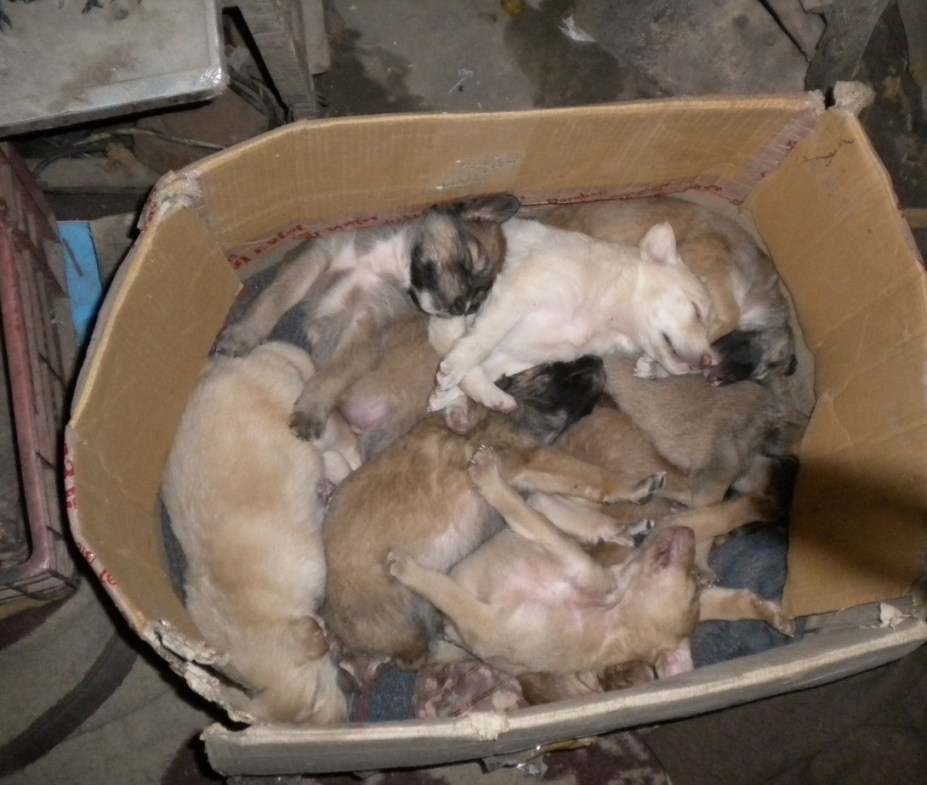
Once again, please do spread the word about her to animal-lovers in Delhi. Also: she has a new litter of pups – eight of them – born to a dog who evaded the van when it came to pick up candidates for sterilisation. They are all adoption-worthy. Here are fuzzy photos of them sleeping in a cardboard box together (you might not be able to make each one out, but hopefully you'll get a general impression of cute multipupdomness).
Friday, January 04, 2013
An old woman and her dogs
I’ve only actually known Pratima Devi for the past six months, though we have both been in Saket – living five minutes apart – since 1987. I was vaguely aware of her existence over the years: when passing her side of the PVR complex on winter nights, I would see a couple of charpoys with dogs on them, a bonfire burning nearby. Once or twice I saw her looking very dishevelled, yelling at someone in what seemed an ill-tempered way, and I may have formed the impression that she was a belligerent nutcase who communicated only with animals and didn’t like people.
There was a story with a very interior, contemplative tone that I read as a child in one of our Hindi textbooks – I forget the title, but the premise has stayed with me all these years, long after much of what I learnt in school has been forgotten. It was told in the voice of a privileged man who sees a poor person and wants to go across and talk – to try and understand something of this person’s life and circumstances – but finds an invisible force holding him back; some combination of self-consciousness, social conditioning and perhaps an internal prejudice that makes him believe meaningful communication with someone from such a different background is impossible.
Whatever the case, though I was intrigued by the “kutton waali amma” who was often spoken of in our colony, I didn’t make an effort to come close or get to know her. That changed last June, after Foxie went. Driven by an urge that overrode all our hesitations and procrastinations, we went across and said namaste to Pratima Devi, and were relieved to find that she was extremely warm and friendly, and most happy to talk – not just about the dogs but about her life, and ours.As we spoke to her over the next few days, many little details emerged. She left her village in West Bengal’s Nandigram in the early 1980s, she told us, mainly to get away from her husband, a lout and wastrel. She once worked as an ayah for the family of the actor-model Rahul Dev (and is still in occasional touch with them). A tea-stall she ran in the spot where she currently lives was shut down by the MCD; later she set up a little temple against the wall near her shack – it has, in a way, legitimised her presence, made it more acceptable to the people around (including the many youngsters who park their bikes nearby and are unnerved by the dogs). One of her sons lives in Sangam Vihar, working as a mistri – she has the option of staying with him (I’ve met him, he seems a kindly, concerned chap), but she can’t leave her dogs, and besides one senses that self-sufficiency is important to her. She was awarded a Godfrey Phillips prize for “social courage” a few years ago and proudly shows photos from the ceremony to anyone who visits her. She has applied for an Aadhaar card but is puzzled by the complications of the procedure; a card was once despatched but never made it to her because she has no fixed address. (I’ve seen the application form – it simply says “Near Saket Shauchalay, PVR Complex”.) Many of the dogs have film-star names - Raj Kumar, Dharmendra - which they live up to with their strutting and preening.
It happened on a day I went to see her after more than a week. She was with a couple of her associates – a parking attendant and another garbage-collector – and looking more depressed and agitated than I had ever seen her. The previous few days had been particularly hard: she had been laid up with a bad fever and cold, had been unable to work or to go to INA market to buy meat for the dogs, and it happened to be one of those phases when hardly anyone had come across to see her or offer help - her son wasn’t in town either.
Moaning through a backache, describing how one of her pups (a tiny Dalmatian, abandoned by some heartless sub-human) had a festering wound and was being treated by a local doctor for an exorbitant Rs 100 a day, gentle Pratima Devi muttered and fumed, half to herself, half to us: she used maa-behen gaalis as she spoke of a man who had promised to help her secure an electricity connection through the MCD, but who had then made off with more than a thousand rupees. “Gareebon ka sab phaaydaa uthaate hain,” she wailed, her face showing no trace of its characteristic warmth and openness. She wondered aloud what would happen to her dogs after she passed on. (It’s a thought that worries everyone who knows her; though these are street dogs, they are more pampered and loved than many house pets. When she’s away even for an hour or two, they get restless and start chasing after passing autorickshaws to see if she has returned.)
This encounter was a bucket of cold water in my face. I have seen her many times since that day, and she has mostly been back to her upbeat self – but that one day, when the mask slipped, is not something to forget.
I didn’t intend this post as a call for aid, but Pratima Devi has had more bad days than good ones recently (being old and living on the street as the Delhi winter gets worse will do that), and she could always do with some help, even if she doesn’t ask for it. So do go across and see her if you are in Saket sometime, and if you like dogs. (I wouldn’t normally put in that second proviso – Pratima Devi is well worth meeting even if you aren’t an animal-lover – but one must be practical and spell out these things; if you get within 10 feet of her you’ll have to contend with a few dogs first growling softly and then, when they know you mean no harm, sniffing or nuzzling you.) Or if you’re interested in meeting her but would prefer a sort of “introduction”, send me an email and I’ll take you across.
P.S. must say this, though I wish I didn’t have to. It infuriates me that people sometimes come by in their cars and leave their animals with this poor old woman, treating her like a fully funded animal shelter – which she emphatically is not. (Not that registered animal shelters have it easy either.) Her heart is big enough for all these dogs (her son tells me she holds the compassionate but highly impractical view that she should get bitches spayed only after they have had one litter of pups), but it increases her burden enormously, as well as adding to her worries about the future. So please, DO NOT use her as a dumping ground for unwanted pets.
P.P.S. Here's a photo of Pratima Devi with two of her friends at an event held to mark Anti-Rabies Day; Abhilasha went with her.