[From an on-off series about little connections between generally unrelated movies that happened to be made around the same time]
The films: Bimal Roy’s Madhumati and Alfred Hitchcock’s Vertigo, both released in the summer of 1958
The case: Hitchcock’s film (one of his least successful when it came out, but now among the most celebrated movies ever made) has a detective, Scottie (James Stewart), becoming obsessed with a woman named Madeleine (Kim Novak); they fall in love, but then she dies (or so he thinks) by falling from a great height, and he comes to believe he is responsible. Shortly afterwards, he meets Judy, who bears a strong facial resemblance to Madeleine – he emotionally arm-twists her into dressing up as his lost love so he can immerse himself in a fantasy.
 In Madhumati, a tragic love story is similarly followed by an attempt at remaking/play-acting. Anand (Dilip Kumar) falls in love with a village girl named Madhu (Vyjayantimala) but loses her (she falls from a tall building, though this is not immediately revealed) and wallows in grief and guilt until he meets Madhavi, who looks just like Madhu. He persuades her to dress up as the woman he lost.
A strong similarity in plot points then, but there is a big difference in the two men’s personal imperatives and in the nature of the love depicted in the two films. The obsessed Scottie believes that Judy can somehow become the dead Madeleine, and his “love” has an ugly element of control or possession in it. Madhumati takes the more sentimental position. Once Anand realises that Madhavi is someone else altogether, he doesn’t show the slightest romantic interest in her; he asks her to pretend to be Madhu only so he can trap the villainous Ugranarain (Pran) into a confession.
 The point is clearly made in an important scene where Madhavi comes to meet Anand in his cottage. Here is a flesh-and-blood woman who strongly resembles the dead Madhu, and who is sympathetic to his plight – yet he leaves her mid-conversation and dashes outside because he has heard the plaintive song of Madhu’s ghost. It might be said that like Scottie he is chasing a shadow, a woman who doesn’t exist – except that in the world of Madhumati the ghost does exist. A defining difference between the two stories is that Roy’s film believes in the supernatural, and this in turn allows it to posit an eternal version of love, built on the idea that Anand and Madhu are soulmates for all time. (Vertigo pretends for a while to believe in the supernatural – and in reincarnation – but this is eventually revealed to be a red herring.)
The twin motifs of climbing towards a height, and then falling from it, feature strongly in both films too (and in different ways suggest the vertiginous feelings that accompany romantic obsession). Both are breathtakingly good-looking films – one in colour, the other in black-and-white – and the cinematography has an ethereal quality: in Vertigo there is a scene
The point is clearly made in an important scene where Madhavi comes to meet Anand in his cottage. Here is a flesh-and-blood woman who strongly resembles the dead Madhu, and who is sympathetic to his plight – yet he leaves her mid-conversation and dashes outside because he has heard the plaintive song of Madhu’s ghost. It might be said that like Scottie he is chasing a shadow, a woman who doesn’t exist – except that in the world of Madhumati the ghost does exist. A defining difference between the two stories is that Roy’s film believes in the supernatural, and this in turn allows it to posit an eternal version of love, built on the idea that Anand and Madhu are soulmates for all time. (Vertigo pretends for a while to believe in the supernatural – and in reincarnation – but this is eventually revealed to be a red herring.)
The twin motifs of climbing towards a height, and then falling from it, feature strongly in both films too (and in different ways suggest the vertiginous feelings that accompany romantic obsession). Both are breathtakingly good-looking films – one in colour, the other in black-and-white – and the cinematography has an ethereal quality: in Vertigo there is a scene  in a cemetery where Scottie (and the viewer) sees the enigmatic Madeleine from a distance, as if through a mist; when Judy first emerges from the bathroom having “transformed” into Madeleine, she seems ghostly too. In Madhumati the mist is a palpable, living presence almost throughout the film, and Madhu is sometimes presented as an apparition, as someone not quite of this world, even before tragedy strikes.
 In both films (I know, I’m stretching now) a tree plays a central part in the lovers’ assignations: Madhu and Anand use a tree’s shadow falling across a rock to mark the time of day they will meet; Madeleine counts the rings on an ancient redwood to reflect on the transience of human life. That might seem a minor detail, but the redwood scene is also a reminder of the big divergence between the films: Madhumati is built on circularity and the idea that nothing ever really “ends” – if Anand and Madhu can’t be together in this life, they will always have another chance in the next one – while Vertigo suggests that there are no such second chances and that an attempt to artificially construct one can only result in tragedy; lives are finite and circumscribed, and too often wasted in pursuing an ideal rather than in appreciating what stands in front of you.
And lastly, one of those pleasing coincidences that often occur when one is watching many (varied) films over a short period. Last month I saw two films – on consecutive days – that were dramatized stories about real-life directors. One was Hitchcock, which I wrote about here (and which made a reference to Vertigo’s plot as a variation on Alfred Hitchcock’s real-life treatment of blonde actresses). The other film, Meghe Dhaka Tara, was about Ritwik Ghatak, who was the story-writer of… Madhumati. (If this blog had a soundtrack, this would be the cue for an ululating ghostly wail.) Which brings me to an irony in the Vertigo-Madhumati association: Hitchcock – the “commercial” director, usually associated with escapism – made the more hardheaded film, a cynical work with many scenes that make a viewer feel like he has bitten into a sour lemon; while Roy and Ghatak – both archetypes of the "socially conscious" artist – created a lush melodrama (I don’t use the word pejoratively) about stormy nights, wandering spirits and immortal romance. It’s a pleasing reminder of cinema's limitless possibilities, and of the limits of classification.
Just realised that Jesse Eisenberg, who plays Mark Zuckerberg in The Social Network, is a few months older than Zuckerberg in real life. Can anyone think of other instances of actors playing real-life characters who were younger than them? I have a niggling feeling that there have been a few such cases (and possibly a couple that are very obvious), but I can't put my finger on many.
The ones I have so far:
- Dustin Hoffman and Robert Redford were both several years older than their real-life characters, reporters Carl Bernstein and Bob Woodward, in the film about the Watergate expose, All the President's Men.
- Gary Cooper as baseball star Lou Gehrig in The Pride of the Yankees.
- In The Great Dictator, Charles Chaplin played Adenoid Hynkel, a barely disguised version of Adolf Hitler (who was a mere four days younger than Chaplin in real life).
- In The Boys From Brazil (an adaptation of Ira Levin's excellent novel), Laurence Olivier played a Nazi-hunter modelled on Simon Wiesenthal - who was a year younger than Olivier - but the character had a different name.
As you'd expect, there are a few close contenders from biographical movies about sportspeople and musicians who achieved a lot at a young age: in Fear Strikes Out, Anthony Perkins played Jimmy Piersall, who was just two years older than him. Then there's James Stewart in The Glenn Miller Story (four years) and Paul Newman as the boxer Rocky Graziano in Somebody Up There Likes Me (six years).
Any additions to this list? Movie buffs?
Update: just to clarify what I mean, I'm talking about actors who were born before the real-life people they portrayed.
Last month saw two important movie anniversaries. While May 20 was the birth centenary of James Stewart, one of Hollywood’s finest actors (and one of my personal favourites), the week before that marked 50 years since the release of a film that contained Stewart’s most complex performance: Alfred Hitchcock’s Vertigo, a poetic, very intimate story about obsession and what it can engender.
 Though it received indifferent or sneering reviews in 1958, Vertigo saw a huge, almost alarming turnaround in critical reception over subsequent decades, so much so that it now competes with the once-untouchable Citizen Kane on many “best film” polls. (Note: I find it strange and vaguely disturbing that any one film – be it Citizen Kane or Vertigo or Faster Pussycat, Kill Kill for that matter – could inspire such consensus among motley groups of movie-lovers; it almost feels like there’s some secret society deciding these things. I would be much more interested in a collection of top-10 lists prepared by 20 different people, which mentions 200 separate films with no repetition. Like some of these.)
Vertigo isn't my personal favourite among Hitchcock’s films (at this point in time, it isn’t even in my ever-shifting top 5: those would currently be Psycho, Strangers on a Train, Notorious, Rope and The Trouble with Harry). It’s always fallen in the “admire more than love” category for me, so it might seem paradoxical that I’ve been compelled to revisit it many times – on one occasion, greatly inconveniencing myself to catch a film-festival screening – and my admiration has increased with each viewing. For starters, I’m always struck anew by the sheer beauty of the film (thank FSM for the print-restoration that took place in the mid-1990s, when the negative was in dire shape). It’s truly lovely to look at, full of lengthy wordless sequences and some very evocative use of San Francisco locations such as the Golden Gate Bridge and the sloping streets.
I’m almost certain that no other Hitchcock film has as many dissolves as this one does, and while that in itself doesn’t have to mean anything, in Vertigo these dissolves have the effect of heightening the relationship of each shot to the next, and of making each seem like a vital part of a living, breathing organism. Scene by scene, this film is more rigorous and compact than anything else Hitchcock did, with the possible exception of The Birds and Notorious – you can almost sense the director agonising over every frame, making sure that it fits in perfectly with the overall look and mood. Adding greatly to its effect, of course, are Bernard Herrmann’s lush music score and Stewart’s daring performance as a man who starts off by being eminently likable (in the classic Jimmy Stewart tradition) but who gradually reveals a very dark side - one that's all the more disturbing if you can relate to it.
 The film begins with a haunting prologue – a scene that can, in retrospect, be viewed almost independently from the main narrative – that shows detective Scottie Ferguson (Stewart) discovering (in the worst imaginable situation) that he suffers from a paralysing fear of heights. Though advised to recuperate for a few weeks, Scottie is intrigued when an old college friend asks him to follow his wife Madeleine (Kim Novak), who may be possessed by the spirit of an ancestor. Unaware that he is being used as the set-up in an elaborate murder scheme, the detective finds himself falling in love with Madeleine and becoming her protector. When she dies, in an incident that might have been prevented if it weren’t for his vertigo, the guilt-stricken Scottie withdraws into himself – until, one day, he meets a woman, Judy, who bears a strong physical resemblance to his deceased love. He pursues her, they become close and then, unmindful of her feelings, he sets about trying to refashion her in the image of Madeleine.
It’s difficult to discuss the plot without giving away spoilers, so here’s the obligatory alert. With around half an hour left to go, the narrative makes one of the most startling right turns I’ve seen in any film – it abandons Scottie’s viewpoint (he has been our point of identification throughout so far, and the central figure in every scene) and shifts to Judy’s, in the process casually making a revelation that most suspense films would have saved for the end. But this helps achieve a larger purpose: as the movie heads towards its climax, we have been made privy to both Scottie and Judy’s internal demons, and the effect is very ambivalent and unsettling.
 Anyone who engages closely with Vertigo will see that its thriller aspects – built around a convoluted, implausible, easily dismissed plot – are a pretext to explore more universal themes. In Scottie’s idealisation of Madeleine, his callous treatment of the more earthy Judy and the latter’s hesitant succumbing to his demands, we see the emotional arm-twisting that accompanies the deepest relationships: how our feelings towards other people are very often based on the image we have created in our heads rather than what they are really like; and how easy it is to make compromises or try to reshape yourself – often to the detriment of all concerned – to win the acceptance of someone you care about. In fact, I’m not at all sure that Vertigo is exclusively about romantic love. It seems to me that the most cutting observations made here – about emotional dependence and the subtle, often perverse manipulations that accompany many of our closest bonds – can apply just as well to any relationship.
Hitch's most problematic film?
It’s widely accepted that this is Hitchcock’s most intimate work, and this can be a stumbling block for the casual moviegoer, conditioned to think of this director as a witty entertainer who traded mainly in suspense. But I think the emotional directness and rawness of Vertigo can be problematic even for the more knowledgeable and devoted Hitchcock fans – because while we believe that the man is a great artist and that his work deals with serious ideas, we are accustomed to seeing this done obliquely rather than head-on.
 To illustrate what I mean: the parlour conversation between Marion Crane and Norman Bates in Psycho is an example of a superb scene that provides the beating heart of a very profound film, anchors it and brings many of its deeper themes into the open. But crucially it’s also a scene that uses sardonic black humour as a smokescreen or a defence mechanism (much like the rest of the film does). The dialogue between Norman and Marion occasionally reaches a high pitch of intensity (e.g. Norman reflecting on his mother being left alone in the Gothic house if he were to leave her: “the fire would go out, it would be cold and damp like a grave – if you love someone you can’t do that to them even if you hate them”) but the tension is repeatedly dispelled by a clever one-liner or a wry observation (“A son is a poor substitute for a lover”/“Mother isn’t quite herself today”/“Some people even stuff dogs and cats, but I couldn’t do that”). It’s ironic and detached.
Vertigo, on the other hand, doesn’t give the viewer these breathers: it wears its heart on its sleeve. In the later scenes, when Scottie looks longingly at Judy, searching for glimpses of Madeleine in her, or when he waits for her to emerge from the bathroom after having transformed completely into the person he idealises, it’s difficult to look at James Stewart’s face – you almost feel like you’re intruding on something that’s too private. Consequently, the film occupies a unique position in Hitchcock’s filmography: it doesn’t have the distancing black humour of Psycho and Rear Window or the elegant wit of the early British films, nor is it a full-blown entertainer like North by Northwest (a first-time viewer expecting to see a “Hitchcock thriller” will almost certainly be disappointed, even angered, by how slow-moving and abstract it is). And if you look at it as the sum of its plot twists, it’s easy to dismiss it as a good-looking but pointless melodrama.
But for viewers who are lucky enough to be drawn into its world and absorbed by the dilemmas of its central characters, this is a very mature work that grows richer each time you see it – though of course, this presupposes the sort of viewer who would elect to see it more than once! Also, you probably need to be a serious movie buff/historian to appreciate how astonishing it is that such a personal film could have been made in mainstream Hollywood in the 1950s by one of the most high-profile directors in the world, working within the many constraints of the studio system. I’m hoping a special-edition anniversary DVD makes it to Indian stores soon.
P.S. In the context of Vertigo being a film that doesn’t have mass-appeal and can make viewers uncomfortable, I recently came across this post on Jim Emerson’s Scanners blog: a discussion about films that are so personal that they work best when watched alone, rather than with an audience in a hall. Emerson also links to an interview with novelist Steve Erickson, who speculates that one reason why Vertigo’s critical appreciation deepened after its original release was that many budding movie buffs (future directors and critics) in the 1960s and 1970s saw it at home, on TV.
I’ve never seen Vertigo “work” with an audience in a theatre, and I’ve seen it with an audience at least four times...a movie that seems absurd in the collective dark, shared with other people, but watched alone on DVD has the force of a private dream.
I think there’s something to this: I remember the general restlessness and the snickering in the hall when I saw Vertigo on the big screen at PVR Saket of all places – part of a very short-lived experiment by the hall to show movie classics. In fairness, it must be said that the print they showed was a terrible one (from before the restoration) and the sound even worse. Besides, and there’s no polite way to say this, it was a PVR Saket audience.
P.S. 2: Also see this old post about the accusations of misogyny in Hitchcock’s films. The accusations seem even more bizarre when you see the obvious sympathy that Vertigo has for the Judy character, and how the film launches its emotional crescendo at precisely the point when Scottie leaves the room (and us) for the first time and the camera turns to Judy to learn her story. More from Camille Paglia about Hitchcock and Vertigo here.
P.S. 3: Here's a great piece by Adam Gopnik, originally published in the New Yorker I think, which marvelously links the death of a beloved goldfish with the premature revelation in Vertigo. Wonderful piece of writing.
[A shorter version of this post appeared in the New Sunday Express a couple of weeks ago]
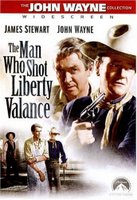 The very first shot in John Ford’s The Man Who Shot Liberty Valance is of a train pulling into a little railway station. Anyone familiar with the grammar of classic movie westerns will know that the railroad plays a very special role in these films: it’s a symbol of advancement, the bridge between the Old West and the New West; in some ways a bridge between savagery and civilisation. American mythology has it that before trains connected the Midwestern towns and frontiers with the East Coast, the rule of the gun prevailed. Authority figures were often irrelevant; the winner was usually the fastest draw.
On the train are the US senator Ransom Stoddard (James Stewart) and his wife Hallie (Vera Miles), who have come to visit the small town of Shinbone where they had first met a long time ago. They are received at the station by an aging former Marshall, and one immediately senses the nostalgia in the air. “The place sure has changed, Link,” Hallie tells him, “Churches, high schools, shops…who would have thought it?” “The railroad’s done that, Hallie,” he replies. The tone of this conversation is telling. They are talking about the markers of civilisation, of human progress, yet there’s a residual sadness, a sigh of regret beneath the words. There’s something almost grudging about the acknowledgement that change has, on the whole, been for the better.
Stoddard and Hallie have come to Shinbone for the burial of an old friend named Tom Doniphon, a man hardly anyone in town even knows about. The editor of the local newspaper, thrilled at the chance to interview a possible future vice-president, presses Stoddard for details. Who was this Doniphon and why was he important enough for a US senator to take time off from his important schedule?
In flashback, we get the meat of the story: Ransom’s arrival in Shinbone as an idealistic young lawyer decades earlier, eager to bring education to the boondocks; his encounter with the savage outlaw Liberty Valance (Lee Marvin) who has the townsfolk in perpetual fear; his arguments with the rugged Tom (John Wayne), who believes that the only way to deal with Valance is with a gun; his attempts to get the people to organise themselves into a community governed by proper laws; and finally, his reluctant confrontation with Valance – in a shootout scene that lays the ground for the film’s most famous line: “When the legend becomes fact, print the legend.”
Star personalities
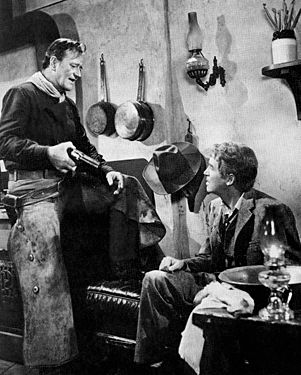
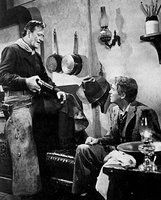 John Wayne and James Stewart were 54 and 53 respectively when this film was made, and one of the standing criticisms of The Man Who Shot Liberty Valance is that they were far too old for their characters in the “flashback sequence” (which is, after all, 90 per cent of the film). Makeup helps to an extent, and one of the most notable things about Stewart’s performance as the young Ransom is how he quickens his reactions and physical movements without making it very obvious. He’s a lot more alert and sprightly than he presumably was in real life (in fact, even as a young man, Stewart’s stock in trade was a shuffling, slow walk and a Midwestern drawl – so this performance, given in his 50s, is probably among his most energetic ever!).
The criticism about age is of course justified from the point of view of verisimilitude, but it’s impossible to imagine this film without these men in the leading roles, for their screen personalities are crucial to its effect. Stewart, a more nuanced actor, was the modern man – vulnerable, complex, unafraid to show a feminine side (in fact, he spends some of the key scenes in this film in an apron, which has led to much critical analysis of gender roles!). This was reflected in the roles he played in middle age, especially in films by Hitchcock and Anthony Mann. Wayne, in contrast, was repeatedly used by Ford in their many films together as an emblem of the Old West – the macho cowboy who survived by his shooting skills. By all accounts, the screen image was not very far from the man’s real-life persona, for Wayne was known to be jingoistic, brow-beating, politically on the far right, pro-Vietnam War, full of notions about what “real men” must be like.
Watching him in The Man Who Shot Liberty Valance, I remember a story told by Kirk Douglas in his autobiography The Ragman’s Tale. Douglas, who himself frequently did macho-man roles early in his career, had just stretched himself as an actor by playing the tortured Vincent Van Gogh in Lust for Life. In his book, he recounts an incident involving Wayne, who was present at a private screening of the film:
[John] kept looking at me. We hadn’t worked together yet. He seemed upset. He had a drink in one hand, motioned to me with the other. Out on the terrace, he berated me. “Christ, Kirk! How can you play a part like that? There’s so goddamn few of us left. We got to play strong, tough characters. Not those weak queers.”
I tried to explain. “Hey John, I’m an actor. I like to play interesting roles. It’s all make-believe. It isn’t real. You’re not really John Wayne, you know.” He looked at me oddly. I had betrayed him. I took it as a compliment; the picture had moved him, or at least disturbed him.
This is one side of the story. For the other side, you need to watch Wayne in some of his best roles in films like The Searchers, She Wore a Yellow Ribbon and Red River – movies where he betrays a vulnerability, even a lack of self-confidence, beneath the posturing. Though a limited actor in many ways, he had the ability to convey the sadness and disaffection of a man who knows deep inside that his beliefs and values have no place in a rapidly changing world. Some of this can be seen in The Man Who Shot Liberty Valance: note the many scenes where Wayne watches Stewart with a curious little smile on his face, trying to figure him out. Or the way he observes 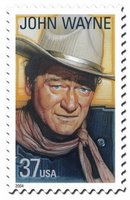 the growing closeness between Ransom and Hallie and realises that he is losing “his girl” (another phrase that has its roots in an old patriarchal system) to a more sensitive man, a symbol of progress. Above all, note Ford’s seeming iconizing of Wayne in scenes like the key conversation between him and Stewart near the end of the film (the slow dissolve where, for a couple of seconds, what we see on screen is the sort of image that would be perfect for a postage stamp). But what Ford is doing here is more complex: he’s inverting the myth. This isn’t a Wayne character who will ride off triumphantly into the sunset; he’ll fade away quietly, spend his later days forgotten and alone.
This great film is about the passing of an old world. Despite some sentimentalising (as in the suggestion that Hallie continued to carry a torch for Tom; that she made the practical decision to marry Ransom and become a modern woman, but on some level was still in love with the rugged, uneducated frontiersman), it isn’t a mere elegy, for it recognises that many things about that old world were undesirable – who would argue in favour of the “let’s settle this with guns” brand of machismo? However, it gently makes the point that even when change is for the better, it’s possible to mourn the passing of a simpler time. It reminds us that the present is, after all, built on the bones of the past, and that various phases of transition have seen the crushing of the dreams of decent, well-meaning people. (In the context of the story, the implication is also that law and order in the West might never have been set down if it hadn’t been for the heroes of an earlier time, who went about things in a less “civilised” way. “Nothing’s too good for the man who shot Liberty Valance,” is the film’s ironical last line; but by this point we know better.)
Like many of the best Hollywood classics, The Man Who Shot Liberty Valance can be appreciated foremost on narrative terms. The story, the dialogue and the performances (including Andy Devine as the cowardly Marshal Link Appleyard, and of course Lee Marvin as the petulant outlaw whipping his victims with a belt – a Method performance that's delightfully incongruous to this film) are of the highest order, and held together by one of the greatest of movie directors. John Ford made so many superb films that one tends to take his oeuvre for granted – rarely is there a singling out of this or that movie, the way one often sees done with Welles or Kurosawa or Hitchcock or Bergman. But this latter-day film is undeniably among his very best work.
[This is a much longer version of a piece I wrote for the New Sunday Express earlier in the week. A few previous posts on classic films: Strangers on a Train, Yojimbo, M*A*S*H, 8 1/2, Spartacus, The Texas Chainsaw Massacre, Twelve Angry Men, Peeping Tom, The Passion of Joan of Arc.]


 In Madhumati, a tragic love story is similarly followed by an attempt at remaking/play-acting. Anand (Dilip Kumar) falls in love with a village girl named Madhu (Vyjayantimala) but loses her (she falls from a tall building, though this is not immediately revealed) and wallows in grief and guilt until he meets Madhavi, who looks just like Madhu. He persuades her to dress up as the woman he lost.
 The point is clearly made in an important scene where Madhavi comes to meet Anand in his cottage. Here is a flesh-and-blood woman who strongly resembles the dead Madhu, and who is sympathetic to his plight – yet he leaves her mid-conversation and dashes outside because he has heard the plaintive song of Madhu’s ghost. It might be said that like Scottie he is chasing a shadow, a woman who doesn’t exist – except that in the world of Madhumati the ghost does exist. A defining difference between the two stories is that Roy’s film believes in the supernatural, and this in turn allows it to posit an eternal version of love, built on the idea that Anand and Madhu are soulmates for all time. (Vertigo pretends for a while to believe in the supernatural – and in reincarnation – but this is eventually revealed to be a red herring.)
 in a cemetery where Scottie (and the viewer) sees the enigmatic Madeleine from a distance, as if through a mist; when Judy first emerges from the bathroom having “transformed” into Madeleine, she seems ghostly too. In Madhumati the mist is a palpable, living presence almost throughout the film, and Madhu is sometimes presented as an apparition, as someone not quite of this world, even before tragedy strikes.