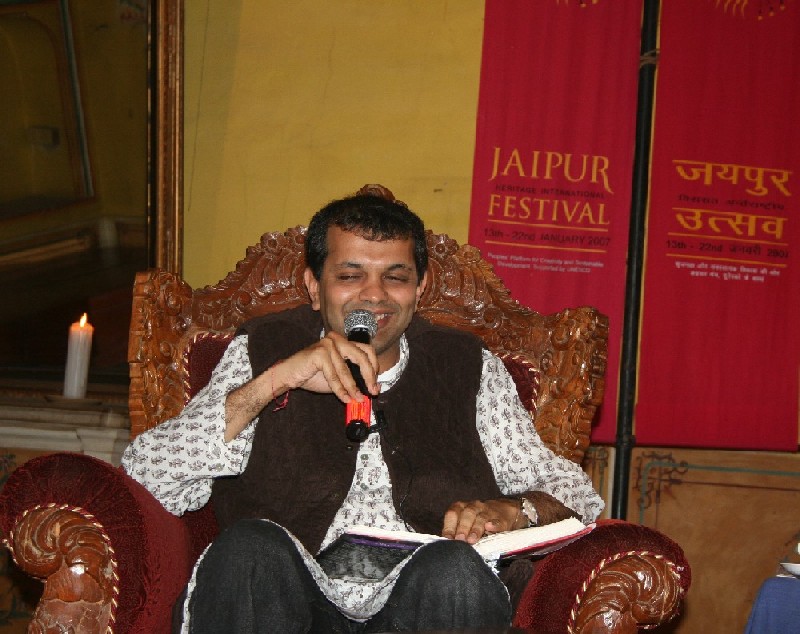
Showing posts with label Jaipur Literature Festival. Show all posts

Friday, December 07, 2012

Dead writers' society: on Howard Jacobson's Zoo Time

In another few days, every town and street corner will be hosting a Big Literature Festival. It is natural then, around this time of year, to hear murmurings about smug, back-patting, liquor-guzzling intellectuals. Along with some less-than-tasteful suggestions: it may be remarked, for instance, that a giant Godzilla foot squelching down on the Jaipur festival lawns on a weekend evening would wipe out our literary community in one swell foop. But notably, most such comments come from insiders themselves and therefore have a certain amount of wistful self-loathing built into them – the last time I heard the Godzilla one, it was said at Jaipur on a weekend evening, and by someone who is himself sometimes regarded as being part of this putative “community”. (He, of course, denies it vigorously. He also denies being the present writer.)

Creatively executed, such self-commentaries – litterateurs sniffing or whining about litterateurs – can be a form of meta-fiction, and meta-fiction is all the rage these days. Much contemporary literature is explicitly about writers and writing, giving the impression that the Novel is not so much dead as trapped in a giant hall of mirrors. Self-reflexive writing of this sort can become tedious (witness the present column), but heading into December I found it almost comforting to read Howard Jacobson’s new novel Zoo Time, with its comically apocalyptic vision of the publishing world – a vision that almost makes our lit-fest and book-launch season seem stable and sane.

Here are some of the things that happen in Zoo Time’s hysterical universe. A publisher shoots himself in the mouth shortly after a meal with an author (during which they talked about a literary world forever altered by Twitter, blogs and vampire-replete bestsellers). Terrified agents lock themselves in lavatories “rather than have a manuscript handed to them personally like a subpoena”, and one of them is lost on the Hindu Kush with a manuscript in his backpack. (“Had Quinton lost his bearings and gone stumbling through the ice with my manuscript wrapped around him for insulation, or had the novel itself sent him mad? The question, to tell the truth, wasn’t much discussed. A literary agent going missing was much too common an occurrence to attract speculation.”) The marriage of the book’s narrator – Guy Ableman, author of a novel titled “Who Gives a Monkey’s?” – is in trouble, partly because the sound of his writing drives his wife to madness. (“But so did the sound of my not writing.”)

In this strangely familiar dystopia, literary parties are like funeral wakes (“except that at a wake there’d have been more to drink, and fuller sandwiches”) and a car exhaust backfiring might cause passersby to wonder if another publisher had taken his life within their earshot. The few remaining readers quiver with rage whenever they meet a writer (“was it because reading as a civilised activity was over that the last people doing it were reduced to such fury? Was this the final paroxysm before expiry?”) and are actively hostile in their dissection of his “berk” (no one says “book” anymore, it's too much effort). The best chance a young author has of producing a hit is to write a memoir about losing his sight when his adoptive mother’s silicone breasts exploded in his face.

Beyond all these things, Zoo Time’s threadbare “plot” is about the deep attraction Ableman feels for his wife’s mother Poppy, but he uses a literary analogy to describe even this: is sleeping with your mother-in-law like stealing your own book? Throughout, he is a self-conscious wordsmith in the act of constructing his own story, correcting himself mid-sentence, giving us glimpses – whether reliable or not – of how his real life intersects with his fiction. And in doing this, Jacobson’s novel asks that pertinent question: should a writer exist (for the reader) beyond the page? It is a question that was raised memorably in Jaipur two years ago, when J M Coetzee – among the last of the truly taciturn big-name authors – read a long extract from his work but didn’t otherwise say a word. Jacobson may or may not have had Coetzee in mind when he writes about a Nobel-winning Dutch author who simply sat on the stage in front of his festival audience: “So the hour would have passed, each staring at the other in silence, had someone not thought of showing slides of the bridges of Amsterdam. When it was over they gave him a standing ovation.”

Zoo Time is among the most tongue-in-cheek doomsday books I have read. It is about the long-awaited demise of writing and reading (and therefore about the end of everything, since it is narrated by a man obsessed with these things), but it is also a reminder that good meta-fiction can help keep literature alive in the very process of sounding its death-knell. If writers absolutely have to write solipsistic books about writing (and really, one wishes they wouldn’t), this is a fine way to do it. I do hope though that Jacobson is careful in choosing what passages to read at his (no doubt many) impending appearances in clubby literary festivals.


Perhaps the one that begins thus?
This is when you know you’re in deep shit as a writer – when the heroes of your novels are novelists worrying that the heroes of their novels are novelists who know they’re in deep shit... 

[Did a version of this for Business Standard's Eye Culture column]

Saturday, January 28, 2012

On "liberal extremism" (and soft oppositions to freedom)

I’ve had a cordial relationship with Chetan Bhagat for a long time; there are things I like about him, as a person and – yes – as a writer too. I once faced flak in literary circles for saying mildly nice things about his early work, and I still often have arguments with friends who make condescending remarks like “Why has Chetan Bhagat been invited to a literature festival?” But I’m deeply disturbed by the position he has adopted on the Salman Rushdie-Jaipur issue, especially his repeated endorsement of the bizarre idea that the whole mess was jointly caused by “extremists on both sides”.

Two exhibits. First, some samples from Chetan’s Twitter feed:

“When extremists on both sides turn a festival into an activist venue, there's a security risk.”

“In a fight between extreme fundamentalists and extreme liberals, the sufferer is the beautiful jaipur litfest, the gainer an appeasing govt.”

“Extreme fundamentalists. Extreme liberals. Extremely difficult to deal with either.”

“If you are truly religious, you believe in forgiveness. If you are truly liberal, you respect other points of view. Sadly, don't see it much.”


A response to that last Tweet: sure – if you’re truly liberal, you respect other points of view. (Since the meaning of “respect” is often hazy in this context, a clarification: it means that you believe people should have the freedom to peacefully express their views, no matter how strongly you disagree with them.) What you emphatically DO NOT respect – or condone – is the demonstration of those views through threats and violence, which curtails the similar rights of other people. And it’s the religious extremists who have been curtailing rights in the Rushdie case; the “liberal extremists” have been responding to the bullying with non-violent protests. This is an important distinction. Even if you find it convenient (for whatever reason) to think of strong-voiced liberals as extremists, do have the grace to acknowledge that there is no equivalence between these two forms of “extremism”.

Exhibit 2: this CNN-IBN video featuring Chetan, Ruchir Joshi (who was one of the four authors who read from The Satanic Verses in Jaipur) and Asaduddin Owaisi, who called for the arrest of the writers.


On view here is Chetan as the “balanced” diplomat-cum-moderate who is willing to listen to both points of view and who badly wants the two parties to find a middle ground – “because otherwise this whole controversy is kind of useless”. I will not comment on individual actions, he starts by saying. Then, “As an artist you have full freedom to write whatever you want to. However... Should you be exercising the right to hurt people?” And to Owaisi, “I request you to withdraw your case”, followed by this astonishing statement: “We are all Indians here – we will not let someone who is not Indian [meaning Rushdie] affect our unity.”

This is a great issue to unite the country,” he says – apparently “uniting the country” means ensuring that no one says or does anything that might be perceived as offensive to any community’s God, be it Allah or Krishna or Saraswati. “We Indians are believers. Our value system is not the same as London or Paris or Amsterdam.” (Incidentally, Amsterdam was where Theo van Gogh was murdered by a religious fanatic not so long ago because he made a film – and it should be clear to any thinking person that no corner of the world is safe from the extremisms of the “value system” Chetan is so proud of – but let that pass for now.)

------------

In this piece, Chandrahas Choudhury lists three types of opposition to freedom of speech in India. The third of these, he says, is an “insidious kind of muzzle on the genuinely free expression of ideas”:
“... what one might call a soft opposition, or self-censorship [...] that honestly doesn't understand what individuals have to gain by rocking the boat of a particular religious order, and believes that ‘religious sentiments should always be respected’ and art has no business to question or mock what is held by some to be sacred”
I have had dozens of encounters with “soft opposition” of this sort. These typically involve conversations with well-meaning family members or acquaintances who might very loosely be described as “liberals” (or at least as “cool” or open-minded people). When the subject of an artist offending religious sentiments comes up, they usually say: “Yes, but was it necessary to write that article/do that painting/make that cartoon? Couldn’t he have been more sensitive?” Or “I agree that he has the right to do or say this. But should he have done it?

This type of conversation sometimes reaches a critical point if you reply: “Agreed - it might have been nicer/more sensitive to do things in another way. But what if the artist politely hears you out and then says he has chosen to disregard your advice – that he will go ahead and do this anyway? What will your response be then?” I've found that the mask of unequivocal “liberalism” can slip off very quickly in this situation.

It’s worrying that so many people in India seem not to understand what good art can be all about, and the conditions necessary for its meaningful survival. As Ruchir Joshi writes in this piece in The Hindu (bold-marks mine):
I have memories of writers, artists, film-makers being pushed into narrower and narrower pens by people who had no interest in literature, art or cinema other than to use these as excuses to expand their own illiterate, illiberal, poisonous power under the guise of identity politics...
And Amit Chaudhuri in The Hindustan Times:
In India, I get the feeling that the liberal middle class is only dimly aware of the importance of the arts, and how integral they are to the secular imagination, except in a time of media-inflated crisis, when it becomes a 'free speech' issue. Indians know how to talk about writers, but not about writing.
Little wonder that artistic liberty is among the first things to be held hostage (or made conditional, which is the same thing) when "sentiments" are deemed to have been hurt. A friend told me not to write a post about Chetan Bhagat because “he’s such a soft, easy target”. Well, maybe, but here it is anyway, because I think his stance tells us something about the level of discourse around us today. It’s a pity that one of India’s most popular writers seems unwilling to acknowledge that one of the oldest functions of art is to disturb people and encourage them to look with new eyes at everything they hold sacred. We already see too much of that apathy and ignorance in people who don't work in the creative field.

Saturday, January 29, 2011

In Jaipur with Biharis, Swedes and all the other 'chuts'

At a festival this chaotic,” a friend remarked during one of our many chai breaks on the Diggi Palace lawns, “you have to keep a look out for the small pockets of pleasure – a clever remark made by a favourite writer at an otherwise middling session, an impromptu conversation with someone you chance to meet over lunch. Seize that moment and use it as oxygen to tide you over the next few hours.”

I spent most of this year’s Jaipur lit-fest in a haze, looking for sitting space and finding none, being shepherded hither and thither by a sea of people, or fretting about the panels I was moderating. More than once, I envied the hundreds of book-lovers who had come with plenty of time on their hands and with absolutely no agenda other than to sit down and hear authors talk. For such people, the JLF must be heaven. Not so much for the reporters hunting for “exclusive” quotes or filing multiple stories on harsh deadlines. Or for someone, like yours truly, who can only take so much of crowds.

So after a while, I decided that the only way to survive the madness was to take my friend’s advice and greedily accumulate as many of the nice little moments as possible. A few personal highlights, randomly listed:

– In the course of a warm discussion with Zac O’Yeah, the Swedish crime writer Henning Mankell told a funny story about his experiences in a Mozambique town where a police force had only just been introduced, and the protocol between the confused young men who were inducted as policemen and the small-time thieves they had to apprehend was unclear. Thus, you might see a policeman walking down the street holding a freshly caught thief by the scruff of his shirt, but then casually stopping to have his shoes polished – while ordering his detainee to fetch him some cigarettes from a nearby shop, with the latter dutifully complying.

For Mankell, a writer who trades in methodical police procedurals with clearly drawn lines between detectives and civilians, this must have been quite an eye-opener; no wonder he remarked, “It’s fashionable nowadays to say that the world has become very small, but that isn’t true at all – it’s still just as big as it is, and people in one part of it can’t begin to imagine what daily life is like in the other parts.”

– There was also the pleasure of hearing Martin Amis speak about “the myth of decline” – the tendency to look at the past through rose-tinted glasses, going as far back as pre-historic cave writings that lamented “Where are they now, the heroes of old?” Discussing the supposed death of the novel, Amis quipped that when the second edition of Cervantes’ Don Quixote was published in the early 17th century, there would have been critics who said, “Well, that’s it, that’s the end of the novel – it has no future.” (Note: if the human mind is hard-wired to think of the past as being forever glorious and the present as being bleak, little wonder I spend so much time reminiscing about the cosier days of the Jaipur lit-fest.)

– Amis being sardonic during his introduction of a talk dramatically titled “The Crisis in American Fiction”: “I’d like to begin by asking these three struggling, panicking American novelists about the ongoing crisis in American fiction.” The writers he was speaking to? Richard Ford. Junot Diaz. Jay McInerney.

– I was unhappy about missing the “Cinema Bhojpuri” session moderated by the incomparable Amitava Kumar, but was gratified when I later heard (from Amitava himself) that he said “Dabangg ek Bhojpuri film hai, behanchod” during the course of the session. (On the other hand, it wasn’t nice to hear about the censoring of Faiza S Khan's reading at the “Pulp” session.)

– Thoroughly enjoyed Jeet Thayil’s reading from his forthcoming novel Narcopolis at a session where I introduced him and CP Surendran. (I think this was shortly before poor CP was attacked by an offence-taking sardar.) Jeet’s reading included a lengthy stream-of-consciousness passage where the word “chut” is used almost as a poetic refrain; the drug-addled narrator employs it to describe all varieties of Indians (except for Maharashtrians). After the session, an audience member asked Jeet the inevitable question “If you hate India and Indians so much, why do you continue living here?” Sigh.

– Had a brief chat with the novelist Marina Lewycka, who joked that when she wrote serious books that intended to probe the human condition, they ended up being nominated for comic prizes, and vice versa. Lewycka, incidentally, leads a fairly quiet life in Sheffield, Yorkshire, and she looked understandably dazed by the largeness of the festival. (While on that, poor Ruskin Bond! He probably saw more people in a single day in Jaipur than he has his entire life in Landour.)

– Following the Popcorn Essayists session, a group of schoolboys came up to me and asked me to sign their lined registers. “Sir, are you involved with Bollywood?” one of them asked as I scrawled my name for the third time. I considered telling them I was Aamir Khan but instead shook my head. Boys and registers vanished in a puff of smoke.

Such was Jaipur.

[If you don’t already have festival reports coming out of your ears, try Google: there’s plenty of media coverage, good and bad. Some really good photos on Mayank Austen Soofi’s blog, for example (the ones above of Kiran Desai and Martin Amis are from him). And the official website is putting up videos of sessions, though some of the links are wrong.]

Thursday, January 06, 2011

Popcorn essays at the Jaipur Literature Festival

Update: the schedule for this year's edition of the Jaipur lit-fest is now online - check this link. And here's the line-up of participating writers and speakers.

On January 24, Anjum Hasan, Kamila Shamsie, Namita Gokhale, Jaishree Misra and I will be in a session centred around The Popcorn Essayists: What Movies Do to Writers, the film-essay anthology I've edited for Tranquebar. The ladies will read from the pieces they've written for the book (topics include 1980s Bollywood gossip,
the Kaurismaki brothers, the case for censorship, and the relationship between the language of prose and the language of film) and there will be a light discussion as well, hopefully with much audience participation. Do try to drop in for the session - it should be fun (with the side-benefit that you might just run into Orhan Pamuk, J M Coetzee or Junot Diaz sipping kulhar chai on the lawns outside!).

P.S. Here, for anyone who missed it earlier, is Manil Suri's piece for the anthology, excerpted this month in Caravan magazine. And here's his Helen dance which, sadly, will not be replicated at the Jaipur fest.

Friday, January 30, 2009

Festival notes 6

Some final scrapings from the Jaipur-fest barrel:
People loved Aamir's Ghajini because it laid everything on so thick – it's like eating vada pao and tikki. Incidentally, everyone talks about it being a Memento copy but hardly anyone pointed out that the scene with the blind man is a straight lift from Amelie
(Chetan Bhagat, discussing popular taste and in the process revealing that he watches French films)

---------
You can be a magpie when you write in English. If I were writing in Bangla I don't know if I would have been allowed to use non-Bangla words
(Tahmima Anam)

----------
I like my friends! They call me a gregarious hermit.
(Vikram Seth, in reply to Sonia Faleiro asking if he was a solitary writer who wasn't too keen on making friends)

--------
Before coming here, I was told that pleasure was one of the characteristics of Hinduism. Well, we certainly had a lot of that here!
(Scottish poet Meg Bateman, discussing the weeklong "Found in Translation" workshop for poets in Neemrana)

---------

More Nadeem Aslam:
I'm told that it's a good time to be a Pakistani writer – people are interested in your work. Well, I feel the opposite: I'd much rather that my country wasn't burning and my books didn't sell.

I find it very difficult to define people in terms of a religious or nationalist identity. I have 51 first cousins – yes, I know, that's the BJP's nightmare! – which means that right since childhood I've known 51 different ways of being a human being. One cousin is a non-believer, another is devout, one is happily married, another is divorced, another is unhappily married but sticking to the marriage...I can go on and on and on, there's a whole spectrum right there.
------------

And on a completely unrelated note, two blog posts I recently read and enjoyed: Scott Adams' very moving post about his beloved cat Sarah; and Roger Ebert on...many different things, including parthogenesis, the Donald Duck family tree, and the mathematics of the hereafter.

Wednesday, January 28, 2009

Festival notes 5: chatting with Chetan

“That was a fun session we had yesterday,” said Chetan Bhagat as we sat on the Diggi Palace front lawns watching Pico Iyer talking with William Dalrymple, “but I wish they had scheduled it for Saturday or Sunday instead of a Friday morning. Most of my readers are working-class people – they don’t have the luxury of taking time off on a weekday to come for an event like this. Still,” he said thoughtfully, “it was nice that they thought of inviting schoolchildren, and that the teachers brought them along. It livened things up.”

The last sentence is an understatement. The “Chetan Bhagat in Conversation” session at the Jaipur lit-fest was a huge success that ended with the author being mobbed by autograph-seekers and media outside the Durbar hall. The last time I saw such frequent and enthusiastic applause inside this hall while a discussion was in progress was three years ago, when Shobha De held court over an audience that included several college-girls with giant stars in their eyes.

Chetan was also being modest when he gave the schoolchildren credit for livening things up. Actually, it was all him. He was spontaneous, witty in his distinct, earthy style, and connected with his audience in a way that few public speakers manage (it helped, of course, that the hall was filled with people who had read and enjoyed his books). Namita Gokhale and I were co-moderating the session but we were redundant, which is something I thoroughly approve of being when up on a stage. Before the session, I had prepared a token list of questions: about Chetan’s fractious relationship with critics, the vehemence that he seems to invite from people who are obsessed with preserving the Integrity of Literature, and the kneejerk inverse snobbery that he himself has sometimes responded with. But once the session began, I realised that this was not the time or place to discuss these heavyweight matters. What the audience mostly wanted was for Chetan to speak about himself, and to ask him their own questions.

There were lots of quotable quotes from him, most of which I neglected to take down. Commenting on his spurts of defensiveness, Chetan said, “I’m a sensitive person, and I do sometimes react if people keep saying ‘He sucks. He sucks.’ It’s almost like a style statement for me now!”

During the session, I brought up my conversation with Tushar Raheja a couple of years ago (see this post about mass-market fiction) – about Raheja wondering why anyone would spend Rs 400 or Rs 500 on a book when he could go out for a meal with his girlfriend for that money, and how this indicated a growing willingness among some readers and writers to look at a book as a product like any other. It was, of course, the decision to price Chetan’s first book Five Point Someone at Rs 95 that directly led to the opening up of a new market.

“Well, yes, I always say love comes first,” Chetan quipped. “If there’s a book priced at Rs 500 and you can have a meal with your girlfriend instead, that’s what you should do – unless it’s a book about how to get new girlfriends!” Loud cheers followed. But on a more serious note, he immediately pointed out that for many of his readers in smaller towns, Rs 95 in itself is a fairly substantial price for a book. “And the margins are still big – large bookstores like Crossword keep 40 of those 95 rupees.”

“I’m learning new things about this country all the time,” he said, “Someone who had read one of my books wrote to me from a town called Durg, and I didn’t even know where that was. I’ve also learnt that my third book, The Three Mistakes of My Life, has been more popular in smaller towns than the first two books were – because those readers can’t relate to call centres and IIT campuses.”

While we’re sitting on the front lawn the next day, a group of girls come up to Chetan and shyly ask for autographs. One of them haltingly says that she loved all his books, but that she wishes there wasn’t so much abusive language in Five Point Someone: “I wanted my father to read it but he got angry and said he could not read something with so much bad language.”

“I’ll try and get the publishers to produce a U-rated version,” says Chetan, smiling.

When they leave, he says to me: “See, reactions to any book take place on so many different levels. Literary critics think my books are so safe, and that they don’t challenge anyone at all, but the fact is that these books often shock the middle-class people who are their primary readers. Whether you like it or not, you have to take into account the responses and feelings of even naïve readers. In Five Point Someone, when I had the two lovers engage in pre-marital sex, I got so many responses from people who said they liked the book but felt that Neha should not have “given up” her virginity. There have even been readers who know so little about novels that they don’t realise this is fiction: I get letters reproaching me for ruining Neha’s life by telling this story. ‘Tumne Neha ki zindagi barbaad kar di, ab uss se shaadi kaun karegaa?’ (‘You’ve spoilt Neha’s chances of getting married.’) I don’t know how to explain to them that this is a made-up story.”

I’ve known Chetan for a few years now, and have always thought of him as someone who thinks a lot about the issues surrounding his writing – about why critics feel the way they do about him, about what his success tells us about the nature of English-language reading and writing in India. Of course, I don’t agree with some of his views, and I suspect that he doesn’t have much time for my stance that reviewing is an essentially personal act, not a public service; that you have to be honest to your own feelings about a work rather than try to extrapolate what it might mean to “the majority” of readers or to a hypothetical reader with different tastes. Whenever the subject has come up in the past, the talk has gone nowhere.

But here’s a straight transcription of some of what he said to me the other day. These are not the words of someone who doesn’t think about what he’s doing, or about his place in the larger picture:

“A lot of people don't realise that taste can be used to run other people down. But all of our tastes are a product of our environment, the families we were born into, our upbringing. If I’m from a sophisticated background I might have exposure to the finer points of Japanese cuisine. But a traditional Jain family won’t know anything about it – does that mean these people are dumb?

I don’t have a problem with criticism, but some of it gets nasty and personal, and then I do feel like hitting back. When you condemn me, you judge my reader, and my readership is huge. It’s like saying that the democratic choices that have been made by a whole lot of people are wrong.

Many people don’t understand that my books are read by government-school kids, for whom English is very much a second language, and who know that they have to learn it if they want to get anywhere in life – beyond a point you can’t be successful if you don’t know English. And my books often provide them with an entry point into that world. They would be scared if they picked up a more literary work and saw complicated sentences in the first paragraph.

Let me give you a hypothetical situation – try to visualise it. Imagine that for whatever reason, your life takes a turn where it suddenly becomes very important for you to know French in order to get ahead in life. So you start learning it, work hard at it, persevere for weeks and months. Once you’re done with the basics, someone gives you a French novel written in a simple, conversational style and you get through it – this makes you feel like you’ve got somewhere, gained some sort of acceptance into a world that used to be closed to you. Then you pick up the newspapers the next day and see that critics everywhere have written that this book is utter crap, that only an idiot would like it. How do you feel then? And what service is such a review doing?

If you’re a critic, you at least owe it to yourself to be aware of how art connects for different people. But there is so much nastiness directed at my work. A reviewer writing about my third book for a prominent newspaper began by proudly announcing ‘I haven’t read Chetan Bhagat’s previous books but I went to my editor and asked if I could review this one, because I wanted to slam it.’ That was the first sentence of the review!”

(More on Chetan soon. In full disclosure, he wasn’t the festival’s biggest draw on the day of his session: that honour belonged to a certain Mr Bachchan who made an appearance on the front lawns an hour or so after our session got over.)

Tuesday, January 27, 2009

Festival notes 4: knick-knacks

A few fragments of conversation overheard at the Jaipur lit-fest:
At the airport here I saw people sitting about reading newspapers. In California they would have been looking at themselves in little mirrors. In Japan they would have been playing on those handheld videogames. When you’re in India, it’s almost possible to believe that reading and writing make sense in the modern world. I mean, come on, we’re literally sitting on the same stage that Amitabh Bachchan was sitting on yesterday!
(Pico Iyer, during his front-lawn discussion with William Dalrymple)

Things started happening to English literature in the mid-1980s. Suddenly it was about Rushdie and Ishiguro and Ondaatje and other strange-sounding foreign names. Before this happened, it felt like you were walking into a closed, stuffy room in Miss Havisham’s house - it was still all about Dickens and Eliot.
(Iyer again)
-------
Good books get praised in the first year of their publication, bad books get praised, good and bad books get ignored. You can’t take all this too seriously.
and
I approve of sponging off your parents...People always say a book will come out of you no matter what, but that isn’t true – you can’t write if you don’t have money.
(Vikram Seth, in conversation with Sonia Faleiro)
---------
There are so many Indias, it really should be possible to write about India at several different levels.
(Vikas Swarup, discussing the controversy about poverty-depiction in Slumdog Millionaire, based on his novel Q&A)
I had just read David Mitchell’s Cloud Atlas, with its six intersecting narratives, and I thought I’d try to write Cloud Atlas Lite, so to speak.
(Swarup again, this time discussing his second novel The Six Suspects. Actually, “lite” doesn’t begin to cover it. Here are my reviews of Cloud Atlas and The Six Suspects)
--------
In Afghanistan there are people who are so cut off from modern knowledge that if they see a shooting star or satellite movement in the sky they say, look, Allah just moved that star from there to there.
(Nadeem Aslam, talking about his new novel The Wasted Vigil)


Aslam again, tongue-in-cheek, responding to a question about how traditional Islamic people view technology: “Actually, some of them use it very well! Bazookas and other weapons, and Google Earth to plan terrorist attacks, even though they wouldn’t allow you to take a photo of the women in their house.”
----------
Some people thought I was being offensive to the generals’ families through my book – but then they were offensive to 130 million people for 12 years. You have to look at the scale.
(Mohammed Hanif, on the reactions to his writing about real-life Pakistani generals in his political satire A Case of Exploding Mangoes)

Monday, January 26, 2009

Festival notes 3: Shakespeare's unconsidered trifles

You know a literary discussion has been successful when you come out of it wanting to immediately pick up the book at the centre of the talk. More so if the “you” in question happens to be a weary professional reviewer like yours truly, who already has a backlog of hundreds of unread books that will require multiple lifetimes to get through. The “Shakespeare Wallahs” panel in Jaipur between Charles Nicholl and Michael Wood whetted my interest in Nicholl’s The Lodger, an investigation of the time spent by William Shakespeare as a lodger in the house of Christopher Mountjoy in 1604, and the possible effect his experiences there had on his writing. (Full disclosure: I didn’t see all of the session, since it was on at the same time as another one that I wanted to follow.)


As Nicholl put it at the start of the talk, he and Wood count among the Shakespeare aficionados who “challenge the idea of Shakespeare’s facelessness – the idea that very little is known about him”. The Lodger is based on a remarkably well-preserved piece of paper that dates back to 1612; a court document from a case where one “William Shakespeare, Gent” appeared as witness. Nicholl showed us a print of the paper on a screen, focusing on Shakespeare’s signature ("William Shaks") at the bottom – “hurriedly scrawled, much like a busy writer signing away on book copies at a literature festival like this one!” – and called it a valuable relic, an immediate representation of a moment in the Bard’s life, of “his voice coming down to us through the centuries”. The document is a record of the questions put to Shakespeare in the court and his answers, and Nicholl was boyishly enthusiastic about it: “When I first saw it, I speculated about the possibility of retrieving fingerprints from it – or, more far-fetchedly, a DNA sample.”

The case in question pertained to a marriage that ran into trouble because the father – Shakespeare’s landlord Mountjoy – had withheld his daughter’s dowry; what adds spice to the tale is that Shakespeare himself had presided over the ceremony seven years earlier where the young couple plighted their troth, to use the language of the time (put differently, he “made them sure”). All this was happening around the time that he was writing King Lear in an upstairs room in the Mountjoys' house, and Nicholl remarked on the opening Act of that great play, with its reference to Cordelia as the old king’s “dowerless daughter”. He also made connections between the goings on in the household and other Shakespeare plays of the time, such as All’s Well That Ends Well.

“That single court document,” Nicholl said, “reveals intimate biographical details about someone who has always been an enigma, along with many links between life and art." Pointing out that a character in The Winter’s Tale is described as "a snapper-up of unconsidered trifles", he said, "What we see here is William Shakespeare himself snapping up unconsidered trifles from his landlord’s house and using them in his work. We see him in the full flow of life, drawing from the life around him, a picture that’s very different from the usual portrait of the reclusive writer.”

He also joked about a maid at the Mountjoys' house referring to the playwright as "One Mister Shakespeare who lay [lodged] at the house." "She probably couldn't understand what this man was doing alone in his room all day, keeping these odd hours," Nicholl said, "and perceptions about writers haven't changed much all these centuries later."

[More on The Lodger here]

Festival notes 2: Diaspora Lite with Kunzru, Anam, Aw and Aslam

The term “Diaspora writing” has become something of a cliché in any discussion involving authors of south Asian origin who are settled outside their home countries. Implicit in its use is the assumption that these “Diaspora writers” must be angst-ridden, torn between cultures and at all times preoccupied with questions of identity. This is, to say the least, a simple-minded assumption. To some extent it might hold good for first-generation immigrants, but there are many younger writers who don’t much care to be straitjacketed and who think of themselves as citizens of a shrinking, multi-cultural world – their thoughts and feelings influenced by too many factors to count.

As a books journalist long jaded by the D word and the banalities surrounding it, I would normally have stayed very far away from the Jaipur festival’s panel discussion “Defining Diaspora”. But the panelists – Hari Kunzru, Tash Aw, Tahmima Anam and Nadeem Aslam – were all dynamic, interesting writers and I had a feeling they would bring a lightness of touch to the topic. This proved to be the case.


As moderator, Kunzru began by asking his co-panelists to identify why they might have been chosen for this session. “Well, I’ve done Double Diaspora,” joked Tash Aw, explaining that he was of Chinese ancestry but that he and his family had stayed in Malaysia long enough for him to think of it as his own land, and that he currently lived in London.

He was starting to elaborate when a deadpan Kunzru interjected. “Just a minute,” he said, “let’s make this as simple as possible for the audience. Why ‘Diaspora’?”

“Okay,” says Tash, “Chinese origin...”

Whereupon Kunzru holds up his index finger and goes “One!”

“...grew up in Malaysia...”

“Two!”

“...and now live in London.”

“Three! There you go!” says Kunzru.

The “One, two three” format was repeated for the other participants and it perfectly set the tone for a discussion where the authors joked about the widespread tendency to label them (“Why are we lot up here, and expected to orientate our lives around this word? Why not Ian McEwan?”) but also found time to reflect on their personal journeys and the journeys of their families. The soft-spoken Nadeem Aslam, one of my very favourite speakers, described how he had shifted from Pakistan to northern England at the age of 14 and now thought of himself as a British Pakistani. “But as a writer, my only nationality is my desk.” He mentioned that his English had been of the “This. Is. A. Cat variety” when he left Pakistan (where he had studied in an Urdu-medium school), but subsequently developed enough to become his principal language of expression: “I could have written in Urdu but I would have been nervous about the quality.”

Nadeem also movingly discussed how and why his parents’ feelings towards their adopted country were different from his. “Even after living in England for so many years, they discuss the weather by saying, ‘It’s quite cold here today, I wonder what it must be like there’ - the ‘there’ being Pakistan. And I can understand why that is. It’s much easier for me – I had my parents with me, in England. But they had left their parents behind, and that made such a difference to how they felt about life in the new place.”

Kunzru’s life has followed a somewhat different trajectory: the son of an Indian (Kashmiri Pandit) father and a British mother, he has lived most of his life in England and is more “English” than Nadeem is. But he recalled that when he was growing up he would often be asked “Where are you from?” and that he soon learnt that the
expected answer was not, for example, “Bedfordshire”; the question was code for “Who had sex to make you?”

This was followed by banter about exotic book jackets – the sort which feature hennaed hands, saris and flowers - which, again, have the effect of labeling South Asian writers and giving the impression that they can only write about certain things, and in a certain way. Tahmima Anam recalled how one of her publishers had homed in on a jacket with a woman in a pink sari... for a book where the protagonist was a widow who only wore white. “When I pointed this out to them, they said, Don’t be so literal!”

“I get houses on stilts,” Tash Aw quipped. “Maybe we should set up an Anti-Orientalising Jacket Collective!” replied Tahmima.

Despite the panelists’ agreement about the D-word being restricting, they had different views about the role that their home countries play in their writing. Kunzru’s last (and in my view, best) novel My Revolutions doesn’t have an India connection at all (which is something I had discussed with him during our panel the previous day). In a similar vein, Tash Aw said that he didn’t feel any particular responsibility towards Malaysia when he wrote his novels, but Tahmima admitted that she felt a strong responsibility to Bangladesh, “perhaps because there are so few writers there who are presenting the realities of the country. I’m not saying that I want to write a history textbook but I do have political stakes”.

I spoke with Nadeem Aslam later and I think he feels the same way about Pakistan. More on that soon.

[A few more thoughts about the Diaspora thing in this old post about Rishi Reddi's book Karma and Other Stories. And an earlier post about Aslam's quiet eloquence here]

Sunday, January 25, 2009

Festival notes 1: general reflections

Back from Jaipur yesterday. Had a very good time at the festival, which was extremely well-organised despite being bigger and more crowded than ever before (note: I attended the 2006 and 2007 editions, couldn’t make it last year). Given the large number of authors, moderators and journalists whose schedules had to be coordinated, the big crowds that showed up each day, and the many events running simultaneously, plenty might have gone wrong but everything ran quite smoothly – credit to co-directors Namita Gokhale, William Dalrymple and Sanjoy Roy, and their teams of efficient young people responsible for the festival’s daily functioning.

I have ambivalent feelings about the literature fest having grown into such a big event from the cosy little thing it was in 06. It’s very good for book-lovers, writers and publishers, of course, but the current scale can get overwhelming if you’re anything other than a social animal who thrives on human company round the clock. At almost any given time during the four days I was there, the lawns of the Diggi Palace were packed end to end with bodies – socialising, conducting interviews, watching the evening concerts, eating and drinking. On balance, I think it was a wise decision to leave for Delhi on Saturday afternoon and miss most of the weekend madness.

I was a bit frustrated when two or more sessions I wanted to catch were running simultaneously (on at least one occasion, much flitting occurred between the three venues - the Durbar Hall, the Mughal Tent and the Baithak -
during the space of an hour), but this isn’t really something to complain about. The variety of the programme only made the festival more eclectic, and it also makes sense because none of the venues is built for a huge audience; it's better to spread things out a bit.

With so many members of the “literary community” being present, most of the writers, publishers and journalists spent their time catching up with friends or making new acquaintances, rather than attending the talks. (I plead guilty: I only saw three sessions in their entirety, not counting the ones I was directly involved with. Caught some of the others in bits and snatches, and on the TV screens that had been set up outside the Durbar Hall.) Most of the seats inside the halls and tents were filled by book-enthusiasts who aren’t lit-circuit insiders, so to speak – including the groups of schoolchildren and college-goers who had been invited for some of the sessions. This is a good thing; these discussions and readings are meant primarily for people who don’t have regular access to literary events. I thought the response to most of the sessions, including the low-profile ones, was very encouraging.

If I’d gone alone I might have become restless after a point, but Abhilasha came along too (and got more journalistic work done than inefficient little me did, despite the fact that she was officially on leave and I wasn’t). The Diggi Palace is a comforting, homely place even in the midst of such hustle-bustle, and a non-literary highlight of our trip was renewing contact with the canine members of the residing household, including the little Jack Russell terrier whom we met on our last visit more than a year ago. Here’s a picture:


Bindiya is the small one on the left; pictures of her as a puppy in this post. The Diggi Palace is a very animal-and-bird-friendly place. Even with all the human activity on the lawns, the feeding bowls for the sparrows, parrots and squirrels were in place – except, perhaps, during the Amitabh Bachchan session, which the birds and squirrels watched intently from up in the trees.

(More posts coming soon)

Monday, January 29, 2007

Absolutely the last post on the Jaipur festival

Here’s the link to a fly-on-the-wall piece I wrote about the fest for Business Standard. Includes stuff I’ve already put up here and here (especially the “Session Snippets”) but I’ll still post the whole thing a little later – because the BS website, there’s no polite way to say this, is crap. Para breaks are random (because of a ridiculous notion some people have that no one will read a paragraph that’s more than 5 lines long), words that are supposed to be italicized/in bold aren’t, and the links keep changing. I was told more than a year ago that improvements are underway but it doesn’t ever look like happening (which, to be fair, is true for the world in general).

Update here's the piece, minus the Session Snippets:

“I get the impression,” poet Jeet Thayil deadpans, “that India has discovered the literary festival and is going to make up for the past with a vengeance.” Thayil is referring to the sudden preponderance of lit-events being organised in the country, but he might as well be talking about the blink-and-miss pace of activity at the one we are at — the Jaipur Literature Festival, held in the Diggi Palace between January 19-21. Inside the hall, a few feet from where we are standing, a reading-cum-discussion is underway, one of many scheduled for the day. We are by the lawn outside, near the little book-stall and coffee-stand, having decided (like many others) that it’s impractical to try and attend each session; it makes more sense to choose your events and spend the rest of the time soaking in the general atmosphere.

The Jaipur festival allows for such an approach, being relatively informal in its structure — the sessions are free-flowing, not centred around a specific theme, and the event descriptions usually not more elaborate than “So-and-so well-loved author reads from her work and speaks with so-and-so”.

Of course, informality does start to disappear as an event gets bigger in scale. At last year’s edition of the festival it was possible to meet someone like Hari Kunzru at the door as he left after his reading, and shepherd him to a deckchair for an impromptu five-minute interview. This year things aren’t so simple. With a larger audience and (more pertinently) larger media representation, authors tend to be chary and stick to their own comfort groups — though it’s ridiculous to suggest, as some news reports did before the event, that Salman Rushdie has a security contingent accompanying him around. The man is usually surrounded by a clique of friends, fellow authors and festival organisers, but it isn’t uncommon to see him blithely entering the hall all by himself and occupying the nearest available seat.

The quality of the actual events stays consistent most of the way through, though minor irritants do show up. Pramod Kumar, former director, Jaipur Virasat Foundation, is candid about the areas that need to be improved on. “We’ve had seating problems, especially for the highest-profile events,” he says, alluding to the Kiran Desai and Rushdie sessions where the audience spilled over onto the lawn; Desai’s conversation with Barkha Dutt was especially frustrating for those who didn’t get good seats because the TV set installed outside the hall played Twinkle Twinkle and the acoustics weren’t up to par. “I’m also disappointed by the lack of questions from the audience,” Kumar says, though this does also stem from the need to hurriedly wrap one session up so the next one can begin.

At any rate, you can be assured of strange and wondrous sights at a literary event spread over three days, especially if you’re uninitiated to cocktail book launches and the lit-party circuit. For starters, the image of the author as a reclusive beast cooped up in a room with pen and Muse goes rapidly out the window. There are games of one-upmanship between writer and writer, agent and agent, journalist and journalist, and various permutations of these. There is groupism, bitching, backstabbing, canoodling. Two heavyweights who might not be very happy to run into one another are steered away at key moments by the organisers. Wannabe writers pursue publishers and agents with large manuscripts in their hands. Caferati, the online forum for aspiring writers (http://www.caferati.com/), has its own stall set up in one corner, where there is much (good-natured) hard-selling of the group’s first book, the self-published Stories from the Coffee-Table.

At the other end of the lawn a schoolgirl talks excitedly on her cellphone: “Haan, uncle? Rushdieji mere peeche baithe the!” Other students take photographs inside the hall with flash-enabled cameras (despite a strict injunction not to) and whisper loudly to each other: “Damn, I clicked that guy’s picture instead of that guy’s! Which of them is the main guy for this session?”

And in the midst of all the fun and frivolity, there are even some provocative discussions about literature — authors reading from and talking about their work, sessions that cover legacies from the past (in the form of a moving homage to the late poets Dom Moraes, Nissim Ezekiel and Arun Kolatkar) and possible directions for the future (Penguin India editor Ravi Singh cautions that all the talk about explosive growth in Indian publishing is “ridiculously overstated — the average print runs for mid-list books hasn’t changed in the last 10 years”, but Zubaan publisher Urvashi Butalia is more optimistic about the increase in the number of bookstores, genres and the growing importance of literature for young people).

One of my favourite moments came when authors Ira Pande and Namita Gokhale, cousins, began a session by chattering jovially amongst each other and then apologising to the audience: “Sorry about this, when Namita and I get together we turn into a Johar Mahmood show and forget all about the audience.” However, this didn’t stop the ladies from embarking on a thoughtful conversation about the work of Pande’s mother Shivani, the acclaimed Hindi writer. In the final reckoning, this balance between intimacy and serious discussion is what makes the Jaipur festival a success.

Sunday, January 28, 2007

Of penumbras and KRAs

[Have spent the last few days putting together longish feature stories about the literary festival and such, so it was a nice break to do this lightweight “My Week” column in personal diary-form, for the Sunday Business Standard.]

Friday
A freelance writer is more likely to be going to bed at 3.30 AM than waking up at that time, but I have to be ready for the early-morning drive to Jaipur – I'm going with a group of friends (fellow bloggers and journalists) for the annual literary festival and have decided to take my car, having suffered motion sickness on the bus journey last year. Co-travelers offer to share the driving if I get tired, but my insides can stand a long road journey only if I’m behind the wheel myself. (This makes life very complicated. Midway through a journey from Shimla to Kalka once, I had to ask a startled cab-driver to stop and allow me to drive the rest of the way.)

Once on National Highway-8, I briefly regret my decision as we find ourselves in the middle of a bizarre (for this time of day) traffic pile-up just outside Gurgaon; I ruminate darkly on all the things I've heard about improved roads and infrastructure. Later, alarm bells ring when we see a long line of trucks heading back towards us on our side of the road, but the traffic clears and there are no further problems. Unfortunately we reach Jaipur only around 11.30, having missed a session I badly wanted to catch - the one featuring domestic worker-turned-author Baby Halder.

In the next three days we attend readings and discussions, laze in deckchairs on the Diggi Palace lawn, chat with writers and publishers and go out for non-literary dinners each night (note to anyone visiting Jaipur: try Cafe Kooba, it's excellent). While shopping in the Walled City, a prominent blogger friend who shall remain unnamed is miffed when a crafts store assistant asks him in polite English if he "would like to try a sari". (Immense emasculation proliferates.)

Saturday
At an otherwise excellent session featuring author Amit Chaudhuri in conversation with editor/critic Anita Roy, I hear the former use the phrase "the Penumbra of the Self". Having long believed that "penumbra" was either a gruesome inner body part or a six-headed mythical monster, I am stunned into reverential silence. These literary festivals really do expand one's mental horizons, even if the coffee is below par.

“I am truly mesmerised!” the short balding man in the audience says to the beautiful poet who has just finished a reading. “You seem obsessed by the human body. Can you tell me your worldview please?”

Sunday
Jade Goody, who said all those mean things about Shilpa Shetty, has been evicted from the celebrity house and India has once again chastened the rest of the world with its Moral Superiority. A newspaper quotes Shetty's family as saying "good has triumphed over evil, just like in Bollywood films". I shake my head so hard it falls off.

In the evening we are entertained by a stream of quotable quotes by Salman Rushdie as he holds forth on faith ("my mother developed religion in her old age – but it was like arthritis"), censorship ("you can't burn a thought"), the Indian Army in Kashmir, and many other topics.

Monday
I reach Delhi around 12 PM after another long morning drive, and with fever and a bad cough to show for my pains. The rest of the day is spent staring listlessly at the TV screen. Outstanding match between two of tennis's finest youngsters, Rafael Nadal and Andy Murray, and I wonder philosophically whether you get more brownie points in the afterlife for writing a dozen good books, winning a dozen Grand Slams or participating in a dozen reality shows.

The "We support Shilpa" messages on the tickers of news channels read: "My sentiments, and the sentiments of millions of We Indians, have been offended". Seeking comfort in numbers, what? I consider possible National Mottos to go with our national anthem and national song: "I am Indian and my sentiments are always hurt." Pleased with this small contribution to the national cause, I sleep, only to be tormented by nightmares about Amit Chaudhuri's penumbra chasing me through a cold and dark forest where the trees are all painted in the national tri-colour.

Also
The features department in office is abuzz with talk about a grand new concept called "Key Result Area" (KRA), conceived by the human resources team as a way of measuring employee performance. It sounds very promising, but a senior editor tells me the acronym makes much more sense when you add the letter "P" to it. Another sniffs, "How can you quantify a writer's work or reduce it to cold figures?" It feels like I'm back at the lit-fest.

Wednesday, January 24, 2007

Jaipur fest session notes 2: Amit Chaudhuri

Amit Chaudhuri has this air of gravitas but he can be very funny in his understated way. When Anita Roy, moderating his session, cautiously said, “I hope you don’t take offence, but it seems you’re something of an oddity in the pantheon of Indian writers…”, Chaudhuri promptly retorted with a faux-offended “How dare you!” (Was it just my imagination at work or did it seem like a Naipaul send-up?)

Anyway, Anita’s point about Chaudhuri being an “oddity” was that he seems to belong to a different time-zone from the other major Indian writers of his generation – in terms of his influences and the nature of his writing. “On the one hand there’s been this prevailing notion that only big, sprawling books can capture the reality of this big, sprawling country,” she said, “but on the other hand your work is almost miniaturist.” (At this point Hurree leant across to remind me that Chaudhuri had once referred to a certain type of Big Book as “baggy monsters”.)

And yet, Anita continued, despite these differences, you are seen as a 36-point figure on the Indian literary scene rather than, say, a 24-point figure. (I enjoyed this cheeky way of expressing the difference between a heavyweight and an author of medium standing; also thought it was a nice comment on literary hierarchies.) Chaudhuri responded by discussing his discomfort with “the triumphalist nature of Indian writing” and by mentioning some of his early influences, including Arun Kolatkar’s Jejuri: “this lineage is as important as the huge monuments of Rushdie and Midnight’s Children.” Here, he also touched on how his relationship with most of the books he read in the late 1970s has changed over the years. “I don’t feel the same way now about many of the books I enjoyed in 1976, and vice versa. Jejuri is one of the exceptions – I loved it then and I still love it.”

Shortly afterwards, he was asked what he thought of Suketu Mehta’s remark (made during an earlier session) that Indian writing in English is more interesting and dynamic than in other languages because Indians who are thinking/writing in English are seeing more rapid change. Chaudhuri looked around faux-surreptitiously. “Is Suketu here? No? Then it’s safe to disapprove?” He then proceeded to tackle the question in seriousness – he didn’t argue against Mehta’s position forcefully but with quiet effectiveness, by asking rhetorical questions: “Are good writers simply a product of rapid change? I’m not sure.” The classes of society that are not seeing very rapid change, he pointed out, still produce great writers (C S Lakshmi, for instance) because great writing can come out of a search for freedom – from feeling in the dark, and pushing the walls back.

“The old language of literature is being replaced by the language of the market,” he said later, alluding to the blurb culture. “There was a time when it took a while for a book to develop a reputation. Today we’re being told even before a book’s release that it’s a masterpiece. Time has turned around.”

P.S. Anita is a hugely entertaining moderator. She allows herself to be cheeky, gets sidetracked now and again and refuses to be didactic about the Big Issues – and paradoxical though it might sound, I think these qualities makes authors feel more comfortable when they’re talking to her. The format of a panel discussion at a literary festival is a bit stifling anyhow – it’s understood that serious issues are going to be discussed and meaningful things said, and some lightness and irreverence during the actual discussion always helps. Of course, what made this session such a success in the final reckoning was that Chaudhuri himself was responsive and articulate.

Tuesday, January 23, 2007

Jaipur fest: notes on sessions 1

Short notes on a few of the sessions I attended. Will draw on these for the stories I have to do:

Kiran Nagarkar in conversation with Shoma Choudhary

This session was a bit of a mess. The acoustics were poor and Nagarkar, who can be a very entertaining reader, seemed uninspired – it was immensely boring to sit through more than half an hour of readings from various sections of God’s Little Soldier (the sound was so bad that I’m not even sure whether he read three passages or four). The discussion that followed the reading was far too brief, largely inaudible and went off into odd tangents, such as who Nagarkar’s favourite Indian directors were (to my everlasting regret, he didn’t say Manmohan Desai – though I did hear a disembodied “Kurosawa” at one point, which probably means I missed a turn in the conversation).

(It’s a pity; I was looking forward to this session, especially since I missed his book launch in Delhi, where the conversation was also moderated by Choudhary and where Aamir Khan was in attendance.)

William Dalrymple in conversation with Mark Tully
I’m a big fan of Dalrymple’s zeal as a presenter, the way he brings 19th century Delhi to life in his writing and his talks, and the powerpoint slides that he uses to illuminate his talks on White Mughals and The Last Mughal – but after the first 50 times my enthusiasm starts to wane. The man is staggeringly good at repeating presentations word for word, inflexion by inflexion, and yet making it sound spontaneous each time.

Some of Dalrymple’s material here was an exact repeat of his presentation at the last edition of the Jaipur festival – such as the bit about Sir David Ochterlony who went for evening promenades around Delhi with his 13 Indian wives, each of whom had her own elephant. Major déjà vu also happened when I heard such sentences as “Already strange things are happening to his facial hair” – said during the slideshow of the gradual physical changes in William Fraser after he had spent a few years in India.

I’m sure this session was a delight for the first-time viewer, but for me personally there was very little new to hear or see; it didn’t help that I had attended two of his presentations around the time of the Last Mughal launch in Delhi.

Keki Daruwala, Jeet Thayil and Jane Bhandari remember the late Dom Moraes, Nissim Ezekiel and Arun Kolatkar
Easily the highlight of Day 1, even though I don’t have much of a feel for poetry. This session was as free-flowing as it could get, with Daruwala, Thayil and Bhandari taking turns to read from the work of Moraes, Ezekiel and Kolatkar, and interspersing the readings with little anecdotes and asides. Thayil was outstanding – apart from his readings, I enjoyed the photographs he showed us, such as the one of Kolatkar sitting in the inn where he received his visitors (“his apartment was so tiny he couldn’t meet people there – sometimes he had to take them out to the balcony”). He also described the poet’s voice as that of “a stoned and benevolent God who believes in man even though man has ceased to believe in him”.

“You’re allowed to laugh. These are funny poems,” Jeet said to a too-solemn audience at one point. Enjoyed that.

Suketu Mehta in conversation with Dalrymple
Very entertaining session, though I found myself seated between a couple of schoolgirls (a whole contingent of students had come for some of the events) who were taking photographs with flash-enabled cameras and whispering loudly to each other. Stuff like “Oh shit, I clicked that guy’s [Dalrymple] picture instead of that guy’s [Mehta]! Which of them is the main guy for this session?”

Mehta read out some of the funnier bits from Maximum City, proferred his thoughts on non-fiction (“it requires many years of trudging in the dirt – and a big advance”) and related stories about meeting gangsters, bar girls and movie stars for his research. One of his stories, about meeting a hitman who had turned vegetarian because he needed to keep his mind cool (“if I ate meat, I would end up killing many more people”), was the same as the one I heard from Vikram Chandra when I interviewed him here. But let’s not go down the Suketu Mehta-Vikram Chandra road...

The audience was livelier than usual. One gent was the source of much mirth for the way he worded a question: “One of the most fascinating portions of your book was about meeting Satish and Mickey – remember?” Everyone roared in laughter, but I thought it was fair enough: do the authors of Big Books really remember everything they’ve written, even if it’s based on a real encounter?

In reference to Mehta’s story about discovering that the police staged “encounter killings”, someone else asked if he felt any conscience pangs as an Indian citizen. “Well, I’m not an Indian citizen,” Mehta quipped, before quickly adding “In any case what was I supposed to do, call the cops?” Who watches the watchmen...

Monday, January 30, 2006

Last notes on the fest: Hari Kunzru, Shobhaa De

Am rushing through the rest of the Jaipur fest report, because 1) I'm lazy and 2) my agent tells me I've written an average of 4000 words per day in the last week, which is over the legal limit. So here's a point-by-point summing up.

- Predictably, the largest crowds showed up for the Shobhaa De reading. Watching the level of audience participation at events like these really does give food for thought to those of us who are snobbish about certain kinds of writers. When De read out wry passages from her books, many shoulders could be seen convulsing with laughter; college girls exchanged excited looks whenever she said anything mildly entertaining, this was clearly a high point in their lives. (One of them stood up and gushed "Ma'am, for me you are the epitome of life and feminism!") A young boy said her very presence made men feel "humble", admitting when asked that he felt so himself. An elderly man called her column "uncharitable, liberal and sarcastic". De nicely played off her image as an attention-soaker too: "A little reaction please!" she exclaimed in mock-indignation when no one clapped after she'd finished a reading. ("We were too breathtaken to react, ma'am!" a front-bencher stammered apologetically.)

- De also drew the biggest applause when she remarked that on a daily basis she encountered at least four or five exceptional women doing exceptional things – "but I don't see an equivalent number of exceptional men. Where are you, guys? Join us at the winning goal (post?)!" Rah rah.

- Hari Kunzru read from The Impressionist, a passage where Pran Nath manages to dissemble as an Englishman because of his unusual skin colour. As a half-Indian who's grown up in the UK himself, Kunzru talked about how he often gets slotted by critics and journalists. "It feels odd when people say oh you're so lucky, you have the best of two cultures – like I've been handed two goodie-bags. But no one experiences culture like that: it's more like the sum of everything that makes me what I am."

- "I'd like to write a futuristic book," he said, mentioning his fascination with the ways in which human beings interact with the technology of their own making. "We treat the Internet more as a moody living organism than as a cold machine. It's like discussing the weather, we say things like 'oh, it looks like it's going to be slow today'."

I was a little put off by Kunzru's condescending remark that the kind of sci-fi he'd like to write is "literary sci-fi, like Margaret Atwood does for instance – not the kind of sci-fi where you have these strange characters in an invented setting" – here Kunzru waved his hands about in a less-than-convincing attempt to evoke the kind of "stereotypical sci-fi" he was talking about.

Had a decent chat with him later though. I find his treatment of the theme of lack of communication (in the brilliant short stories he's written for Mute magazine, for instance) quite compelling, and I wanted to know when he's going to get back to short fiction. "Probably not too soon," Kunzru said. "I'm a lazy writer and I can't write short stories side by side with a novel – which is what I'm working on now." He thinks Jaipur is a wonderful place for literary events of this sort – "the right atmosphere, enthusiastic people and a lot of venues scattered over a relatively small area".

(My review of Kunzru's Noise here.)

- One of the charms of the fest for me was that it wasn't a lavish, media-infested event with journos crawling about the place like maggots on rotting meat. What this translated into was small but enthusiastic audiences and a merciful lack of cameras and microphones - meaning it was possible for the writers to mingle with the crowd and discuss their work relaxedly rather than switch into P3P mode every now and again. This gave the festival a flavour that's usually missing from the ostentatious book launches/readings held in Delhi. I've become fed up of those types of events and was quite happy not to run into a single other lit-journo at this one.