[Was asked by Crest newspaper to do this piece about characters played by many different actors onscreen. Fairly assembly-line and hurried, as such write-ups tend to be, but fun to do – reminded me of the light cinema pieces I used to write for the Cafedilli website a decade ago. Only putting this up here because the blog is malnourished these days]
When Robert Downey Jr took off his shirt for an action scene in the new Sherlock Holmes, movie historians dashed to their research hubs: was this the first onscreen Holmes to get into a topless fight? We may never know the answer – the legendary detective has been portrayed so many times on film that keeping track of “firsts” is impossible. It’s best to stick with the subjective assessment that Downey Jr has the most impressive pectorals.
Fine actor though Downey Jr is, he isn’t the best Holmes; the competition is too stiff. Consider Christopher Plummer, nicely sardonic in Murder by Decree, which pitted the detective against no less a quarry than Jack the Ripper. Or Michael Caine, playing an actor hired by Dr Watson - who's the real star of the show - to impersonate Holmes in the genre-bending comedy Without a Clue. Jeremy Brett’s Holmes in the 1980s series was probably the most “authentic”, but that was television so I’ll only give it an honourable mention. My personal vote for best feature-film Holmes (and I haven't seen them all, I should add) goes to the urbane Basil Rathbone, who played the part in a very popular series of films in the 1940s. The profile, the cap, the voice... everything about Rathbone was exactly as readers of the original stories envisioned, even if the plots were sometimes updated to fit then-contemporary events.
Conan Doyle’s sleuth is one of many fictional characters that the movies never tire of; his closest competitor in the popularity stakes (pun unintended) is Count Dracula from Bram Stoker’s novel. The Hungarian actor Bela Lugosi initiated the portrayal of the bloodthirsty Count as a darkly attractive figure, Christopher Lee sank his teeth even further into the part in the British Hammer films, and Francis Ford Coppola’s 1992 version had Gary Oldman playing a dashing combination of Dracula and Vlad the  Impaler, with a bit of werewolf (!) thrown in. But the creepiest vampire portrayal ever is from the great silent film Nosferatu. With his lean physique, spidery fingers and rodent-like face, the German actor Max Schreck was perfectly suited to the part. His vampire was repulsive and otherworldly – so otherworldly, in fact, that it was possible for another film made decades later to play around with the premise that Schreck was a vampire in real life! Nosferatu gets extra points for being decidedly unsexy, unlike the vampires in popular culture today.
Dracula is famously undead, but Death has a long tradition of appearing in human form in movies, the most iconic representation being in Ingmar Bergman’s The Seventh Seal, about a medieval knight being shadowed by the Grim Reaper. Brad  Pitt made a luscious Death in the overlong drama Meet Joe Black – the camera was clearly in love with this toy boy – but my favourite is the Grim Reaper parody in the goofy comedy Bill & Ted’s Bogus Journey. In Bergman’s film, the knight challenged Death to chess; in this one, Bill and Ted make him play Twister and electric football, and beat him like a drum. Cheating Death was never such fun.
It’s difficult to choose just one among the actors who played another death-cheater, James Bond, but we’ll do the purist thing and stick with Sean Connery. Timothy Dalton, George Lazenby (remember him?) and Daniel Craig were more laconic – arguably closer to the spirit of the Ian Fleming novels – but Connery’s roguish charm and litheness gave 007 a dimension that even Fleming hadn’t envisioned. Roger Moore comes a close second. Pierce Brosnan? Fine actor, but for anyone who watched Remington Steele for more than one season it’s impossible to associate him with another recurring character.
 From the ultimate man of action to a tragic hero burdened by indecision: Shakespeare's Hamlet has long been a litmus test for actors, and its screen adaptations are innumerable. Laurence Olivier won the best actor Oscar for the atmospheric 1948 version, and Mel Gibson gave one of his better performances (which isn’t necessarily saying much) in Franco Zefferelli's 1990 film, but I have to go with Kenneth Branagh, whose sumptuous-looking four-hour version retained the entire text of the play, yet still managed to be gripping throughout. Branagh was a wonderfully energetic Hamlet; his recitation of some of the key soliloquies was so vivid that I can still hear the words in my head years after I last saw the film.
Among the Bard's heroines, Lady Macbeth has had a long and varied screen life. In Roman Polanski’s excellent 1971 Macbeth, the fragile-looking Francesca Annis performed her hand-washing soliloquy in the nude, whimpering as she is supervised by nurses. Vishal Bhardwaj’s Maqbool gave us a fine desi Lady Macbeth, Nimmi, all the more effective because we never thought the ethereal Tabu could be a manipulative vixen. But the best Lady Macbeth by a country mile was in Akira Kurosawa’s classic Throne of Blood. Isuzu Yamada’s chilling performance as Asaji isn’t rooted in psychological realism – the film is based on the Noh theatrical form, and Yamada’s face is made up to resemble an impassive mask – but when she’s on screen it’s impossible to take your eyes off her.
One character it’s surprisingly easy to take your eyes off is Indian cinema’s favourite tragic hero, Devdas. Here’s a role that can make a lazy performance look good: produce a distant, glaze-eyed expression, slur a little and you’ll be admired for “understated acting”. This is what most actors from K L Saigal to Abhay Deol have done over the decades, so why not judge the role by its very limited requirements and hand the trophy to that master of self-conscious “understatement”, Dilip Kumar, who played Devdas in Bimal Roy’s 1953 movie? (Yes, this IS a back-handed compliment.)
Of course, recurring characters don’t have to be fictional. Historical figures can be very popular too, and the more colourful the better: take England’s Henry VIII, famous for dispatching wives and ministers to the royal chopping block. The mercurial monarch has been played by some fine actors, including Richard Burton (Anne of the Thousand Days), Robert Shaw (A Man for All Seasons) and, most recently, Eric Bana (The Other Boleyn Girl), who took the modern, interior approach and avoided being influenced by stereotypes. These are all fleshed-out  performances, but ironically the best screen Henry of them all was a deliberate caricature of the king as a gluttonous buffoon. The 1933 British film The Private Life of Henry VIII makes no pretence at being historically accurate, it just has a grand old time depicting Henry’s boudoir shenanigans, and the great Charles Laughton (who, incidentally, also gave the definitive screen performance of other popular characters such as Captain Bligh in Mutiny on the Bounty and Quasimodo in The Hunchback of Notre Dame) chews up the scenery magnificently, in an Oscar-winning role.
In fact, so iconic was Laughton’s performance that it ended up defining Henry for generations of viewers. Which returns us to Downey Jr and a troubling question: will future generations think of Sherlock Holmes as that dude with the rippling muscles?
In his excellent 1944 book Film (a lucid, intelligent study of cinema - including popular film - at a time when there wasn't enough literature on the subject), Roger Manvell made the following observation about Charles Laughton:
“Men of the great acting quality of Laughton and [Leslie] Howard are often accused of being themselves at the expense of their parts...[but] a man is often chosen for his first lead because he has the right face and physique for the part: Laughton passed through a series of parts for all of which his physique and remarkable face were of great plastic value. He has great versatility within his own range – Henry VIII, Captain Bligh, Rembrandt, Quasimodo, Ginger Ted, Ruggles, all different and yet the same photogenic Laughton mannerisms in all.”
 The first thing you notice when you watch Alexander Korda’s biopic Rembrandt is how closely Laughton – aided by basic makeup, including an untamed set of whiskers – resembles the great Dutch painter. But the resemblance becomes incidental after a while, as the focus shifts to the actor’s wonderfully subdued performance, several shades away from his scenery-chewing Henry VIII. But then this is a quiet film, different in tone from The Private Life of Henry VIII (also directed by Korda), which played almost like a parody by comparison. (And who could blame it, given its subject matter!)
In Rembrandt, apart from a short scene or two (such as the one where the painter, on a visit to his hometown, briefly regains some of his vigour and even gets into a brawl in a local tavern), the emphasis is on the character’s discontent: his melancholia after his wife’s death and his subsequent relationship, driven by loneliness, with a shrewish housekeeper; his difficulties in dealing with the demands made by the noblemen who commission his work; his struggle with the question of vanity and where it leads an artist ("it's no greater than and no less than when a shoemaker makes a pair of shoes" he says, responding to praise for one of his works); and his nostalgia for (but also inability to return to) his humble roots in a milling family.
 This isn’t an exhaustive or well-rounded biography – it’s more like a series of snapshots (if that isn’t an inappropriate word to use in connection with a 17th century painter), starting at a point where Rembrandt, already a highly regarded artist, is in his late 30s. There aren’t many specific insights into his work, apart from an episode where he depicts members of the Civil Guard as posturing buffoons (and, when confronted, tells them “Vanity and stupidity are written all over your faces – the only distinguished things about you are your hats and breastplates”). However, there’s a key scene where he convinces a beggar to pose as King Saul. “You can’t be a good painter then,” the beggar says when approached, “Decent painters paint decent people.” But as he poses, Rembrandt tells him about Saul and David, and the beggar, now dressed as a king, is so moved (by the story of Saul being moved by David’s harp-playing) that he wipes a teardrop from his cheek with a corner of his robe. The shot powerfully connects with the real-life Rembrandt’s painting of Saul and David but it also shows a painter cleverly getting his subject “into character”. A short while later the roles will be reversed, as the beggar tries to playfully teach the artist the tricks of his own trade. (“Look miserable...but not too miserable, or they’ll think you’re past helping. When your right eye waters, let your left eye twinkle, so as they say ‘Look at that fellow, he may be starving but he’s got a merry air’.”)
 Another couple of scenes like this, and Rembrandt could have been a really great film. As it stands, it’s a pretty good one. It has depth and feeling, and it’s elegantly shot in black and white; you’d think colour would be a better choice for a movie about a famous painter, but this doesn’t really make a difference, even when there are vivid references to colours, such as Rembrandt imagining what a ruby-red necklace would look like on his wife’s white neck. (Sidenote: watching the beggar-as-Saul scene, a whimsical question popped into my mind. Which is truer to life – a black-and-white photograph, or a realistically coloured painting?)
But dominating everything is the Laughton performance, his fluid face running the gamut of emotions from frustration to quiet pride to sorrow. Incidentally his real-life wife Elsa Lanchester plays Hendrickje, the woman with whom Rembrandt finds love. She’s a fine actress but I always feel a disconnect when I see her playing anything other than the Bride of Frankenstein!
[I write occasional pieces about old films on DVD for the New Sunday Express, but I haven't really been posting them here, mainly because the 600-word format isn't too satisfying. But I'm putting some of the earlier ones up.]
 In her essay on Anthony Harvey's The Lion in Winter, Pauline Kael said the film suffered from a unique flaw: it had too much (inappropriate) integrity. The James Goldman play about the succession intrigues between King Henry II, his estranged wife Eleanor of Aquitaine and their children over an eventful Christmas weekend in 1183 was a cheerfully bawdy production, but Kael felt the film version, with Peter O'Toole and Katharine Hepburn in the lead roles, had turned it into an earnest, seriously meant melodrama: “they’re playing a camp historical play as if it were the real thing.”
I don't agree with this criticism, though I'll admit a bias: I first saw The Lion in Winter at age 14, when I was a sucker for grand-looking epics with florid posturing (and even more of a sucker for anything that starred the incomparable Hepburn). But even at the time, I sensed that this wasn't your standard historical film: it was homelier, more accessible than, say, Anne of the Thousand Days, and the first film in its genre that didn't make me feel like I had to watch it standing at attention. It seemed to come from a recognisable world, the squabbling between Henry and Eleanor not that much different from the ones I'd seen between various sets of uncles and aunts, even if the language was an odd mix of Medievalese and locker-room. (The only other medieval epic I'd seen that created a similar mood was The Private Life of Henry VIII, with Charles Laughton hamming it up magnificently in the title role – but that was a creaky black-and-white film, not really comparable to the Technicolor opuses of the 1950s and 1960s.)
As the title suggests, The Lion in Winter is a dramatisation of Henry's mid-life (or, as it would turn out, late-life) crisis, his attempt to pick the right heir from amongst three sons (including the prince who would later be known as Richard the Lionheart) and his banter, alternately acerbic and tender, with his ex-wife. Also thrown into this right regal soap opera is Eleanor's stepson, the petulant Prince Philip of France. While turkeys wait to be spread out for the banquet table, these royals feed on each other – conniving, recriminating, digging up past grievances.
 There isn't a weak link in the performances. Hepburn, who won the third of her record four Oscars for this role, perfectly mixes poise and vulnerability (her real-life struggle with Parkinson's Disease adds to the poignancy of her performance as a woman who has been cut off from her family for too long) and Peter O'Toole is an astonishingly energetic Henry (the scene where he baits Richard and then makes as if to bring his sword down on his son's neck is a heart-stopper, even though you know all this is High Farce). Anthony Hopkins, more than 20 years before achieving fava-bean-and-chianti stardom in Silence of the Lambs, makes a fine Richard, and the callow, much-too-young Timothy Dalton is perfectly cast as the callow, much-too-young Philip.
Watching the film again as an adult, I'm not entirely sure what James Goldman had in mind when he wrote exchanges such as these:
Henry: The day those stout hearts band together is the day that pigs get wings.
Eleanor: There'll be pork in the treetops come morning.
and
Henry: You're like a democratic drawbridge: going down for everybody.
Eleanor: At my age there's not much traffic anymore.
But it's easy to guess the overall effect he was reaching for. He was trying to de-mythologise an important period; to rescue it from the sterility of school textbooks and bring it to joyous, rambunctious life, linking the political and the personal in a way that modern audiences could relate to. It works. The Lion in Winter is a cheeky thumb-wag in the face of any delusions we might have about the dignity of royal houses (admittedly, recent events have made it hard to sustain those delusions anyhow) and the grandeur and purposefulness we associate with key historical events. It reminds us that much of history has been built on individual hubris, quirks and whimsies, and that the fates of nations might be decided by a wrong word spoken here, a telling glance there. As one character says, frat-boy style, to another, "If you're a prince, there's hope for every ape in Africa."
--------
Trivia: Having also played Henry II in Becket a few years earlier, O'Toole became the first actor to be Oscar-nominated for playing the same role in two unrelated movies. (A year later, with Goodbye, Mr Chips, he was nominated for a role that another actor - Robert Donat - had already won an Oscar for.)
DVD Extras: Audio commentary by director Anthony Harvey and an interview with Anthony Hopkins
[Some earlier posts on old films: Yojimbo, 8 1/2, Fearless Vampire Killers, The Passion of Joan of Arc, Badlands, The Texas Chainsaw Massacre, Fiddler on the Roof, Peeping Tom, Eraserhead, Closely Watched Trains]
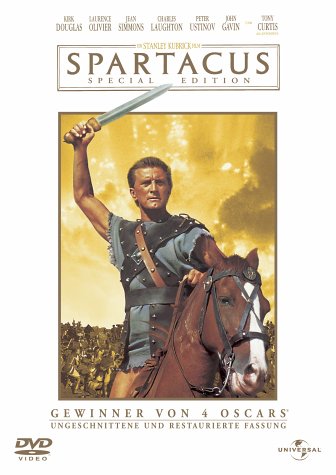
When I started watching American and British cinema seriously, around 1990-91, my entry point into those movies (like that of most viewers who aren’t intrinsically interested in a technical aspect of filmmaking) was through the world of actors. For the longest time I was obsessed with star filmographies from Classic Hollywood (anytime between the late 1920s and the late 1960s). I would scan video-library catalogues for epic films with large star casts (and if the plot involved a historical period I was interested in, all the better) - which was how I came to see, in those very early days, movies like Judgement at Nuremberg, The Longest Day, Becket and How the West was Won. And most memorably of all, Spartacus.
Having just finished a minor school project on the decline of the Roman Empire, I had reason enough to be interested in the story of the slave revolt and its  enigmatic leader, who almost brought the Empire to its knees in the 1st century BC. But there were other, less lofty reasons. To begin with, what a cast! There was the film’s producer, Kirk Douglas, in the title role (though to be honest, I thought Douglas was the most unobtrusive member of the cast at the time). A way-too-waiflike Jean Simmons as Spartacus’s lady love Varinia. Tony Curtis as the dreamy young poet Antoninus, who joins the slave revolt (I learnt later that the role had been written in for no better reason than that Curtis had told Douglas he wanted to be a part of the project!). And best of all, a great trio of British actors: Laurence Olivier as the Roman general Marcus Licinius Crassus (who was historically a member of ancient Rome’s First Triumvirate along with Pompey and Julius Caesar – though this doesn’t figure in the film); Charles Laughton as his political rival, the senator Gracchus; and the multitalented Peter Ustinov (who won the supporting actor Oscar for this role) as the wily slave-trader Batiatus.
And those were only the leading players. The supporting cast was equally interesting to me, since it included actors I was familiar with from other films, even in those early days. The woodenly handsome John Gavin, who had a small role here as the callow young Julius Caesar, had played Sam Loomis in Psycho. Also in a supporting role was John Dall, who was one of the homosexual killers in another Hitchcock film, Rope. All this helped make Spartacus a comforting experience, quite apart from the fact that I was enthralled by the movie itself.
The films we have a deep affection for as children rarely live up to our memories of them. Our tastes evolve as we get older (more so when film-watching is more than a hobby, as in my case), our gaze becomes more analytical and self-conscious on a repeat viewing, so that it’s possible to be slightly embarrassed by performances and dialogue that one originally had a very high opinion of. A scene that one’s memory had inflated into something very grand and elaborate turns out to be a trifle, lasting just a couple of seconds, when one re-watches it; it’s like returning to that mansion-like house you had visited as a child and finding that the halls and stairways are much narrower than you expected.
Over the years, when I returned to Spartacus, I was able to see the little flaws more easily – the Hollywoodisation (read: cheesiness) of some scenes, the incessant, manipulative music score, the fact that occasionally (but only occasionally) one gets so fascinated by the acting bouts between titans like Olivier and Laughton that one forgets about the characters they are playing. But in essence, my high opinion of it hasn’t changed. This is one of the best-written, best-acted, most intelligent epics of its time, superior in most ways to others of its time and genre (Ben-Hur, The Ten Commandments, Quo Vadis?, The Fall of the Roman Empire). Part of that superiority comes from the fact that there are no religious overtones in the story at all (this was something that made many of the period epics of the time both maudlin and distracting) – the focus is entirely on the internal politics in the Roman senate.
The Stanley Kubrick quandary
I find it annoying that Spartacus has suffered a decline in critical appreciation for a reason that doesn’t have much to do with the actual merits or demerits of the film itself. The facts are these: the movie carries a “directed by Stanley Kubrick” credit and Kubrick, as most of us know, was one of the great directors (more crucially, a great auteur-director). But on Spartacus he was a pawn – he was hurriedly brought in after the original director Anthony Mann had quit, and throughout the shooting he not only had to be subservient to Kirk Douglas’s vision, he also had to deal with the massive egos of the British actor-directors working in the film. By all accounts it was a traumatic experience for him and in subsequent years, short of actually disowning Spartacus, he did everything to make it clear that it wasn’t “his” film. And over the years, as Kubrick’s own reputation as a master filmmaker (deservedly) grew, some critics and moviegoers turned their resentment to this one film he never had full control over.
But this is silly reasoning. Just because Spartacus isn’t a good Stanley Kubrick film doesn’t mean it can’t be a good film on its own terms. Agreed, there are certain kinds of movies that would fail miserably if their directors weren’t allowed full control. But this isn’t one of them. It was already in production long before Kubrick arrived on the sets, it had been carefully scripted and planned by some of the most dedicated people in the craft (including the writer Dalton Trumbo, who had been on the Hollywood blacklist for Communist affiliations and who Douglas permitted to use his own name on the project) – and the results are there for all to see. This film is a remarkable collaborative effort between some of the most talented people (across all fields) in the film industry of the time, and a movie that somehow managed to shape up coherently despite a long and very problematic filming process.
However, there’s something else that gets overlooked. When a great artist contributes to a work, no matter how half-heartedly, it’s inevitable that he’ll leave his stamp on it. Notwithstanding Kubrick’s own resentment of the film, Spartacus does also contain a few ideas and visuals that foreshadow his later work – notably the theme of the conflict between humanity and mechanisation. Spartacus postulates that the practice in ancient Rome was to turn human beings into machines through the practice of slavery - world dominance was maintained by stripping people of their humanity and turning them into cogs in the machinery that kept the Roman Empire running. Some scenes (the clinical, relentlessly efficient Roman battalions intercut with the disorganised slave camp; the cold gleam in the eye of the sadistic slave-master who was once a slave himself) palpably come from the same hand that gave us Dr Strangelove struggling with his own mechanical arm, Alex being systematically transformed into a Clockwork Orange, and the magnificent image of Dave Bowman dismantling the computer HAL in 2001: A Space Odyssey.
Over 1200 words. Lots more to say but will stop now.
P.S. As I mentioned in the previous post, the special features on the DVD are awesome, especially the commentary by Kirk Douglas, Peter Ustinov, Howard Fast, Saul Bass and restoration expert Robert Harris, and the long interview with Ustinov where he supplies some uproarious impressions of Olivier and Laughton. Excellent DVD review here, by the way.
And if you’re interested in knowing more about the film and its shooting, do read Douglas’s wonderful autobiography The Ragman’s Son.
 Impaler, with a bit of werewolf (!) thrown in. But the creepiest vampire portrayal ever is from the great silent film Nosferatu. With his lean physique, spidery fingers and rodent-like face, the German actor Max Schreck was perfectly suited to the part. His vampire was repulsive and otherworldly – so otherworldly, in fact, that it was possible for another film made decades later to play around with the premise that Schreck was a vampire in real life! Nosferatu gets extra points for being decidedly unsexy, unlike the vampires in popular culture today.
 Pitt made a luscious Death in the overlong drama Meet Joe Black – the camera was clearly in love with this toy boy – but my favourite is the Grim Reaper parody in the goofy comedy Bill & Ted’s Bogus Journey. In Bergman’s film, the knight challenged Death to chess; in this one, Bill and Ted make him play Twister and electric football, and beat him like a drum. Cheating Death was never such fun.
 From the ultimate man of action to a tragic hero burdened by indecision: Shakespeare's Hamlet has long been a litmus test for actors, and its screen adaptations are innumerable. Laurence Olivier won the best actor Oscar for the atmospheric 1948 version, and Mel Gibson gave one of his better performances (which isn’t necessarily saying much) in Franco Zefferelli's 1990 film, but I have to go with Kenneth Branagh, whose sumptuous-looking four-hour version retained the entire text of the play, yet still managed to be gripping throughout. Branagh was a wonderfully energetic Hamlet; his recitation of some of the key soliloquies was so vivid that I can still hear the words in my head years after I last saw the film.
 performances, but ironically the best screen Henry of them all was a deliberate caricature of the king as a gluttonous buffoon. The 1933 British film The Private Life of Henry VIII makes no pretence at being historically accurate, it just has a grand old time depicting Henry’s boudoir shenanigans, and the great Charles Laughton (who, incidentally, also gave the definitive screen performance of other popular characters such as Captain Bligh in Mutiny on the Bounty and Quasimodo in The Hunchback of Notre Dame) chews up the scenery magnificently, in an Oscar-winning role.