[Did a version of this short review for Time Out magazine. Also see these earlier posts on the work of Chakraborti, who is one of my favourite contemporary writers: an interview; Or the Day Seizes You; Derangements; Balloonists]
--------
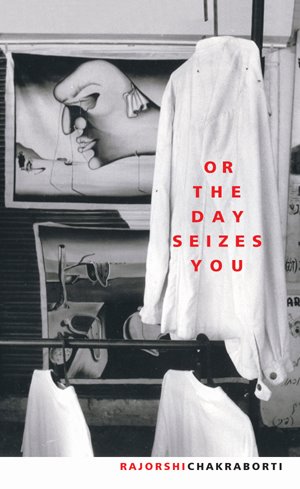
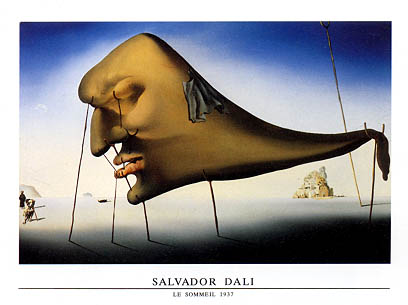
“When did I go to sleep and where had I awoken?” wonders the narrator of one of the stories in Rajorshi Chakraborti’s new collection, “In an askew world where everything was familiar but nothing unfolded as I foresaw it?” It’s a question that might come from any of Chakraborti’s protagonists, going back to his excellent debut novel Or the Day Seizes You, the dominant tone of which was hinted at by a cover jacket that combined two Dali paintings about dreamscapes and endless drifting.
 That novel’s mood of escalating paranoia had reminded me of Kazuo Ishiguro’s great, surreal The Unconsoled, a book about a man who – as Pico Iyer once memorably put it – is “lost in a foreign place and unable to read the signs”. Chakraborti, one of the most provocative Indian English novelists of his generation, has often worked with this theme in his fiction, and the stories in Lost Men (one of which, “The Good Boy”, was – in full disclosure – first published in a Tehelka collection that I co-edited) are vignettes about lives that have spun into disorder. For instance, the darkly comic “Viju’s Version” – my favourite of these pieces – begins by recounting the series of missteps that lead a well-meaning boy to bring public humiliation to his school, before segueing into a narrative about the same luckless Viju’s entanglements with Maoists and organ-buyers (“he was always the victim of accidents far outside his control,” an acquaintance sarcastically reflects). In “The Last Time I Tried to Leave Home...” another young man – embarking on a life-changing journey – finds himself unable to tread a straight path to the airport. Two other stories are about people who literally cannot play ball: the narrator of “Knock, Knock” is assailed by a bank employee who “bowls” stones at him; in “The Third Beside Us”, a boy is invited to join a cricket match that turns into a nightmare, including a batting stint that he likens to Sunil Gavaskar’s infamous 36 not out in the 1975 World Cup.
Lost in time as well as in space, many of the characters here attempt to understand – or just to properly recall – their own pasts. This might take the form of a man unexpectedly encountering his old family doctor in a place far from his hometown (in “City Lights”) and shortly afterwards finding himself in a part of the city made familiar by a childhood memory of letters from a friend. Or it might (in “Half an Hour”) take the shape of a boy being distracted from an urgent errand by a glimpse of someone who may or may not be an old classmate, now apparently wearing a blind person’s glasses. Often, the characters’ growing desolation is concealed beneath a restrained tone. “I kept moving around, met a few diverting people,” says the title story’s narrator – a man whose wife has recently died – but this is a deceptively simple summary of what is a very layered tale about grief and love.
Occasionally the narratives conduct metaphysical conversations with each other, as in “A Good Dry-Cleaner is Worth a Story”, which describes a road accident that has been alluded to (as a dream) in another piece. This means that though Chakraborti’s prose is consistently direct and elegant, these stories are elliptical, sometimes claustrophobic, and demand a reader's full concentration. (They didn’t all work for me: my attention drifted during passages of “Down to Experience: A Novella”, a rambling tale set in late 1940s Europe, involving people caught between groups and ideologies, unsure what side they or their friends are on, or if sides even exist.) However, once you acquire a taste for this writer’s very particular universe – with its glimpses of the inner spaces of people confounded by delays, detours, bad luck and unreadable signs – it is very hard to leave it.
What happens when you gather a line-up of established authors who don't write professionally about cinema and ask them for personal essays about a cherished film or film-related experience?
This happens:

[Click to enlarge]
The anthology will be out in a month or so, but here's a quick summary of what the pieces are about:
- How do you "read" a film, how do actors recapture the immediacy of their feelings when they dub for a scene months after the original shoot ...and other questions that movie buffs ask themselves ("Jellyfish" - Manjula Padmanabhan)
- A tongue-in-cheek analysis of a cult Punjabi film as a Bible for foot-fetishists ("The Foot-Worshipper's Guide to Watching Maula Jatt" - Musharraf Ali Farooqi)
- On dreamlike vistas, from Buster Keaton's Steamboat Bill Jr to a surreal chase scene featuring Kader Khan and Vinod Mehra ("Perchance to Dream" - Rajorshi Chakraborti)
- How the Bihari actor Manoj Bajpai passed himself off as a native in an archetypal Mumbai movie ("Writing my own Satya" - Amitava Kumar)
- From watching Wim Wenders’ Wings of Desire to reading Michael Cunningham’s ‘White Angel’ - how does the language of film differ from the language of prose? ("Two Languages in Conversation" - Kamila Shamsie)
- On the tumultuous romance between a man and his car in Ritwik Ghatak's Ajantrik ("Gaadi Bula Rahi Hai" - Sumana Roy)
- Why a middle-aged male author performed a Helen dance in drag after a public reading in Brooklyn (Manil Suri's "My Life as a Cabaret Dancer", which you can read here)
- Secret agents, suave detectives, fake ghosts ... on Hindi film noir and thrillers from the 1950s and 60s ("Villains and Vamps and All Things Camp" - Madhulika Liddle)
- What the silences in the Kaurismaki brothers' movies reveal about Finland and its people, and why an Indian writer should be so interested ("Going Kaurismaki" - Anjum Hasan)
- When you're starved for moviegoing experience, a Charlie Sheen thriller can be "the greatest movie ever made by man" ("Terminal Case" - Sidin Vadukut)
- On why being scared is a good thing ("Monsters I Have Known", by yours truly)
- A novelist recalls her time publishing a gossip-driven film magazine in the 1970s, steeped in "a Film Lok parallel to Indra Lok" ("Super Days" - Namita Gokhale)
- A writer who worked for the British Board of Film Classification on the occasional need for - and her ambivalence about - censorship ("The Final Cut" - Jaishree Misra)
And here's the video of the Popcorn Essays session at the Jaipur lit-fest, where four of these writers read from their pieces.
Updates to follow as the release date draws near.
Earlier this month I was having lunch with Rajorshi Chakraborti – a few hours before his book launch – and we were talking about films. Orson Welles, Vijay Anand, Roman Polanski, Basu Chatterji, contemporary Korean directors (about whose work I know almost nothing), you name it. Rajorshi has written a wonderful piece for an anthology of film essays that I’m editing for Tranquebar (more on that soon) and he mentioned that if he were to do another one, he’d consider writing about an aspect of Hrishikesh Mukherjee’s cinema that interests him: the idea that role-playing can enrich life, making it unpredictable and wonderful at the same time.
 A few days later I happened to watch Mukherjee’s 1973 film Namak Haraam, which I had last seen when I was a child. This film is a key work of its time, for a number of reasons. For starters, it was the second movie, after Mukherjee’s Anand, to bring together Hindi cinema’s incumbent and future superstars (Rajesh Khanna and Amitabh Bachchan respectively), and it can be argued that the director’s use of their contrasting personalities – Khanna serene and dreamy-eyed, Bachchan abrasive and practical – represents a thematic progression from the way he used them in the earlier film. (This is not to undermine Anand, but simply to point out that Khanna was more obviously the leading man and the focus of attention there, whereas Namak Haraam gives the two actors equal space.) With the benefit of hindsight, we can say that it also marked a passing of the baton - Hindi cinema as dominated by the Bachchan persona in the next decade would be very different from the one that Khanna had reigned over in the previous three or four years.
Further to Rajorshi’s observation, it struck me that Namak Haraam is one in a series of Mukherjee movies that explore how a certain form of role-playing – even one that begins for base or selfish reasons – can turn out to be liberating, cathartic, even ennobling. (Among the others are Chupke Chupke, Rang Birangi, Baawarchi and notably the superb Gol Maal.) The plot of Namak Haraam has Somu (Khanna) taking up a job as a worker in the factory run by his rich friend Vicky (Bachchan) so he can help Vicky get his revenge on a union leader who had slighted him. But Somu’s experiences living with the workers and their families has a transforming effect on him and changes the equations between the friends.
 This set-up is used to comment on the master-servant relationship, the class divide and the nature of soft socialism in a country where the gap between the poor and the privileged is huge – and of course, all this is done not shrilly or didactically, but in the characteristic gentle Mukherjee style. In a couple of scenes, the line between reality and play-acting is intriguingly blurred: when Somu first confronts Vicky about workers' rights in front of a large crowd, there's a tiny moment where you're not quite sure if this is part of the plot or whether their ideologies have really begun to clash. Somu and Vicky don’t seem to be acting – they appear to be taking their private little game very seriously.
Namak Haraam marks one of Bachchan’s most interesting pre-stardom performances. It’s possibly the first time he played a character who could be described as a loose cannon. One sees here the seeds of the rage that would become so familiar in his later “Vijay” roles, but the effect is different: the fits of anger are driven not by righteous indignation but by petulance – the petulance of a spoilt rich boy who flies into a tantrum when things don’t go exactly as he wants them to.
On a lighter note, this film is a reminder of a more innocent time, when it was possible for two leading men to lie in bed together and look soulfully into each other’s eyes, caress each other’s arms through soft silk shirts, breathlessly wonder over the phone when they are going to meet again, and participate in an intimate  song sequence (“Diye Jalte Hain”) where one man sings while the other lovingly takes a video of him (stroking his camera all the while). None of this is as intense as the furious lovemaking between Dharmendra and Jeetendra in Dharam Veer, but it comes close at times. Little wonder that though this was the first time Amitabh and Rekha were in a film together, they weren’t romantically paired - in fact, their characters appear almost to be romantic rivals!
The reason I’ve listed these points of interest is because I was dismayed by how bad the print of the film was, even on a DVD produced by a respected company. It was scratched or blurred in several places, ugly spots appeared periodically, a couple of seconds of film were missing here and there, the sound quality was poor. Throughout the second half, the sound wasn’t in sync with the visuals – a problem with the DVD recording, one assumes - and this hindered my experience of the last hour of the film (including the beautiful song "Main Shayar Badnaam").
Which returns us to the question: whither film restoration and film packaging? Internationally, the salvaging of movies is being taken very seriously, even though it’s a demoralizing and high-investment job. Restored prints (or superior transfers) are then released in classy DVD packages that whet a viewer’s interest and bring the movies to a new audience. I doubt we’ll have the resources or the technology for the same level of preservation in India anytime soon, but I have to say this: if the print of a film like Namak Haraam (just 36 years old and starring two of the giants of Hindi cinema at vital stages in their careers) is in such a poor state, one shudders to think of the hundreds of low-profile gems that don’t feature big-name actors. Or films of a much earlier vintage. It’s already a matter of record that the original print of Alam Ara, the first Indian talkie, no longer exists. Much of our cinematic heritage could be lost before we realise it.
P.S. Surprisingly, even our most high-profile movies haven’t been given the full DVD treatment yet. Take Sholay. If I were in charge of putting together a DVD package for it (and given whatever resources I needed), I would at the very least include: 1) Three separate audio-commentary tracks, one featuring the surviving members of the cast, the second by Salim-Javed (I know they aren’t on talking terms any more, but this is my fantasy) and the third by Ramesh Sippy and some of the technical crew, 2) A restored, cleaned-up version of the film’s original ending, which had Gabbar being killed by Thakur (and which is available on some DVDs – I saw it on one a few years ago), 3) Anupama Chopra’s enjoyable book about the film. And this is a very basic list – I’m not exercising my imagination at all. Imagine what Criterion might have done.
 P.P.S. A friend, Praba Mahajan, writes in to tell me about an unreleased 1971 film titled Yaar Meri Zindagi, with Amitabh in a role similar to the one Rajesh Khanna played in Namak Haraam, and Shatrughan Sinha as the haughty rich friend. Check this link for details - and don't miss the reference to the "pheasant girl" and the description of Amitabh's character as "a messiah for the pheasants". Doctor Dolittle would have been so proud.
[Did this for Biblio]
“I love the world of dreams,” the author Rajorshi Chakraborti told me during an interview a few years ago, “I love their density of unexpected surprises, the askew angles, the stretching of limits. And I try to tell stories through situations and images, especially those that seem powerful and evocative enough to suggest many possible readings.”
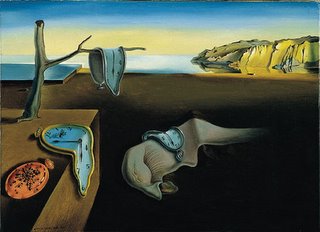
This was no idle claim. With its dreamlike narrative, Chakraborti’s debut novel Or the Day Seizes You, published in 2006, was one of my favourite chance discoveries as a reviewer. In this vivid, hallucinatory book, a man named Niladri abruptly leaves his wife and little daughter, goes to London by himself and returns five years later, only to get entangled in a drama involving his father and a ganglord. That synopsis makes the narrative seem more linear than it is, but the book’s real tone is summed up by the two Dali paintings on its cover – “The Persistence of  Memory”, with its melting clocks, and “The Sleep”, with a giant sleeping head precariously tied to the ground – both of which point to a sense of temporal and spatial dislocation; of time being both stretched out and compressed, and uncertainty about where dream-life ends and waking-life begins.
In the second novel Derangements (2008), a writer named “Raj Chakraborti” disappears in suspicious circumstances and his editor subsequently receive a manuscript that includes episodes from Raj’s own life as well as a first-person account by one of his invented characters. Like its predecessor, Derangements is full of vignettes and imagery that don’t belong to the world of the realist narrative. Here, Chakraborti revealed himself to be the sort of writer who obsessively reworks the themes and structures that interest him, even if it means risking allegations of repetition. “I like exploring the predicaments and limitations of middle-class, urban Indian masculinity within rapidly changing social conditions,” he said during our conversation. Indeed, his first two novels centred on men who are, in different ways, adrift: from the security net of families and the responsibilities of daily life; ultimately, perhaps, even from themselves.
And so, I wasn’t at all surprised to find that his new novel is titled Balloonists and that its droll cover image has two pairs of men’s legs floating in mid-air, amidst a flock of birds.
 The shortest of Chakraborti’s books so far, this is also in some ways the most accessible, and certainly the funniest. The plot seems suspiciously simple at first – after the fast-paced opening twenty pages, I thought I was reading some other author. This is roughly what happens: a young British-Asian writer named Dev panics when he learns his girlfriend Jo is pregnant. He travels to Germany for a brief meeting with an ex-girlfriend Heidi (spending some time with her ninety-year-old great-aunt along the way), but the encounter is too brief and mundane to be of any real consequence.
I was going to build up to telling Heidi that I’d staked my visit on the possibility of change, of both of us being able to set aside the voodoo dolls we’d made out of one another, and move beyond the comfort zone of freezing someone once and forever in our minds. But I’ve told you the way it turned out. Where was the opportunity?
A few days later, Dev somehow finds himself traveling to north-east India in search of Heidi, who has mysteriously gone missing. His companion on this trip, and its instigator, is another of Heidi’s former beaus, an incorrigibly cheery and therefore (to the moody, withdrawn Dev) intensely annoying man named Rodrigo.
This is the foundation of a plot that gets increasingly strange as it progresses. In Calcutta, when Dev’s persistent mama-ji emotionally arm-twists him into accompanying him for a meeting with a loan-shark (“not your usual consumer-loan or credit-card types, slightly more assorted and unorthodox than that”), we realise that the Heidi trail is going to be spotted with narrative detours. By the time the meeting – which the overenthusiastic Rodrigo also ends up attending – takes place, high up on a desolate, uncompleted shell of a building, we sense something shifting beneath the surface of what had so far seemed like a straightforward tale. And when Dev and Rodrigo reach Shillong and find themselves (possibly) being targeted by a couple of hitmen dispatched by an indeterminate someone whose motives are not clear, and when they spend two days on a large rock watching their watchers, we start to wonder how much of this is taking place inside Dev’s head.
 Reading Balloonists, I got the disorienting sense of moving into the “inner space” of Dev’s mind, so that one can't sure what to take at face value. The self-referential tone that marked Derangements (now published as Shadow Play in the US) is present here as well. At times Dev gives the impression that he’s figuring out how and what to write in the process of writing it, almost as if the novel is being created in collaboration with its reader. He addresses us directly, and more often than most fictional narrators do. At one point he considers providing us a full transcript of the “crazy, one-sided rant” directed at him by Heidi’s mother on the phone, but then decides, “Fuck it, it’s just too boring. There’s no way Mrs B deserves that much airtime. She can write her own story and take the leading part.” At another point, after describing a conversation with his uncle who addresses him by his nickname, he tells the reader, “And no, you won’t learn from me what the pet name Buro means, and why it was bestowed upon me. Get off your arse and make an effort if you want to know so bad.”
One way of looking at these asides is that Dev is trying to be cute, and not doing a particularly good job of it. But the interpretation I prefer is that these little moments are our pointers to his shaky hold on reality. There’s a hint of hysteria in these passages. Is he the sort of man who is given to speaking to imaginary people – and, by extension, hearing voices in his head? In which case, can the details of his story be trusted? Does Rodrigo, for example, really exist or is he a projection, a much more extroverted alter ego who can take initiatives and plunge headlong into the crazy schemes that Dev is too emotionally bottled up to work out for himself?
Read in that light, much of the book – especially the chapter “Limbo” in Part One and “So Far” in Part Two – takes on a different shade. “Limbo”, Dev’s account of his torturous plane journey with Rodrigo, is one of the finest bits of sustained funniness I’ve read in a while, deriving its effect from the contrast between the two men. Dev’s sullenness manifests itself in numerous sarcastic, stream-of-consciousness observations about his co-traveler.
This was it, a new high even for him in ludicrousness. He was like Sergey Bubka, raising his own record for the pole vault one centimetre at a time, to a stratosphere far above, where he reigned alone. Rodrigo was the Bubka of bullshit ... Being a moron was like his pigmentation: he had been this way and no other from the moment I’d met him. Holding it against him would be tantamount to a form of racism.
But at the end of this rant, Dev asks himself a question: if Rodrigo is so intolerable, why is he voluntarily in his company?
Because I wanted to reach Heidi. I, who claimed to want nothing and tried to be portable and weightless, without baggage or possessions, who actively sort to make no mark or wave within the goings-on of the world, and never to raise his voice, who just wished to pass through his own life undigested and untransformed like a stone or a shadow, still evidently had another layer of desire I’d overlooked to shed, the last stubborn pound.
This is a poignant admission coming from a man who is a social misfit, drifting loose – and ultimately, despite his claims, perhaps not all that happy about it. “I can’t bring myself to believe in permanence,” says Dev late in the book, a remark that returns us to the event with which his story began. On one level, Balloonists can be read as an allegory for the paranoia of a man who isn’t ready to be a father, terrified that this life-changing event will tether him to the world. By the end, it also reveals the traces of a surprisingly moving love story about someone who has been so damaged by an earlier relationship that he can no longer trust himself or feel attached to anything.
But it feels wrong to provide a neat summation of a book that is more about a state of mind than about a beginning, middle and end. In any case it’s tricky to review a work like Balloonists after reading it just once, because you’re left with the nagging feeling that there’s something here that has just eluded your grasp. Already I feel the need to read it a second time, because I have a mild suspicion that the plot and the characters don’t really exist – that they are all creations of Dev the megalomaniac writer, bound to nothing but his manuscripts.
I’ve been helping the good people at Tehelka put together their year-end special, an anthology of short fiction. The authors we commissioned were given no brief other than the word “excess” and the result is a varied and exciting collection of pieces about (among other things): a vampire flummoxed by the system of faith prevalent in India; a pacifist vegetarian dog in South Africa; a group of people setting off from various parts of the country in an attempt to escape excess; a surgeon who likes working on cancers of the mouth and also enjoys videos of anal sex and facials; a little boy playing a mushroom in a school play. The contributors are Altaf Tyrewala, Ambarish Satwik, Amruta Patil, Anjum Hasan, Kalpish Ratna (Kalpana Swaminathan + Ishrat Syed), Manjula Padmanabhan, Mridula Koshy, Rana Dasgupta, Rajorshi Chakraborti, Ruskin Bond, Sarnath Banerjee, Sudeep Chakravarti, Sunetra Gupta, Tishani Doshi and Vivek Narayanan.
The issue will be on the stands by the 26th or 27th of this month, so do look out for it. The redoubtable Nisha Susan, who has been anchoring the special and generally bullying me into doing things I’m very bad at (brainstorming, attending meetings, calling up and speaking with people), will also put up something about it on her blog soon.
[Earlier posts on some of the contributing authors and their work: Patil’s Kari, Chakraborti’s Or the Day Seizes You and an interview, Kalpish Ratna’s Nyagrodha, Swaminathan’s Ambrosia for Afters and Bougainvillea House, Padmanabhan’s Escape and an interview, Dasgupta’s Tokyo Cancelled, Narayanan at Jaipur, Chakravarti’s Tin Fish.]
Update: just saw all the pages before they were released and the illustrations accompanying the stories are stunning; the Tehelka design team has done a fabulous job. I'm feeling excited about the special all over again - this thing could be a collector's issue just for the artwork.
As a book reviewer, one of my favourite chance discoveries was Rajorshi Chakraborti’s debut novel Or the Day Seizes You (review here, author interview here). Its urgent, dreamlike narrative was among the most distinct by a new Indian author in a while and it was a book very few people seemed to have heard of: writing about it was more satisfying than reviewing a high-profile, widely felicitated book that was already guaranteed space in a dozen newspapers and magazines.
 Or the Day Seizes You was a very ambitious work, but Chakraborti’s second novel Derangements is even more so, and its structure is more complex. It spells out its meta-fictional intentions right at the beginning, through an “Editor’s Note” wherein we gather that a writer named Raj Chakraborti has recently disappeared in suspicious circumstances and that his editor has subsequently received a manuscript from him. What follows is the full text of this manuscript, which includes parallel stories: episodes from Raj’s own life – scattered, hazy, like many passages in Or the Day Seizes You – alternate with the first-person narrative of one of his invented characters, Charles Robert Pereira, a serial killer contacted by a mysterious clique of people who want him to work for them. (A tiny illustration of a pen or knife – the instrument of choice for writer and killer respectively – accompanies each chapter.) The connections between the two narratives – or between the lives of Raj and Charles – aren’t immediately obvious but slowly they begin to converge (in a manner that reminded me of an even stranger book, Murakami’s Hard-Boiled Wonderland and the End of the World). In each narrative, the line between what “really happens” and the dream-world is frequently unclear.
As this synopsis might indicate, Derangements isn’t light reading. Though Chakraborti’s prose itself is elegant, one needs intense concentration to follow the twists and turns in the stories, to make connections between one strand and another, and to process the many recurring ideas and images. Like his first novel, this is a book of vignettes, full of hallucinatory imagery (a complicated network of footpaths on a lake; humpbacked hills envisioned by a character as “gigantic whales run aground”; a vision of a bus standing in a desolate lane, which finds an echo elsewhere in the narrative), sequences that are built on impressions and barely remembered incidents (Raj’s childhood recollection of a late-night drive with his father) and moments of outright surrealism, as in a poignant scene involving a woman who turns into a cat.
Running through the dual narratives is a constant sense of paranoia, both about the world at large and about personal relationships. In fact, a running theme in both Chakraborti’s books has been that of the life that has lost its bearings; a protagonist unsure of his place in the world and, increasingly, of the world itself. Speaking about heroes from Greek and Indian epics, one of the narrators in Derangements reflects that
...though their lives resume their expected courses, they are all past their prime, haunted by losses and scars, and their best years have been spent either wandering further away from their destinies, or merely struggling to survive until they can come home. The lesson seems to be that such is the nature of life itself, composed solely of twists and derangements, and yet it is the only thing we have, to make the most of and call our own. If we refuse to accept it because it hasn’t run according to plan, that would be the true exile, as we would then be homeless in our own lives.
In a sense, Derangements is also a book-length riposte to that most clichéd (and most pointless) of questions that fiction writers regularly have to contend with: “How autobiographical is your book?” At its heart lies the question of how distanced a writer can become – in some cases, must become – from the business of living (“the infinite variety of the world – the principle to which I have paid lip service all these years: perhaps it has been decades since I was last in touch with any of its actual content,” muses Raj) and how difficult it can be to distinguish between real life and imagined life. What, after all, is a writer’s Rosebud (a word borrowed from Citizen Kane to denote the non-existent key that might unlock or conveniently “explain” a life)?
In my view Chakraborti is one of the most interesting writers now operating in Indian fiction. I find his work provocative in a similar way to that of Raj Kamal Jha – both deal with dark and subversive ideas unselfconsciously (and without making a pronounced effort to be “different”) and both are brave writers, willing to take risks (though it’s likely they don’t see it that way themselves; maybe they just write what they have to write) that can distance the majority of readers from their work. In this old interview, Jha told me:
“There will always be people who won’t get from my writing what I get out of it...Personally, I feel lucky if just 4-5 people like something in my book. Even if a single paragraph works for them, that's very satisfying… I think paras can work in isolation, pages can work, even individual lines can work in isolation. Fleeting scenes from movies leave a strong impression on me.”
I can’t claim to know Chakraborti’s feelings on the subject, but his writing shows a similar private integrity, a willingness to stay away from the safety nets that are so important to many writers. Like I said, Derangements doesn’t make for easy reading – and I have a troubled feeling that a book like this should ideally be read a second time before one ventures to review it – but it has a haunting, lingering quality that very few writers can achieve.
[Earlier related posts here and here]
I’d been wanting to speak with Rajorshi Chakraborti ever since I finished his novel Or the Day Seizes You (which I wrote about here). But since he's in the UK currently and a plan to visit Delhi fell through, the discussion had to be done via email. Normally I prefer face-to-face interviews (even though it means more work for me, in terms of writing out the profile etc) – it gives you an immediate sense of the person you're talking to, allows for free-flowing questions that follow the natural course of the discussion, rather than a pre-formatted template. But in this case Raj's responses to the sketchy questionnaire I sent him were so detailed that it almost didn't matter. Here's more or less the full transcript of the conversation (though I hesitate to use that word since my own contribution to it was so frugal).
[Note: this discussion is best read after you've finished the book. If not, read the review for an idea of the book's content.]
------
Rajorshi Chakraborti was born in Calcutta, but spent some of his childhood in Bombay. In 1994, when he was 16, he moved to Victoria, Canada on a scholarship. He moved to England in 1996 and completed his BA in English Lit. from the University of Hull. Since 1999 he's been moving between Calcutta, London and Edinburgh, juggling various jobs alongside his writing.
I believe you won the Philip Larkin prize after graduating from Hull University. When did you start writing poetry? Have any of your poems been published?
Misleading as it is, the Philip Larkin Prize was actually for 'best final year essay by an undergraduate', so that didn't have anything to do with poetry per se. I did write poems as an adolescent which were (regrettably) published quite frequently in the teen/youth pages of newspapers in Bombay and Cal. One of them even won a Times of India-sponsored national poetry competition in '93, but they were all juvenile pieces whose only lasting value is that I'll never write like that again. But seriously, I have no talent for poetry even though there are a few poets I enjoy enormously, and return to over and over.
So it's safe to say you're more comfortable with prose now.
 I decided at about 18 that prose is where my real interests, as well whatever little ability I might have, lie. Since then, I haven't written another poem, nor have any occurred to me. This was also the time when I fell in love with the novel form. I wrote two dreadful novels rapidly that year one after another, utterly imitative of everyone I admired at the time -- the usual suspects for an impressionable late adolescent, Garcia Marquez, Camus, Kundera -- and a whole bunch of stories. Again, their only value is that I got those particular mistakes out of my system forever.
For the next six years, however, I didn't write a word of fiction, even though the longing to write burned as steadily as before. I just had no stories compelling enough to tell. Instead, and the Ph.d was a very useful alibi for this, I read voraciously, like a starving autodidact, everything from Cervantes through Balzac and Flaubert, Musil and Mann all the way to the most recent African and American stuff. Whatever interesting writers I could find from each region, Central Europe, Latin America, Australia, and of course India. Somewhere during those years, I also began a similarly prolonged love affair with selected genres and phases of the history of cinema. I was very lucky to be in Edinburgh for most of this time, where both the facilities and the company to share some of these discoveries are most congenial.
Recently, I briefly returned to attempting short stories but none of my efforts satisfied me. Perhaps I'm coming up against another of my limitations, but for now I realise that though my novels are quite episodic, I do enjoy composing larger works, in which each of the sections sets off multiple resonances with others, and I can include a lot more overall. Of course, this might well be a question of not possessing sufficient skill at compressing my themes.
The surrealistic narrative of your book is fascinating, and not the sort of thing one is accustomed to seeing in Indian writing in English. It's much more subtle than, say, magic realism, which often lends itself to excess and can go badly wrong in the hands of over-indulgent authors. In contrast, your book requires a careful reading to realise that all is not as it seems – that this isn't a strictly logical narrative. Did you intend it to be that way in the beginning? Or did you start off constructing a straightforward story about this character, Niladri, and then find that the story lent itself to a fragmented, unchronological narrative?
No, I only ever thought of him in that 'fragmented, unchronological' way. In fact, I carried a few episodes and images in my head for a long time before I saw they could form part of the same novel, because they were about a similar sort of character. And then each chapter, in the unfolding of its reactions and details, surprised me as it occurred to me, because I had no pre-formed template for the characters at all. I suppose the only vague pointer I had about Niladri was that he is a man whose first instinct is to run in the face of anything unpredictable and challenging. At some point the title showed up to help me along, though Saul Bellow's own masterly novella, Seize the Day, has always seemed to me to ironically hint at the opposite, that whatever you (fail to) do, ultimately it's the power of happenings and of being itself that will seize you.
But apart from being cowardly, I also found other incidents occurring to me where he is brutal, such as towards his neighbour, or single-mindedly unscrupulous, as he is in his job. Yet, at other junctures, all he wants to do is abdicate, opt out from all responsibilities, as father, son, even as a human being and a citizen using his heart and his interpretive powers to empathise, understand and then enter in some way everything that is happening around him. Yet, despite these failings, I never thought of him as hopeless, or utterly rotten. So, fragmented, multiple, contradictory, yes, that's how I saw him from the beginning. I was, and wanted to be, constantly surprised, as much as the next reader would be.
As for the surrealism, I was glad you emphasised this aspect. First of all, I simply love the world of dreams, their density of unexpected surprises, the momentum of events and transformations, and finally their whole atmosphere where all limits are stretched and angles askew. Perhaps additionally my style emerges out of my love of cinema, as well as from an addiction to implausible anecdotes. But I love telling stories through situations and images, especially those that seem powerful and evocative enough to suggest many possible readings. Apart from being hauntingly beautiful and compellingly readable in their own right, I love those images and situations in the works of other writers that I think of as 'radioactive', i.e. endlessly generative of new readings. impossible to nail down to a single interpretation.
What ideology of insect is Gregor Samsa? What is Joseph K being tried for? How do we understand the accumulation of events in The Music of Chance or The Unconsoled? And yet, despite the mystery, page after page flashes past as we read, gliding forward upon what Kundera wonderfully describes in Kafka as the "beauty of perpetual astonishment", and "the poetics of surprise". In my own small way, these things are what I strive for in my work as well.
Who have your influences been – in literature and film (if any), or in other art forms?
Well, from what I've described above, some idols would be fairly obvious to guess, without attempting for a moment to compare myself with any of these names. Kafka, Paul Auster, the surrealist in Ishiguro, Orson Welles, Hitchcock, Buster Keaton, the settings and rhythms of film noir, the angles, lighting and mood of expressionist silent cinema. But there are so many other artists I admire for different things, some of which I would love to incorporate into my work, other aspects that I can admire as an observer while knowing my talents could never stretch to covering them. Joyce, Saul Bellow, Philip Roth, some of Rushdie's novels, Borges, Fellini, Satyajit Ray, Werner Herzog, Jean Vigo, Aleksandr Rodchenko, Truffaut, the music of Erik Satie. There's also this great tradition of rambling, anecdotal, vividly drawn comedy that I'm very fond of, that includes R K Narayan and Anita Desai from India, Cervantes, Chekhov, and Laurence Sterne, but is particularly rich for some reason in Czech literature and film, ranging from Kafka's Amerika to Jaroslav Hasek and Bohumil Hrabal, and the films of someone like Jiri Menzel.
 The book's cover, with its use of Dali paintings that deal with the world of dreams, is very apt – how did that come about? Were you involved in the design process at all?
My editor asked for my ideas about the cover, and I emailed them about a dozen different visual possibilities that seemed to me to express something of the atmosphere of the novel. Based on these suggestions, I suppose their design dept. went to work. They got back to me a while later with three ideas, and I picked this one immediately. Its juxtapositions seemed to me wonderfully evocative of the mood of the book, and yet the image is opaque and mysterious, almost begging a story unto itself. So yes, there was a level of collaboration. But the design was someone else's original idea, and I'm delighted with it.
Slightly tedious question. You've been away from India a long time. Themes of dislocation/being adrift often figure in the work of non-resident Indian writers, and it's visible (albeit in a significantly different form) in Niladri's story as well: his constant running away from things, not seeming to belong anywhere. Does any of this draw from your own experiences?
About the autobiographical aspect, I can honestly say that almost all the actual details of the story are fictional, but a lot of the feelings fuelling or arising from those moments are derived from personal experience. And even with those feelings - grief, loneliness, being haunted by your losses - you often take them in a different direction in the story from how you would or may have reacted personally. A fairly obvious point, but one I suppose may be restated. Your characters become experimental selves, as it were, choosing numerous roads not taken by you. You also spread out different autobiographical details among different characters.
As for the abiding sense of dislocation/being adrift, I think it's clear I didn't want to write about those sensations within the context of cultural displacement, which is a well-travelled path in world fiction, and especially in much Indian English writing of the past so many years. I have nothing against such novels, but other writers can depict such situations with much more sensitivity and acuteness than me -- the immigrant torn between individuality and community, tradition and desire, for instance. If I'm permitted to sound pretentious for a little longer, what I did discover in the course of writing the story was that it could be a perspective into exploring the predicaments and limitations of contemporary Indian masculinity, within rapidly changing circumstances. And since middle-class urban life is the only world I know somewhat from the inside in India, I should further qualify that as middle-class, contemporary, urban Indian masculinity.
As the definition of individuality is thrown open here, because of various new social conditions, straining against the boundaries of family, tradition, and gender, and old certainties about fixed roles which were getting pretty threadbare and hypocritical for many of us anyway, begin to seem absolutely inadequate, how will the hitherto enthroned Indian male respond to the new imperatives of interpretation and self-reorientation? When his wife refuses to remain in a marriage where she has absolutely nothing in common with him, for example, and begins a relationship with someone else? The frequency of such newer forms of self-exploration by women, among others, is only going to increase. More and more young Indians, of both genders, will spend years abroad, as students as well as professionally. How do they cope with the challenges of isolation, unfamiliarity, the excitement but also the anxiety of discovering and renegotiating themselves? I try to introduce these questions somewhat, but never from a position of superiority or judgement. I'm part of the same journey, the same questions.
Alongside this, of course, there is the much-discussed opening up of our economy and its multiple implications and possibilities. How will we as citizens respond creatively to those new interpretive challenges, as well as acknowledge our new responsibilities? At a time when present-day corporate capitalism is a beast regarded with great suspicion by many globally for its inability to address issues of widening inequality and ecological devastation, we as a middle class, weary of shoddy goods and the permit Raj, are bringing three hundred million enthusiastic new capitalists to the waning party. What does Nilu's professional unscrupulousness mean in this regard, and what about his obdurate refusal to empathise with the victims of the impending riots, or even to interpret such events beyond the narrowest and most self-centred of horizons?
The book's structure is so unconventional – jumping from one unconnected incident to another, ending abruptly; did you face any resistance from your editor/publisher? Was there much reworking from your original draft?
My editor, V K Karthika, was actually very appreciative of both the form of the book and the texture of its incidents. If there was any reworking suggested (and incorporated), it was to do with the overtly political content of certain passages, which she thought clogged and burdened the text unnecessarily. I note from your review that you too had problems digesting some of these, so perhaps that is a challenge for my next book, a more harmonious integration of political preoccupations within the story and the characters.
There's a passage in Or the Day Seizes You, Rajorshi Chakraborti's compelling debut novel, where the narrator visits an "exclusive men's club" in London along with a couple of friends. This is effectively an amusement park of sex, housed in a sprawling seven-floor building: they pay at the desk, are given cards with their numbers and asked to wait for their turn. In the meantime, they have the run of the place – access to unlimited drink, the right to wander anywhere they please in the building, even watch what's going on in various bedrooms; the place looks neat, well-managed, efficient. But the night wears on and it becomes obvious that things aren't as perfect as they seem: at 3 in the morning they're still 15 numbers away from their turn. Exploring the upper floors, the narrator realises with a start that what he thought were a long line of doors are mere paintings – clearly a ruse to make the place appear grander than it really is. An angry Nigerian joins their group and delivers a long monologue about how they're all being cheated: "Look at what they offer you. You sit around for hours waiting for them to keep their promise, and they tease your eyes and ears so you won't leave, but that's the way it will be all night..." This extraordinary scene ends with the three men being forced to leave at 7am, weary and perplexed, never having achieved what they came to the club for. People being repeatedly frustrated in their attempts to finish something, or even to focus on the task at hand...this is a theme rooted in the surrealist tradition. Luis Bunuel's film The Discreet Charm of the Bourgeoisie is built on the constantly interrupted efforts of a group of six people to sit down to dinner. In an earlier Bunuel picture, The Exterminating Angel, guests at a dinner party succeed in eating all right, but then find they cannot leave the house (no reason is specified). In Kazuo Ishiguro's The Unconsoled, a famous pianist is kept from his central task (though we never learn what that is) by a number of irritating distractions.. (Like the characters in The Discreet Charm..., he never gets to finish a meal either – which paves the way for the powerful ending involving a seemingly limitless feast spread out at the back of a tram-car.)Or the Day Seizes You has other elements in common with these works: a continuing sense of dislocation, of time being stretched out to the point where it doesn’t mean anything, uncertainty about where dream-life ends and waking-life begins. Some of this is reflected in the book's cover design, which is one of the more interesting I've seen lately. Two famous Salvador Dali paintings occupy the background: "Le Sommeil" ("The Sleep"), which depicts a giant sleeping head precariously tethered to the ground, and the hypnotic "The Persistence of Memory" with its landscape of eerily folded “melting” clocks. The book contains no reference to Dali or to surrealism, and I don't know about how much collaboration there was between author and designer, but it's a strikingly appropriate design. 
 It's difficult to write a straight review of a book like this. It doesn't have a conventional beginning, middle and end, and it feels almost irrelevant to summarise the contents. But here goes anyway: Niladri Dasgupta, a man in his mid 30s, gets a complaint about his seven-year-old daughter's inappropriate behaviour at her school, and this in turn leads to the discovery that his wife has been unfaithful. After a brief visit to a hill-station with his daughter, he leaves the country and goes to London by himself. Five years later, he returns to attend the funeral of an uncle who was murdered during an altercation at a traffic jam. He learns unpleasant truths about the reasons for the estrangement between his father and the deceased uncle, discovers that a vital part of his life – involving his family's cruelty towards a neighbour – was founded on a falsehood. He visits his ex-wife, marvels at how completely she has settled into a new life without him: "I found her absolutely undepleted and her magic circle was as large as ever, only I wasn't inside any more."Interspersed with all this are vignettes from his life in London – including the sex-club incident and a trip to Normandy that ends in a nightmarish car chase. Near the end of the story Niladri is fleeing once again – this time as the result of his father's foolishness in taking on a powerful local ganglord. At a point where one would think the book could easily have gone on for another 100 pages, it simply ends. This plot isn't remarkable in itself, but what's notable is the ease with which Chakraborti creates the sense of a life that’s perpetually adrift. In its refusal to draw obvious connections between the various episodes in Niladri’s life, the book is, paradoxically, more effective than a conventional narrative would have been. This is a story (if you can call it that) about missed connections, about the vast spaces that can exist between people in close relationships – and appropriately, at the centre of it is a passive narrator; Niladri is like a blank slate, content to be scribbled on. ("Forgive me if I narrate nothing in order and have omitted so much that must have occurred around me," he says, "I probably represent it as if I were alone with my feelings in some underwater womb surrounded by silence.") As a whole, Or the Day Seizes You can be a bit mystifying, but chapter by chapter (fragment by fragment?) it's one of the most engrossing books I've read in a while. It's full of dream-like sequences, some of which foreshadow others: the very prologue, with the 11-year-old Nilu being forced to go to school despite heavy rain and finding himself practically alone in the building, has no obvious connection to anything that follows – but it prepares the ground for the book's tone of agoraphobia and general paranoia. In fact, the abstract elements in the book are so striking that I found it difficult to process the more straightforward presentation of ideas: a long rant, for instance, about corruption in high places, about the hegemony exercised by the powerful over the weak, about how the world's rich are part of a perpetual conspiracy to keep the poor in their place. (This occurs in two speeches made by different characters in different contexts.) Or the Day Seizes You is a thought-provoking first novel that hasn't yet received the attention it merits. Even if you're not into surrealism, do give a try. And though I've revealed more here than I usually do about the plot and specific scenes, flipping through it again I realised there's much I haven't touched on: the book manages to pack a lot into its 200 pages.
 That novel’s mood of escalating paranoia had reminded me of Kazuo Ishiguro’s great, surreal The Unconsoled, a book about a man who – as Pico Iyer once memorably put it – is “lost in a foreign place and unable to read the signs”. Chakraborti, one of the most provocative Indian English novelists of his generation, has often worked with this theme in his fiction, and the stories in Lost Men (one of which, “The Good Boy”, was – in full disclosure – first published in a Tehelka collection that I co-edited) are vignettes about lives that have spun into disorder. For instance, the darkly comic “Viju’s Version” – my favourite of these pieces – begins by recounting the series of missteps that lead a well-meaning boy to bring public humiliation to his school, before segueing into a narrative about the same luckless Viju’s entanglements with Maoists and organ-buyers (“he was always the victim of accidents far outside his control,” an acquaintance sarcastically reflects). In “The Last Time I Tried to Leave Home...” another young man – embarking on a life-changing journey – finds himself unable to tread a straight path to the airport. Two other stories are about people who literally cannot play ball: the narrator of “Knock, Knock” is assailed by a bank employee who “bowls” stones at him; in “The Third Beside Us”, a boy is invited to join a cricket match that turns into a nightmare, including a batting stint that he likens to Sunil Gavaskar’s infamous 36 not out in the 1975 World Cup.