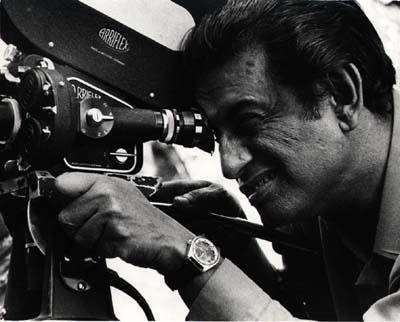
John W Hood’s Beyond the World of Apu: The Films of Satyajit Ray, published by Orient Longman, is a very low-profile book – I can find hardly anything on it online – but a very rewarding one. The essays here are elegantly and carefully written, and create a pleasantly reflective mood that somehow mirrors the experience of watching Ray’s cinema.
 Ray was a multifaceted filmmaker and his oeuvre covered many themes, settings and styles, ranging from the stark but affectionate rural narrative of Pather Panchali to the cynical corporate-life urbanity of Seemabaddha, and from the wordy clash of ideologies in Ghare Baire to the imaginative visual flourishes of Goopy Gyne Bagha Byne and Hirak Rajar Deshe. For the sake of convenience, Hood arranges the 29 films into nine broad chapters with such titles as “The Calcutta Triptych”, “The Urban Middle Class”, “The Tribute to Tagore” and “The Cry Against Tradition”. This arrangement isn’t always satisfying – it’s more cosmetic than organic, as Hood himself admits, and at least one of the classifications, the chapter “An Early Pastiche”, is arbitrary – but it serves the purpose well enough. Besides, any impression that Beyond the World of Apu might be a disjointed or incoherent work vanishes when you actually get down to the essays on the individual films – it’s here that Hood’s love for Ray’s cinema makes itself felt.
 The format of these essays is misleadingly simple: at first glance, they appear to be lengthy plot synopses with a few comments thrown in here and there. But to read them more closely is to be impressed by Hood’s rigorous attention to detail in watching each film (this is comparable to Tim Dirks’ astonishingly detailed Greatest Films website), making notes on it, discussing sequences and characters at length and observing thematic connections or contrasts between different works.
This in-depth treatment also means that Hood can avoid emphatic black-and-white judgements. Though he stresses the importance of acknowledging that not every Ray film is a masterpiece (and categorically names the ones that he considers the director’s lesser works), he gives himself the space to discuss the strong points of the flawed films as well as the less satisfactory aspects of the masterpieces. He doesn’t gloss over any film, but at the same time his respect for Ray’s artistry never encumbers his critical faculties – he observes, for instance, that with the exception of Uttam Kumar’s performance in Nayak, Ray’s films are full of “hackneyed images of drunkenness” (and, on at least one occasion, a trite portrayal of mental illness and senility), and that some of the later works are verbose and pedantic. Though I disagreed with him on some specifics about the films, most of the arguments he uses to back up his opinions are difficult to quibble with. (One notable exception: discussing one of Ray’s late, lesser works Shakha Prashakha, Hood points to the excessive use of English words and phrases as a flaw because of “the sometimes heavy Indianness of their enunciation”. This didn’t make much sense to me; in real life, the sort of people depicted in the film do use a lot of English words and phrases, and speak them in heavy Indian accents.)
But in essence, this isn’t the sort of film writing that sets out to be instructive or didactic: Hood is first and foremost a movie-lover articulately engaging with the career of a filmmaker he greatly admires. And that’s an appropriate approach to this particular director, for the beauty of Ray’s best work lies in observation rather than judgement; in the interplay between characters and in little details and vignettes that add texture to a narrative. (Personally speaking, I have a hard time pointing to a single favourite scene – or even two or three favourite scenes – in a cherished Ray film: the overall experience is so much more satisfying than its composite parts.)
In his Introduction, Hood clearly states his objectives. “[This book] aims to be no more than a critical examination of 29 works of art, based simply on the texts themselves. It is not in any way biographical, nor does it make any claim to offer film history.” Beyond the World of Apu is a fine demonstration of these assertions. In its ordered structuring and clear setting out of goals, it resembles a lengthy specialised thesis in places, but it’s also an accessible work that avoids academic jargon or the sort of “critspeak” that might distance the casual (but engaged) viewer of Ray’s films. My own litmus test for the book’s effectiveness was that I was equally engrossed by the essays on the films I haven’t seen (or remember dimly) as on the ones I have seen. Hood’s book lacks the intensely personal touch of Robin Wood’s The Apu Trilogy (sadly out of print now), but as a comprehensive study of Ray’s career it belongs in the top tier. Despite its occasional formalness, this is a warm and inclusive work of movie analysis, a fitting tribute to the art of a man whose work is characterised by affection and empathy for the human spirit.
[Did a version of this review for the New Sunday Express]
 Ray was a multifaceted filmmaker and his oeuvre covered many themes, settings and styles, ranging from the stark but affectionate rural narrative of Pather Panchali to the cynical corporate-life urbanity of Seemabaddha, and from the wordy clash of ideologies in Ghare Baire to the imaginative visual flourishes of Goopy Gyne Bagha Byne and Hirak Rajar Deshe. For the sake of convenience, Hood arranges the 29 films into nine broad chapters with such titles as “The Calcutta Triptych”, “The Urban Middle Class”, “The Tribute to Tagore” and “The Cry Against Tradition”. This arrangement isn’t always satisfying – it’s more cosmetic than organic, as Hood himself admits, and at least one of the classifications, the chapter “An Early Pastiche”, is arbitrary – but it serves the purpose well enough. Besides, any impression that Beyond the World of Apu might be a disjointed or incoherent work vanishes when you actually get down to the essays on the individual films – it’s here that Hood’s love for Ray’s cinema makes itself felt.
 The format of these essays is misleadingly simple: at first glance, they appear to be lengthy plot synopses with a few comments thrown in here and there. But to read them more closely is to be impressed by Hood’s rigorous attention to detail in watching each film (this is comparable to Tim Dirks’ astonishingly detailed Greatest Films website), making notes on it, discussing sequences and characters at length and observing thematic connections or contrasts between different works.
This in-depth treatment also means that Hood can avoid emphatic black-and-white judgements. Though he stresses the importance of acknowledging that not every Ray film is a masterpiece (and categorically names the ones that he considers the director’s lesser works), he gives himself the space to discuss the strong points of the flawed films as well as the less satisfactory aspects of the masterpieces. He doesn’t gloss over any film, but at the same time his respect for Ray’s artistry never encumbers his critical faculties – he observes, for instance, that with the exception of Uttam Kumar’s performance in Nayak, Ray’s films are full of “hackneyed images of drunkenness” (and, on at least one occasion, a trite portrayal of mental illness and senility), and that some of the later works are verbose and pedantic. Though I disagreed with him on some specifics about the films, most of the arguments he uses to back up his opinions are difficult to quibble with. (One notable exception: discussing one of Ray’s late, lesser works Shakha Prashakha, Hood points to the excessive use of English words and phrases as a flaw because of “the sometimes heavy Indianness of their enunciation”. This didn’t make much sense to me; in real life, the sort of people depicted in the film do use a lot of English words and phrases, and speak them in heavy Indian accents.)
But in essence, this isn’t the sort of film writing that sets out to be instructive or didactic: Hood is first and foremost a movie-lover articulately engaging with the career of a filmmaker he greatly admires. And that’s an appropriate approach to this particular director, for the beauty of Ray’s best work lies in observation rather than judgement; in the interplay between characters and in little details and vignettes that add texture to a narrative. (Personally speaking, I have a hard time pointing to a single favourite scene – or even two or three favourite scenes – in a cherished Ray film: the overall experience is so much more satisfying than its composite parts.)
In his Introduction, Hood clearly states his objectives. “[This book] aims to be no more than a critical examination of 29 works of art, based simply on the texts themselves. It is not in any way biographical, nor does it make any claim to offer film history.” Beyond the World of Apu is a fine demonstration of these assertions. In its ordered structuring and clear setting out of goals, it resembles a lengthy specialised thesis in places, but it’s also an accessible work that avoids academic jargon or the sort of “critspeak” that might distance the casual (but engaged) viewer of Ray’s films. My own litmus test for the book’s effectiveness was that I was equally engrossed by the essays on the films I haven’t seen (or remember dimly) as on the ones I have seen. Hood’s book lacks the intensely personal touch of Robin Wood’s The Apu Trilogy (sadly out of print now), but as a comprehensive study of Ray’s career it belongs in the top tier. Despite its occasional formalness, this is a warm and inclusive work of movie analysis, a fitting tribute to the art of a man whose work is characterised by affection and empathy for the human spirit.
[Did a version of this review for the New Sunday Express]