Showing posts with label Star Plus Mahabharat. Show all posts

Tuesday, October 21, 2014

Abhimanyu the wobbly doll (and a plug for Anti-Serious)

A shout-out for the new online magazine Anti Serious (Laughter in Slow Motion), launched by Sumana Roy, Manjiri Indurkar, Tanushree Bhasin and Debojit Dutta. You can read their mission statements here and surf the various sections. And here is a piece I wrote for them about the tonal peculiarities of some scenes in the Star Plus Mahabharata (centred on the so-tragic-it-was-funny killing of Abhimanyu). The piece was written back when the show was still on, so content-wise it may seem a bit dated - but hopefully the basic point comes across.
Attacked from various directions (by a bunch of people who look more like clumsy sidekicks than seasoned warriors), Abhimanyu continues to smile, like the college fresher who is undergoing a spell of mild ragging and knows he will come out of it having influenced people and won new (grown-up) friends [...] And perhaps here, the writers unintentionally tapped into something truthful about the Abhimanyu character that generations of teary-eyed Mahabharata readers have missed: that he is a swollen-headed – if insanely talented – 16-year-old boy with a highly romantic view of war, who doesn’t quite understand the implications of it all.
 [Full piece here]

Sunday, July 27, 2014

More from the TV Mahabharat - a stylised blooding

Not that I’ve done any research on this, or intend to, but I wonder if episode 248 of the Star Plus Mahabharat – telecast on Friday night – represents a new frontier in the depiction of violence and gore in the history of Indian television. I suspect it does; I was startled by its vividness, even though one knows that the killing of Dushasana is not something that lends itself to refined, non-bloody treatment. In fact, even the YouTube version of the episode (which you can see here) is censored – some shots, including one where blood bursts like a geyser out of the dying man’s chest, have been excised. (This was also the case in earlier episodes involving the killing of Jarasandha and Shishupala.)

I have had a very complex relationship with this TV show over the months (and I intend to write about this at much greater length in the future sometime) – there have been some brilliantly conceived moments, some fine visuals, good performances and even intelligent writing, but there have also been far too many slack, simplification-riddled scenes, as well as internal inconsistencies and terrible pacing (nearly 10 episodes for the game of dice, followed by a hurried four or five episodes to depict the Pandavas's entire 12-year exile). However, I think there was much in this episode that was extremely well done, especially from around the 16-minute mark where Draupadi enters the battlefield and Bheema – who is practically in a trance at this stage, calling out to her in a hollow, robotic voice – begins the macabre ritual of washing her hair with Dushasana’s blood.

If you don’t like gore, you’re thinking: I don’t want to watch this, or even continue reading this. But (speaking as someone who does like gore, so possibly I’m not the best “objective” judge) I don’t think this scene is as viscerally revolting as it might have been. And the reason is this: it is heavily stylised. Everything about it is excessive and Grand Guignol – even the “blood” glistens and gleams, like the pig’s blood in the climactic scene of Brian DePalma’s Carrie – and while one could have seen that as a flaw in the production, in this case I think it perfectly fits the theatrical mood of the scene.


After all, this IS one of the most brilliantly hyper-dramatic passages in the Mahabharata. Apart from its importance as retribution, it is, from Bheema’s point of view, his moment in the sun – it represents a converging of almost every emotion he has experienced with regard to Draupadi, not just since that terrible day in the dice hall 13 years earlier, but also in larger terms: feeling unappreciated, second best, having to know that she feels much more deeply for Arjuna than for him. And here he is now, and here she is, and he alone is to be the agent of her long-desired vengeance, the one who will get to stroke and bind her hair after all these years of denial, while the other husbands and the other protagonists in this drama – even the puppet-master Krishna – are reduced to mute spectators, watching a performance. At the surface level, this is a depiction of a wronged woman being avenged (and the show has often drawn facile and somewhat problematic parallels between Draupadi’s story and the current public discourses about rape and capital punishment in India) – but at a deeper and darker level it is another vindication of the patriarchy, a depiction of a beast-like man asserting control and possession over a woman. And while this serial has hardly ever been radical about such things, I do feel that this subtext slips through in the scene. 


I never thought I’d say this about an Indian television actor (much less someone who was apparently cast in a role because of his physique and his experience as a wrestler), but I think the actor Saurav Gurjar, who plays Bheema, is pitch-perfect here. And the tone of the scene in general is very close to the many stylised depictions of this episode in our traditional dance forms like Kathakali. You can see one of those performances here, in an old episode of Shyam Benegal’s Bharat ek Khoj, starting around the 2.20 minute mark. It used to give me nightmares as a child.

[Earlier posts on the Star Plus Mahabharat: Bride of Frankenstein; Kryptonite Karna; the benevolent patriarchy]

Thursday, February 27, 2014

Pop goes the epic: Draupadi in High Heels, Karna’s Wife and other new-age retellings

[Yes, here I go obsessing about you-know-what again, this time for the Indian Quarterly, and with a focus on two new novels with Karna in a starring part. This is a slightly different version of the piece that appeared in the magazine]

-----------

In the glossy new TV version of the Mahabharata, there is a scene where the princess Gandhari blindfolds herself so she can join her soon-to-be-husband Dhritarashtra in the world of the unsighted. This is among the most dramatic early moments in Vyasa's epic, and is usually presented in exalted terms - the princess proclaiming her resolution; the flamboyant, and decisive, binding of the cloth around her eyes - which is why I was intrigued by the new show’s handling of the scene. Much of the shot is filmed as point of view: we see Gandhari holding the blindfold, but then we watch it through her eyes as it comes closer and closer to them, eventually blurring the whole screen. The effect is akin to a handheld-camera horror film, complete with scary music and agitated breathing on the soundtrack. An earlier episode has established that the princess is afraid of the dark and awakens in a cold sweat if the wind blows out the dozens of diyas in her room. What she is now doing to herself feels much more immediate.


One doesn’t have to read too much into this, of course. High production values and reasonably thoughtful script notwithstanding, this Mahabharata, telecast five days a week, is very much aimed at viewers of daily soaps – which means presenting incidents in mundane, homely terms, stretching scenes out endlessly, and setting up episode-closing cliffhangers. The blindfold scene is a set-up for the next, hyper-dramatic sequence where Gandhari enters the Kuru sabha for her wedding, and viewers – along with the other characters in the story – get to see her with her eyes covered for the first time.

But the scene works on another level too, by showing a majestic act in human terms. Rather than a self-assured princess reaching for the Grand Gesture with her thoughts on posterity, this is a scared, impetuous girl who may have made a decision without realising its implications (and of course, there will be major implications for the story). It makes Gandhari easier to relate to, sympathise with or chastise, and it also ties in with what a number of recently published books have been trying to do – to make these old stories more accessible, with results that are inventive and facile in equal measure.


Such retellings of epics are not in themselves a new phenomenon. There have been countless “perspective” versions across the Indian languages, some notable ones being from major writers such as MT Vasudevan Nair (Randaamoozham, translated from Malayalam into English by Prem Panicker for his blog, and then by Gita Krishnankutty for Harper Collins) and Shivaji Sawant (the Marathi classic Mrityunjay). But a majority of those works were in the realm of literary fiction, and aimed at readers who had a deep enough knowledge of the epic to want to explore alternate narrative possibilities. What has been happening recently is a little different: stories from the Mahabharata and Ramayana are being revisited in ways that would appeal to a wider range of readers, and in the garb of fast-paced genre fiction.

And inevitably, certain characters have special appeal for the new generation of bards. Prominent among them is Karna, half-brother of the Pandavas, who is abandoned as an infant, raised by low-caste foster parents and discovers his true identity too late. One of ancient literature’s most compelling tragic heroes, Karna is a notably "modern" figure even in straightforward Mahabharata translations. His presence continually runs against the very assumptions of the period – such as the “God-granted” division of people into social hierarchies by their birth rather than their capabilities – and raises uncomfortable questions for the other characters as well as for the reader. (What happens when a person comes up against consistently hostile circumstances, or when personal dharma collides with what is perceived as the greater good?) The new TV show gives Karna rousing speeches where, apparently addressing the camera directly, he punctures the hubris of the high-born people around him, including one where he sharply tells the Brahmin teacher Drona that there is no such thing as a divine or magical birth, because every birth is a wondrous event for the parents concerned.

An earlier issue of this magazine carried an essay about literary crushes. As a child, traversing the vast landscape of the Mahabharata, I was obsessed with Karna, and could see him as the template for the angry young men played by Amitabh Bachchan in films like Trishul. Reading C Rajagopalachari’s translation of the Mahabharata aloud to my mother, I would sometimes excise sentences that showed Karna in a poor light. In my defence, I was all of ten years old; but it means I can relate to the many attempts now being made to turn Karna into an almost conventional, vanilla hero rather than a deeply complex person capable of extremes of anger and spite.

My literary crush was a platonic one, but two new books, both written by women who clearly feel strongly about Karna, explore his possibilities as a romantic hero. In these novels, Karna – about whose love life we learn almost nothing in the original Mahabharata – has transformed into an irresistible, golden-eyed (or blue-eyed) hunk, a sensitive new-age metrosexual, a darkly mysterious stranger who is essentially good-hearted and who might be saved by the love of the right woman. Both books begin with the heroine’s first glimpse of this man, whose physical features and personality are described in near-fetishistic terms. A strong strain of wish-fulfillment runs through them, and both are roughly classifiable (if you like classifying books) as “commercial” or “mass-market” fiction, though in my view they are very different in quality.


The less interesting of the two, Aditi Kotwal’s Draupadi in High Heels – an entry in Penguin India’s Metro Reads imprint for popular fiction – centres on a poor little rich girl named Deeya Panchal who, in the midst of jet-setting around the world, socialising with the likes of Sonam Kapoor at fashion shows and brooding about ex-boyfriends, discovers that her life has uncanny parallels with the mythological Draupadi's. For one thing, she is in degrees of romantic or potentially romantic entanglements with three suave, business-family brothers, the modern-day versions of the Pandavas (“Uggh. I suddenly felt like a doll which was being passed around from one brother to the other”). She also confides important matters to a close friend named Krish Gopinathan (Krishna), and is drawn to a handsome social outsider named Karan, whose origins are “shrouded in mystery”.

Though the framework here is the genre often derisively called chick-lit (“brat-lit” might be more accurate for this novel), the central idea has been explored before. The possibility of an unarticulated connection between Karna and Draupadi – both fiery, headstrong people – has persisted for a while in folklore and in regional extrapolations of the epic; it was there in Pratibha Ray’s celebrated Oriya novel Yagnaseni, in P K Balakrishnan’s Malayalam Ini Njan Urangatte (translated into English as “Now Let me Sleep”) and more recently in Chitra Banerjee Divakaruni’s The Palace of Illusions, which ended in a bohemian post-war Heaven where Draupadi is finally free to express her real feelings for Karna.

In contrast, the Deeya of Draupadi in High Heels goes about her work on terra firma. She not only chooses Karan to be her life partner, but also helps him discover his real identity. (He was the product of a hushed pre-marital affair involving a socialite and her German boyfriend in England!) The book’s final two sentences – “As I looked into his light-brown eyes which glowed with abundant love, I realized that a man with a golden heart like his deserved all the happiness and acceptance in this world. And I was so glad that I got to share these moments with him!” – should tell you everything you need to know about the mawkishness of the prose, as should the supposedly descriptive passages (“What fascinated and captivated me the most was his face – which was the most perfect that I had ever seen!” and “Some strong, indefinable feeling swept through my body and found its place at the bottom of my stomach”). 


But they will also tell you that this is an attempt to give Karna a happy ending, to retrospectively correct the wrongs done to this anti-hero – and in fact, this impulse is common to many Mahabharata-retellers. In 1991, the acclaimed film director Mani Rathnam made Thalapathi, with Rajnikanth as a modern-day Karna, which ends with the protagonist achieving validation and self-worth. “[As a reader] I’ve always wished that he lived on,” Rathnam told Baradwaj Rangan in one of the interviews in the book Conversations with Mani Ratnam, “So much has gone wrong. There’s so much stacked against him. Maybe there’s a bit of hope, a bit of optimism in this, but I felt that his death would look too doomed, too tragic.”

The other new Karna-as-romantic-hero book is Kavita Kane’s Karna’s Wife, redundantly sub-titled “The Outcast’s Queen”. Despite its weak points – flat dialogue, for one – this is unquestionably a more serious-intentioned work than Kotwal’s, and founded on a closer psychological understanding of the epic. (Kane has probably read her Mrityunjay too.) The protagonist here is a freshly created character, a princess named Uruvi who becomes Karna’s second wife after performing an action that is exactly the opposite of Draupadi’s: she rejects Arjuna, whom everyone expected her to marry, in favour of the intense social outcast.

A problem with some “perspective” versions of the Mahabharata is that they turn their protagonists into near-omniscient narrators – The Great Golden Sacrifice of the Mahabharata, for instance, is part-narrated by an Ashwatthama who seems blessed with a panoramic view of everything that is happening to all the other characters. The same charge could be leveled at Karna’s Queen: the fictional Uruvi conveniently happens to have grown up around the elders of Hastinapura and is even the foster-daughter of Kunti (mother of Karna and the Pandavas), which means she is privy to all sorts of information. The very opening page is a description of her first view of Karna when he challenges the Kuru princes during their competition; Uruvi has a ringside seat here, right next to Kunti, and she chirps on in modern slang, providing such commentary as “Bhima is downright mean!” and “Ma, please, it’s fair enough!”

At this stage I was ready to dismiss Karna’s Wife as another facile retelling, but reading on I found points of interest in it. Uruvi – even though she is part of Karna’s life and is affected by his actions– can be viewed as a sutradhaar figure who is essentially outside the narrative, a stand-in for the author. It is almost as if Kane traveled in a time machine to Hastinapura (think of Mark Twain’s A Connecticut Yankee in King Arthur’s Court) and then set about confronting major characters like Bheeshma, Kunti, Duryodhana, and Karna himself, and either telling
them off or getting a clearer understanding of their feelings. If one were to be really generous to this book, one might say that what she has attempted (consciously or otherwise) is a form of literary and social criticism – revisiting the story as a 21st century person, bringing modern morality to it, and doing this not from a safe distance but as an insider. (In an interview, Kane was asked which character from the Mahabharata she would like to meet and speak with. “Karna, of course!” she replied, “And I would have done exactly what Uruvi did.”)

If Karna is a dashing lover in these books, the new TV show also presents him in terms that resemble the Western comic-book superhero. Poetic licence has been taken with the impenetrable armour and earrings attached to his body, gifts from his divine father, the Sun God. In a touch that may remind you of Clark Kent turning into Superman in the phone booth, the new serial has the protective armour making its appearance only in specific moments of crisis; it then spreads across Karna’s muscular abdomen, which, seen in close up, resembles that of modern superheroes in full gear. The parallel with Superman, who is encased as a baby in a protective bubble by his father Jor-El, is hard to resist. And of course, the armour will also turn out to be Karna’s Kryptonite when he has to give it away. All of which may be a way of reminding oneself that the Superman story is itself a modern myth that is derivative of ancient ones. The circle completes itself here.

****

It’s worth asking why the epics are such an endlessly replenishing mine for contemporary writers. One obvious answer is that these are rich stories with multiple strands, forever open to new interpretations and psychological analyses. A more cynical answer would be that they provide lazy or unimaginative authors with a ready-made template: the plot, structure and character types are largely in place, and the embellishments (or twists, as in Draupadi choosing Karna over Arjuna) are all that are needed.

Everything hinges then on the quality of execution, on what new ideas are introduced, and how convincingly they are injected into an existing palimpsest. One of the more notable (in theory at least) attempts to shift the epic to a modern setting was in Sandipan Deb’s gangster novel The Last War, which set the Mahabharat in the Mumbai underworld, casting Arjuna and Karna as Jeet and Karl, two expert hitmen primed for a final showdown. It was a good idea to move the story to the Bombay of the last 60 years, letting the many familiar dramatic episodes play out against the backdrop of a fast-changing city, with occasional references to such real-life events as cricket match-fixing. (In this version, Yudhisthira goes to jail when he is tricked and implicated in a cricket-betting controversy.) And there is an irreverence built into the book's very fabric: the very first chapter has the modern versions of Krishna and Arjuna faux-philosophising over glasses of Scotch, and all the characters are basically thugs.

But this also raises questions about Deb’s decision to lift plot details and even dialogues wholesale, and to clumsily stick them into situations where they become anachronistic. For instance, the episode of Arjuna seeing only the eye of the wooden bird he has to shoot at is presented exactly as it is in the original, except that of course he is using a rifle. After Draupadi (called Jahn here) is nearly raped, she swears that she won't tie or oil her hair until she has soaked it in her assailant’s blood. Besides, the prose includes several pretentious references to “dharma” or duty. Deeply ambiguous as this concept already is in the original Mahabharata, it is rendered meaningless in a situation where everyone is operating outside the law.

However, one might note that even in this amoral version – where there are no real standards of “good” and “evil” – the Karna character is the one who secretly makes the phone call that helps preserve Draupadi’s honour. It seems that even the author of a hard-boiled underworld rendition of the epic can’t resist whitewashing Karna, almost to the point where his complexities are siphoned away.

That’s another feature common to contemporary retellings though: the need to subvert conventional ideas about the “bad guys”, or to reveal the shaky moral foundations of the “good guys”. Among recent books, there are Anand Neelakantan’s Asura and Ajaya, which eschew the history-as-told-by-the-victors narrative to present the Ramayana and Mahabharata through the eyes of Ravana and the Kauravas respectively. The Rama-Sita relationship has been thoughtfully dealt with in such modern-lens retellings as Samhita Arni’s The Missing Queen (a “speculative thriller” about a journalist’s search for Rama’s missing wife after the war with Lanka) and Sita Sings the Blues, an animated film by the American Nina Paley, who intersperses episodes from the Ramayana with the story of Paley’s own estrangement from her husband.


And always, there is the story of Surpanakha, Ravana’s sister who becomes the catalyst for events in the Ramayana after she is rebuffed and disfigured by Rama and Lakshmana. The incident – though presented in terms of the good guys giving a demoness her just desserts – is an inherently ambiguous one, and can be interpreted in terms of gender-directed or caste-directed violence. This has been done many times in modern fiction (an example being Amit Chaudhuri’s spare, uncompromising short story “An Infatuation”), but one of the most enjoyable Surpanakha retellings I have read is a piece in the anthology Breaking the Bow, which collects speculative fiction inspired by the Ramayana. Kuzhali Manickavel’s “The Ramayana as an American Reality Television Show” is a clever account of how the Surpanakha episode may have unfolded in the voyeuristic-exhibitionistic cyber-age, with statements from the aggrieved rakshasi’s blog, the hysterical social-media reactions by her fans and detractors, and Twitter ripostes by the “Real Rama”. It adds up to a commentary not just on the ancient epic (it is easy for contemporary writers to poke holes into the social mores and pomposities of an earlier era) but also on the vagaries of our own time.

In any case, the past few months alone have brought us romantic Karnas, a gangster Mahabharata and the Ramayana as science fiction and thriller, along with prolonged daytime soaps where one might conceivably, in future episodes, get to see Duryodhana helping his son with his Algebra homework. And all this in addition to the ever-growing corpus of books by Amish Tripathi, Krishna Udayashankar, Ashok Banker and others, where Indian mythology is retold in a style resembling 20th century Western fantasy from Tolkien onwards. Or Amruta Patil's beautifully illustrated visual retelling, Adi Parva. But why stop there? Other genres and tropes are yet to be explored. Personally I am toying with the idea of getting onto the bandwagon and fashioning two of my personal obsessions – tennis and irreverent humour –
into Mahabharata novellas. One of them would stage the Kurukshetra war as a series of Grand Slam matches, with the Karna-Arjuna battle played out in the manner of a Roger Federer-Rafael Nadal epic in a Wimbledon final. (As Orwell said, sport is war minus the shooting. Such a story would require no “arrows can be injurious to health” signs.) The other would cast Groucho Marx as a non-sequitur-spewing Krishna, confounding Arjuna and everyone else on the battlefield with a modern Gita that begins “These are my principles. If you don’t like them, I have others.” Like Groucho, the epic is whatever you want it to be.

-------------------

[Some related posts: the Rashomon-like world of the Mahabharata; Iravati Karve's Yuganta; The Palace of Illusions; The Last War. The PDF of Prem Panicker's Bhimsen is here. And something about the Karna-as-Rafa illustration that went with the piece.]

Tuesday, February 11, 2014

Quick thoughts on the pulping of The Hindus (and the benevolent bully)

Some thoughts in connection with the depressing - but not, in our times, very surprising - news about the “pulping” of Wendy Doniger’s book The Hindus by Penguin India (after a petition that, among other things, alleges that Doniger’s “approach is that of a woman hungry of sex”, that a Shiva linga can only be a cigar, so to speak, and that the idea of Krishna having an erotic life is unthinkable and un-Hindu).

I have written before about the smug certitudes that so often accompany religious belief, and the sophistry/cherry-picking inherent in the thought process that goes: “THIS is what the scriptures really meant, and it’s all good and clean and pure and exactly as I want it to be. Anything else – anything that makes me uncomfortable, or doesn’t fit the accepted moralities of today, or makes the Gods seem imperfect, or even vaguely suggests that those old books may have been a product of their age rather than containing unassailable wisdom and truth for all time – any such thing HAS to be a flawed reading, or a later corruption of the text. Or, wait, it can be interpreted THIS way, which makes everything okay again.”

This thought process isn’t limited to those whom we can conveniently label “fanatics”. Some generally intelligent people I know, including some who aren't especially religious, often bring up that beautiful, soothing – and nonsensical – idea that all religions “in essence” or “in their original form” teach love, universal brotherhood, tolerance and non-violence. A cursory reading of the major works of ancient literature shows how bizarre this claim is. But of course, once you know, with absolute certainty, that they really are all divine texts, that so-and-so really WAS a God, and that Gods by definition are good and all-knowing and so on, it becomes easy to rationalise anything.

I had an email conversation with a friend today – it touched briefly on the Doniger episode, but it began as a discussion of the new TV Mahabharat, which (no surprise) depicts Krishna as a forever-in-control avatar, constantly manipulating events towards the Greater Good, interfering in every scene to such a degree that you feel all the other characters could easily have been played by mannequins with little strings attached to them. Compared to this beacon in man-shape, even the Krishna of the B R Chopra serial – a fairly populist show in its time – was a flawed, sometimes conflicted, likably human character.

Anyway, I was telling my friend about the new show’s whitewashing of nearly every dubious action performed by the “good guys”, the Pandavas and Draupadi, how it glibly stacks the cards in their favour, and against those who are on the side of “adharma”. There is a scene at Draupadi’s swayamvara where Krishna meets Karna for the first time and tells him something like, “If you don't get respect – sammaan – it means you have not followed the path of dharma.” Karna asks “But what about someone who has never known respect, right from his earliest days?” and to this Krishna smiles sweetly and wags his finger and says “Oh, in that case, you must strive all your life for respect. But don't do it by siding with adharma.”

One gets the gist of what is being said, and even buys into it to a degree if one is hung up on the Bhakti Tradition Krishna and the Mahabharata-as-Morality-Tale. And I’m not suggesting that the injustices done to Karna be used to justify or even gloss over the wrongs he participates in. But this scene (and there are others like it) presents such a simple-minded view of what is good and what is bad, and such an undermining of lived experience. As I told my friend on email, if this Krishna travelled to modern-day Delhi and met an autorickshaw driver who had just been smacked hard by a rich kid in a BMW because their vehicles had grazed each other, he'd probably say the same thing with the same expression.

She replied: “That is what I find so fearfully disturbing about the […] discourses of today: they all conspire (consciously or otherwise) to vindicate a certain hierarchy by transforming it into benevolent, enlightened patriarchy, striving to achieve everyone's well-being. Poppycock.” Well said. There are so many versions of this benevolent patriarchy. (“Yes, yes, we believe in freedom of speech too,” they say with indulgent smiles, “But, you know, this will hurt so many feelings. Couldn't you avoid writing it?”) And we see a form of it in the objections to books like Doniger’s, by people who want a single, standardised, comforting version of things, with nothing that will rock any boats.

[Related thoughts in these posts: Arun Shourie on innocents in a Godless world; divine savages and “real” truth; tales from a crematorium; Chetan Bhagat and “liberal extremism”]

Saturday, February 01, 2014

Rafa the low-born (tennis at Kurukshetra)

Had to share this. I wrote a piece for the magazine Indian Quarterly recently, about a new crop of epic retellings being done in popular genres such as young romance and the underworld thriller. The piece – which centred on two new books about Karna, one of my childhood literary heroes – ended with a jokey line about how, if I ever did a Mahabharata-retelling myself, I would merge my personal obsessions and present the Kurukshetra war as a series of Grand Slam tennis matches: 128 warriors, falling by the wayside one by one (over 18 days, or over a fortnight), all of it leading up to a grand finale - the decisive Arjuna-Karna battle, cast as a meeting between Roger Federer and my favourite sportsperson Rafael Nadal.

It was a throwaway reference, not central to the piece in any way, so imagine my surprise when I saw a PDF of the story and found that the illustration done for it brought together Karna and Rafa (dressed in Wimbledon whites, including the sleeveless kavacha he wore until a few years ago) in one surreal, bow-and-bandana juxtaposition. I didn't have anything to do with planning the image, so this was most fortuitous, and I must thank the illustrator Salil Sojwal. Here’s the picture:


Illustration: SALIL SOJWAL

Of course, one is now tempted to make Nadal: Federer = Karna: Arjuna analogies, based on nothing more concrete than the facile perceptions we form of sportspeople. Thus, Roger as the privileged prince and favoured son, all grace and artistry, seemingly born to conquer the world, his destiny pre-written in stone; and Rafa as the dark cloud on his horizon, the upstart shaking up the fraternity with his unconventional style of play and his apparently uncouth mien (which conceals a sweet but defensive nature). Roger pirouetting his way across tennis courts with a sense of entitlement, while Rafa plays catch-up, struggling with the slings and arrows of outrageous fortune: chronic injuries, a style of play that doesn’t meet the aesthetic demands of people who want their tennis to be like ballet, and an inability to make himself properly understood – which in one famous case after the 2006 French Open led to public booing because he had been mistranslated. (“Chale jao, suta-putra,” yells the Hastinapura crowd.)

I could go on, but I won’t. Instead here are two photos of cho-chweet bonding between rivals. The first is from the great years of the Roger-Rafa bromance (more on that in this post); the second is from a recent episode of the Star Plus Mahabharat where Karna helps Arjuna (disguised here as a brahmin) lift a chariot wheel out of the mud (!!). Can't see the resemblance? Either there is no poetry in your soul, or you have better things to do with your time.


"
"VAMOS!!!"

Tuesday, January 21, 2014

Bride of Frankenstein

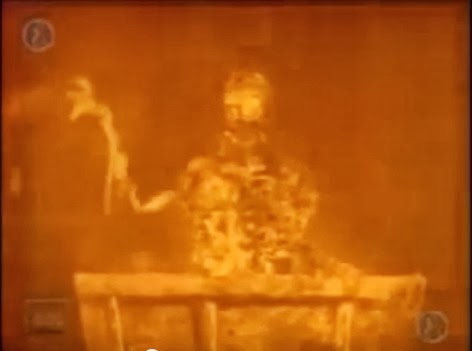
Having lately discovered that Karna and Superman are the same person, I have now unearthed similarities between Draupadi and the Frankenstein monster. This is best illustrated with screen grabs from the Star Plus Mahabharat and old movie versions of the Mary Shelley story.

First, behold how the monster (in the 1910 film, that is) and Draupadi are each born of fire – though one emerges from a vat, the other from a sacrificial yagna:


(More about the fire scene in that old Frankenstein film here)

Next, mark ye, that both these hapless creatures (still coming to grips with the strangeness of the world around them) are surprised by their reflections in a mirror:


As they settle in, they each befriend a little girl and sit with her by the side of a pond, playing with flowers and such.


Much of the emotional impact of those scenes comes from the knowledge that the fire-princess and the monster have never experienced the joys and wonders of childhood. But grown-ups can have fun too. Here is Paanchali doing something that would get Boris Karloff lurching manfully towards her swayamvara:


[Coming up next: Bheema and Jughead Jones]

Monday, December 30, 2013

Stuart Little and the Pandavas in the house of lac

Imagine my delight when I checked the Tata Sky synopses for this week’s episodes of the Mahabharat and saw the following summary for Wednesday (episode 77):


Now I feel like I have a moral responsibility to write similar 3-sentence synopses for future episodes: the first sentence should be a non-sequitur, or at least have no obvious connection with the main narrative, while the remaining two sentences should solemnly continue the plot at snail’s pace. For example –

Episode 78: Bhima and the rat jive to the beat of “I'm Alive”. The Pandavas wonder why the walls smell of oil and fat.
Vidura tells his men to dig a tunnel.

Episode 79: Vyasa is very angry with the Star Plus writers. S
ahadeva says there is no smoke without fire. The Pandavas uncover the plot to burn down the palace. 

Episode 80: Arjuna goes for target practice, but someone with sharp teeth has nibbled through the bow-string. Vidura informs Bheeshma about his plan. Bheeshma sighs deeply.

Episode 81: The rat considers moving somewhere safer, like the Bigg Boss house. The tunnel is half-finished. The workers take a lunch break and discuss the wickedness of the Kauravas.


Episode 82: Devdutt Pattanaik tells the rat dharma is subtle. Shakuni sends Purochana another secret message. Yudhisthira adjusts his crown and wonders if he should light a candle.

Teaser for the week after: Will the mouse douse the burning house? Find out in episode 83! Or episode 95!

(And so on. Feel free to weigh in. The epic is limitless and malleable, we must keep adding to it.)

[An earlier post: Karna and Kryptonite]

Thursday, December 19, 2013

Notes from the Star Plus Mahabharata: Kryptonite Karna

I have been following the new Star Plus Mahabharata fairly closely, a process made easier by the fact that each episode is uploaded on YouTube a day after the telecast (though the more flamboyant action scenes are better seen on H-D TV). The show has its problems – as any five-day-a-week Mahabharata would – but it definitely isn’t bad, or unintentionally funny, in the way that Ekta Kapoor’s shoddy Kahaani Hamaaray Mahabharat Ki was***. Hope to do an extended post about it at some point (have written something in an essay for a magazine, which I will put up here soon), but for now a quick note about certain inventive things they have done to Karna. His impenetrable kavacha (armour) isn't permanently attached to his body, as in the original epic. Instead it appears only in specific moments of crisis – when an arrow is headed for his chest, for instance. In this episode, you can see this happen twice: first, with the teenage Karna, around the four-minute mark; then with the first appearance of the adult Karna at the end of the episode, when a flaming thing comes at him out of the artificial sun he has created with his astra. (Yes!)

These scenes put me in mind of modern comic-book superheroes with their secret powers – Clark Kent turning into Superman in the phone booth – and tight costumes worn over muscular abdomens. But there are parallels anyway: the Superman back-story has baby Kal-El being encased in a protective bubble by his father, much like Karna gets his kavacha from his divine daddy Surya. Watch this scene from the 1978 Superman and tell me you don’t recognise other rudiments of the story: the child being sent away by tearful parents (Marlon Brando as Kunti, who would’ve thunk?); the foster-parents being unable to come to grips with the apparently superhuman gifts of the infant they have raised in their humble home. And the armour will also turn out to be Karna’s Kryptonite when he has to give it away later in the tale. Another reminder that modern mythologies are so often derivative of ancient ones.

P.S. that episode I linked to also features Puneet Issar as Parashurama, allowing doddering folks of my vintage to feel deeply nostalgic about his performance as Duryodhana 25 years ago. 

*** Some posts about Kahaani Hamaaray Mahabharat Ki: 1, 2, 3, 4, 5, 6
Also, an old post that ponders the important question: why did Karna need to borrow vinegar from hairy and characterless women?