Showing posts with label nostalgia. Show all posts

Thursday, March 12, 2015

Satanic shirts and lasting values: remembering the 80s classic Naseeb Apna Apna

(A history lesson for all you little teenagers and 21-year-olds. You’re welcome)

For people of my generation, it can be unsettling to find that new movies set in the 1980s or even the 1990s are now officially “period films”. Take Sharat Katariya’s charming (and surprisingly low-profile, given its many fine qualities) Dum Lagaa ke Haisha. Set in the mid-90s in Haridwar, with a callow young protagonist who idolises Kumar Sanu(!) and manages an audio-cassette store for his father (the CD era is about to knock forcefully on their door), this film has obvious nostalgia value for anyone above a certain age
– and obvious knock-their-eyes-out-of-their-sockets value for anyone below that age. All the usual signifiers are here. Rotary phones, red Ambassadors, rickety grey scooters, a reference to Vinod Khanna as the epitome of male hotness.

The tiny moment that left me nearly moist-eyed though was when Prem (Ayushmann Khurana) struggles to remove a videocassette from its tight cover – he has to yank the thing out – and then does something that people of my generation so unconsciously did hundreds of times in the old days. He flips open the little lid at the rear of the cassette and blows at the visible strip of film to clear away dust particles and other lethal, real-or-imaginary microscopic things. (This keeps the player’s “head” safe, we would tell ourselves.) Then he puts the cassette in. If he is anything like I was, he is holding his breath for the few seconds until the TV screen lights up. (Please, please let it not be covered by “snow”, which could mean the VCR has packed up again and needs to be serviced.)

The scene lasts barely a few seconds but I felt sentimental because I wondered if any of the young people in the hall would even know what it meant. Or would they dismiss Prem’s gesture as a character quirk? (“Hey, there’s a guy who likes to whisper randomly at rectangular plastic objects. It’s probably a religious thing.”)

However, there’s another reason why Dum Lagaa ke Haisha took me disappearing down the foggy ruins of time. Its story about a self-absorbed man who is pushed into an arranged marriage and is then indifferent to his wife because she is an overweight “saand” (at least, that is what the plot seems to be about at first – it takes a right turn in the second half and becomes much more about the insecurities of Prem, intimidated by a woman who is smarter and more poised than him) reminded me of another film that haunted my younger self.

I have spoken, oh gawping teen readers, about the character-building ritual of blowing into a videotape’s rear end. Let me now introduce you to a thing called Chitrahaar that we used to watch on Wednesday and Friday nights. It provided the soundtrack of my childhood, pre-dating the Kumar Sanu-Sadhna Sargam one you hear so much of in Dum Lagaa ke Haisha. In the mid-80s this soundtrack included the yowling number “Teri Meherbaniyan”, sung by a dog to Jackie Shroff (or vice versa), which I wrote about here, as well as Anil Kapoor screeching “Zindagi Har Kadam Ek Nayi Jung Hai” to himself. And it included a hypnotic, droning song called “Bhala Hai Bura Hai”, which was telecast so often that its lyrics nestled into the minds of every little Indian boy and girl and gave us moral conditioning and good value system for decades to come. They began:

“Bhala Hai, Bura Hai, Jaisa bhi Hai
Mera Pati Mera Devtaa Hai

(Good, Bad, Whatever,
My husband is my flying spaghetti monster and I will worship It and feed It samosas and beer)”


Thus spake Naseeb Apna Apna.


It wasn’t just the song, but the power of the accompanying visuals. Displaying acres of wifely stoicism was a dark-complexioned woman who didn’t fit the Hindi-cinema ideal of beauty (not even the one established by south Indian heroines like Rekha and Sridevi). The film did everything it could to make her look ludicrous anyway. She sticks her tongue out (when she isn’t singing) and makes other strange expressions for no clear reason.
Most important of all, trailing her head at a distance of several metres is an astonishing upright chhoti that ends in a ribbon; the sort of accessory that would have made Hanuman very envious as he set about using his tail as a wick to set Lanka afire.

Also visible in the scene (though he tries his best to stay out of sight)
is Rishi Kapoor, doing his famous double-takes and managing somehow to look mortified, cocky, sheepish, contented, despairing, self-important, despicable and helpless all at the same time, all in the same frame.

In fact, Kapoor tweeted a few days ago that Dum Lagaa ke Haisha was like an updated version of his 1980s film. (You only have my word for it, but I made the connection before he did.) He would have good reason to remember Naseeb Apna Apna – it was possibly the hardest thing he ever had to do, a role that would have any actor yearning for a more lightweight assignment, such as playing Hamlet and Falstaff on the same night. Because apart from anything else, this film is highly confused about its own characters: it feels for them while simultaneously making fun of them (or passing judgement on them). And Kapoor’s Kishen is often on the receiving end of this double-headed treatment. 


Take the early scenes where he is being bullied by his authoritarian father. Kishen should be the sympathetic underdog here, since he is saying nothing more unreasonable than: what, you want me to marry a girl I haven’t even seen? And yet, and yet... look at the shirt they made poor Rishi wear:


(Talk about subliminal messages. Beware, India's sons and daughters, the film is saying here. If you argue with your Mogambo-like dad or wag your finger at your poor long-suffering mother over something as trivial as your choice of life-partner, even your clothes will publicly denounce you.)
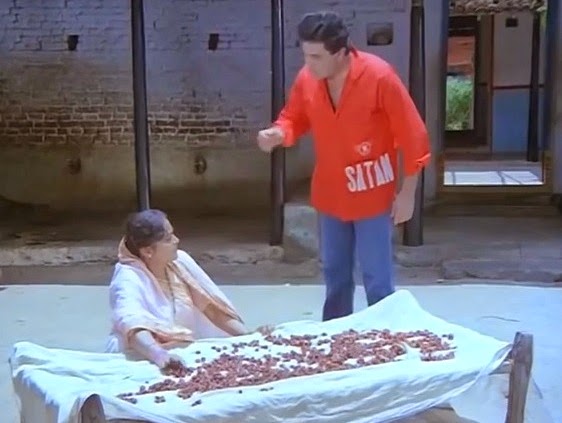

Ten years before Amrish Puri played the patriarch whose permission must be sought in DDLJ, here he is as a fiercer, more rustic version of that patriarch, the boy’s father this time, who threatens to break his son’s legs if he tries to leave home. “I’ll staple you to that horse’s back if I have to,” he growls (or words to that effect), so the next scene has Kishen in bridegroom’s garb riding along sulkily on his way to wed the “plain-looking” Chandu (Radhika). At this point you think Naseeb Apna Apna has set itself up so that one of two things will happen: 1) The parents eventually see the error of their ways, recognise that times are changing, or 2) Tradition is upheld and glorified; young man finds love with papa-certified girl, starts wearing placid white shirts with "सुन्दर सुशील बेटा" printed on them. 

But no, the film mixes and mashes both these ideas while sticking to its larger agenda: to gratuitously make fun of Chandu and her Hanuman-ji chotti. At the same time it introduces another, fairer-skinned heroine – Farha – who gets to be not just Kishen’s wife of choice, but the film’s Christ figure too. Summary of what follows: Wife 1 is happy to abase herself by playing maid to Wife 2 if this means she can get to live in the same house as her (their) husband. And Wife 2 is happy to sacrifice her very life if it means that husband and Wife 1 may find happiness with each other. (Meanwhile Kishen continues to look miserable – look at the rough hand fate has dealt him!)

This also means that the similarities between Naseeb Apna Apna and Dum Lagaa ke Haisha are only skin-deep. In the new film everyone is likable, and the big message of the present day – that Indian men need the right sort of education – is in plain sight. Prem’s father meekly accepts his culpability when his daughter-in-law Sandhya gives him a lecture about not having taught his son to respect women. (Her wisdom, and the father’s sensitivity, are tellingly set against the values of the khaki-shorts-wearing brigade Prem is involved with, bent on producing a species of men who have no need for a female presence in their lives.) Back at Sandhya’s home, when her mother tries to feed her the usual line about a woman’s place being with her husband, aurat ki destiny etc, the educated girl coolly shuts the door in the mother’s face and that’s that. Not much room here for real social conflict.

Prem himself
– before he makes a serious effort to improve his attitude – comes close to being a worm in some scenes, but never in the way that the forever-entitled Kishen is. Basically: Dum Lagaa ke Haisha is steeped in political correctness and social progressiveness and general feel-goodness; Naseeb Apna Apna wouldn’t know what any of those things were if they were brought to it on a large silver tray carried by a gharelu, pallu-covered bahu with eyes cast downward. 

Well, apart from the very special, tearful sort of feel-goodness that comes from watching a Noble Soul make the Ultimate Sacrifice in the Last Scene – we loved that sort of thing in the 80s. And with that observation, this post comes to...

Tuesday, December 09, 2014

Hindi cinema and the Anglophone viewer: MK Raghavendra on the new Bollywood

[Did this review for Biblio]

Conversations involving movie buffs who grew up in the 1980s often touch on the divergence between the mainstream Hindi films of then and the Bollywood of the past decade. This isn’t necessarily an exercise in rosy-eyed nostalgia, nothing as simple as “things were better in our time”, but it involves a recognition that even as our movies have become more sophisticated – more professionally made, with bound scripts, a variety of settings and subjects, and greater attention to detail – something important has been lost too. It is pointed out that even the tackier commercial films of the 1980s often had a raw honesty, a willingness to engage head-on with the non-English-speaking world, to create an immediate identification between the audience and the characters on the screen; the fourth wall had not been pulled down and replaced by a gossamer veil of irony. Indeed this quality is inseparable from the impression one gets, looking back, that the cinema of that time was clumsy, insular, not attempting a discourse with the cinemas of other countries.

In the last decade and a half, the pendulum, propelled by rapid globalisation and the “India Shining” narrative, has swung very far in the other direction. In a shrinking world (or in a world that upper-class Indians can convince themselves has shrunk), our films have elaborate premieres at international festivals; American stars like John Travolta and Kevin Spacey shake a leg to the “lungi dance” at our award shows; the multiplex culture has seen many seminal movies being targeted at an audience that travels widely and for whom English is a first language. MK Raghavendra’s new book The Politics of Hindi Cinema in the New Millennium is about this shift in Hindi cinema’s idiom in the years following economic liberalisation. Its thesis is that during this period, films have increasingly been made for Anglophone viewers – so that the underprivileged have been marginalised or ceased to be subjects of the new cinema – and that the state’s withdrawal from the public sphere has had notable consequences for the filmic treatment of patriotism, community, aspiration and politics. Raghavendra proposes that even when the films themselves are celebratory, they carry bleak implications for the idea of an Indian “nation”.

Needless to say, this is a very big topic, and he tackles it by looking closely and in an organised manner at a number of key films released between 2001 (the year of Dil Chahta Hai, Lagaan and Gadar) and 2012 (Paan Singh Tomar) – what are their implications and undercurrents, what might they tell us about the post-liberalisation nation? Thus, for instance, the section on the feel-good Lage Raho Munnabhai notes the curious, cynical ways in which Mahatma Gandhi’s teachings have been transformed and re-applied to the imperatives of modern India, while films such as Bunty aur Babli are analysed in terms of how the go-getting entrepreneurial spirit is now celebrated without agonizing much about moral compromises. Overall, the accent is on films that have been successful – to some degree or other – across India, but the choice of movies is also a reminder that the line between the categories “mainstream” and “non-mainstream” is now less clear than it was in the “commercial film vs parallel film” (or Manmohan Desai vs Shyam Benegal) era. There are blockbusters by Karan Johar and Farah Khan (Kabhi Alvida na Kehna and Om Shanti Om respectively) and a stylish, glamorous thriller (Dhoom 2) but also lower-key movies such as Nagesh Kukunoor’s Iqbal and Anusha Rizvi’s Peepli Live; there are relatively commercial works by respected auteurs (Vishal Bhardwaj’s Kaminey, Mani Ratnam’s Guru), alongside the oeuvre of that most self-consciously “socially conscious” director Madhur Bhandarkar.


Inevitably the results are uneven, with some essays being more stimulating and focused than others. Some conclusions are easily drawn: anyone can see that a film such as Zoya Akhtar’s Zindagi na Milegi Dobara, populated by posh, cosmopolitan people (three friends on a road trip in Spain), is about and for Indians who are citizens of a global world; largely unconcerned with lives outside upper-class circles. But some of Raghavendra’s sharper observations concern films that, on the face of it, deal with poor people in lower-class milieus – he points out that these films, being made for multiplex audiences, often view the underprivileged with an anthropological (if sympathetic) detachment. Hence Bhardwaj’s Kaminey, though set in a crime underbelly, has the tenor of “a low-life fantasy lived out by the aspiring, upwardly mobile classes”. And though Taare Zameen Par is about an underdog – a boy whose classroom troubles stem from dyslexia – the visuals in an early scene, where little Ishaan imagines aquatic life reminiscent of that in the American animation hit Finding Nemo, are presented in terms that only a well-off, Anglophone viewer can relate to. “The child of a farmer in a hot dry district, for instance, is unlikely to imagine the Sun as a smiling yellow orb.”

Some of these analyses might make you reexamine your feelings about a film. Take Peepli Live, about a farmer in dire straits, who finds himself at the centre of a heartless media circus when he announces he will kill himself. Conventional wisdom has it that this film is empathetic towards the class that the protagonist Natha belongs to – certainly, there is little questioning the filmmakers’ good intentions. Yet, as Raghavendra points out, Peepli Live too belongs to a tradition of Anglophone cinema (the credit titles and the important closing legend are exclusively in English) where a viewer is not encouraged to directly identify with the poor in the
way that viewers of an earlier time might have. And in this context he makes an interesting point about the use of movie stars in commercial cinema. “Film stars are naturally people in whom the public projects itself”, he notes – implying that when Nargis plays the destitute Radha in Mother India, or Dilip Kumar plays the villager driven to banditry in Gunga Jamna, or Amitabh Bachchan follows a similar arc in a more urban setting in Deewaar, there is a level of immersion that an audience might not achieve when watching the unknown Omkar Das Manikpuri playing Natha in Peepli Live (no matter how good his performance or how “authentic” the casting).

This is a thoughtful argument, one that extends beyond the scope of this book, in its regarding of stars with established personalities as “signifiers”. In fact, Raghavendra often draws attention to such signifiers – little filmmaking decisions that in some way or the other affect a viewer’s responses to a story and its characters. In writing about Prakash Jha’s Raajneeti, he notes that the central characters – the people whom the audience must, to some degree at least, root for – are played by urbane, westernized actors – Ranbir Kapoor, Katrina Kaif, Arjun Rampal – while the more rustic Manoj Bajpai (“who was born in a small village in Bihar”) plays their adversary. The film itself, being amoral, doesn’t give us any particular reason to think of the former set of characters as “good”, but the casting subtly affects our attitudes.

Elsewhere, he observes that even though Bhandarkar’s Page 3 is “less bleak in tone” than Govind Nihalani’s 1980 film Aakrosh (the former is a stylishly told, mass-audience-friendly narrative; the latter is sombre and hard-hitting in a manner characteristic of the “parallel” movement of the early 1980s), it is Page 3 that is essentially more pessimistic. And this difference has to do with the changed situation, Bhandarkar’s film having been made in a climate where capitalism runs rampant and true justice for the poor – in this case, sexually exploited lower-class children – is a fading dream. (“The characters are implicated in a situation which is irremediable, that is, increasing dominance of the market over the state […] there is no authority to which one might appeal.”) Similarly, 3 Idiots, which presents itself as a “triumph of the underdog” tale, doesn’t attempt to explain how the Aamir Khan character Phunsukh Wangdu has risen from the servant ranks to become an internationally respected scientist; the film simply tells us this has happened and allows us to leave on a feel-good note. “In this inability to imagine Wangdu lies an uncomfortable truth: that such a person is unimaginable. It is unimaginable that a servant’s child in India will become a celebrated inventor. Elite educational institutions are not for his kind even when the institutions have been established by the state.”

These propositions are open to debate, of course. One might paraphrase a famous truism about India: “For every observation you make about Hindi cinema, the opposite can also be shown to be true.” It can also be pointed out that many of the conscientious “art-film” directors of the 80s lived cushy, cosmopolitan lives at a remove from their downtrodden subjects. (Nihalani’s excellent 1984 Party, about a group of bleeding-heart artists and armchair activists at a house party, can be viewed as a caustic self-interrogation.) And if Peepli Live is classified as a mainstream film for the purposes of this study, would this also be true for, say, Neeraj Pandey’s A Wednesday or Rajkumar Gupta’s Aamir, which do offer a chance to directly relate – in the case of the former, almost to a dangerous extent – with the frustrations of the helpless “common man”?

The fact that each essay must ultimately veer round to the big thesis about the Anglophone audience makes this book heavy-handed and forced at times, and the dry, mostly impersonal writing it represents is not for all tastes. But it is possible to quibble with Raghavendra’s broader conclusions while appreciating the quality of his engagement. Within the broad church of academic work on film, he is one of the better writers and thinkers around, worth taking seriously for the quality of his insights, and his analyses of individual films are always worth reading. Whether making an intriguing connection between two different sorts of movies (the fictionalised Dhirubhai Ambani biopic Guru and the caper film Bunty aur Babli) or pointing out how locales in Gadar are subtly placed at the service of patriotism (“India is always assisted by the film’s cinematography – with views of the countryside in which wheat fields are conspicuous – while Pakistan is portrayed through the city […] India is evidently the more fertile and democratic space”), he is consistently perceptive about the underpinnings of popular cinema. Even if you don't agree with everything he says about the state of the nation, you’ll probably find yourself looking at some of these films through a new prism – and that is one of the most valuable things a critic can do.

Saturday, April 12, 2014

Revisiting J P Dutta’s Hathyar (and reflections on the bad old 1980s)

[Did a shorter version of this essay for the new issue of The Indian Quarterly]

Those of us whose cinematic consciousness was shaped in the 1980s tend to agree that, nostalgia aside, these were poor times for mainstream Hindi cinema. Actors did multiple shifts a day, zombie-walking through barely scripted potboilers (with the end results rarely indicating that they had succeeded in telling one character from the next, or that the films had expected them to). Production design was non-existent, comedy tracks appalling, and there were those ghastly closing shots where an assembly of surviving good guys stood together in a huddle beaming at the camera in the “mahurat” pose (after a few seconds of dutiful glycerine-shedding because one of their number had just sacrificed his life to save the day). Residue from the Angry Young Man films of the 1970s included the very worst of Amitabh Bachchan (from Pukar and Mahaan through Toofan and Jaadugar). In the immediate pre-liberalisation, pre-multiplex era, “Bollywood” operated in its own vacuum.

Today the DVD culture and the work done by NFDC has made it possible to see good, restored prints of the “parallel” cinema of the time, the best work of Benegal, Nihalani, Mishra and others. And so, for those of us of a certain age who like to think we take cinema seriously, it seems natural to focus our energies on revisiting those movies (which we were too young to appreciate when they came out) rather than waste time and effort trying to locate the few scattered gems that may have come out of the mainstream.


As I have written before on this blog, the first two years of the 1990s were when I became distanced from Hindi films (though a part of me loved the dhishum-dhishum and the familiar, reassuring structures) and sought nourishment elsewhere. I hadn’t read much film theory, had no concept yet of auteurs – like most young viewers, I mostly didn’t even think of films in terms of their directors. Yet, even at age 13, turning nastik and renouncing the mandir of Hindi movies, I knew that some of these films had a special energy in them and gave the impression that actual thought was taking place at the level of camerawork, scripting or performance; that an individual sensibility lay behind the whole. Mukul Anand was one such director (while Hum was the only film of his I whole-heartedly liked, there were stand-up-and-take-notice moments in nearly all his work, even in this tiresome thing called Khoon ka Karz). Another such director was J P Dutta, and one of my clearest memories from the summer of 1989 was watching Dutta’s Hathyar and sensing, without being able to articulate it, that I was seeing something more interesting than the regular action multi-starrer. Looking at tacky posters of Hathyar, with red-eyed Dharmendra and droopy-eyed Sanjay Dutt flaring nostrils and brandishing guns, you wouldn’t think it was any different from a dozen other khoon-aur-badlaa films that these actors were doing around the same time, but that would be an injustice to this layered work about the seductiveness of violence.

This month marks 25 years since the film’s commercial release. Though it has a tiny cult following among knowledgeable buffs, it deserves to be better known; along with the director’s earlier Ghulami, it is the high point of an erratic but important career. Dutta’s work has always been prone to flab and overstatement – something that is most obvious in the star-studded Kshatriya and LOC Kargil – but these 1980s films nicely balanced the large canvas with the intimate moment. They used sprawling vistas in ways that did justice to the conceit of the 70 mm screen, while inhabiting these vistas with well-defined characters who had interiority. Looked at from a distance, they can seem like standard uber-macho sagas, but on closer examination they turn out to be thoughtful critiques of violence and how that violence is related to a feudal, patriarchal tradition and passed down until it becomes a self-fulfilling prophecy. There are strong roles for women as tempering influences or – in some cases – as facilitators for the more unsavoury aspects of tradition. And even while operating within the hyper-dramatic idiom of the commercial Hindi film, they successfully incorporated elements from outside that
world. Ghulami has Mithun Chakraborty as a wisecracking action hero (whose trademark line “koi shaq?” was guaranteed to draw front-bench whistles) but also has a side-track featuring parallel-cinema stars Smita Patil and Naseeruddin Shah as husband and wife who weigh mutual respect against ideological differences. And in Hathyar, the voice of conscience is played by someone who usually worked in a very different corner of the mainstream – Rishi Kapoor, whose presence here, in one of his best roles of the time, is a tip-off that this won’t be your regular action film.**

Memory can play tricks on us when it comes to old movies, but the lullaby that bookends Hathyar’s narrative turned out to be exactly as I remembered it when I saw the film again recently. In the opening shot a little boy, initially seen in silhouette, sits on a rocking horse as his thakur father sings to him about a prince who roams the world on a flying steed and returns home when he is tired. (“Ek raja ke bête ko lekar / Udne waala ghoda…”) They are interrupted by an uncle – a more militant member of the thakur’s clan – who gives the child a toy gun, against the father’s protests. Our Avinash won’t grow up to be a coward, the chacha says pointedly. “Aaj kal sharaafat ko hee kaayarta kehte hain,” (“These days decency is mistaken for cowardice”) the father sighs, trying to take the gun away from his boy, but the child is already enthralled, he won’t let go – “Nahin, hum kheleinge” are his chilling words – and the framing of the shot (which dissolves into the adult Avinash’s arms holding a real rifle) makes it seem like the weapon is an extension of his hand. The circle begun by these scenes will be completed in the film's final sequence, set in a toy shop where Avinash realises that running his blood-smeared palms over a plastic globe is the closest he will come to having the world in his hands or flying to exotic lands on a magic horse.

In the casting of Sanjay Dutt as a gun-obsessed young man who becomes a pawn in games played by larger forces, Hathyar weirdly pre-echoes real-world events. In cinematic terms though, it is a forerunner to Ram Gopal Varma’s Satya and other sleek, realistic city-crime films that would herald the multiplex era. Dutta’s early work was mostly set in villages and expanses of sunbaked desert where feudalism ran rampant and the line between rebel and daku, victim and aggressor, was erased. (Anyone who had the pleasure of watching Ghulami on a big screen – I have a dim childhood memory of this, though I may have nodded off during the Naseer-Smita scenes – will know how sweeping his visual sense was and how well he used these majestic settings.) But Hathyar was, literally, different terrain for him. Arriving in Bombay to escape village feuds, Avinash’s father is immediately confronted by violence and apathy of a different sort, though the hoodlums here are dressed in jeans and sneakers. “You said we’d move to the city to get away from the jungles, to live with civilised people,” Avinash’s mother (Asha Parekh in a good latter-day role) sarcastically tells her husband, “Well, here we are. Go and hug the cultured people you were so eager to meet.”

The ugly face of the metropolis is omnipresent – they see someone who has fallen off a train and died, and people being casual and indifferent about the tragedy – but new friendships and ties are formed too, and the city's “good” side seems to converge in the personality of one man, their principled and sensitive neighbour Sami bhai (Kapoor). Meanwhile, Avinash gets seduced by the Bombay underworld. This is partly circumstantial, but it could be a natural arc of his personality and upbringing: when we first saw him as an adult, back in the village, he was more interested in the deer at the end of his rifle than in his girlfriend Suman’s talk of romance and marriage; he dashed off while she was mid-sentence, in a scene that played like a variant on a famous episode from the Ramayana (and in this age of epic retellings and reexaminations, it might briefly make you wonder: was Rama’s pursuit of the deer Maricha driven as much by primal blood-lust as by the desire to fulfill his wife’s wish?).


In fact, one possible weakness of Hathyar is that it sometimes appears to blur two separate issues. The first involves the choices that face an unprivileged boy struggling to make ends meet and to support his mother in a predatory world. The second is his own apparent love of violence for its own sake, and the hint that he can prioritise it above his close relationships. At times the film seems undecided about whether to treat Avinash as an amoral sociopath with aggression running in his veins or as a pawn of fate, a cinematic descendant of Deewaar’s angry young man Vijay. But perhaps the two things aren’t mutually exclusive - perhaps what is being suggested is that if Avinash’s background and upbringing hadn’t been so rooted in casual bloodshed, it might have been easier for him to make the “right” choices later in life.

Hathyar doesn’t have the cool, organic sophistication of the gangster films that would come a few years later, such as RGV’s work, but there is an emotional directness in its key moments, and some very striking images, such as a shot of two people huddled together between trains passing on adjacent tracks shortly after the discovery of a dead body. Effective use is made of a minatory background score, and the scene that introduces the adult Avinash has the deliberate texture of gun porn, with loving close-ups of a shiny rifle being assembled, a hand stroking it, loading bullets, cocking it, taking aim. And watching such scenes, an old question in popular-film studies rears its head: is it possible for a powerful visual medium like cinema to meaningfully critique something even as it depicts it? If a film sets out to be a thoughtful commentary on violence but also contains well-executed action sequences – or soulful music to underline the protagonist’s personal dilemmas – does it compromise itself by making the violence “thrilling”?

There are no easy answers to these questions. Personally I don’t believe an objective distinction can always be made between films that are gratuitous/exploitative and films that are well-intentioned: directors and writers bring diverse sensibilities and approaches to the same material, and much depends on interpretation as well as on a viewer’s ability to distinguish between something that might temporarily be stimulating when viewed on a screen while being abhorrent or condemnable in the real world. But this aside, anyone watching Hathyar should be able to see that it accommodates a wide range of attitudes to violence and pacifism, cynicism and idealism.


Dutta’s best work (I’m thinking mainly of Ghulami and Hathyar – and perhaps Yateem, which I don’t remember all that well) sometimes reminds me of the cinema of Otto Preminger, in that it deals with intimate human stories within very large, multi-character frames (so large, in fact, that the films are constantly in danger of being dismissed as bloated epics by a viewer who hasn’t attentively watched them). Like Preminger’s Advise and Consent (a remarkably mature, multi-dimensional political film), Exodus and Anatomy of a Murder, these films present diverse points of view and life experiences without passing sweeping judgements – and yet without getting so fatalistic that they completely abjure notions of right and wrong.
 
In Hathyar, a poetic contrast is made between Avinash’s father putting his life into his toy statues, making something new and creative out of mud, and his son who kills people and watches their bodies fall in the mud. But lines are not clearly defined. There is the implication that the Gandhi-like men of integrity in this cut-throat world can “live by their principles” partly because someone less idealistic, more open to compromise, is looking out for them. And yet the film does this without glamorising those who chose the path of crime. All this adds up to a level of complexity that would point the way ahead to the more thoughtful, grounded screenwriting of the indie film culture.

-------------------------

** One of Kapoor’s finest moments in the film – a triad of wordless gestures that take up just a few seconds – is a late scene where his character Sami bhai is beaten up by Avinash. Having offered no resistance, the dazed Sami bhai is now clutching a pole, out of breath. When he sees that Avinash is done and is about to walk away, he first holds his hands out in a “what, you’re finished?” gesture, then indicates “come, hit me some more, I’m still standing” and finally, as Avinash makes no move back, Sami – though still visibly shaken and reeling in a way that not many beaten-up leading men of the time seemed to be – waves his hands in an almost dismissive gesture, as if to say "This was the extent of your bravado? You have a lot to learn about real courage."

Tuesday, November 06, 2012

Tinkle tinkle little store

[A nostalgia piece I did for Kindle magazine's issue on book-stores and book spaces]

The first bookstore in my life – and the only one I can claim to feel really nostalgic about – had two wheels and a nasal voice that called out “Maga-zine! Maga-zine!” late in the evening. This was a thin man on a bicycle, bearing an improbably large selection of glossies tucked into a small space behind his seat. He would come to our house in south Delhi’s Panchshila Park each day – my mother being a compulsive renter of movie magazines – and it was through him that I discovered Amar Chitra Katha’s Tinkle comics. I was five years old; I know this because the oldest of the comics in my carefully maintained stack is dated July 1982.

Tinkle was a fortnightly then, and one could expect the latest issue to arrive anytime between 12 and 15 days after the previous one. I suspect my earliest understanding of the passage of time developed during those days. On most evenings I wasn’t too interested in the kitaab-wallah uncle’s comings and goings, but a little calendar in my head told me when nine or ten days had elapsed since the last Tinkle, and then the next few evenings were filled with anticipation. The sound of the bicycle bell, the dash to the door, the disappointment when I realised that today wasn’t the day, or the thrill when I saw the cover of a fresh issue for the first time (and quickly flipped through it to check if the final story was Kaalia the Crow, which I loved, or Shikari Shambhu, which I only mildly liked) – these things became a part of the daily routine. He sometimes played teasing games, claiming with a sad face that the latest issue was going to be delayed and then unveiling it just as I had turned away balefully.

It may seem like pushing things to designate this slender herald a “bookstore”, but I should stress that we bought every one of those Tinkles. I was just starting to learn that the books one found interesting were to be kept and hoarded and revisited and fussed over, not merely read once and returned (like the magazines that my mother exchanged every day). It’s a lesson I have never unlearnt; as I write this, a number of bookshelves, makeshift bookshelves, tables, racks, bed-boxes and bed surfaces in my house are creaking in confirmation.

It didn’t take me long to learn that Bicycle Uncle was the mobile arm of a tiny shop – more like a stall – in the nearby Malviya Nagar market. Today this market occupies a low-rung position in a south Delhi filled with mall complexes, but even back then it was mainly a muddy, winding maze of vegetable stalls, shops selling groceries and trinkets, artificial jewellery and countless packets of bindis – most of this of very little interest to the child that I was. However, at some point during our walk through the back-lanes, we turned a corner and there the book stall was with its egalitarian display: Amar Chitra Kathas sharing space with Archie comics and digests, Jataka tales in one corner, Jughead Jones in the other. I have no idea now what the stall was called, if it was called anything (quite possibly it was only informally referred to by the owner’s name) or if it still exists. But I recall many happy times spent there on cold winter evenings and on rainy days when one had to wade through slush to reach it.

The Malviya Nagar byways wouldn’t have done for the “proper” books, though – the sophisticated publications by Enid Blyton and suchlike. For these, one had to travel what seemed to my child-self a very long distance – a 20-minute drive to South Extension, the home of Teksons.


It feels strange now to think of how central Teksons was to my early life: the shop is still around, in the same location, but I haven’t been to it in years, or felt the slightest desire to do so. In the same way that one doesn’t get to choose one’s relatives or one’s earliest nursery-level friends, it became the bookstore of my childhood by default, only because my family so often went to South Extension. As a young adult my preferred haunt would be the Midlands in Aurobindo Market, mainly for its round-the-year, unadvertised 20 percent discount on all IBH prices and its efficient display. And there would be many other fortuitous encounters: locating a much-sought-after graphic novel in London’s Foyles, for example, and picking it up despite its price and weight only because I knew there was no hope of getting it in India. Or a clearing-up sale in a shabby Connaught Place store, where I chanced upon a rare film book that is still one of my most prized possessions: Danny Peary’s Cult Movies, a collection of warm and informed essays that had a huge influence on me as a writer and movie-watcher (and which, incidentally, is not available anywhere today, even online).

But it was in Teksons that I formed most of my early reading habits, moving over the years from Blytons to Agatha Christies, and thence to Maughams, Wodehouses and Hemingways. Each visit was an encounter with new possibilities and changing tastes: becoming aware of a world outside that of the Famous Five’s macaroon-and-scone picnics; working out what type of book to turn to next; reading descriptions on back jackets, flipping pages to see if a stray passage of text struck a chord or revealed an interesting conversation or idea. It was here that I bought my first Christie, Murder in Retrospect, which would chill the summer afternoons I spent in Ludhiana during a family trip. Here it was that I felt indescribably proud lugging a copy of Maugham’s Of Human Bondage to the cashier’s counter: it was such a bulky book with such a grown-up title, it was so much more respectable to be seen buying something like this rather than another in the Hardy Boys Case Files series (which I may also have smuggled across to the counter). It was at Teksons too that I bought my first proper dictionary, a pleasingly heavy Oxford publication that made me feel much empowered as a reader. (Today, in the Internet age, physical dictionaries seem laughably unnecessary – but that only makes the memory even more precious.)

All this said, I am not sentimental about book-stores as physical spaces. Certainly, I don’t fetishize them like some of my friends do. This might seem odd coming from someone who has been an eager reader since a young age, worked professionally on the literary beat for years, never used an electronic-reader to date, and been a late convert to online buying (my first Flipkart purchase was as recently as early 2011). But perhaps it has to do with the fact that for much of the past decade my job has entailed receiving unmanageable quantities of books, more than 90 percent of which I will never read. I can understand the attraction a good bookstore holds for a keen reader who doesn’t work professionally with books – and who perhaps only gets to indulge the reading habit for 20 minutes at the end of a tiring day – but take it from me: when one’s own room starts looking like a particularly messy publisher’s warehouse, some of the romanticism associated with entering a store and smelling thousands of new books (or thousands of old books in a second-hand store) wears away.

What doesn’t wear away is the memory of early discovery – of the browsing rituals that become a gateway to new knowledge about the world and about oneself. Or simply hearing the sound of a bicycle bell tinkling and knowing that 30 pages of fresh stories await a reader's immersion.

Monday, December 05, 2011

Time out of joint: Stephen King revisits a "foreign country"

[Did a shorter version of this for the Sunday Guardian]

Entirely without planning, Stephen King became a major theme in my reading last week. It began with his fine short story “The Dune”, included in the Granta Horror special (here's a post about that book). Then, despite my reluctance these days to commit to a really bulky book, I became hooked to King’s new 740-page novel 11.22.63, which is a time-travel story sprinkled with social observation about the late 1950s and early 60s – a key time (it can be said with the benefit of hindsight) in America’s social, cultural and political development. The date in the book’s title – November 22, 1963 – is of course a historical touchstone, and it must have special significance for an American of King’s age; he was 16 when John F Kennedy was killed in Dallas.

A romantic view of things has it that if the hugely popular president had lived and won a second term, the long-term effects for his country would mostly have been positive – for instance, the Vietnam War, which set a pattern for American hegemony around the world and created deep psychological scars for the Baby Boomers of King’s generation, might have been avoided. It’s easy then to see an element of wish-fulfilment in King’s story about a man who has the tools to change history: a good, inventive novelist is well-placed to engage in vicarious wish-fulfilment of this sort. But I think 11.22.63 came equally from his desire to simply revisit the world of his childhood and to imagine what that distant world might look like to someone who never experienced it firsthand. (Even though I’m only in my thirties, I can relate to that manner of nostalgia. I sometimes think what fun it would be to take some of the smugger 18-year-olds of today and deposit them into the pre-Internet, pre-satellite TV, pre-cellphone India of 1985, without any warning about what to expect!)

King’s protagonist is Jake Epping, a 35-year-old English teacher who gains access to a portal that opens into September 1958. The rules of the game are quickly established: a traveller can go back in time, stay for as long as he wants to, and return to the present via the portal; only two minutes will have elapsed in 2011 (regardless of how long he was away), but he will have aged by whatever period he spent in the past. And crucially, each time he uses the portal will mark a “reset” – as in Groundhog Day, all of his encounters and actions in the previous visit will be erased.

The discoverer of the portal, a diner-owner named Al, is old and dying; he has lived nearly five years in the past, attempted and failed to prevent the Kennedy assassination, and he doesn’t have the option of going through the process again. So he turns to Jake for assistance. And it’s here that King introduces a sub-plot that makes his book more complex than you might think if you read just the back-cover blurb. Jake’s initial motivation for time-travelling involves something much more low-key (in the larger scheme of things) than the Kennedy killing: he has recently read an essay written by an old janitor, Harry Dunning, whose mother and siblings were murdered by his violent father on Halloween 1958, and this seems like a god-sent opportunity to alter the destinies of that poor family.

In other words, the “watershed moment” that stirs Jake most isn’t the one in American history textbooks – it’s the one in the personal history of this anonymous old man. This tension between Big Events and seemingly unexceptional lives will become one of the most interesting things about the novel.

The subplot about Frank Dunning, the ticking time-bomb, serves a purpose both within Jake’s story and for King as a novelist gradually building suspense, shifting from one meter to the next. It’s a dress rehearsal of sorts for Jake, with Dunning cast as the relatively small-time adversary he must face before the much more tricky business of dealing with Lee Harvey Oswald and his possible associates. And for King, it helps set in place one of the central ideas in this novel: that the past is “obdurate” and resistant to change. The bigger the stakes, the more difficult Jake’s mission will become. (On the day he has to stop Dunning, he wakes up with a crippling stomach infection that almost renders him immobile; so how much worse will things get when he has to alter the destiny of the US president?)

****
The first 250 or so pages of this book – which includes two excursions into the past and two attempts by Jake to stop Dunning from killing his family – are pure thriller, laced with period detail, and it’s this section that is most likely to appeal to the casual reader. (With a few minor changes, I think this first third could have made a fine novel in its own right.) To fully enjoy the rest of the book – where Jake starts tracking the movements of that young, Russia-returned malcontent Oswald and his perplexed wife Marina – it helps to have a basic interest in the Kennedy assassination. But it isn’t imperative. In a way, JFK and Lee Harvey Oswald are Macguffins: King is really building our interest in his fictional creations, starting with Jake, Al and the mentally feeble janitor whose world fell apart when he was just 10 years old – but eventually also Sadie, the woman Jake falls in love with. Beyond a point, I stopped thinking about real history and instead became involved in this imagined world.

On the question of whether 11.22.63 needed to be as lengthy as it is, I’m undecided. King is a master of the brisk narrative, but at times I found myself losing patience and skimming over paragraphs; there are a few dispensable subplots and details, and careful editing could have cut this down by 100 to 150 pages without losing the qualities that make it such a good novel. At the same time, this is a very large canvas and a case can be made that it deserves epic treatment.


As a work of speculative fiction, this novel plays with such ideas as the Butterfly Effect and the ever-tantalising “What if?” question. (Jake and Al assume that the prevention of Kennedy’s assassination would have positive long-term effects, but what if saving the president changes the future in countless other ways that couldn’t yet be imagined?) It raises the possibility that history is full of mysterious recurrences and echoes (the past harmonizes with itself, Jake muses to himself, as he notes little connections between the people he meets and the inadvertent repetitions in his own actions). It’s also a persuasive love story, with a lonely man finding a home – and an intense, meaningful relationship – in this new world and wondering if he even wants to return to the place he came from (or even if his life in 2011 was an elaborate hallucination).

And of course it’s about the idea of the past as a foreign country, where (to quote L P Hartley) people do things differently. One of Jake’s first tangible sensations of 1958 is the wholesome taste of beer: “I sipped through the foam on top and was amazed. It was... full. Tasty all the way through. I don’t know how to express it any better than that. This fifty-years-gone world smelled worse than I ever would have expected, but it tasted a whole hell of a lot better.” Other details build up, with references to advertisements, TV shows, popular culture and the social mores and prejudices of the time; Jake has to process 1950s slang and accents whenever he speaks to anyone, and must be cautious himself about using phrases that have not yet come into existence. But there is also a caution against idealising an old way of life. In one significant passage Jake is shaken out of his living nostalgia for the “fresher” world of 1958 when he sees a makeshift outdoor toilet for “Coloured” people, located near a clump of poison ivy. He also has firsthand experience of the ugly nature of small-town gossip in a society that is still very conservative in many ways.

King must have had a great time working on this book, supplementing his boyhood memories with hard research. His affection for the period and his reluctance to over-romanticise it come through in equal measure, and at its best 11.22.63 is a terrific mix of the usual time-travel paradoxes and light social commentary on a bygone time. You need a bit of patience to read the whole thing though.

Wednesday, April 21, 2010

Childhood’s end (the day the comfort food died)

Heartbreaking news came to me as I stood at the Nirula’s counter earlier this afternoon, and its bearer was a man with a large grin on his face.

Nirula’s has discontinued its mutton sausage pizza.

“Why?” I asked, swaying on my feet. To expand the “Indian” menu, replied the grinner. (“Try our new keema-do-pyaaza pizza, it’s very good.”)

I suddenly feel very old. Just a few days ago I was
reminiscing with an old school-friend, Nakul, over lunch (at the Chi Kitchen & Bar, incidentally – one of my favourite restaurants), and I told him that he was central to my first ever memory of a proper Nirula’s meal. A group of us were at the Chanakyapuri branch sometime in the early 80s at a birthday party when I heard Nakul telling the waiter:

“One cheese sausage pizza, please.”

Each syllable was clearly enunciated; even at age 7 he had a deep and powerful voice, seemingly tailor-made for elocution classes or annual school debates. Just as important, he spoke with the confidence of a kid who had eaten at Nirula’s many times before and knew exactly what he wanted to order.

It was my introduction to the idea that things like pizzas could exist outside of Archie comics – that they could be a part of my world too. So I ordered the same thing, trying my best to sound like a veteran, and within weeks the simple, chewy Nirula’s sausage pizza went from being something daunting and unfamiliar to being the best sort of comfort food. In later years it would become peripheral, as I got acquainted with more sophisticated pizzas at more sophisticated restaurants, but it was always just a phone call away. Even my London-based cousin, visiting last year, said it reminded him of his childhood, though he had never spent more than a couple of weeks in India as a child.

And now, it’s gone. Because Nirula’s is suddenly “Desilicious”.

I can be just as desi in my eating tastes as the next guy, but why was this necessary? What next, hot chocolate fudge with a kulfi base?

[Another food-related nostalgia rant here]

Saturday, June 13, 2009

Future reloaded: the new Star Trek

If you were growing up in the monopolistic shadow of Doordarshan in the early and mid-1980s, Sunday mornings were dull things – or at least it seems in hindsight that they should have been. Actually, there was an hour or so of post-breakfast anticipation until the TV screen resolved itself into a black background representing the vastness of outer space, with tiny white dots speckled across it. The theme music we had been waiting for filled the room and our eyes strained to identify which of those little dots would turn into the comforting shape of the Starship Enterprise as it hurtled towards us from the depths of the blackness. “Space: the final frontier...” began the sonorous voiceover.

Those of us who watched Star Trek on black-and-white TV sets didn’t know that Captain Kirk’s shirt was yellow and Mr Spock’s was blue; these were things we found out later. (I had to wait until I saw a videocassette of “The City on the Edge of Forever”, one of the show’s very best episodes, at a US-returned aunt's house.) Nor did we know about the series' history: that it hadn’t been particularly successful in its initial, three-year run on American television in the 1960s but had developed a staggering fan-base in subsequent years – a following that led to Trekkie conferences, a number of feature films (which we had mixed feelings about because the characters looked older and wore more sophisticated uniforms) and later, more intelligently scripted TV shows featuring new characters, e.g., Star Trek: The Next Generation, which substituted the iconic line “...where no man has gone before” with the more politically correct “...where no one has gone before”. (Didn't work.) When popular demand or sentiment necessitated a reappearance of one of the older characters, the results could be sad – William Shatner, the original show’s lithe Kirk, was embarrassingly corpulent in his much-hyped guest role in Star Trek: Generations, made nearly 30 years after he first played the Enterprise’s captain.

Given the tortuous and expectation-laden history of the Star Trek franchise, it’s a minor miracle that a new movie has done a more than respectable job of returning us to Kirk and crew as we remember them from the original show, and to have them played by youngsters who closely resemble the prototypes. It doesn’t seem like a very good idea in theory, but J J Abrams' film (titled, simply, Star Trek, though the tagline “The future begins” has become something of an unofficial sub-title) pulls it off. Riding on a complicated plot involving the opening up of a time continuum by the embittered Romulan leader Nero, it begins with the birth of James T Kirk (on a day when many other tumultuous events – not always easy to decipher – take place) and follows him through the years, to his decision to join the space academy and his acquaintance with his future First Officer, the half-Vulcan Spock. (There's something very amusing about the solemnity of the place-titles that alternately read "Iowa" and "Vulcan" as the film tracks their parallel stories.)

For boys of a certain age and temperament watching the original TV series, the cucumber-cool Spock – briskly efficient in a crisis, invulnerable to cheap human emotion – was always more fascinating than the relentless skirt-chaser and macho-man Kirk, the same way Jughead was always cooler than Archie. At any rate, it was the contrast between their personalities – the friendship, the friction, the banter – that drove the show. And one of the areas where the new film scores is in its depiction of the grudging, even resentful (and competitive) dawn of the Kirk-Spock relationship.

This is where prequels play a special role in epic sagas. Done well, they can provide a tantalisingly off-kilter view of character development and personal destiny; of how a character got from Point A to Point B, and what was gained (or lost) along the way. Watching the trajectory of Jedi hero Anakin Skywalker’s slide into darkness in Star Wars Episode 3: Revenge of the Sith is doubly poignant because the viewer already knows – from having seen the original trilogy – that Anakin will become the evil lord Darth Vader, and that he will find redemption in the end. (The Anakin-Vader story wouldn’t have been so compelling if it had been told in chronological order.) Similarly, the new Star Trek adds depth and dimension to both its protagonists. Chris Pine’s outstanding performance as Kirk gives us a barroom brawler from the American Midwest whose cockiness conceals an intelligent young man born to be a leader (but who has to be given a nudge in the ribs every now and again), while Zachary Quinto’s Spock is a vulnerable misfit on his home planet who must learn to balance his human and Vulcan sides. These are two young men with chips on their shoulders, and the different ways in which they learn to shoulder their responsibilities, adjust to their circumstances – and, eventually, slip into the roles that we already know they are destined for – adds up to a very satisfying climax.

Notably, the script and the performances achieve this without seriously compromising on the pulp tone of the original show. Of course, there’s no denying that this film looks very different from the original series (which was, let’s face it, a sometimes-campy 1960s show that didn’t have sophisticated special effects; as a viewer, you knew the characters were in trouble of some sort if the sets began shaking and people started falling all over each other). But it captures something of the old spirit, which is no mean task in this day and age. There are nifty in-jokes, such as the one involving Dr McKoy’s “bones”. And you don’t need to be a hard-core Trekkie to feel a frisson of excitement when Kirk and McCoy catch their first ever glimpse of the Enterprise as the shuttle they are traveling on prepares to dock on the giant starship. Or when the “older Spock”, played by the wonderful Leonard Nimoy (who has spent a lifetime in this role), makes a short but crucial appearance to make sense of all the time-travel madness.

The one element this Sunday-DD nostalgist thought was missing from the film? The music score of the original show, sans any orchestral frills. The end credits just felt wrong without it.

[Did this nostalgia piece for the Sunday Business Standard]

Sunday, June 29, 2008

Cyberspace and movie-love

[From a column I did for Business Standard]

I recently realised that this month marks 10 years since I first got an Internet connection at home. (I was a Net user for a year or so before that, but only sporadically, at a tech-savvy friend’s house – it took me a long time to overcome my diffidence about being alone with the monster.) This led to speculation about the role the WWW played in my development as a movie-lover – even to the point where it helped me transfer a personal obsession to a professional sphere.

For a youngster living in Delhi, the early 1990s was a lonely time if you were interested in something other than mainstream Hindi cinema – for me, it was marked by solitary treks to the video libraries of embassies, a copy of my thick movie guide in a polythene bag. As a teenage Indian who became inexplicably and unreasonably passionate about (for example) Hollywood films of the 1930s, it was unthinkable that I would ever be able to discuss these interests with anyone else; it had to remain a privately pursued hobby and there was certainly no future in it (assuming of course that I wasn’t going to move to the US and become a film historian).

When I got my first personal computer in late 1995, a precious side-purchase was a CD-ROM titled Cinemania '96, a collection of film reviews, essays, movie stills, biographical details and – most fascinatingly – short clips from around 25 seminal American and British films. Articles on the CD were “hyperlinked”, which meant that clicking on an actor’s name in a cast list took you straight to his biography page – it was a wondrous discovery and my first (relatively primitive) experience of something that I today take for granted on the Internet. Back then, being able to watch short clips from films like Taxi Driver (the tense two-minute scene with Martin Scorsese in a cameo appearance as a paranoid husband who makes Travis Bickle park outside his wife’s apartment) on a PC, without having to go out and rent a videocassette, seemed like the apotheosis of technology’s marvels.

But after the Net made its advent, the parameters changed forever. In the months and years that followed, I spent a large amount of time on movie websites, sometimes contributing short pieces to them. My first paying assignment as a film writer came not for a print publication but as a moonlighter for the now-long-defunct website Cafedilli, which – the nature of the Internet being what it is – had no problem with a Delhi-based writer doing articles on international cinema. And though I was never too keen on online forums, it could be a stress-buster to occasionally log on to a site run by people with similar interests and take part in a short, intense discussion about Cary Grant or Preston Sturges – if only to remind myself that the world did contain other nutcases obsessive about the same things (some of whom, it turned out, were actually Indians, based in my city) **. All this, incidentally, was before blogs became popular and the real explosion of opinion pornography began.

Even knowing how the Net has mollycoddled our generation – turning what used to be arduous, hard-won research into a matter of a few well-chosen search words and mouse-clicks – one never ceases to be surprised by how much is available online. Recently, while writing a piece on Hitchcock's Vertigo, I decided to see if YouTube had any material – interviews, commentary - on the film. Among the goodies I found was an alternate ending that had been shot for European audiences (and which I had never seen before, even though my DVD of the film has a good collection of special features) as well as valuable information about the restoration of the film’s negative. Each time I make serendipitous discoveries like these, I marvel at my naiveté in thinking that the Cinemania CD-ROM was the best that it could get. On the Net, I’ve watched documentaries and behind-the-scenes footage that there would be little chance of getting hold of anywhere else; all of it contributes in an ongoing way to my movie-love and helps me grow as a writer too. And who can even begin to guess what the future will bring?

**
It turns out that the nutcase factor works both ways. One of the recent pleasures of Net-surfing has been the discovery of excellent Bollywood blogs created by non-Indians who have a fascination for Hindi cinema – such as such as Beth Loves Bollywood, Filmiholic and the Post-Punk Cinema Club blog, a treasure-trove of posts about Shashi Kapoor films of the 1960s and 1970s (even a Bollywood historian would be astonished by some of the detail). More on these in a later column.

[Related nostalgia posts here, here and here.]

Tuesday, March 18, 2008

Rant against sentient ATMs; and generation gap-ism

I was withdrawing money at an ATM a couple of days ago when the machine became unsolicitedly chatty. “It’s been a pleasure servicing you,” said the display screen, “Have a nice day and don’t forget to take your cash.” Now, with a little effort I could overlook the inappropriate “servicing”, which made me feel like a bachelor in a lap-dancing club, but the second sentence took things too far. “Don’t forget to take your cash”? Really? Did this machine imagine I had popped into the booth to pay it a courtesy call, or to experience the unique high that comes from randomly pressing buttons? If I had a display screen on my own chest, I would have replied, “OF COURSE I won’t forget to take the cash, you iron-brained moron – the cash is why I’m here. And what do you know about ‘nice days’ anyway? You’re just a stationary pile of nuts and bolts and magnetic chips. You’ll never walk in a garden, smell flowers, hear birds singing, blah blah...” (No, it isn’t relevant that I don’t get to do any of these things myself, spending most of my day in the company of a personal computer.)

This whole business harks back to an ancient fear of machines, combined with the important childhood lesson that one mustn’t talk to strangers. I was terrified of computers when I first encountered them in the late 1980s in school. The first time I (mis)heard the term CPU, I thought the thing would look like C3PO from Star Wars, and while it was a relief to find that it was just a passive rectangular box, my fears weren’t completely allayed. Those were the years of DOS and the large floppies that lived up to their name (not like the smaller, more compact versions you get these days...oh wait, you don’t get any floppies these days), and I dreaded the practical classes, freezing at the act of inserting a floppy into C3PO, never sure which end had to go in – strangely enough I didn’t develop the confidence to do it myself even after watching it being done several times. (A friend usually helped with this and other infernally complicated processes, such as typing things on the keyboard, and I revered him as a tech-wizard because the expression on his face when he sat at the computer wasn’t that of someone watching The Evil Dead alone in a dark room.)

I also come from a generation that vaguely remembers what it was like to stand in a long queue in a squalid, state-operated bank with a cheque in hand each time we wanted some hard cash (which was more often than today, because – pay close attention, little boys and girls, and get out your smelling salts – we didn’t have credit-cards back then either). It was part of our psychological conditioning that withdrawing cash from a bank had to be a tedious, sweaty, hard-won process, nearly as difficult as earning the money in the first place. So it was that when the first
automatic teller machine came to our neighborhood, it took us days to believe that such a thing could be. When we stood outside the booth and peered inside, we were like the chimps in 2001: A Space Odyssey, gazing at an alien monolith in fear and wonder. Once we actually found the nerve to enter the booth, it took courage to figure out the right way to insert the card into the slot (the first time we did it wrong and the machine made a series of indignant beeping sounds, we were convinced the world was coming to an end, or at least that the contents of our bank account were about to be chewed up).

Even after I stopped being afraid and learnt to coexist with machines, I retained the idea that one should keep them at arm’s length. But now the things talk to us in our own language and treat us like equals. This is difficult for my central processing unit to absorb.

P.S. Nostalgia and disconcertment have been running themes lately. Earlier this week I had occasion to visit the new campus of the institute where I did a post-graduate communication course almost exactly a decade ago. Peeping in at the ongoing classes, it occurred to me that everyone in the current batch has a cellphone and that these young men and women probably spend a lot of time texting each other during lectures the way people in our batch used to pass around hurriedly-scribbled-on paper chits 10 years ago. It’s one of those things that can make you feel unexpectedly old – a reminder that generation gaps will never cease to exist, even if you were once naïve enough to believe that your own generation has seen it all and can never be surprised or made to feel obsolete.

[More generation-gap whimpering here and here]

Monday, February 11, 2008

Bombay notes (emphasis: food)

Had an even better time in Bombay than I did last year – spent more time getting to know south Bombay really well, imagining how charming the place must have been like decades ago when my mom and her family lived there (more on the nostalgia angle in this post). After a few last-minute uncertainties, Abhilasha managed to come along too, which was good. We walked a lot – from the Radio Club, where we were staying, to the Colaba Causeway, to Kala Ghoda and around Churchgate. Visited the Haji Ali shrine too. Met old and new friends including Amit, Chandrahas, Sonia, Peter, Rahul, Soumik, Praba and Paromita.

The two panels I was on went off as well as could be expected, given my fear of these things, and the David Sassoon Library garden was a friendly setting. The first panel, on online writing, was enlivened by Time Out editor Naresh Fernandes’s snarky and ungenerous views about blogs, especially the ones that “amount merely to public diaries”. Naturally, this meant lots of tiresome generalisation. Naresh did sweetly admit that he liked a couple of blogs, including mine, but he made the all-too-easy mistake of referring to my blog as simply an extension of my journalism. Whereupon I pointed out that the posts that are extensions of the journalism are usually more indepth and more personally satisfying than the versions that appear in print (a reflection on the many limitations of mainstream media in India – inadequate word-counts for reviews, incompetent sub-editors, etc) and that I’m more proprietorial about them than most of the stuff I’ve written for official publication. Also, that I do write “personal diary posts” as well; wonder what he’ll think of this one, for instance!

Technically speaking, I was the “moderator” of the second panel, about banned books, but my task was made very easy by my fellow panelists. Manjula Padmanabhan, whose dark and subversive writings I’ve long admired (and who included me in this Suki comic strip a couple of years ago), wrote a short script that enabled us to begin things on a strong note. Devangshu Datta, Amit and Chandrahas managed the rest, with erudite views on a number of topics (including
the availability of gay porn at the Ahmedabad railway station, which DD was surprisingly knowledgeable about).

Most importantly, food tourism happened. Here’s the list:

- Mahesh Lunch Home and the revolving restaurant Pearl of the Orient, repeated from last year. Discovered sumptuous crab claws at the latter (the name is misleading; the meat of the dish is what I assume to be the crustacean’s forearm or calf region, or maybe the biceps – though given the size of each chunk, it would have had to be the sumo-wrestling champion of crabs).

- At one point we were greedy enough to have a 12 PM brunch at Café Leopold (yes yes, the Shantaram one) on the Colaba Causeway, only an hour or so before meeting someone for lunch. Abhi had Akuri, the Parsi preparation of scrambled eggs, while I settled for something so boring that I’m embarrassed to mention it here.

- Mutton dhansak at one of the Kala Ghoda stalls. This was – ahem – at 7 PM, a couple of hours before a lavish dinner at a maasi’s house: home-made tandoori pomfret and around eight other superb dishes, including a versatile salad made by Dayal uncle, who is a true artist in the kitchen and will make us many fine meals in the future (and who is hopefully reading this post).

- Excellent beef steak-and-fried egg sandwich at Café Churchill. Perfectly done – none of the ingredients was excessive relative to the others – and just the right size. And the thing was priced at just Rs 110! In a Delhi café (say, The Big Chill), something of comparable quality would have been Rs 200 at the very least. (In general, food prices were to die for. I also can’t believe that it’s possible to take a cab a short distance and pay a fare of Rs 13. I’m assuming that all this talk about Mumbai being expensive to live in is entirely because of the rents.)

- The best fish-and-chips I’ve ever had – light, tender, not too strong – at the Cricket Club of India. With an outstanding Orange Nougat for dessert.

- But the pick of the foodie experiences was probably our lunchtime visit to the Irani café Britannia, which has been around since the mid-1920s and is among the few surviving Irani joints in the city. It’s a ramshackle sort of place to look at (the “High Class Restaurant” written in fading letters on an old and rusty signboard seemed ironical when we first saw it) and we were told it runs on the whimsies of its octogenarian owner – opening for only a few hours at lunchtime, staying closed on Sundays, and if two people show up early when they’ve booked a table for four, they might not be allowed to sit down until the others arrive. Despite this, it has a huge and loyal clientele, and the food made it easy to see why. We had two of the staple Irani dishes – Sali boti, which is mutton topped with lots of potato straws and best had with a warm, soft roti, and the berry pulao, both delicious. (Couldn’t figure out the provenance of the little berries sprinkled on the rice, but were told later that they are still specially imported from Iran.) I’m not a big fan of caramel custards, but experts in this field claim that the ones served here are incomparable.

Eighty-five-year-old Boman Kohinoor still takes every order himself, being nervous about entrusting this delicate task to anyone else, even the younger family members who also work here. It was fascinating to see him doing the rounds. When he took our orders, every sentence was preceded by a businesslike “Now!” or “Listen!” When we ordered the fizzy Pallonji raspberry drink instead of the fresh lime water he had suggested, he gave us a faux-suspicious look. “You guys Parsi or what?!” he croaked, “Parsi means raspberry.” After he was finished, he beamed round at us all, called us “good girls” and “good boys” (one of my uncles is over 60) and tottered off to the next table.

One last thing that has to be mentioned, because it was a motif of the trip and because I’m still shaking my head about it: this utterly bizarre rumour spread by shivering Mumbaiites that their city is in the throes of winter. They should have been in Delhi on the night of February 1 when my brother-in-law’s wedding ceremony was held outdoors and guests were dropping like Bedouin in Greenland. People, I accept that your city (the southern tip of it anyway) is the greatest in the world, but your definition of cold weather merits you the appellation “Wuss”. And no, this isn’t Delhi-chauvinism. The moment we stepped out of the plane at the Indira Gandhi airport, I commenced a sneezing fit that still hasn’t fully ended. These things can't be faked. (The idea that Mumbai had a meaningful winter this year will be debunked at greater length in a subsequent post.)

P.S. Turns out even sophisticated cities have unintentionally funny signboards. Like this one: