Showing posts with label Cary Grant. Show all posts

Friday, November 21, 2008

DVD updates: boxed classics

On my recent visits to local music stores I’ve seen a series of box-sets by Sony Pictures, themed around famous male stars – James Stewart, Marlon Brando, Gregory Peck, Omar Sharif among them. Three films in each package, cover price Rs 999. In certain circumstances I would be okay with paying that much for a three-DVD set, but I have a couple of reservations with this lot. First, most of the discs are bereft of special features, which is a real letdown when you consider that the internationally available versions of these movies have a wealth of carefully put together interviews and supplementary documentaries.

Second, the selection of movies appears to have followed a well-thought-out formula: combine one undisputed must-have from the actor’s filmography with a couple of films that are of indifferent quality (or hold a relatively unimportant place in his career). Thus the Brando set contains the early biker-gang classic The Wild One (in which the Young Mumbler famously snarls “What’ve you got?” in response to the question “What are you rebelling against?”) but also includes Arthur Penn’s uneven The Chase and the 1990s comedy The Freshman, in which Brando played a supporting role. (Note: The Chase is interesting in its own right for being an overlooked work by Penn, who was among the most interesting American directors working in the 1960s, and as the immediate precursor to the pathbreaking Bonnie and Clyde, but I doubt it could be placed on a list of the dozen most representative Brando films.)

For the movie buff, the rub is that if the one true classic happens to be a film that isn’t easily available elsewhere, you might end up buying the whole box-set for it. My own undoing was the Jimmy Stewart set, which I simply had to pick up for the sole reason that it includes the outstanding courtroom drama Anatomy of a Murder, which I’ve been trying to locate for ages. But the two other films on this set – the Western Two Rode Together and the witchcraft comedy (!) Bell, Book and Candle – are middling at best, and the experience left me feeling slightly cheated. How easily this set could have been redeemed if they had thrown in just one of Stewart’s Hitchcock thrillers, or the dark Westerns he made with Anthony Mann in the 1950s.

In this context an honorable nod to an earlier Sony Classics box-set that isn’t quite part of this series: the five-film Cary Grant Collection. What’s notable is that none of these films is less than a minor classic, and all of them are from Grant’s peak years: Howard Hawks’ breathless newspaper comedy His Girl Friday, Leo McCarey’s romp about marital mishaps The Awful Truth, George Stevens’ comedy about clashing ideologies The Talk of the Town (an earlier post on which here), the whimsical Katharine Hepburn co-starrer Holiday and the aviation drama Only Angels Have Wings.

But really, Rs 1999 is too much to pay even for these gems; a screwball-comedy/Cary Grant hound like me might fall for it (and I did), but that price tag is hardly likely to lead new viewers to discover these films. So here’s my DVD box-set wishlist for Christmas: 1) Slash prices by at least 30 per cent, 2) Throw in an extra disc with a feature-length documentary on the actor, 3) Start a similar series for female stars, with Bette Davis and Barbara Stanwyck at the top of the list. Someone at Sony/Columbia, please get out that Santa costume.

P.S. A bonus attraction on the three-DVD sets is a collection of autographed postcards – mostly publicity stills – but these are curios at best: there’s a distinctly smudged, photocopied look about them. No substitute for good Disc Extras.

[I hope to do a longer post on Anatomy of a Murder soon but it will depend on free time, which has been non-existent lately. This post is a version of my films/DVD column for Business Standard.]

Wednesday, October 10, 2007

Film classics: The Talk of the Town

For a couple of years in the early 1990s my movie-watching centred on American and British classics from the 1930s and 1940s – I gorged myself on the work of directors such as John Ford, Billy Wilder, Howard Hawks, Carol Reed, William Wyler and Leo McCarey, and actors such as Cary Grant, Charles Laughton, James Stewart, Katharine Hepburn, Irene Dunne and James Cagney, watching up to three or four films from that period each week. Those were memorable days and inevitably when I watch or re-watch those films today it’s with nostalgia – as much for my own adolescence as for Hollywood’s Golden Age.
Recently I watched George Stevens’ 1942 The Talk of the Town, a film I knew a lot about but – to my own astonishment – had never actually seen. It’s a wonderfully skilful comedy, only slightly marred by a verbose, overplayed ending. Three very charismatic actors are in the central roles: Ronald Colman as the stuffy law professor Michael Lightcap, interested more in the theory of law than its practical applications; Cary Grant as political activist and rabble-rouser Leopold Dilg who has been implicated in a case of arson but escapes from jail and hides out in the cottage that the professor is renting for the summer; and Jean Arthur as schoolteacher Nora Shelley, the cottage’s former owner, who finds herself caught between the two men.
The film works best as a witty comedy of errors, especially the first half with Nora trying, unsuccessfully, to keep Leopold hidden in the attic while Lightcap tries, equally unsuccessfully, to work in seclusion. The scene where the two men meet for the first time is a great chuckle-out-loud moment. Lightcap is dictating an article to Nora, whom he’s reluctantly employed as a secretary; his piece is full of heavy-handed pontificating about legal theory and Leopold, who’s been sneaking about in the kitchen, can’t help overhearing. So he steps out, munching an apple, and matter-of-factly informs the learned professor that everything he’s saying is hogwash, that none of it is relevant in any way to the man on the street. “Who is this?” the startled professor asks Nora with as much dignity as he can muster. “The gardener,” she replies, quick as a flash.
Under this new guise, Leopold soon forms an unlikely friendship with the professor, though the former's need to overturn conventional ideas and “correct” people’s perceptions is, of course, the very reason he keeps getting into trouble. “It’s a form of self-expression,” he tells Nora later. “Some people write books, others write music, I make speeches at street corners.”
The Talk of the Town is highlighted by writing that stands up with the best of screwball-comedy (“How do you propose we thaw him, Leopold, with a blow-torch?”) and some fine sight gags (a confused Nora trying to peer into a room using the light of a candle that she herself blew out seconds before; a pack of sniffer dogs, mostly harmless-looking cocker spaniels, creating a ruckus; an eye-popping two-wheel contraption driven by the local postman; Nora dropping a fried egg on a newspaper to cover up a “Wanted” photograph of Leopold before the professor sees it). Then there’s the running joke about Lightfoot’s beard, which becomes a symbol of his inability to loosen up and have some fun. When he finally decides to shave it off, there’s a superb faux-maudlin close-up of his faithful man-servant, deeply distressed by his master’s decision, watching with tears glistening in his eyes - even the soundtrack goes all violin!
I’m a lifetime member of the Cary Grant Adoration Club and also have high regard for Jean Arthur, who was a superb comedienne in films like The More the Merrier – but good as they both are here, they come off second-best to Ronald Colman. Words like “debonair”, “urbane” and “suave” could well have been invented to describe Colman’s screen personality (you’ll find a combination of them in almost any description of his career), but we are reminded here that dry wit and aloof elegance weren’t his trademarks; these qualities, when they showed up in his performances, were balanced by a quiet, genteel kindliness. Watch the scene where he pretends to flirt with a girl who might provide a key to the Dilg case: though you can see flashes of the dashing heartthrob of 1920s films (perhaps an older, warmer version of Clark Gable), you also see a charmingly vulnerable social misfit who’s out of his depth in this situation. (“Your physical coordinations are remarkable,” he tells her after they dance together.) This is an excellent performance in what starts off as a character role but ends up dominating the movie. Though Colman was 51 when The Talk of the Town was made, he also more than holds his own in the love triangle that subtly emerges as the film goes on (and it’s a genuine triangle – at times the bond between the two men seems deeper than either of their relationships with Nora).
The film isn’t as effective when it gets serious about the conflict between the two approaches to law (the academic approach, tied up with rigid rulebooks, and the practical, humane approach involving the effect of the law on the common man) – one problem being that most of the arguments are too context-specific, another that they seem out of place in this genre. But thankfully it never gets too serious, and it’s possible to simply enjoy the banter between Lightfoot and Leopold; to appreciate, in a more general sense, the proletariat-plebeian friction between them and the way each of them grudgingly learns from the other - even if the lesson is simply that borscht "tastes best with an egg in it”.
(The Talk of the Town is available on DVD as part of the Cary Grant Box Set, which also contains the popular classics The Awful Truth, His Girl Friday and Only Angels Have Wings, in addition to the superb, under-watched Grant/Katharine Hepburn-starrer Holiday.)

[Movie stills from this fine site about Ronald Colman]

Sunday, June 11, 2006

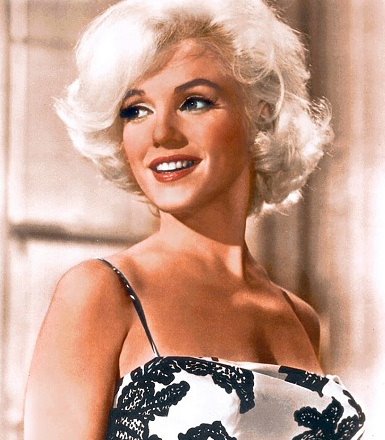
To Marilyn on her 80th

[When Baradwaj Rangan of The New Indian Express asked if I could send in a quick, impromptu piece about Marilyn Monroe – the peg being that her 80 birth anniversary went by recently – I forgot all about my phobia of short deadlines and made a beeline for the laptop. Not because I’m a big MM fan, but because it gave me an all-too-rare opportunity to write something about Old Hollywood – which was the one subject I could comfortably have done many long theses on in my adolescent years. This piece, especially the snippets on some films at the end, was a happy change from some of the writing I've recently been doing.]

Of
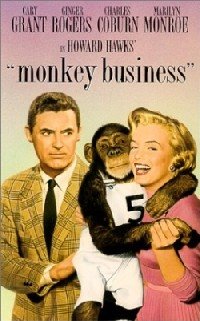
Marilyn Monroe's many early films, one that deserves to be revisited is Howard Hawks' Monkey Business. In this madcap 1952 comedy, Marilyn – no longer an ingénue but not yet a star – played second fiddle to a baby chimpanzee as well as to the human leads, Cary Grant and Ginger Rogers, but she was both wide-eyedly endearing and arrestingly sensual in her short role – a combination that set the tone for the rest of her career. The movie never became part of the Marilyn cult and for that reason it's refreshing to watch today – a reminder that there was more to her than the scenes that have been so widely referenced and parodied over the decades: "Diamonds are a Girl's Best Friends", the skirt billowing up over the New York subway grating, the movie stills with the femme fatale posing languidly against the background of the Niagara Falls. In Monkey Business one can see the rough outline of the image that would make MM one of the icons of 20th century popular culture, without being overwhelmed by the image itself. Somehow, even the fact that the film is in black-and-white helps; it defies the gorgeous Technicolor poster stereotypes one normally associates with the actress. Here, it’s possible to see Marilyn as just another attractive young supporting actress, albeit one with that most elusive of qualities: it’s difficult to keep your eyes off her when she’s on screen, even when she’s sharing space with the great Cary Grant.

The threadbare plot of Monkey Business involves a scientist trying to develop a "fountain of youth" potion. Marilyn, being forever young herself, wouldn't have needed it – she died at 36, quickly becoming one of the many celebrities whose mystique partly lies in the fact that we never saw them old and wrinkled, complaining curmudgeonly about how much things have changed since their day, muttering platitudes about “the pictures getting smaller”.

On June 1 this year she would have turned 80, an idea that's as hard to process as, say, a pot-bellied, 65-year-old Jim Morrison croaking out verses from "An American Prayer" on the David Letterman Show in front of a bored young audience. Or an aged Madhubala being cajoled into playing a silly role in Dev Anand's latest ego project. Cruel as the thought might seem, Marilyn's iconic status probably hinges on her sad early exit. It's hard to imagine her sustaining her stardom past the mid-1960s. Hollywood became leaner and meaner as that decade progressed and despite her latter-day resolve to be taken seriously as an actress, and the Method-acting grit on view in her final film
The Misfits, it's unlikely that she would have been able to effect a 180-degree turnaround in her screen image.

Nor would it have been easy to simply vanish into oblivion.
Greta Garbo managed it, but that was in a less celebrity-obsessed age, and besides Garbo really did "want to be alone". Marilyn probably wouldn't have had the willpower to drop out of sight for good. She was famously insecure, famously needed to be loved and sought after; chances are she would eventually have been sweet-talked out of retirement and made to parody her own screen image in some B-grade summer comedy – perhaps as Britney Spears's hep grandmom in a teen-movie turkey. What better way to shatter the fond memories of millions of film buffs.

So happy birthday to Norma Jean, and may her star shine evermore – even as we allow that had this been a real birthday rather than a birth anniversary, the celebrations may have had to be muted.

Recommendations:


Some Like it Hot
Billy Wilder's acerbic comedy with smashing performances by MM as singer Sugar Kane and by Jack Lemmon and Tony Curtis as murder witnesses in drag. A pox on those who thought Curtis looked hotter than Marilyn!


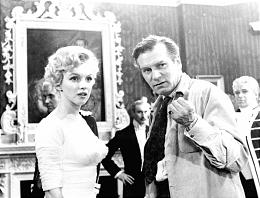
The Prince and the Showgirl
Not a top-notch film but one that's worth seeing just for a demonstration of the
unfathomable mysteries of Star Quality. This was largely an ego project for director-actor Laurence Olivier, trying to show he could step out of Shakespeare mode and make a (relatively) contemporary film opposite a leading Hollywood actress. By all accounts Marilyn, though initially keen to work with one of the world’s most respected classical actors, felt very uncomfortable and out of place during the shooting. Watch the film today, however, and none of that shows; all you see is the Floozy stealing every scene from right under the nose of the Great Actor.

Gentlemen Prefer Blondes
The classic musical about two gold-diggers, played by MM and Jane Russell. Some fine setpieces including the career-defining "Diamonds are a Girl's Best Friends" and quite a few breezy comic scenes. However, it’s difficult today to see why this was her vehicle to stardom: most people now prefer Russell’s knowing performance as MM’s wisecracking friend. And she was a brunette.


Bus Stop
MM’s first attempt at being a "serious actor" – by toning down the make-up to appear unglamorous for her role as a melancholy saloon singer, and more importantly, by turning in a thoughtful, poignant performance. Unfortunately, it still isn’t among her most widely seen films.


P.S. I always thought MM was devoid of mystery thanks to all the hype, but one time I found her genuinely alluring was in that small role in Monkey Business. It’s an avowedly silly film and has dated in some obvious ways, but I recommend it to anyone who likes any or all of the following: Cary Grant; Ginger Rogers; screwball comedies; chimpanzees; and of course, Marilyn.

Tuesday, September 28, 2004

Hitchcock, Notorious and misogyny

Watched Hitchcock’s Notorious last night at the India Habitat Centre. It’s one of my all-time favourites, though the last time I saw it was around six or seven years ago. But I’ve read so much about the film since then and it was interesting to see to what extent my own experience of it would chime with that of others.

Initially I felt the discomfort that comes from protectiveness for a beloved old movie -- will an impatient modern audience be able to open themselves to it, or will they disparage it as quaint and creaky? In this case, I needn’t have worried much since most of the audience present were film buffs and Hitchcock lovers, not multiplex-goers who had accidentally drifted into the screening.

What I wasn’t prepared for was how they reacted to the suspenseful scenes. With all the overanalysis Hitchcock has latterly been subjected to, one often loses sight of his original metier, and it’s always a pleasant surprise to discover that his movies, even the really old ones, still do have the power to move and excite modern-day audiences. Some first-time viewers at yesterday’s screening reacted in exactly the same way to key scenes as the original 1946 audience would have (leaning forward in their seats, clutching the armrests, hissing things like "get out before it’s too late!" to the characters onscreen). I had a similar experience when I showed Psycho to a friend a few years ago. Had never expected her to react viscerally, given all that we’re told about today’s audiences being innured (thanks to the much-increased blood-and-gore that films like Psycho paved the way for).

In Notorious and Vertigo, Hitchcock made two of the most unabashedly romantic movies in film history, though neither is a conventional love story. The strange love triangle in Notorious is far more important to the film than the silly plot-pushing device (the Macguffin) of the uranium-filled bottles and the Nazi conspirators. Watching the film, I was struck yet again by the ridiculousness of the charge that the director was a misogynist. One of my favourite rebuttals to this charge comes from Camille Paglia, who was delightfully voluble about the topic in an interview she gave to Karl French for a book on screen violence in 1996.

French: I agree he was a great director, but he was nakedly misogynistic...

Paglia: I don’t accept this. That is an absurd argument. We’re talking about a man who made films in which are some of the most beautiful and magnetic images of women that have ever been created. I mean, for heaven’s sake, to call that misogynistic, when we think of Grace Kelly in To Catch a Thief, when we think how fabulous Janet Leigh is in that shower scene, we think of Kim Novak in Vertigo...what I’m saying about all of the great artists from Michelangelo to Botticelli to everyone else is that in the fascination with these goddess-like figures of women there is an ambivalence, a push-pull in it, a complexity of response, but to stress the negative in Hitchcock...? I think you need far more complex terminology to deal with people who achieve at the level Hitchcock did. The women he created, for heaven’s sake, have absolutely dominated the imagination of late twentieth-century cinema. Everyone’s imitating it, everywhere, to this day."


(Here’s a little more on the subject from Paglia.)

Now Ingrid Bergman looks breathtaking in Notorious -- and for my money it’s her definitive role -- but I should think it’s also self-evident to anyone who watches the film that her character gets far more sympathy from the director than either of the two male protagonists. One man (Cary Grant) can’t bring himself to admit he loves her until it’s almost too late; takes advantage of her love for him, using her to infiltrate a spy ring; and then mopes around sullenly until good sense finally prevails. The other man (Claude Rains) does genuinely care for her, we feel, but uhh...he’s also the Nazi villain. Major roadblock to sympathy, that. To appreciate Notorious fully, it’s imperative to be able to empathise with the Bergman character -- to see her as she really is, not as the manipulative men in her life depict her.

Notorious now joins the painfully short list of Hitchcock movies I’ve seen on the big screen -- the others being Vertigo (terrible print, dating from before the film’s restoration), Psycho and Strangers on a Train. Hope I don’t have to wait too long for the next one.