[Here's the full text of the essay I did for Zubaan's anthology about motherhood. The book has plenty more in it, of course, including excellent pieces by Anita Roy, Manju Kapur, Shashi Deshpande and others. Look out for it - gift, spread the word etc.
Note: the "Motherly vignettes" section was meant to be a stand-alone thing, published either as a box or in different font, to mark it from the rest of the text, and perhaps to mirror the detours and interludes so often present in mainstream Hindi cinema. Didn't work out that way, but I've included it here]
-------------------------
Around the age of 14 I took what was
meant to be a temporary break from Hindi cinema, and ended up staying away for
over a decade. Years of relishing masala movies may have resulted in a form of
dyspepsia – there had been too many overwrought emotions, too much
dhishoom dhishoom, too much of the strictly regimented
quantities of Drama and Action and Tragedy and Romance and Comedy that existed
in almost every mainstream Hindi film of the time. Besides, I had developed a
love for Old Hollywood, which would become a gateway to world cinema, and
satellite TV had started making it possible to indulge such interests.
One of my catalysts for escape was
Alfred Hitchcock’s Psycho, a film that is – among many other
things – about a strange young man’s special relationship with his equally
strange mother. I won’t bother with spoiler alerts for such a well-known
pop-cultural artefact, so briefly: Norman Bates poisons his mom, preserves her body,
walks around in her clothes and has conversations with himself in her voice. In
his off-time, he murders young women as they shower.
None of this was a secret to me when I
first saw the film, since a certain Psycho lore existed in my
family. Years in advance, I had heard jokes about “mummification” from my own
mummy – apparently, in the early 60s, her school-going brother had returned
from a movie-hall and informed their startled mother that he wished to keep her
body in a sitting position in the living room after she passed on.
Hitchcock’s film had a big effect on
the way I watched and thought about movies, but I must admit that my own
relationship with my mother was squarer than Norman’s. We quarrelled
occasionally, but always in our own voices, and taxidermy did not obtrude upon
our lives. Looking back, though, I think we could be described as
unconventional in the context of the society we lived in. I was a single child,
she was recently divorced, we had been through a lot together and were very
close. But we were both – then, as now – private people, and so the
relationship always respected personal space. We didn’t spend much time on
small talk, we tended to stay in our own rooms for large parts of the day (and
this is how it remains, as I type these words in my shabby freelancer’s
“office” in her flat). Yet I always shared the really important stuff with her,
and I never thought this was unusual until I heard stories about all the things
my friends – even the ones from the seemingly cool, cosmopolitan families –
routinely hid from their parents: about girlfriends, or bunking college, or
their first cigarette.
 Some of this may help explain why I was
feeling detached from the emotional excesses of Hindi cinema in my early teens.
In his book on Deewaar, the historian Vinay Lal notes, “No
more important or poignant relationship exists in Indian society than that
between mother and son, and the Hindi film best exemplifies the significance of
this nexus.” That may be so, but I can say with my hand on my heart (or
“mother-swear”, if you prefer) that even at age 14, I found little to relate to
in Hindi-film depictions of mothers.
Some of this may help explain why I was
feeling detached from the emotional excesses of Hindi cinema in my early teens.
In his book on Deewaar, the historian Vinay Lal notes, “No
more important or poignant relationship exists in Indian society than that
between mother and son, and the Hindi film best exemplifies the significance of
this nexus.” That may be so, but I can say with my hand on my heart (or
“mother-swear”, if you prefer) that even at age 14, I found little to relate to
in Hindi-film depictions of mothers.
Can you blame me though? Here, off the
top of my head (and with only some basic research to confirm that I hadn’t dreamt
up these wondrous things), are some of my movie memories from around the time I
left the mandir of Hindi cinema:
* In the remarkably bad JamaiRaja, Hema Malini is a wealthy tyrant who makes life difficult for
her son-in-law. Some of this is played for comedy, but the film clearly
disapproves of the idea of a woman as the head of the house. Cosmic balance is restored only
when the saas gets her comeuppance and asks the
damaad’s forgiveness. Of course, he graciously clasps her
joint hands and asks her not to embarrass him; that’s the hero’s privilege.
* In Sanjog, when
she loses the little boy she had thought of as a son, Jaya Prada glides about
in a white sari, holding a piece of wood wrapped in cloth and singing a song
with the refrain “Zoo zoo zoo zoo zoo”. This song still plays incessantly in
one of the darker rooms of my memory palace; I shudder whenever I recall the
tune.
* In Aulad, the
ubiquitous Jaya Prada is Yashoda who battles another woman
(named, what else, Devaki) for custody of the bawling Baby Guddu, while
obligatory Y-chromosome Jeetendra stands around looking smug and noble at the
same time.
* In her short-lived comeback in
Aandhiyan, a middle-aged Mumtaz dances with her screen son
in a cringe-inducingly affected display of parental hipness. “Mother and son
made a lovely love feeling with their dance and song (sic),” goes a comment on
the YouTube video of the song “Duniya Mein Tere Siva”. Also: “I like the
perfect matching mother and son love chemistry behind the song, it is a eternal
blood equation (sic).” The quality of these comments is indistinguishable from
the quality of the film they extol.
 * And in Doodh kaKarz, a woman breastfeeding her child is so moved by the sight of a
hungry cobra nearby that she squeezes a few drops of milk out and puts it in a
bowl for him. The snake looks disgusted but sips some of the milk anyway.
Naturally, this incident becomes the metaphorical umbilical cord that
* And in Doodh kaKarz, a woman breastfeeding her child is so moved by the sight of a
hungry cobra nearby that she squeezes a few drops of milk out and puts it in a
bowl for him. The snake looks disgusted but sips some of the milk anyway.
Naturally, this incident becomes the metaphorical umbilical cord that  attaches
him to this new maa for life.
attaches
him to this new maa for life.
As one dire memory begets another, the
title of that last film reminds me that two words were in common currency in
1980s Hindi cinema: “doodh” and “khoon”. Milk and blood. Since these twin
fluids were central to every hyper-dramatic narrative about family honour and
revenge, our movie halls (or video rooms, since few sensible people I knew
spent money on theatre tickets at the time) resounded with some mix of the
following proclamations:
“Maa ka doodh piya hai toh baahar
nikal!” (“If you have drunk your mother’s milk, come out!”)
“Yeh tumhara apna khoon hai.” (“He is
your own blood.”)
“Main tera khoon pee jaaoonga.” (“I
will drink your blood.”)
 Both liquids were treated as equally
nourishing; both were, in different ways, symbols of the hero’s vitality. I
have no recollection of the two words being used together in a sentence, but it
would not amaze me to come across a scene from a 1980s relic where the hero
says: “Kuttay! Maine apni maa ka doodh piya hai. Ab tera khoon piyoonga.”
(“Dog! I have drunk my mother’s milk, now I will drink your blood.”) It would suggest
a rite of passage consistent with our expectations of the über-macho lead: as a child you drink mother’s milk, but you’re all
grown up now and bad man’s blood is more intoxicating than fake Johnnie Walker.
Both liquids were treated as equally
nourishing; both were, in different ways, symbols of the hero’s vitality. I
have no recollection of the two words being used together in a sentence, but it
would not amaze me to come across a scene from a 1980s relic where the hero
says: “Kuttay! Maine apni maa ka doodh piya hai. Ab tera khoon piyoonga.”
(“Dog! I have drunk my mother’s milk, now I will drink your blood.”) It would suggest
a rite of passage consistent with our expectations of the über-macho lead: as a child you drink mother’s milk, but you’re all
grown up now and bad man’s blood is more intoxicating than fake Johnnie Walker.
Narcissists,
angry young men and deadly guitars
All this is a complicated way of saying
that I do not, broadly speaking, hold the 1980s in high esteem. But
that decade is a soft target. Casting the net much wider, here’s a proposal:
mainstream Hindi cinema has never had a sustained tradition of interesting
mothers.
This is, of course, a generalisation;
there have been exceptions in major films. Looming over every larger-than-life
mother portrayal is Mother India, which invented (or at
least highlighted) many of the things we think of as clichés today: the mother
as metaphor for nation/land/nourishing source; the mother as righteous avenging
angel, ready to shred her own heart and shoot her wayward son if it is for the
Greater Good. Despite the self-conscious weightiness of this film’s narrative,
it is - mostly - possible to see its central character Radha as an individual first and
only then as a symbol.
But a basic problem is that for much of
her history, the Hindi-film mother has been a cipher – someone with no real
personality of her own, existing mainly as the prism through which we view the
male lead. Much like the sisters whose function was to be raped and to commit
suicide in a certain type of movie, the mother was a pretext for the playing
out of the hero’s emotions and actions.
Anyone well acquainted with Hindi
cinema knows that one of its dominant personalities has been the narcissistic
leading man. (Note: the films themselves don’t intend him to be seen
thus.) This quality is usually linked to the persona of the
star-actor playing the role, and so it can take many forms: the jolly
hero/tragic hero/romantic hero/anti-hero who ambles, trudges or swaggers
through the world knowing full well that he is its centre of attention.
(Presumably he never grew out of the maa ka laadla mould.)
So here is Raj Kapoor’s little tramp smiling bravely through his hardships, and
here is the studied tragic grandiosity of Dilip Kumar, and here is Dev Anand’s
splendid conceit (visible in all the films he made from the mid-1960s on) that
every woman from age 15 upwards wants only to fall into his arms. In later
decades, this narcissism would be manifest in the leading man as the vigilante
superhero.
 A maa can easily
become a foil for such personalities – our film history is dotted with
sympathetic but ineffectual mothers. Though often played by accomplished
character actors such as Achala Sachdev and Leela Mishra, these women were
rarely central to the movies in question. If you have only a dim memory of Guru
Dutt’s Pyaasa, for example, you might forget that the
self-pitying poet (one of the most doggedly masochistic heroes in our cinema)
has a mother too – she is a marginalised figure, watching with some perplexity
as he wanders the streets waiting for life to deal him its next blow. And her
death adds to the garland of sorrows that he so willingly carries around his
neck.
A maa can easily
become a foil for such personalities – our film history is dotted with
sympathetic but ineffectual mothers. Though often played by accomplished
character actors such as Achala Sachdev and Leela Mishra, these women were
rarely central to the movies in question. If you have only a dim memory of Guru
Dutt’s Pyaasa, for example, you might forget that the
self-pitying poet (one of the most doggedly masochistic heroes in our cinema)
has a mother too – she is a marginalised figure, watching with some perplexity
as he wanders the streets waiting for life to deal him its next blow. And her
death adds to the garland of sorrows that he so willingly carries around his
neck.
 While Dutt made a career out of not
smiling, the protagonist of Raj Kapoor’s bloated Mera Naam
Joker earned his livelihood by making people laugh. Essentially,
however, Raju the clown is as much of a sympathy-seeker as the poet in the
gutter is. Mera Naam Joker includes a magnificently maudlin
scene where the joker continues with his act (“The show must go on!” growls
circus-master Dharmendra) just a few minutes after learning that his mother has
died. As he smiles heroically through his pain, his friends watching backstage
wipe their tears – cues for the film’s viewer to do the same.
While Dutt made a career out of not
smiling, the protagonist of Raj Kapoor’s bloated Mera Naam
Joker earned his livelihood by making people laugh. Essentially,
however, Raju the clown is as much of a sympathy-seeker as the poet in the
gutter is. Mera Naam Joker includes a magnificently maudlin
scene where the joker continues with his act (“The show must go on!” growls
circus-master Dharmendra) just a few minutes after learning that his mother has
died. As he smiles heroically through his pain, his friends watching backstage
wipe their tears – cues for the film’s viewer to do the same.
Speaking of Raj Kapoor, I often wonder
what impression Russian movie-watchers must have of Indian men and their mother
fetishes. If Kapoor was the most popular Hindi-film star in the former Soviet
Union, an improbable second was Mithun Chakraborty, the stature of whose 1982
film Disco Dancer in that part of the world is among the
profoundest cinematic mysteries. (Possibly apocryphal stories are still told
about how Indian visitors to the USSR in the Iron Curtain days could clear
borders by warbling “Jimmy Jimmy” whereupon stern guards would drop their
rifles and wave them through.)
Among Disco Dancer’s
many pleasures is the most thrilling mother-related dialogue in a Hindi film.
Even today, I would walk many a harsh mile to hear the following words echoing
through a movie hall: “Issko guitar phobia ho gaya hai. Guitar ne isske maa ko
maara.” (“He has developed guitar phobia. A guitar killed his mother.”)
This demands some elucidation. Jimmy
(Mithun) has become so popular that his disco-dancing rivals scheme to
electrocute him with a 5000-volt current. But his widowed
maa, having just finished her daily puja for his continued
health and success, learns about this fiendish saazish. She
reaches the venue in time to grab the tampered guitar before Jimmy does, which
results in the most electrifying death scene of a Hindi-movie mother you’ll
ever see.
The subtext to this surreal moment is
that the hero is emasculated by the removal of his mother. As one inadvertently
Oedipal plot synopsis I have read puts it, “After his mother's death
Jimmy finds himself unable to perform. Will he be able to recover from the
tragedy and start performing again?” (Note the contrast with
Mera Naam Joker’s Raju, who does indeed “perform” just a few
seconds after his loss – but no one doubts that he is now a hollow shell of a
person.)
As these scenes and countless others
indicate, Hindi cinema loves dead moms. In the same year as Disco
Dancer, there was an overhyped “acting battle” between Dilip Kumar
and Amitabh Bachchan in Shakti. It played out through the
film, but never as intensely as in the scene where the mutinous son tries to
reach out to his policeman dad in the room where the dead body of Sheetal (wife
and mother to the two men) lies. In the context of the narrative, the mother’s
corpse becomes the final frontier for a clash of ideologies and life
experiences.
****
I’m surprised at how long it has taken
me to arrive at Bachchan, given that all my early movie-watching centred on him
– and also given that no other major Hindi-film personality has been as
strongly associated with filial relationships. But perhaps I’ve been trying to
repress a memory. One of the last things I saw before forsaking Bollywood in
1991 was this scene from the fantasy film Ajooba. Bachchan
(makeup doing little to conceal that he was playing half his age) brings an old
woman to the seaside where a dolphin is splashing about, beaming and making the
sounds that dolphins will. With sonly fondness in his eyes and a scant regard
for taxonomical accuracy, AB says: “Yeh machli meri maa hai.” (“This fish is my
mother.”)
 This could be a version of post-modern
irony, for Bachchan had come a long way from the star-making films in which he
played son to the long-suffering Nirupa Roy. Unlike the “mother” in
Ajooba, Roy was a land mammal, but she seemed always to have
a personal lake of tears to splash about in at short notice.
This could be a version of post-modern
irony, for Bachchan had come a long way from the star-making films in which he
played son to the long-suffering Nirupa Roy. Unlike the “mother” in
Ajooba, Roy was a land mammal, but she seemed always to have
a personal lake of tears to splash about in at short notice.
Was that too irreverent? (Am I failing
the test of the good Indian boy whose eyes must lower at the very mention of
“maa”?) Well, respect should ideally be earned. The mothers played by Roy are
good examples of the ciphers I mentioned earlier, and though she often got
substantial screen time, I don’t think it was put to much good use.
Consider an early scene in Prakash
Mehra’s Muqaddar ka Sikander. When the orphan Sikander recovers
Roy’s stolen purse for her, she expresses a wish to be his new mother: “Beta,
ab se main tumhari maa hoon.” “Sach, maa? Tum bahut achi ho, maa,” (“Really,
mother? You are very nice, mother”) he replies. Having rushed through these
lines, they then exit the frame together in the jerky fast-forward style of the
silent era’s Keystone Kops. There is a reason for the haste: the audience wants
to see the adult Sikander (Bachchan), so the preamble must be dispensed with.
But the result is the trivialising of an important relationship – we are simply
told that they are now mother and son, and that’s that. It’s
a good example of character development scrubbing the shoes of the star system.
Manmohan Desai’s Amar Akbar
Anthony is another movie very dear to my heart (and a genuine classic
of popular storytelling), but it would be a stretch to claim that Roy’s Bharati
(you know, the woman who simultaneously receives blood from her three grown-up
sons) is a fleshed-out person. Medically speaking, she scarcely appears human
at all: in the first minutes of the film we learn that Bharati is suffering
from life-threatening tuberculosis; a while later, she carelessly loses her
eyesight and the TB is never again mentioned; years pass and here she is,
distributing flowers, haphazardly stumbling in and out of the lives of the
three heroes; eventually her sight is restored by a Sai Baba statue.
But it is well-nigh impossible to write
about Bachchan and his mothers without reference to Yash Chopra’
sDeewaar (and to an extent, the same director’s
Trishul). Deewaar is to Hindi cinema what
the James Cagney-starrer White Heat (“Made it, Ma! Top of
the world!”) was to Hollywood: the most quoted and parodied of all mother-son
movies. In no small part this is because the film was a fulcrum for one of our
most iconic movie personalities, the angry young man Vijay.
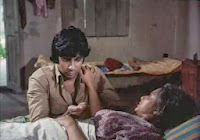
Speaking for myself, childhood memory
and countless spoofs on music channels had turned Deewaar
into a montage of famous images and dialogues: Bachchan brooding outside the
temple; a dramatic pealing of bells and a prolonged death scene; Shashi Kapoor bleating
“Bhai” and, with nostrils flaring self-righteously, the famous line “Mere Paas
Maa Hai.” But when I saw it as an adult, I was surprised by how powerful the
film still was, and how its most effective scenes were the quieter ones. One
scene that sticks with me is when the mother – Sumitra Devi – is unwell and the
fugitive Vijay can’t see her because police have been posted around the
hospital. He waits in a van while his girlfriend goes to check on the level of
security. She returns, tells him things aren’t looking good; and Vijay (who is
wearing dark glasses – a chilling touch in this night-time scene) says in a
deadpan voice, his face a blank slate, “Aur main apne maa tak nahin pahunch
sakta hoon.” (“And I can’t even reach my mother.”) There is no overt attempt at
pathos or irony (how many other Indian actors of the time would have played the
scene this way?), just the stoicism of a man who knows that the walls are
closing in.
In another scene Vijay hesitantly calls
his mother on the phone, arranges to meet her at the temple, then tries to say
something more but can’t get the words out and puts the receiver down instead.
The film’s power draws as much from these discerning beats of silence as from
its flaming Salim-Javed dialogue. However, little of that power comes directly
from the mother’s character. Sumitra Devi is defined by her two sons, and to my
eyes at least, there is something perfunctory and insipid even about the moral
strength she shows.
 There is a tendency, when we assess
Hindi cinema, to make sweeping statements about similar types of movies.
Frequently, I hear that Deewaar and
Trishul are the same film because both are built around the
theme of a son trying to erase his mother’s sufferings by rising in the world –
even literally, by signing deed papers for new skyscrapers, the constructions
she once worked on as a labourer (Vijay, like James Cagney, is trying to make
it to “the top”). But there are key differences in the central character’s
motivations in the two movies, and I would argue that
Deewaar is the superior film overall because it is more
tightly constructed.
There is a tendency, when we assess
Hindi cinema, to make sweeping statements about similar types of movies.
Frequently, I hear that Deewaar and
Trishul are the same film because both are built around the
theme of a son trying to erase his mother’s sufferings by rising in the world –
even literally, by signing deed papers for new skyscrapers, the constructions
she once worked on as a labourer (Vijay, like James Cagney, is trying to make
it to “the top”). But there are key differences in the central character’s
motivations in the two movies, and I would argue that
Deewaar is the superior film overall because it is more
tightly constructed.
However, Trishul
scores in one important regard: it is one of the few Bachchan films where the
mother has a personality. Cynically speaking, this could be because she dies
early in the film and isn’t required to hold the stage for three hours, but I
think it has a lot to do with the performance of Waheeda Rehman – an actress
who made a career of illuminating mediocre movies with her presence.
“Tu mere saath rahega munne,” sings
this mother, who has been abandoned by her lover – the song will echo through
the movie and fuel her son’s actions. “Main tujhe rehem ke saaye mein na palne
doongi” (“I will not raise you under the shade of sympathy”), she tells her
little boy as she lets him toil alongside her, “Zindagani ki kadi dhoop mein
jalne doongi / Taake tap tap ke tu faulad bane / maa ki audlad bane.” She wants
him to burn in the sun so he becomes as hard as steel. He has to earn his
credentials if he wants the right to be called her son.
With a lesser performer in the role,
this could have been hackneyed stuff (in any case the basic premise is at least
as old as Raj Kapoor’s Awaara), but Rehman makes it
dignified and compelling, giving it a psychological dimension that is lacking
in all those Nirupa Roy roles. It’s a reminder that an excellent performer can,
to some extent at least, redeem an unremarkable part. (I would make a similar
case for Durga Khote in Mughal-e Azam, which – on paper at
least – was a film about two imperial male egos in opposition.)
Motherly
vignettes (and an absence)
In discussing these films, I’ve
probably revealed my ambivalence towards popular Hindi cinema. One problem for
someone who tries to engage with these films is that even the best of them tend
to be disjointed; a critic is often required to approach a movie as a collection of
parts rather than as a unified whole. Perhaps it would be fair then to admit
that there have been certain “mother moments” that worked for me on their own
terms, independently of the overall quality of the films.
One of them occurred in – of all things
– a Manoj Kumar film. Kumar was famous for his motherland-obsession,
demonstrated in a series of “patriotic” films that often exploited their
heroines. (See Hema Malini writhing in the rain in Kranti,
or Saira Banu in Purab aur Paschim, subject to the
controlling male gaze that insists a woman must be covered up – after the hero
and the audience has had a good eyeful, of course.) But one of his rare
non-patriotism-themed films contains a weirdly compelling representation of the
mother-as-an-absent-presence. The film is the 1972 Shor,
about a boy so traumatised by his mother’s death that he loses his speech, and
the song is the plaintive Laxmikant-Pyarelal composition “Ek Pyaar ka Nagma
Hai”.
 In too many Hindi movies of that time,
ethereal music is played out to banal images, but this sequence makes at least
a theoretical nod to creativity. The visuals take the shape of a shared
dream-memory involving the father, the little boy and the mother when she was
alive; the setting is a beach and the composite elements include a violin, a
drifting, symbolism-laden bunch of balloons, and Nanda. Mirror imagery is used:
almost every time we see the mother or the boy, we also see their blurred
reflections occupying half the screen; occasionally, the lens focus is tinkered
with to make both images merge into each other or disappear altogether. Even
though the setting is ostensibly a happy and “realist” one, Nanda is thus
rendered a distant, ghostly figure.
In too many Hindi movies of that time,
ethereal music is played out to banal images, but this sequence makes at least
a theoretical nod to creativity. The visuals take the shape of a shared
dream-memory involving the father, the little boy and the mother when she was
alive; the setting is a beach and the composite elements include a violin, a
drifting, symbolism-laden bunch of balloons, and Nanda. Mirror imagery is used:
almost every time we see the mother or the boy, we also see their blurred
reflections occupying half the screen; occasionally, the lens focus is tinkered
with to make both images merge into each other or disappear altogether. Even
though the setting is ostensibly a happy and “realist” one, Nanda is thus
rendered a distant, ghostly figure.
I’m not saying this is done with anything resembling
sophistication – it is at best an ambitious concept, shoddily executed; you can
sense the director and cinematographer constrained by the available technology.
But the basic idea does come through: what we are seeing is a merging of past
and present, and the dislocation felt by a motherless child.
[While on absent mothers, a quick aside
on Sholay. Ramesh Sippy’s iconic film was heavily inspired
by the look of the American and Italian Westerns, but it also deviated from the
Hindi-film idiom in one significant way: in the absence of a mother-child
relationship. The only real mother figure in the story, Basanti’s sceptical
maasi, becomes a target of mirth in one of the film’s
drollest scenes. Most notably, the two leads Veeru and Jai (played by
Dharmendra and Bachchan) are orphans who have only ever had each other. We tend
to take Sholay for granted today, but it’s surprising, when
you think about it, that the leading men of a Hindi movie of the time should so
summarily lack any maternal figure, real or adopted.]
 In Vijay Anand’s thriller
Jewel Thief, a clever deception is perpetrated on the
viewer. Early on, Vinay (Dev Anand) is told that Shalu (Vyjayantimala) is
pining because she has been abandoned by her fiancé. This provides a set-up for
the song “Rula ke Gaya Sapna Mera”, where Vinay hears Shalu singing late at
night; we see her dressed in white, weeping quietly; the lyrics mourn her loss;
our expectations from seeing Dev Anand and Vyjayantimala together in this
romantic setting lead us to assume that what is being lamented is a broken love
affair. But later, we learn that though Shalu’s tears were genuine, she was
really crying for a little boy who has been kidnapped (this is, strictly speaking,
her much younger brother, but the relationship is closer to that of a mother
and son, and the song was an expression if it). It’s a rare example of a
Hindi-movie song sequence being used to mislead, and changing its meaning when
you revisit it.
In Vijay Anand’s thriller
Jewel Thief, a clever deception is perpetrated on the
viewer. Early on, Vinay (Dev Anand) is told that Shalu (Vyjayantimala) is
pining because she has been abandoned by her fiancé. This provides a set-up for
the song “Rula ke Gaya Sapna Mera”, where Vinay hears Shalu singing late at
night; we see her dressed in white, weeping quietly; the lyrics mourn her loss;
our expectations from seeing Dev Anand and Vyjayantimala together in this
romantic setting lead us to assume that what is being lamented is a broken love
affair. But later, we learn that though Shalu’s tears were genuine, she was
really crying for a little boy who has been kidnapped (this is, strictly speaking,
her much younger brother, but the relationship is closer to that of a mother
and son, and the song was an expression if it). It’s a rare example of a
Hindi-movie song sequence being used to mislead, and changing its meaning when
you revisit it.
There is also a lovely little scene in
a non-mainstream Hindi film, Sudhir Mishra’s Dharavi.
Cab-driver Rajkaran, his wife and little son are struggling to make ends meet
as one mishap follows another. Rajkaran’s old mother has come to visit them in
the city and one night, after a series of events that leaves the family
bone-tired and mentally exhausted, there is a brief shot of two pairs of sons
and mothers, with the former curled up with their heads in the latter’s laps –
the grown-up Rajkaran is in the same near-foetal pose as his little boy. It’s
the sort of image that captures a relationship more eloquently than pages of
over-expository script.
Breaking
the weepie mould: new directions
One of the funniest mothers in a Hindi
film was someone who appeared only in a photograph – the madcap 1962 comedy
Half Ticket has a scene where the protagonist Vijay (no
relation to the Angry Young Man) speaks to a picture of his
tuberculosis-afflicted mother. TB-afflicted mothers are usually no laughing
matter in Hindi cinema, but this is a Kishore Kumar film, and thus it is that a
close-up of the mother’s photo reveals ... Kishore Kumar in drag. This could be
a little nod to Alec Guinness and Peter Sellers playing women in Ealing Studio
comedies of the 50s, or it could be a case of pre-figuring (since the story
will hinge on Kumar posing as a child). Either way, it is a rare instance in
old cinema of a mother being treated with light-hearted irreverence.
But as mentioned earlier, the more
characteristic mother treatment has been one of deification – which,
ironically, results in diminishment. When the maternal figure is put on  a
pedestal, you don’t see her as someone with flaws, whimsies, or heaven forbid,
an interior life. (One of Indian cinema’s starkest treatments of this theme was
in Satyajit Ray’s 1960 film Devi, with the 14-year-old
Sharmila Tagore as a bride whose world turns upside down when her childlike
father-in-law proclaims her a reincarnation of the Mother Goddess.) And so, if
there has been a shift in mother portrayals in recent times, it has hinged on a
willingness to humanise.
a
pedestal, you don’t see her as someone with flaws, whimsies, or heaven forbid,
an interior life. (One of Indian cinema’s starkest treatments of this theme was
in Satyajit Ray’s 1960 film Devi, with the 14-year-old
Sharmila Tagore as a bride whose world turns upside down when her childlike
father-in-law proclaims her a reincarnation of the Mother Goddess.) And so, if
there has been a shift in mother portrayals in recent times, it has hinged on a
willingness to humanise.
Around the late 1980s, a certain sort
of “liberal” movie mum had come into being. I remember nodding in appreciation
at the scene in Maine Pyaar Kiya where Prem (Salman Khan)
 discusses prospective girlfriends with his mom (played by the always-likeable
Reema Lagoo). Still, when it came to the crunch, you wouldn’t expect these
seemingly broad-minded women to do anything that would seriously shake the
patriarchal tradition. In her younger days Farida Jalal was among the
feistiest of the actresses who somehow never became A-grade stars, but by the
time she played Kajol’s mother in Dilwale Dulhaniya le
Jaayenge, she had settled into the role of the woman who can feel for
young love – and be a friend and confidant to her daughter – while also
knowing, through personal experience, that women in her social setup “don’t
even have the right to make promises”. The two young lovers in this film can be
united only when the heart of the stern father melts.
discusses prospective girlfriends with his mom (played by the always-likeable
Reema Lagoo). Still, when it came to the crunch, you wouldn’t expect these
seemingly broad-minded women to do anything that would seriously shake the
patriarchal tradition. In her younger days Farida Jalal was among the
feistiest of the actresses who somehow never became A-grade stars, but by the
time she played Kajol’s mother in Dilwale Dulhaniya le
Jaayenge, she had settled into the role of the woman who can feel for
young love – and be a friend and confidant to her daughter – while also
knowing, through personal experience, that women in her social setup “don’t
even have the right to make promises”. The two young lovers in this film can be
united only when the heart of the stern father melts.
Such representations – mothers as
upholders of “traditional values”, even when those values are detrimental to
the interests of women – are not going away any time soon, and why would they, if cinema is
to be a part-mirror to society? An amusing motif in the 2011 film No
One Killed Jessica was a middle-aged mother as a figure hiding behind
the curtain (literally “in pardah”), listening to the men’s conversations and
speaking up only to petulantly demand the return of her son (who is on the lam,
having cold-bloodedly murdered a young woman). It seems caricatured at first,
but when you remember the details of the real-life Jessica Lal-Manu Sharma case
that the film is based on, there is nothing surprising about it.
But it is also true that in the
multiplex era of the last decade, mother representations – especially in films
with urban settings – have been more varied than they were in the past. (Would
it be going too far to say “truer to life”? I do feel that the best
contemporary Hindi films are shaped by directors and screenwriters who know
their milieus and characters very well, and have a greater willingness to
tackle individual complexity than many of their predecessors did.)
Thus, Jaane Tu...Ya Jaane
Na featured a terrific performance by Ratna Pathak Shah as Savitri
Rathore, a wisecracking mom whose banter with her dead husband’s wall-portrait
marks a 180-degree twist on every maudlin wall-portrait scene from movies of an
earlier time. (Remember the weepy monologues that went “Munna ab BA Pass ho
gaya hai. Aaj agar aap hamaare saath hote, aap itne khush hote”?) One gets the
sense that unlike her mythological namesake, this Savitri is relieved that she
no longer has to put up with her husband’s three-dimensional  presence! Then
there is the Kirron Kher character in Dostana, much more
orthodox to begin with: a jokily over-the-top song sequence, “Maa da laadla
bigad gaya”, portrays her dismay about the possibility that her son is
homosexual, and she is even shown performing witchery to “cure” him. But she
does eventually come around, gifting bangles to her “daughter-in-law” and
wondering if traditional Indian rituals might accommodate something as alien as
gay marriage. These scenes are played for laughs (and in any case, the son
isn’t really gay), but they do briefly touch on very real
cultural conflicts and on the ways in which parents from conservative
backgrounds often have to change to keep up with the times.
presence! Then
there is the Kirron Kher character in Dostana, much more
orthodox to begin with: a jokily over-the-top song sequence, “Maa da laadla
bigad gaya”, portrays her dismay about the possibility that her son is
homosexual, and she is even shown performing witchery to “cure” him. But she
does eventually come around, gifting bangles to her “daughter-in-law” and
wondering if traditional Indian rituals might accommodate something as alien as
gay marriage. These scenes are played for laughs (and in any case, the son
isn’t really gay), but they do briefly touch on very real
cultural conflicts and on the ways in which parents from conservative
backgrounds often have to change to keep up with the times.
With the aid of nuanced scripts,
thoughtful casting and good performances, other small bridges have been crossed
in recent years. Taare Zameen Par – the story of a dyslexic
child – contains an uncontrived depiction of the emotional bond between mother
and child (as well as the beautiful song “Maa”). At age 64, Bachchan acquired
one of his most entertaining screen moms, the then 94-year-old Zohra Segal, in
R Balki’s Cheeni Kum. A few years after that, the somewhat
gimmicky decision to cast him as a Progeria-afflicted child in
Paa meant he could play son to Vidya Balan, who was less
than half his age. There is quiet dignity in this portrayal of a single working
mother, though the film did kowtow to tradition (and to the ideal of the
romantic couple) by ensuring that she is reunited with her former lover at the
end.
One of the last Hindi films I saw
before writing this piece – another Balan-starrer, the thriller
Kahaani – has as its protagonist a heavily pregnant woman
alone in the city, searching for her missing husband. This makes for an
interesting psychological study because the quality of the film’s suspense (and
the effect of the twist in its tail) depends on our accumulating feelings –
sympathy, admiration – for this mother-to-be, laced with the mild suspicion
that we mustn’t take everything about her at face value. I wasn’t surprised to
discover that some people felt a little betrayed (read: emotionally
manipulated) by the ending, which reveals that Vidya Bagchi wasn’t pregnant
after all – the revelation flies in the face of everything Hindi cinema has
taught us about the sanctity of motherhood.
****
Given Vinay Lal’s observation about the
centrality of the mother-son relationship in Indian society, it is perhaps
inevitable that our films have a much more slender tradition of
mother-daughter relationships. Going by all the gossip over
the decades about dominating moms accompanying their starlet daughters to movie
sets, the real-life stories may have been spicier than anything depicted on
screen. And in fact, one of the scariest scenes from any Hindi film of the last
decade involves just such a portrayal.
 It occurs in Zoya Akhtar’s excellent
Luck by Chance, a self-reflective commentary on the nature
of stardom in Hindi cinema. The young rose Nikki Walia (Isha Sharvani) is doing
one of those cutesy photo shoot-cum-interviews that entail completing sentences
like “My favourite colour is ____.” At one point her mother Neena (Dimple
Kapadia in an outstanding late-career performance), a former movie star
herself, barges into the room and peremptorily begins giving instructions. We
see Nikki’s expression (we have already noted how cowered she is by her
mother’s presence) and feel a little sorry for her. “Neena-ji, can we have a
photo of both of you?” the reporter asks. Neena-ji looks flattered but says no,
she isn’t in a state fit to be photographed – why don’t you shoot Nikki against
that wall, she says, pointing somewhere off-screen, and then sashaying off.
It occurs in Zoya Akhtar’s excellent
Luck by Chance, a self-reflective commentary on the nature
of stardom in Hindi cinema. The young rose Nikki Walia (Isha Sharvani) is doing
one of those cutesy photo shoot-cum-interviews that entail completing sentences
like “My favourite colour is ____.” At one point her mother Neena (Dimple
Kapadia in an outstanding late-career performance), a former movie star
herself, barges into the room and peremptorily begins giving instructions. We
see Nikki’s expression (we have already noted how cowered she is by her
mother’s presence) and feel a little sorry for her. “Neena-ji, can we have a
photo of both of you?” the reporter asks. Neena-ji looks flattered but says no,
she isn’t in a state fit to be photographed – why don’t you shoot Nikki against
that wall, she says, pointing somewhere off-screen, and then sashaying off.
A few seconds later the shoot
continues. “Your favourite person _____?” Nikki is asked. We get a full shot of
the wall behind her – it is covered end to end with a colossal photo of Neena
from her early days. “My mother,” Nikki replies mechanically.
The younger Kapadia in that photo is
breathtakingly beautiful, but as a depiction of a child swallowed up by a
parent’s personality, this brief shot is just as terrifying to my eyes as the
closing scene of Psycho, with Norman Bates staring out at
the camera, speaking to us in his mother’s voice – for all practical purposes,
back in the womb. Luck by Chance contains other scenes
suggesting that the predatorial Neena is bent on putting her daughter through
everything she herself had experienced in the big bad industry. Do these scenes
get additional power from the viewer’s non-diagetic knowledge that in real
life, Dimple Kapadia herself entered the film industry at a disturbingly early
age? You decide. Still, with the history of mainstream Hindi cinema being what
it is, we should be grateful for this newfound variety, for stronger character
development, and for at least some maternal representations
that aren’t drenched in sentimentalism.
We’ve always had the noble,
self-sacrificing and marginalised mothers and we’ll continue to have them – in
cinema, as in life. So here’s to a few more of the other sorts: more Neena-jis,
more sardonic Savitris, a few moms like the hard-drinking salon-owner in
Vicky Donor, not-really-mothers like Vidya Bagchi – and
even, if it ever comes to that, a desi Mrs Bates staring unblinkingly from her
chair, asking her son to please go to the kitchen and make her some
chai instead of ogling at chaalu young
women through the peephole.
 Mother Bates makes her famous appearance in the climax of Psycho, in a creaky (by today’s standards) but unsettling scene in the basement, where we discover that Norman’s mummy is not a living, domineering harridan but a long-dead, carefully preserved corpse. If I had wanted my illusions to be just as well-preserved, I would have avoided going to the museum at all, so that my only mental picture of her would be as she appears in the film. There was something both comical and poignant about seeing her in a glass cage at the Cinémathèque. Bathed in a beam of yellow light, she stood out from a distance in the darkened room; the idea was presumably to make her look spooky, but it also drew attention to her as an exhibit, something that visitors could point and chortle at (or sit down next to and smile stupidly for a camera). Besides, she was unexpectedly small. (What was I expecting? A two-foot-tall skull with shark-like teeth?)
 Looking at other artefacts – the starfish in the jar from Man Ray’s 1928 film The Sea Star, costumes from such movies as Jean Cocteau’s 1946 Beauty and the Beast – was a strange experience too. Props and objects that have such immediate, vivid associations for a viewer can, when removed from their familiar contexts, become banal and smaller than life. Cocteau’s film was in gorgeous black and white, but these costumes were in “real-world” colour and they seemed garish, almost vulgar when set against the images from the film, playing on a screen above. There was a series of still photos from the Beauty and the Beast set, which showed the
  blandly handsome actor Jean Marais applying the layers of makeup that would transform him into the imperious, tragic Beast. For anyone who has been immersed in the otherworldly milieu of Cocteau’s film, these stills are an exercise in demystification; with a movie like that, which gives the impression of having sprung fully formed from an alternate universe, you don’t want to be reminded that it was put together by a cast and crew, who were probably doing mundane things like talking about the day’s news or taking cigarette breaks in between shots.
 Yet such experiences can also bring a new, more measured respect for the creative process – the processes by which everyday things are transmuted into magic and art, with long-term effects on people’s lives and personalities. (I would almost certainly not have become a professional writer if I hadn’t watched Psycho when I did.) Returning to Ma Bates: here is a wrinkled little skull replica, not particularly authentic-looking or scary when you see it in the cold light of day. Yet someone designed it keeping in mind a film’s lighting and colour scheme, and the desired Grand Guignol-like effect of the climactic revelation. They arranged it just so, placing it in a chair that would swivel around dramatically; at the crucial moment a swinging lightbulb cast shadows over it, making the eye sockets seem alive and menacing; and Bernard Herrman’s music score with its screaming violins added to the effect of the scene.


