Showing posts with label And above all - Jeetendra!!. Show all posts

Sunday, September 18, 2011

‘And if you gaze into the abyss, Rahul gazes into you’

It’s probably accurate to say that this blog hasn’t been kind to Jeetendra and his progeny over the years. I’ve written flippant posts about the films he has appeared in – Dharam Veer, The Turning Brain and Nagin among them – and mocked the tendency to credit him “Above All” in movies where he had an inconsequential role. I’ve commented on the pointlessness of Tusshar Kapoor and written rude things about Ekta Kapoor’s serials (including her mangling of a beloved epic: 1, 2, 3, 4, 5, 6) as well as a skit about her encounter with the Goddess Kali. Rereading some of these posts makes me feel like a lowly earthworm wiggling through slush, much like Jeetendra and Reena Roy in that snake dance, and my conscience makes a “tuk tuk” sound like the shuttlecock popping against Jeetu’s badminton racquet in that Humjoli song. But I digress.

Despite my own record of misdemeanours on the subject of Jeetendra, I have now read something that makes me feel deeply sorry for him: this hilarious post from an American humour site about “the 8 manliest foreign movie posters ever”. At number 1 is a Jaani Dushman poster, and don’t miss what the writer has to say about our hero, whom he recasts as a generic “Rahul”. (He also describes poor Sunil Dutt as "an Arabic Ron Jeremy".)

This post has been going viral on the Net. Given its popularity, it’s probable that long after Jeetendra’s distinguished body of work (Ekta and Tusshar included) has been forgotten, he will be remembered in distant countries as “Rahul, who wanted to rape the wolfman”. Would you wish that fate on him? (Take a deep breath before answering: remember, Rahul’s eyes are watching you.)

P.S. Much as I’d like to take credit for the title of this post, it comes from one of the comments on the Cracked.com piece.

Monday, June 27, 2011

More opening credits: Jaal, Chhupa Rustam and Bombay Talkie

(A follow up to this post)

I had a memory of seeing the 1986 film Jaal in a movie hall, probably Green Park's Uphaar: it was a standard-issue potboiler starring Rekha, Mithun Chakraborty and (surprise surprise) Jeetendra in yet another Special Appearance. But what I didn’t remember – until reader Ahmad Tookhi brought it to my attention – were the opening credits of that film. I won't go so far as to say this sequence represents the acme of creativity and artistic ambition in 1980s Bollywood, but it comes close enough. Watch for yourself (it goes on till the 3.40 mark).


Vinod Mehra was a dependable actor at most times, but I think he deserved a special Filmfare Award just for keeping a straight face during these scenes. What must it feel like to see “Colour Consultant”, “Dress Designers” and “Makeup” neatly printed on a door that’s just been slammed in your face? I also enjoy the way he subtly draws the curtain aside so that “Anand Bakshi” is fully visible, and how he appears to have a breakdown on seeing “Annu Malik” written on the wall. (And I wonder how Tanuja felt about having her name written on the road and then coolly stomped on.)

But here’s another inventive title sequence, from Vijay Anand’s 1973 film Chhupa Rustam. (The “money shot” begins a little after the 5-minute mark.)


Have to admit, this is a one-note concept compared to Jaal. Besides, watching it made me dizzy. (It also made me think of Dev Anand’s train reminiscences, as described here.)

Finally, on a less corny note, here's the video of one of my favourite title sequences ever – the beautiful opening of Merchant-Ivory’s Bombay Talkie. Do keep the volume turned up; Shanker-Jaikishan’s music is ethereal.


(I wrote about the sequence, and the film, in this old post, but the video wasn’t online back then.)

Wednesday, June 15, 2011

Up above the world so high...

One of the many pleasing things about Hindi cinema’s multi-starrer culture in the 1970s was the phenomenon of the “And Above All” in the title credits. This was fuelled by ego clashes and by a general tendency to fawn and mollycoddle: when two or more stars were equally popular and had been in the industry for around the same length of time, who would get top billing?

Such insecurity wasn’t peculiar to Bollywood, of course. In his book Tracy and Hepburn, Garson Kanin observed: “Billing appears to be as important as breathing to some actors and actresses. Important films with ideal casts have fallen apart on this issue.” Old Hollywood came up with inventive methods to keep prima donnas happy – for example, two names might be lettered in the shape of an “X” so that neither star could be said to have taken precedence. (If “Humphrey” was placed above “Ingrid”, at least “Bergman” was above “Bogart”.)

But in our movie industry “Above All” was the preferred solution, and if that failed it was always possible to proclaim a “guest” or “friendly” appearance – even when the actor in question had a substantial role. For a good example of title credits gone awry, I offer you Raj Kumar Kohli’s magnificent horror film Jaani Dushman, about a werewolf-like Shaitan with chest hair that would make Anil Kapoor look like the Glaxo baby.

The film’s title sequence begins well enough with straightforward “starring” credits for Sunil Dutt, Sanjeev Kumar and Shatrughan Sinha (the hierarchy of seniority being apparent enough in this trio), but then things get murky. The next credit has Vinod Mehra with a parenthetical “Special Appearance” next to his name, almost as if he were reluctant to get too deeply involved. Likewise Rekha and a bevy of starlets including Neetu Singh, Bindiya Goswami and Sarika (all playing village belles ripe for abduction). But doing a solo number in the middle of all these special appearances is poor Reena Roy, whose name appears without any qualifiers at all. Possibly her agent failed to read the fine print?
 

Then comes a “Guest Artists” series – Yogita Bali, Aruna Irani and suchlike – followed by one of the more intricate credits I’ve seen:

And Above All
Jeetendra
(Special Appearance)

And so it goes. Briefly, here is a movie whose opening titles could be the subject of a thesis. (You can see them halfway through this video, but to get there you’ll have to watch
Amrish Puri reading “The Sixth Pan Book of Horror Stories” and making a monstrous transformation. The scene gives new meaning to the phrase “that book made my hair stand on end”.)

Come to think of it, Jeetendra had quite a romance going with special titles; his “Above All” billing in The Burning Train conjures images of the actor sitting mournfully by himself on the roof of the train compartment while the rest of the cast travels in comfort. (Alas, the credits of this film were so preoccupied with the male stars that they turned the luscious Parveen Babi into a man by spelling her name “Praveen”. Unforgivable.)

In that awful decade commonly referred to as the 1980s, some films exhausted all their creativity within the opening five minutes. Watching something called Do Qaidi on TV, I discovered the title “Dynamic Appearance by Suresh Oberoi” imposed on a still of the thus-honoured actor (who played a fairly inconsequential part in the film). What, one wonders, were these performers and their families thinking as they watched preview screenings? Did little Vivek Oberoi beam with delight when he saw daddy’s name appear on the screen? Did he tell himself, “I’ll grow up and become a movie star too, and then everyone in the whole wide world will call me Dynamic Vivek?” If so, think of the human tragedy unleashed by five words that appeared ever so briefly in a long-forgotten film. It gives new meaning to Larkin's verse about man handing on misery to man.

P.S. Here is Kanin on the subject of Spencer Tracy’s name always appearing before Katharine Hepburn’s in the films they did together:
Tracy’s position as a Metro superstar meant that there was nothing to discuss [...] It was always “Tracy and Hepburn”.

I chided him once about his insistence on first billing.

“Why not?” he asked, his face all innocence.

“”Well, after all,” I argued, “She’s the lady. You’re the man. Ladies first?”

“This is a movie, chowderhead,” he said, “not a lifeboat.”

Friday, November 16, 2007

Jumping jack-son

Earlier today, a sudden epiphany made clear to me the purpose behind Tusshar Kapoor’s seemingly pointless existence. The answer lies buried in an old folk-tale I read in an Amar Chitra Katha long years ago.

I don’t remember all the details but here’s the gist of the story. A fisherman and his young son supplement their daily living by rowing groups of people from one bank of the river to the other. For some reason – overcharging, probably – the customers resent the fisherman and speak badly of him behind his back. The son is deeply disturbed by this criticism and takes it upon himself to improve his father’s image. This he does by redirecting the censure to himself: when he gets to man the boat alone for a few days (because his dad is indisposed), he behaves obnoxiously with the travellers, pushes a few elderly people into the water and such. Soon the customers are cursing the son instead, and praying for the father’s quick return.

Moral of the story: it falls to children to redeem their parents’ reputations, even if they do this at the cost of their own.

Hence Tusshar Kapoor. The man is so gut-churningly dreadful in everything he does (onscreen, at least) that it becomes possible for us to retrospectively appreciate the brilliance of Jeetendra’s career – something we could never do at the time. The dancing on giant pots with Sridevi? The badminton song in Humjoli? The short skirt in Nagin? The white shoes? Even the pencil moustache? All of it looks like High Art now.

See, this is another reason why people have children, and why they get so sensitive about the subject. We should all have Tusshar Kapoors.

[Earlier posts involving Jeetendra’s films and progeny: Dharam-Veer, Nagin/Jaani Dushman, The Turning Brain, Ekta Kapoor’s soaps]

Saturday, October 06, 2007

Suggestion for the day: wax in vain

Bollywood celebrities, we are repeatedly told, are in vogue all over the world, what with Shilpa Shetty slaying racists on British reality TV and Salman Khan slaying the English language in an American-produced film. Now Madame Tussaud’s, that grossly overpriced wax museum, is in felicitation mode, planning a statue of Salman to go with its existing ones of Amitabh, Aishwarya and Shah Rukh. But I think this is a serious waste of money and effort when other candidates exist who are already in an advanced state of ossification.
I speak in particular of Jeetendra, whom I last saw more than a decade ago, when he was over 50 but modeling for something called “30-plus”. So it was immensely surprising to find that he was one of the judges on a dance show called “Jhalak Dikkhla Jaa” and that, remarkably, his appearance didn’t seem to have changed at all from those Sadaa Suhagan/Sindoor/Tohfa days spent in the company of Jaya Prada-Sridevi-Baby Guddu. But as the show progressed, I began to suspect that something was wrong. This Jeetendra looked human all right, especially in the long-shots, but close-ups revealed that only his eyes moved and the rest of him was stiff (if well-preserved). Obviously, parts of his face had been carefully worked on by Norman Bates (“needles, thread, sawdust…the chemicals are the only things that cost anything”). The only other possibility is that the show’s producers have cleverly put together a remote-controlled robot to fill in for him, but this is too far-fetched. (Still, it’s fitting somehow that his daughter has spent the better part of the last decade providing us with homegrown versions of the Stepford Wives.)
And then there’s Dev Anand who, as recent posts may have indicated, has been haunting my dreams for days now. The DVD accompanying his book features him bounding about a room, nodding his head manically and saying things like “Helloooo, dear friends, it’s meeee, Dev Anand, saying hiii to all his fans!”, trying very hard to look alive but not succeeding. The man is still 16 years old in spirit and one must commend this spirit etc, but the evidence of our eyes reminds us that his corporeal bits turned 16 in the month that the Second World War began. And they’re falling apart now. (His corporeal bits, not our eyes.)
I’m not sure whether this refusal to look old is vanity or a collective hormonal imbalance, but either way Madame Tussaud’s can afford to downsize some of their sculptors. All they need to do with these gentlemen is overlay a thin coating of wax and stand them upright in the “Bollywood” section. That way, they can turn their attentions to Salman 40 years hence.

To paraphrase a black-haired Dharmendra in Johnny Gaddaar, "It's not the age, it's the dotage!"
[Note: family members advised me against writing this, saying, “Be respectful of elders.” But since the people mentioned here are so young at heart, I’m sure they won’t mind. Besides, they have no strands of white hair and I have several.]

Sunday, May 20, 2007

Ensemble classics of my boyhood

Not having been to a movie hall in weeks, I suddenly find that the “ensemble film” is hot property in Bollywood, with the release of Salaam-e-Ishq, Honeymoon Travels and Life in a Metro. Haven’t seen any of these yet but I did see – and write about – Naseeruddin Shah’s directorial debut Yun Hota Toh Kya Hota, which had converging narratives about a number of Indians travelling to the US for different reasons.

But this isn’t Bollywood’s first tryst with the ensemble movie. The masala Hindi film has always been episodic by its very nature, requiring pre-formatted doses of comedy, drama, romance and action, neatly measured and sprinkled together like the garnishings on a Burmese dish. So any such film with a large star-cast becomes an ensemble movie by default: if there are three heroes, you know the songs and fight sequences will be divided equally between them. When I was growing up in that magnificently kitschy decade, the 1980s, such films used to be referred to, much more naively, as multi-starrers. Quick notes on some old favourites I’ve rediscovered on TV.


Nagin

Rajkumar Kohli was a master at the forgotten art of gathering a number of heavyweights/has-beens together, giving them the money that might otherwise have been wasted on a script (along with the promise of ego-massaging credits such as “Friendly Guest Appearance By Sanjay Khan”), and convincing them they were participating in something future generations would never forget. In a way, he was right; no one who sees Nagin will ever forget this classic, which begins with Jeetendra, dressed in a short skirt (he’s an ichadaari naag – a snake that turns into a man whenever it wishes to sing Laxmikant-Pyarelal songs – and that’s just how they dress). When he is cruelly shot down by a group of friends (Sunil Dutt, Feroz Khan, Kabir Bedi and other friendly guests) who figured he was just a regular snake in a mini-skirt, his bereaved spouse (Reena Roy) goes on the revenge-trail. This means finding new and innovative ways to dispose of each culprit, but the hardest task is that she occasionally has to disguise herself as her victims’ girlfriends – which means simulating the facial expressions of Rekha, Mumtaz and Yogeeta Bali. Would you wish such a fate on a girl?

Jaani Dushman

Another Kohli epic, billed as India’s first big-budget horror film. A werewolf (we think; it’s hard to tell under all that makeup) goes on a killing spree each time he sees a young bride (dressed in those knee-length frocks that village belles always wore in the 1980s). Since the village people don’t have enough sense to stop holding large weddings, a series of murders occur — until Sunil Dutt, Shatrughan Sinha and others take on the beast in his own backyard, and he turns out to be Sanjeev Kumar, in another of those character roles that he played because he wanted to be “an actor, not a hero”. (Here, as in many of his other films, he’s neither.) Don’t miss the opening scene with Amrish Puri reading a book of “supernatural stories” before abruptly sprouting hair on his back, and the title card that reads “And above all, Jeetendra”.

Kranti

Manoj Kumar’s florid tribute to the patriotic men and women who fought against the evil British Empire in the early 1800s (never mind that the idea of nationalism didn’t even exist back then in the way it does today; people were probably too busy killing each other over caste, state or mohalla to bother with country-love). Kumar plays the anarchist Bharat, whose eagerness to die for the country is indicated by his waggling eyebrows, twitching lower lip, and the way he keeps smearing soil all over his face. Dilip Kumar is his father, “senior Kranti”**, Hema Malini contributes her bit to the cause by writhing about the deck of a boat during a rain-storm while evil British captors, crosses dangling from their necks, leer at her, and Shashi Kapoor is a dashing prince who switches allegiance. Just when you think the British Raj couldn’t possibly deal with any more star power, in struts the ubiquitous Shatrughan Sinha as a brave Pathan who plans to sabotage the Empire’s collective stomach by selling them chana jor garam. Eventually, our stars sing patriotic songs and die heroically ever after. Jeetendra is nowhere to be seen; they couldn’t meet the requirements of his contract, which specified white shoes and/or a snake-dance.

(To be continued)


** In an earlier Manoj Kumar-as-Bharat film, Purab aur Paschim, Dilip Kumar’s real-life missus Saira Banu played a West-corrupted Indian girl who smokes and wears mini-skirts. Bharat redeems this fallen angel, restoring her to the Bharatiya ideal of the pallu-clad bahu (and in the process fulfilling the archetypal Indian male fantasy of possessing a woman by getting her to cover up rather than the other way around). Unconfirmed reports suggest that Dilip Kumar’s appearance in Kranti was a gesture of gratitude.


[Also see this post on The Burning Train]

Wednesday, May 24, 2006

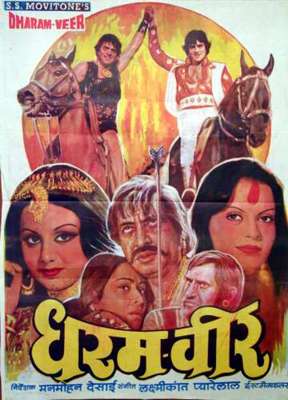
Dharam-Veer: the love that sings its name

Hindi cinema has a long and noble tradition of homo-eroticism, going right back to the aged Aristotle leching at the luscious young Prithviraj Kapoor in Sikandar; but rarely has the theme been presented with such unselfconscious directness, such purity of purpose, most of all with such sweetness, as in the lovely early scenes of Manmohan Desai’s Dharam-Veer wherein Dharmendra (mini-skirted) and Jeetendra (in princely tights) gambol over hill and dale, looking deep into each other’s eyes, clasping hands and singing lyrics that swear undying love: “My life is naught without you” and suchlike. Just watching this song, Frodo and Samwise would have sprouted immense quantities of chest hair and then headed off to the nearest bar to pick up orc-women.

The love of Dharam and Veer for each other is startlingly progressive for 1977, though midway through the sequence the director (perhaps in a bid to throw the censor board folks off track), briefly introduces Zeenat Aman into the song – she plays a haughty princess in a carriage and one shot is cleverly edited to make it seem like Dharam is singing “I will never leave your side” to her rather than to Jeetu. But the illusion is never really convincing; as my observant friend Ajitha pointed out in an SMS, the two men are very mean to her throughout her brief appearance.

Dharam-Veer, one of the many films that defined my worldview as a child, was showing on Set-Max’s correctly titled “Super Cinema Series” last night. This is a great film with many larger-than-life human characters and some surprisingly puny animals. I’m thinking in particular of the small, fluttering hawk that we see on Pran’s shoulder in the early scenes of the film, and the equally diffident tiger that he later does battle with. (Incidentally, watch closely when Pran proposes marriage to his lady love at the beginning of the film. He’s gazing intently into the bird’s eyes throughout his speech. The men in this film really do have issues with women.)

The story
In a palace in an unnamed medieval kingdom somewhere, the villainous Jeevan hears a prophecy stating that his eldest nephew will be responsible for his death. In the manner of all evil maamas since the time of Kamsa, he takes this news in bad spirit and quickly tosses his sister’s newborn baby off the terrace. But the hawk appears, picks up the infant in one swell swoop and deposits him in the house of a poor ironsmith and his wife. So child-lorn are this penurious couple that it never occurs to them to enquire about if someone may have misplaced or lost a baby; instead, with all the stoicism of someone who’s found a 5-rupee coin on an empty road, they accept the baby as their own, and their love ensures that it grows up to become Dharmendra in a mini-skirt (it being decreed in this kingdom that ironsmiths and their sons be so attired). Which does not in any way impede his relationship with the dashing prince Veer (Jeetu).


Meanwhile, Pran dodders bitterly about the countryside (in films of the 1970s and 1980s, no one doddered bitterly like Pran did) with his horse and his hawk, waiting for 20 years to quickly elapse so he can be reunited with his son. And in the palace the villains, led by Jeevan and Ranjeet, scheme to separate the two heroes and thus preserve the heterosexual tradition.


The women
: There are two! In most big-budget multi-starrers made in Bollywood around this time, heroines were inconsequential anyway, but Dharam-Veer goes a step further. While the two heroes are perfunctorily teamed up with Zeenie and Neetu Singh, there’s nothing remotely resembling chemistry between these supposed romantic pairings. The women are so insignificant you can’t even call them foils. (At one point Jeetu teams up with Neetu to rescue Dharam but when the job is done the two men simply ride off together hand in hand, leaving the girl to her fate.)
If Ingmar Bergman’s profoundest films, as we are so often told, are studies of the human face, the greatness of Dharam-Veer lies in the tenderness of the glances exchanged between its two leading men. The film comes alive when they are together. Even when they fight it’s like a lover’s spat, a prelude to the joys of making up.

But unbeknownst to them, they are really long-lost brothers (or cousins, I’m not sure – there were many babies in the early scenes and it got very confusing). This then is what allows the film to return to the path of conformity. Blood is thicker than gay love and clearly Dharam and Veer have no future together other than a platonic, brotherly one. And so they ride off into the sunset together, but this time with their respective heroines, who still look a little confused about their function in this film.


Note
: movie trivia supplied by the TV channel tells us that in 1977 Manmohan Desai released four films – this one, Amar Akbar Anthony, Parvarish and Chacha Bhatija – all of which were golden jubilee hits. Moreover, each of these was based on the lost-and-found theme, a feat that is hopefully unique in film history. (Racking my brain for a comparable directorial achievement in such a short span of time, I can only think of John Ford who, over a 20-month period in 1939 and 1940, released five classics: Drums Along the Mohawk, Young Mr Lincoln, Stagecoach, The Grapes of Wrath and The Long Voyage Home. Unfortunately not one of these movies had a lost-and-found theme, though I did catch an Indian chief grinning lasciviously at Henry Fonda in the first one.)

P.S. Do take a look at this brilliant collection of stills from the gay song (complete with subtitles) on Turbanhead. (Thanks to Brown Magic for the link. I had seen the post many months ago but couldn't find the link when I searched for it through Google.)

P.P.S. Dharam-Veer description from this site: Once Upon A Time In A Kingdom Lived Two Legendary Friends Whose Friendship Came To Be Known As The Eighth Wonder Of The World. This Is He Story Of These Two Friends, Their Loves, Romances, Antics, Bravery Ang Guts, Interwoven With The Intrigues Of State, Justice And Loyalty To There Brethren.

Wednesday, February 22, 2006

Slow brain turning

I have Zee Cinema to thank for renewed acquaintance with many cherished classics from my misspent childhood – such as The Burning Train, which used to be my favourite non-Amitabh film as a seven-year-old (in fact it’s still my favourite non-Amitabh film as a seven-year-old).

Dharam paaji and Vinod Khanna are childhood buddies who serenade Hema Malini and Parveen Babi by cycling after them and singing one of the most instantly forgettable songs of the 1980s (I forget what it was called). This comes on the heels of an elaborate gag where each one pretends to eve-tease the other guy’s girl so that each of them gets to play hero in turn; these shenanigans will provide useful practice for the scenes much later in the film when they have to clamber about the side of the train dressed in smart silver-foil outfits (fuzzy pic below), fighting Danny Denzongpa.

After much coquettish wiggling of noses by the ladies, the two couples settle into happy domesticity and produce a brood of younglings, played by intolerable child actors who make horrible ululating sounds whenever they have to cry (making the viewer want to smack them on the head so they might do some impromptu Method acting instead). The plot of this movie, set a few years after the cycle-serenade episode, ensures there will be plenty for them to cry about.

The best thing about The Burning Train is that the title isn’t an obscure metaphor-ish thingie, as in those movies made by Bresson and suchlike – the film really is about a burning train, or more accurately, a train that is burning. There’s plenty of (intended) metaphor in the story though, with the imperiled chook-chook and its disparate passengers representing the Many Colours of India. Clad in elegant white (a terrifying portent of things to come on satellite television 20 years later) is Simi Garewal as a Catholic schoolteacher escorting a tribe of wailing little monsters. There’s a Hindu priest and a Muslim maulvi who initially squabble but later, faced with certain Death, smile sadly at each other and agree that when you’re being roasted alive in an unstoppable moving oven, religion suddenly doesn’t seem so hot. A loud-voiced but genial Sardarji rounds off this touching panorama. (He will volunteer to unravel his turban later for the Greater Good, just as a lady passenger will remove her sari.) There’s even a pregnant woman, though surprisingly her presence doesn’t lead to any of the “kindly give berth” variety of jokes that I would certainly have incorporated into the script.

Best of all there’s Jeetendra, who shows up halfway through the movie and, without prelude, performs an elaborate dance with Neetu Singh, for once dressed in something other than her favourite fisherwoman outfit (regardless of what she’s playing). When the train starts to burn, Jeetu teams up with Dharam and Veenu and they all change into those silver-foil costumes that people in sci-fi films wear to prevent alien beings from sucking out their mojo.

Jeetu’s white shoes go very well with the foil outfit, and Dharam and Veenu are envious – but they put these differences aside to save the train by doing a series of complicated things (which even they don’t fully understand) in the boiler room, and by kicking Danny off the roof. There is much cheering as Hindus, Sikhs and Muslims embrace: the crisis has united them and never again will there be riots or race-killings. Hema looks appreciatively at Dharam’s silver-foil suit as he gets off the train. “This film is dedicated to the courage of the people, and the soul of India which has remained uncorrupted” says a closing credit. Audiences were courageous enough to stay away from theatres in droves, and The Burning Train was an uncorrupted flop.

[P.S. This film really does have an enormous cast – including Paintal and Keshto Mukherjee, both credited as “Passenger in toilet” on the IMDB page. I must’ve missed that bit.]