Sunday, April 30, 2006

Of spice maidens and asafoetida attacks

"This man may look like an idiot and act like an idiot, but don’t let that fool you. He really IS an idiot!”

Groucho Marx’s forceful words resounded in my head as I watched The Mistress of Spices yesterday. I had expected this film to be so bad (based on the trailers, the news snippets, my knowledge of the storyline, and of course the casting) that I went to see it almost convinced that it would turn out to be enjoyable after all. You know, low expectations beget pleasant surprises and so forth. No such luck. Don’t be fooled by the triteness suggested by the trailers of this film. It really is that trite.

Now it’s understood that the spices in this story are meant to be a – what’s the word, yes, metaphor; a metaphor for Indian traditions/roots/the general mysticism of the East, all of which must be preserved and used with care when you’re living abroad. The problem is, this is a very slight metaphor and it plays out in very foolish ways when it’s taken too seriously. The Mistress of Spices is a film that could have benefited from lightness of tone; instead, it invests considerable dramatic tension in slo-mo pan sequences of cumin seeds and turmeric powder. Lines like “What are you warning me about, chilies?” and “Have I betrayed you, cinnamon?” abound – all delivered in Aishwarya Rai’s just-spent-six-months-in-elocution-class voice.

“She plays the gamut of emotions from A to B,” said Dorothy Parker once of an actress, and Ms Rai brings a whole new dimension to that remark. Her great function is to be the picture-perfect face of Indian Beauty for the West, so naturally she’s afraid to let any trace of expression flit across that face. There are a couple of scenes where she smiles slightly, looks left coyly, looks right coyly, and if you pay attention, around the 40-minute mark her lower lip sort of quivers (unless that was a technical fault). But for the rest she’s so wooden I kept worrying she’d be late for her defumigation appointment.

Like I said, The Mistress of Spices takes its premise very seriously. It opens with a solemn title (presumably for the edification of the Western viewer) that states: “India is a land of myths, magic and tradition. When immigrants from India come to the West they often lose these traditions. This is a story about what happens when such traditions are lost.” A little girl in a village somewhere in India has mysterious magical powers which she uses to warn the elders of impending floods, help locate a lost ring and so on. Bandits come looking for her so she can lead them to treasure. They kill her parents, transport her away in a boat, but she gets free and casts herself into the raging river.

The film could so easily have ended right here, he said wistfully, but the girl survives and comes under the protection of the aphoristically endowed “First Mother”, played by Zohra Sehgal (who I thought of alternately as Mrs Yoda and Old Spice). She names the girl Tilo, trains her and a few others in the magical properties of spices and then transports them to cities around the world, where they must use their knowledge to help people. So now here’s Tilo (Aish) running a large shop called the Spice Bazaar in San Jose, solving customers’ problems by choosing “the right spice” for them. (Did you know turmeric induces tumescence? Okay, I made that up but you get the general idea.) When a soulful young architect named Doug has a motorbike accident outside the shop (“I have to help him, spices! He’s hurt!”), she begins to feel womanly stirrings. But the ghostly spectre of Mrs Yoda appears and warns her that “Chaos will come” if she indulges her own feelings (instead of being selfless like a good Indian).

Doug takes Tilo around San Francisco on his bike, shows her the sights; Aish expresses the ecstasy her character feels by opening her mouth ever so slightly so her lips form a very small oval. But the spice shop has been left unguarded and the spices escape in swirling, powdery hordes! In vengeful wrath they swoop down on the residents of San Francisco, entering their eyes and causing thousands of them to fling themselves screaming from the Golden Gate Bridge. It’s a classic disaster-movie scene. Move over Attack of the Killer Tomatoes, this is Revenge of the Homicidal Haldi!

At this point I wake up in the movie-hall just in time for the last shot; Aish and Doug are lying languidly on a bed of red chillies. With this heartening message of hope and tolerance – Indians can have sex with foreigners as long as they remember to return to the spice shop afterwards – The Mistress of Spices ends.


P.S. Hollywood Reporter describes it as "a universal immigrant story".

Thursday, April 27, 2006

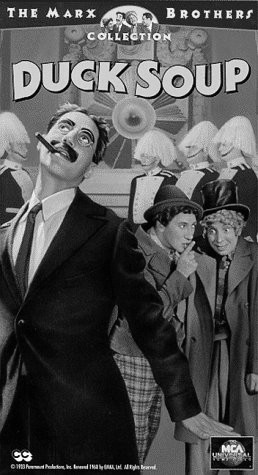
Manic Marxists: Duck Soup revisited

Je suis Marxiste, tendance Groucho” ("I'm a Marxist of the Groucho variety")

- (Attributed to) Jean-Luc Godard

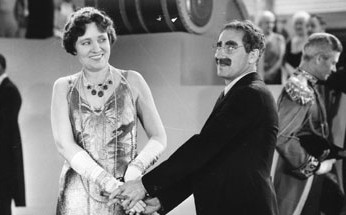
Have to second Godard on that. Watching my DVD of the Marx Brothers' Duck Soup, one of the very greatest of movie comedies, I come to a favourite scene, early in the film. The madcap Rufus T Firefly (played by who else but Groucho Marx, painted moustache and cigar firmly in place) has just been appointed leader of the tiny republic of Freedonia. The amply proportioned Mrs Gloria Teasdale has donated 20 million dollars to save the country from bankruptcy. Mrs Teasdale is played by the delightful Margaret Dumont, who was the prime target for Groucho's many insults in film after film, and this is the first scene between the two in this movie. Naturally, Groucho lays into the woman with his trademark machine-gun delivery of non-sequiturs.


Mrs Teasdale (gushing profusely): As chairwoman of the reception committee, I welcome you with open arms.

Firefly (snapping back): Is that so? How late do you stay open?

Mrs Teasdale (recovering with aplomb): I've sponsored your appointment because I feel you are the most able statesman in all Freedonia.

Firefly: Well, that covers a lot of ground. Say, you cover a lot of ground yourself. You'd better beat it, I hear they’re going to put up an office building where you're standing. You can leave in a taxi. If you can't get a taxi, you can leave in a huff. If that's too soon, you can leave in a minute and a huff. You know, you haven't stopped talking since I came here. You must have been vaccinated with a phonograph needle.

(Groucho delivers the above lines at what seems like 10 words a second.)

The subject of Mrs Teasdale's late husband comes up.


Firefly: Will you marry me? Did he leave you any money? Answer the second question first.

Mrs Teasdale: He left me his entire fortune.

Firefly: Is that so? Can't you see what I'm trying to tell you, I love you!

Mrs Teasdale (rolling her eyes in adoration): Oh, your Excellency!

Firefly (rolling his in imitation): You're not so bad yourself.

And so on. Much as I'd like to, I can't quote all of Groucho's dialogue here - it would take up too much space and it would be pointless anyway, because to appreciate it in the truest sense you have to watch and hear him saying it.

Duck Soup is a brilliant, subversive film about petty politicking and war-mongering, much more potent a satire than Chaplin's The Great Dictator (which was made seven years later). I've heard criticisms about how it doesn't have much of a storyline, that it's just a stitched-together collection of jokes and gags - but this isn't fair. Here's the basic plot: Ambassador of Sylvania calls President of Freedonia an upstart. Latter smacks former with a pair of rubber gloves. Former declares war on latter's country.

That's a good enough storyline for any film, in my ever-so-humble view. But with so much brilliance from the finest set of comedians of the talking era, why would this one need a plot anyway? Like many other Marx Brothers aficionados, I sometimes find it difficult to look beyond Groucho - but Duck Soup provides Chico and Harpo (as a pair of spies) with some of their finest moments too: especially in the running gag about Harpo producing just about anything on demand, including a flaming blowtorch that he has hidden in a coat pocket. And the scene where a real dog emerges, barking, from a house painted on his chest is worthy of a Dali-Bunuel collaboration.

Anyway, watching Duck Soup again, I noticed a few things that hadn't occurred to me before. Firstly, all this talk about Groucho's dialogue delivery being deadpan. In a sense, it is - his voice is completely flat, even when he's saying the absurdest things (which is what makes it so funny). But he isn't straight-faced in the Buster Keaton style: watch his expression after he's tossed off a few insults and is puffing at his cigar before launching into the next round. He always has this amused little look, this slight smile that suggests he's privately surprised people put up with him for as long as they do. This, remember, is the man who once famously said, "I wouldn't want to belong to any club that would want me as a member". (Of course, he also said, "Someday I'd like to join a club and beat you over the head with it.")


The other thing that struck me was how important Margaret Dumont's own personality is in the scenes between her and Groucho. Conventional wisdom tells us that her role in these films was to be a mere foil, a bouncing board for Groucho's lines. But that isn't quite accurate. One of the reasons why the exchanges between them work so well is that Dumont is always so good-natured. At most, when Groucho says something particularly insulting, her brows furrow and she looks around, flustered - but then, a couple of seconds later, she's back to smiling luminously at him. It's almost like a fond aunt indulging a loopy nephew. They get my vote for the Greatest Onscreen Couple ever.

Links: A comprehensive scene-by-scene write-up on the film from Tim Dirks' Film Site. And a nice collection of Groucho quotes.

"Take two turkeys, one goose, four cabbages, but no duck, and mix them together. After one taste, you'll duck soup for the rest of your life." - Groucho Marx

Tuesday, April 25, 2006

Black Swan Green and the child’s eye view

Am three-fourths of the way through David Mitchell’s Black Swan Green, which I’ll be reviewing in a few days. Mitchell has been one of my favourite contemporary novelists ever since I finished his last book Cloud Atlas (review here). One of the motifs running through that dense, complex novel (which was made up of six novellas, each split down the middle, told in six different styles) is the subjugation of one set of people by another; the six stories illustrate the many ways in which power and control are perpetuated.

In comparison Black Swan Green is a much simpler read, but like Cloud Atlas it is concerned with dominance and hegemony – this time in the context of a young boy encountering various threatening aspects of the world around him. Set in 1982 in a small Worcestershire village, this is the story of a 13-year-old, Jason Taylor, dealing with the many terrors of adolescence: a stammering problem that means he has to pre-test each sentence for “danger-words”, a group of bullies at school, the incomprehensibility of the news filtering in from the world beyond the village (including the Falklands War between England and Argentina), and the dark clouds that have started to gather over his parents’ marriage.

Black Swan Green is extremely vivid in its depiction of how lonely and frightening the world can be for a precocious and/or overly sensitive child. Intelligent children are particularly vulnerable, not just to the cruelty of other children but also to that impossible-to-defy power wielded by adults – wherein children, no matter how much they know or how mature they might be at an early age, are expected to stay within well-defined limits, not argue with adults about anything beyond a point (because then it becomes “back-answering”, even if the child is being politely insistent); essentially, “behave like a child”.

There’s a telling little passage early on, where Jason’s mother sweepingly attributes his dislike of sprouts to “adolescent discontent”:
I asked what not liking the taste of sprouts had to do with adolescent discontent. Mum warned me to stop being a Clever Little Schoolboy. I should’ve shut up but I pointed out that dad never makes her eat melon (which she hates) and Mum never makes Dad eat garlic (which he hates). She went ape and sent me to my room. When dad got back I got a lecture about arrogance.
(I always find it a bit rich when adults lecture children about arrogance.)

The above passage, and a few others in the book, touched a chord. As a child, when I got interested in certain subjects I would single-mindedly pursue them for months, read as much as possible about them. This resulted in a comprehensive knowledge of those topics (around the time I was 12 the Mahabharata was one, 1930s and 1940s Hollywood was another) and I got a lot of grief if I happened to correct something an adult had said during a discussion on one of those subjects. Initially they would just look through me as if I wasn’t there, or perhaps smile that horrible, patronising, indulgent smile adults employ to let children know how insignificant they are. But if I supplied proof to back what I’d said (lugging across my Leonard Maltin movie guide, for instance, to show an aunt that Kirk Douglas, not Charlton Heston, was in such-and-such film), the mood would shift to one of near-resentment: how could a mere child have the temerity to show up an adult?

Children are expected to believe that adults, simply by virtue of being adults, have a special perspective on the world, which cannot yet be shared or even questioned. But things are usually more complex and uncomfortable than that, and often have more to do with the most primitive of human instincts: the need to dominate, to enjoy someone else’s helplessness.

Mitchell is also very good at showing how intense and concentrated a child’s life can become when things go wrong – how, at such times, it feels like the whole world is conspiring against you, reveling in your humiliation. One of the finest chapters in Black Swan Green has a traumatised Jason counting down the hours to his “public execution” – he has to perform a reading in front of the whole class the next day and he knows the text will be full of stammer-words. (On another occasion, when he fumbles and can’t get a particular word out of his mouth, this is the description: Miss Throckmorton was waiting. Every kid in the classroom was waiting. Every crow and every spider in Black Swan Green was waiting. Every cloud, every car on every motorway, even Mrs Thatcher in the House of Commons had frozen, listening, watching, thinking, What’s wrong with Jason Taylor?)

Reading Black Swan Green made me think about other books or stories I’ve read that have dealt with the disconnection felt by a precocious child or adolescent, or with the fantasy worlds created by children. Here’s a short list, off the top of my head. (Haven’t thought much about this, so would appreciate more inputs.)

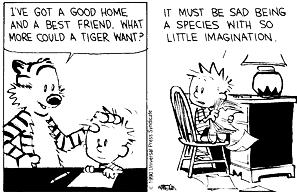
- Calvin & Hobbes: No, I’m not trying to take the fun out of Bill Watterson’s great series by subjecting it to over-analysis (though I do occasionally baulk when I hear people say “Calvin is sho shweet” or “such a loveable brat” in that familiar patronising tone). Calvin & Hobbes is, first and foremost, a very enjoyable comic strip. But it doesn’t take too much effort to see the subtext: an extremely smart, lonely kid building fantasy worlds that are much more immediate and compelling than the real world, with its many constraints.


- Two short stories: Saki’s haunting “Sredni Vashtar”, about a terminally ill child named Conradin, his tyrannical guardian who is determined to deny him every little pleasure, and the polecat-ferret Conradin keeps at the back of the garden; and Roald Dahl’s “The Wish”, an incredibly compelling tale about a little boy inventing a game to be played on a colourful carpet in his house: he has to cross over to the other side by avoiding the reds (which represent fiery coals that will “burn him up completely” if he touches them) and the blacks (which are poisonous serpents). Dahl’s great achievement here is to make it completely irrelevant that this is just make-believe; by the end of the story, the dangers of the carpet are as real to the reader as they are to the child.

- L P Hartley’s The Go-Between, about a young boy who becomes a messenger (and a pawn) in the clandestine love affair between a brusque farmer and young noblewoman – with both of whom he has a strong emotional connection.

- The opening paragraphs of Dickens’ Great Expectations; young Pip meeting the escaped convict in the graveyard: “My first most vivid and broad impression of the identity of things seems to me to have been gained on a memorable raw afternoon towards evening. At such a time I found out for certain that this bleak place overgrown with nettles was the churchyard…”

- And oh well, there’s The Catcher in the Rye and The Bell Jar, but is there really anything left to say about those?

I also think of the flashback sequences in Federico Fellini’s film 8 ½, the scenes of Guido’s childhood: the mysterious chant “Asa Nisi Masa”; the scene where Guido and his friends go to meet a prostitute who is depicted as a giant of a woman, threatening and exaggerated in her sexuality (which is how the adult Guido would remember her); the enormous portraits of saints looking down on and berating Guido in his Catholic school – everything made larger than life, more intimidating.


(Will post a Black Swan Green review next week.)

Sunday, April 23, 2006

Of hairdos and hen-dos: Brideless in Wembley review

Two recent visits to London, brief though they were, helped my appreciation of some of the anecdotes (which I might otherwise have thought exaggerated) in Sanjay Suri’s entertaining Brideless in Wembley. Those trips gave me many memorable insights into the insularity and cultural confusion of Indians living abroad: a sense of the divisions, sub-divisions and sub-sub-divisions not just between one community and another, or one religion and another, but within each community and religion too. These are insights one rarely gets while living in urban, middle-class India, especially if one's family is not heavily into religion or rituals; many things are more easily avoided here.

In London in 2004 I was amused by the response of my uncle’s circle of right-wing buddies to the news that a Congress-led government was coming to power in the home country and that Sonia Gandhi was set to become prime minister. There was serious angst in their conversations about this terrible thing the Indian voters had done in casting the BJP out. “A foreigner becoming PM,” they shuddered. “What has gone wrong with the country we loved and left?” (Okay so they didn’t say it quite that way, but one of my boredom-deflecting techniques on that trip was to construct speech- and thought-bubbles.) Then they would direct sarcastic remarks at waiters at an Italian restaurant, whine about Muslim conspiracies and generally behave like racist boors.

Then, last year, when my Punjabi cousin and his long-time Gujarati girlfriend decided to marry, there was much dismay among the elders on both sides – but especially among the groom’s family, who spent most of the time leading up to the nuptials exchanging “Gujju” jokes in private, and generally shaking their heads and clucking their tongues over this new radicalism that allows youngsters to determine the course of their own lives. At the wedding ceremony, when the bride’s side briefly interrupted the pre-planned schedule with a quick recital of a Jain chant, the groom’s relatives responded by standing up and singing a particularly rumbustious version of “Om Jai Jagdish Hare”. The little games of one-upmanship being played out in this and many other incidents were quite obvious even to an outsider (which is what I felt like though I was surrounded by Indians – including at least a few relatives I'm genuinely fond of when they aren’t busy organising themselves into packs of wolves).

There are doubtless hundreds of more such stories to be told, and many of them can be found in Suri’s book. Brideless in Wembley is essentially a compendium of the author’s encounters with the many Little Indias that have come up in Britain in the decades since the first lot of immigrants travelled uncertainly to the once-Mother Country.

Suri is a journalist based in London since 1990, and observation and reportage are his fortes. The book opens with an account of the Asian presence in Leicester, “the first big town in the West where whites are steadily declining into minority status”, and of some of the earliest settlers from India – people who came to England soon after India’s independence, struggled through years of racism and loneliness, and eventually, by dint of hard work and fortitude, carved a niche for themselves in this foreign land. The author meets some of them and then, in a decision that smacks of whimsy, spends hours at a shopping complex noting the demographics of the thousands of people who pass by, eventually concluding that Leicester isn’t so much multi-cultural as “a city of adjacent cultures” (a variant of “plural mono-culturalism”, Amartya Sen’s term for cultures existing side by side in the same place without ever really interacting).

Ever the questing vole, Suri attends a meeting of Sikhs trying to overrule an order that would make helmets compulsory in high-risk factories; he listens in on a poignantly funny dissection of the turban as protective gear (“for impacts to the front of the head the turban gave 141.7 per cent better protection than a helmet…Sikhs had been known to pick bullets out of their turbans during and after battle”). He learns about the usefulness of the dandia as a courtship ritual in the Gujarati community – a pretext for youngsters to interact with suitable members of the opposite sex, all under their parents’ watchful gaze of course. He notes that Indian youngsters abroad often fall in with their parents’ ways and beliefs to a larger degree than those living in India do. It’s a familiar enough observation, but Suri speculates that this isn’t only because the parents are so unbending in their ways; many of the youngsters are genuinely compliant. “The overwhelming proximity of a wide species of alien cultures and colours brings you closer to your parents than you might otherwise have been.”

At an educational mela where children must learn about Hinduism, there are a series of near-surreal exchanges. (“What’s a Hindu?” asks a teacher. “It lays eggs,” says a child who must have heard “What’s a hen do?”) Suri meets holy celebrities like Morari Bapu, who once performed a katha ritual on board a Jumbo jet, 30,000 feet up. And he interviews the legendary Kailash Puri, agony aunt to thousands of confused NRIs seeking counsel on inter-caste love, lesbianism, virginity and penis size.

The common thread in all these stories is the desperate, almost manic search for identity; the need to belong to a group, to share beliefs. Many of the people Suri meets are ensconced in homogenous little cliques and one can, in a sense, understand their fear that their own culture and traditions might be subsumed by those of others. But what they don’t realise is that by seeking superficial comfort in numbers they are really insulating themselves from vast swathes of other people – including some who are “different” from them in only the most minor ways.

This is illustrated in the author’s description of a cricket match in a local Middlesex league where every player on the field is a Patel, but there are still fine divisions: both teams are Swaminarayan Patels, both from the same 24 villages of Kutch in Gujarat – but they go to different Swaminarayan temples, “and that point of separation alone had made this match possible”. The same story is repeated elsewhere, with small variations. Suri meets the Ravidassias, descendants of families who worked in the leather and hide trade and were considered untouchables; they worship a 14th century preacher named Ravi Das, but this causes friction between the Ravidassias and the larger Sikh community, which does not count Ravi Das among the 10 Gurus. And so it goes.

Brideless in Wembley is a consistently engrossing, informative read, and one that makes its claims explicit early on. “A quick word about what this book is not,” Suri says in his Introduction, “It does not offer dining-table wisdom of the ‘caught-between-two-worlds’ variety…nor is it a history book. I do not have a first chapter called ‘Early Arrivals’ followed by another called ‘Settling In’.” Authors’ warnings of this sort can safely be ignored in most cases, but the reader would do well to heed this one, for this is a book that is best not approached with pre-conceptions about what it should be.

I initially faced that problem myself – I wondered why Suri was moving randomly from one topic to another, instead of trying to provide some sort of overview – and it was only more than halfway through that I made my peace with what he is trying to do here. This is more than anything a book of vignettes, a largely affectionate account of some of the Indian communities living in the UK – of their whims, insecurities, inter-communal and inter-generational divides. The author’s purpose is to observe and record the details of these many lives, not to pass sweeping judgements on them – though he does throw in the occasional sharp commentary when discussing the things parents make their children do in the name of tradition and culture (Muslim youngsters being made to go to madrassas to learn an “Islamic syllabus” in the evenings after regular school hours and recite lines from the Koran without knowing their meaning; five-year-old children “gyrating hips that weren’t there” at Bollywood dance classes where they are primed for possible future careers in the industry; other young children “being pulled into caste long before they’d ever hear that word”).

Brideless in Wembley reads like a book written by someone who is principally a reporter – even the chapter titles have the feel of lazy newspaper sub-heads and captions (“Patel Power”, “London Leather”, “Aunt and Agony”). And it doesn’t work quite so well when Suri tries to be more a writer than a journalist. At such times he produces embarrassingly trite passages like this one (at a meeting of Gujarati limbachias, a caste bound by the detail that their families were traditionally hairdressers):

“I began to survey hairstyles again. They looked no different from hair at any other gathering; for some reason I was disappointed that hair, which had brought everyone together, was not announcing itself in some way…I saw only my eagerness to believe that all hair is special but limbachia hair is more special than
others.”
Or this one, in an otherwise poignant sub-chapter set in an old people’s home:

“The quietness of death seemed to linger in the air – unless I was seeing an imminence of death that they were not.”
But such missteps aside, the strengths of this book are the quality of observation, the eye for detail and the sense of humour running through even the bleakest stories. The discreteness of the chapters and the general lack of structure can make it seem unsubstantial at times, but Brideless in Wembley is best read as a series of (very long) feature stories about Indians in Britain. The book works because these are fine feature stories, with just the right mix of anecdote and insight, and a sharp perspective into lives that are in flux and disarray.

[Have written a slightly extended version of this for Biblio magazine]


[And an earlier post: Bigotry and confusion in NRI-land.]

Friday, April 21, 2006

Vague introspecting

Just back from a short trip that’s been emotionally exhausting but also fulfilling and therapeutic in many ways. And quite an eye-opener; I’ve had to do a lot of introspecting about some of my beliefs, or the things I thought I knew about myself. This was a strange experience because I never thought I had anything like a fixed "worldview". I think of inconsistency as vital to the human condition and I’m always a bit taken aback by the confidence in people’s tone when they say things like "My philosophy of life is such-and-such..." And oh, that old chestnut: "If there’s one thing I can’t stand, it’s hypocrisy" - when said quality is in fact one of the biggest requisites for being a social animal and interacting with others on a daily basis. We’re all hypocrites to some degree or the other, every day of our lives. (Of course, if you want to nitpick about what manifestation of hypocrisy you dislike, that’s your business.)

Bottomline: I’m usually so fluid and inconstant in my beliefs myself that I never expected anything to come as a big revelation. But it’s happened now.

And yes, all this is very nebulous but I don’t yet want to get into the specifics. Might blog about it at length sometime but the post would be obscenely long, and it isn’t something I should just sit down and type out - would prefer to spend some time over it, get my feelings in order etc.

These days even a two-day break from work means an enormous amount of catching up once I’m back. So blogging might slow down a bit, or be restricted to some of my offical writing.

More later.

P.S. I know it seems contradictory to claim I don’t have very firm beliefs - people often tell me my writing is very opinionated. But then writing is, in the final analysis, a very limited mode of expression, and certainly inadequate as an indicator of what a person is really like. Even the most honest, searching writers tend to be much more confused, ambivalent and inconsistent in their everyday lives than their writing would suggest.

Monday, April 17, 2006

Terrence Malick and The New World

Even in blasé, been-there-seen-that Hollywood, a new film by Terrence Malick is an event. The man is one of the genuine auteurs of American cinema, a director whose reputation in cult circles is arguably greater than that of the other, more prolific, more widely known directors who emerged around the same time, in the early 1970s: Scorsese, Spielberg, Coppola and so on.

Much of this has to do with Malick’s Salinger-like reclusiveness and limited output: between 1973 and now, he has directed just four feature-length movies, and there was a gap of nearly 20 years between Days of Heaven and The Thin Red Line. Being reclusive and making films sporadically (rather than having a regular output) doesn’t automatically make you a great artist, but it does suggest that there is a strong purity of purpose in your work; that it flows more from internal compulsions than from, say, the constraints imposed by the studio system, or financial dictates. This is borne out by Malick’s oeuvre. Even a casual viewing of his films (though they aren’t quite conducive to casual viewing!) reveals a very individual style and a powerful, distinct vision of the relationship between human beings and their environment.

The most striking quality about his work is his interest in nature as a whole – as a single entity, with man just one very small cog in the giant machinery. This doesn’t mean that Malick’s films are like National Geographic documentaries – they are feature films, with narrative structures, and built around human stories – but no other director I know is as skilled at creating visual poetry out of the various elements of the natural world: plants, animals, insects, fire, water. Watching most films made by other directors, you feel that they are concerned principally with the human drama (as we, the audience, quite naturally are) – that they don’t much care what’s going on in the background. Even when there’s a lingering shot of a landscape, it usually performs the function of visual relief, or punctuation between scenes, before we return to the main narrative. But watching Malick’s films, you get the (sometimes eerie) sense that he has a special prism of his own: that he’s detached enough to look at members of his own species no differently from the way he looks at the individual trees in a forest, or the individual leaves on a tree, or the blades of grass in a meadow.

And yet, this apparent undermining of the human element doesn’t mean that his movies are clinical or emotionless. Quite the contrary, they have a very particular, heightened emotional quotient – in his best scenes, it’s possible for a viewer to appreciate drama on many different levels, not just the human one. A good example of this was The Thin Red Line, one of the most widely discussed (also among the most widely appreciated, and most widely criticised) films of recent years – ostensibly a war movie, but one that was far less concerned with military strategising and the minutiae of battles than with the interior feelings of the protagonists and their relationship with the terrain they struggled through. It was classified as an “anti-heroic” war film (by critics who made a point of contrasting it with Spielberg’s more conventional war movie Saving Private Ryan, released the same year) – but it was really a film that stood back and coolly showed us how insignificant our conflicts are when set against the larger picture. And it did so without trying to make an obvious moral point.

Malick’s particular brand of filmmaking – his use of interior monologues, for instance, and the long, languid scenes full of nature shots – is fraught with danger: it can easily tip over into self-indulgence, and my admiration for him notwithstanding I was disappointed by his latest film The New World, which I saw yesterday. This is, very briefly, the story of the first English settlers arriving at Jamestown in 1607 and their encounters with the native tribes who have been living in this “new world” for centuries; of the love and empathy that grows between the mutineer John Smith and a young native princess; of the complications that arise from conflicts, both between the settlers and the natives and among the settlers themselves; of Smith’s eventual decision to return to England and the development of a new, more mature relationship between the native girl and another settler, John Rolfe.

Many of the early scenes in this film are very beautiful in the classic Malick style: the initial tentativeness of both the English settlers and the natives, distrust tempered by the desire to trust; a tribal warrior tapping curiously at the armour worn by a settler, almost as if he is trying to work out if this strange creature is really made of flesh and blood underneath, just like himself. And the familiar depiction of nature as sentient and knowing: when two characters wade about on the sea shore, the sound of the waves roaring and the water lapping against their feet seems heightened; it’s almost like a refrain set against their conversation. Other sights and sounds are similarly accentuated: the chirruping of insects, the rustling of blades of grass, a shot of migrating birds in formation, the violence of trees being chopped down by the settlers.

But beautiful though these scenes are, The New World eventually sinks into tedium. The interior monologues don’t have the same effect that they did in The Thin Red Line, partly because the characters don’t carry much weight. Colin Farrell’s performance as John Smith is especially problematic. He’s surprisingly good in a couple of the early scenes, but the bulk of his performance is built on a single puppy-eyed expression that combines bewilderment with vulnerability: it’s like he’s stuck in a phone booth all over again, with an unseen psychopath pointing a gun at him. Christian Bale is nondescript, fine actors like Christopher Plummer and David Thewliss don’t have much to do and the best performer on view, the 14-year-old Q’orianka Kilcher as the tribal princess, can’t salvage the film single-handed.

And yet, even when a Malick film doesn’t work, it can be just as interesting as the successes of many other directors. Watching The New World, I kept thinking how many other directors, given this story to work with, would have belaboured the point about the tragedies that can result from the differences between people; perhaps placed the conflicts between the settlers and the Indians in the larger context of America's violent history. Malick is not very concerned with all this. He is of course concerned in an immediate sense with his protagonists, their thoughts and feelings; but for him the larger picture is much larger than the history of the US or even perhaps the history of humankind.


Also, paradoxically, watching this director work for years on a project only to produce an unsatisfying film at the end of it makes me even more respectful of his approach to his art. A Spielberg can make a turkey one year and then redeem himself the next with a film that is a commercial success (or a critical success, since he swings both ways). A director like Malick doesn’t have that bulwark. He can only trust his instincts, carry on working at the pace he is comfortable with, unmindful of the world outside, and hope that something of his vision actually makes it to the final film and is appreciated, at least by a few. It must be a lonely feeling.

(More on Malick in this post I wrote a long time ago, mainly about his first film Badlands, but also on other elements of his directorial style.)

Sunday, April 16, 2006

Kitab fest - quick notes

I’ve been asked why I haven’t blogged/otherwise written about the Kitab festival. Short answer: I was busy being lazy while the fest was on. I had a very nice time at Kitab – was there pretty much throughout, on all the three days – but I wasn’t too concerned with being a good journalist. I attended most of the panel discussions, enjoyed many of them, even scribbled notes here and there, but I didn’t speak at length with the authors/participants in between sessions. And I generally took advantage of not having committed to covering the event for any publication.

In a way, this was what made Kitab so enjoyable for me: being able to stroll leisurely about one of my favourite places (the India Habitat Centre) in between the scheduled events, soaking in the sun (surprisingly the weather wasn’t unpleasant on any of the days) and conversation, meeting friends from the literary circuit, renewing old acquaintances, making new ones, just talking lazily – all the while knowing that it would take just 5 minutes to pop across to the American Diner or Eatopia for a quick sandwich. No obligations. The whole thing was…idyllic, and that’s a word I can rarely use for events of this sort, where I usually have to keep a lookout for possible stories or interviews. It was like being able to pick up a book and just read it from start to finish, without any fuss, without constantly making mental notes or thinking about what you’ll write in the review.

Also, on the first day and for the first half of the second day I was a little nervous about my own panel discussion: so I spent some time by myself, getting into a comfort zone with the auditorium.

Hence no detailed write-up. But here, mainly as a way of setting down notes for future reference, are some quotes:

- Many of us were impressed by the soft-spoken eloquence of Nadeem Aslam, author of that wonderful book Maps for Lost Lovers. At a panel discussion on whether globalisation limits the types of stories that writers can tell, Aslam had for company far more fluent, confident speakers like Shashi Tharoor and Rana Dasgupta: yet his little talk was the one that moved the audience the most. Aslam used the analogy of a small circle that contains a certain set of feelings within it: a mother’s feelings on seeing her child’s dead body, for instance. “The emotions here would be universal, the same for mothers around the world,” he said, “you’d be able to place them all within that circle. But when you move to the larger question of how the child died – whether in a road accident or perhaps an act of terrorism – you find that you have to step outside this circle to define different sets of experiences for people living in different parts of the world.”

- Later, participating in a discussion on Muslims in the media, Aslam articulated his dilemma post-9/11. “Before September 11, 2001,” he said, “if someone asked me was I a Muslim, I would have said: probably not. Because I don’t fast, or worship, or believe in God. But after the terrorist attacks on NYC, it became imperative to define myself in terms of my religious identity – if only to let people know that Muslims don’t only crash planes into buildings, they live peaceful, constructive lives too.”

- From the irrepressible Shashi Tharoor at the globalisation discussion: “Ultimately it’s important to realise [even while we marvel at the world having become a global village] that most lives are still lived behind national frontiers. Having largely spent the last century in making the world a safe place for democracy, hopefully we’ll now be able to keep it safe for diversity as well.”

- “I get the impression that Bihar is like India’s Alabama,” said Somini Sengupta, New York Times journalist. “Indians think of it in the way they fear others think of them.”

- The panel discussion “From snake charmers to call centres”, about new trends in literature and reportage from South Asia, drew a lot of tangential questions and comments from the audience. One gent was quite amusing in his indignation about Hindi film stars who answer questions in English even when being interviewed by Hindi news channels. Equally amusing was Rahul Bose’s ultra-defensive counter – that one mustn’t assume these actors are fluent in Hindi just because they work in the medium: “for many of them, English is a first language”. As Pavan Varma rightly pointed out later, this argument might hold good for Bose himself, but it scarcely applies to many Bollywood stars, given the quality of the English they speak.

- And in the middle of all this, a delightfully non-politically correct remark from Siddharth Dhanvant Shanghvi, clearly fed up with accusations of writers not writing about the “real India”. “Small-town India is not my reality,” he snapped, “and I’m not planning to go there anytime soon.” (Incidentally, Shanghvi wore a shiny green shirt and a little grey tie, and carried a small briefcase. Very spiffy.)

- Most of us are still scratching our heads over how exactly American actress Goldie Hawn fit into an “Indo-UK literary festival”, but she was, as expected, the piece de resistance: by far the largest audience was present for her session on Saturday. Much jollity was experienced while listening to her account of driving through the villages of Rajasthan in the 1970s and “being invited into huts to share chapattis”, and how happy these poor people in Indian villages looked compared to all the rich people who roamed around vacuously in malls in America. Also her account of a profound spiritual experience in an ashram, where she “sank inwardly into myself, and then started giggling because it was such a wonderful experience”. (“I’m giggling inwardly now,” my evil friend Shougat stage-whispered.)

Will add to this later. Or never.


(Also read this.)

Saturday, April 15, 2006

DVD disorder

Bulk DVD acquisition has just occurred: 24 films (which I probably won’t see anytime in the near future), all purchased from a film appreciation and research group called Drishya. Have mostly picked up movies I saw a long time ago and wanted to own (including Roman Polanski’s Repulsion, Bergman’s Cries and Whispers, Herzog’s Aguirre, Robert Flaherty’s Nanook of the North, Tarkovsky’s Solaris and the Marx Brothers’ Duck Soup) but there are also a few titles I somehow never got around to watching – like Kurosawa’s under-seen version of Gorky’s The Lower Depths, Antonioni’s La Notte, Jiri Menzel’s Closely Watched Trains and Nagisa Oshima's cult erotic film In the Realm of the Senses.

The discs are reasonably priced and it’s for a decent cause – these guys need money to fund their activities around the country – but I had to overcome a mental block to buy them. As I’ve mentioned before, when it comes to DVDs my attitude isn’t that “getting to watch the film is the only thing that matters”. I need the complete package: a proper cover with literature about the movie on it, a semblance of order, the impression that it’s been bought first-hand (one of the things I like best about the Palika Bazaar shop where I usually purchase from is that they supply plastic boxes with every disc – never mind that the boxes are usually out of shape).

But these DVDs are distressingly anonymous: no covers, just regular discs with the names of the films scrawled on top with a felt pen, and loosely placed in little polythene packs. They carry associations of a pure, unfettered film-student love for movies (I visualise all-night film-watching marathons with discs casually strewn around the room), but I feel strange about them somehow. I don’t even feel like storing them alongside my classier-looking DVDs; might keep in a cupboard or something.


The prints are decent, not great: haven’t encountered any major problem yet but some of the films are slightly grainy in places, like there’s been a format-transference problem (no, I have no idea what that means either, but it sounds like it might mean something). But what I’m most relieved about is that (with a few exceptions) the special features on most of the discs seem to be in working order. There are audio commentaries (including a joint one by Polanski and Catherine Deneuve on Repulsion), interviews with directors, a couple of feature-length documentaries. Scorsese’s The Last Temptation of Christ has an interview with Peter Gabriel about the process of composing music for the film. There are two versions of Dreyer’s The Passion of Joan of Arc (one of the treasures in this lot): one silent, the other accompanied by the “Voices of Light” symphonic soundtrack.


Anyway, if you’re interested in picking up hard-to-get films, do check out the Drishya website, which has contact information for various cities. And here’s a catalogue of the available titles.

Tuesday, April 11, 2006

Critiquing the critic

Okay, since I’ve already written far more about reviewing than should be legally permitted, I'll shut up for a bit and just link to another piece. Here’s something by Ben Yagoda about Michiko Kakutani, the New York Times books critic. (Link via Nilanjana)

One of the things I like about Yagoda’s piece (and here we go again) is what he says about the "evaluation fixation":
This may seem an odd complaint — the job is called critic, after all — but in fact, whether a work is good or bad is just one of the many things to be said about it, and usually far from the most important or compelling.
There are also some interesting views here on the whole subjectivity/objectivity thingieness, in the context of Kakutani’s refusal to use the dreaded “I” word.
One of her favorite gimmicks for ducking subjectivity is to invoke the supposed reactions of "the reader" to a book. This is a rather underhanded device ….and a perfect emblem of the way Kakutani muffles her own voice by hiding behind a mask.
I find it quite surprising when reviewers are chastised for employing the first person in their work (it happens more often than you’d think). It almost seems necessary to pretend that the review is not one person’s “subjective opinion” (sorry Chandrahas, couldn’t resist – I’ve become attached to the phrase!) but a universal truth.

Anyway, read the full piece.

[Guilty admission: I have used the word “lugubrious” in speech. More than once. And will definitely continue to do so, if only to annoy people. Also "lachrymose".]

Monday, April 10, 2006

Democracy Minus Zero/No Limit

One of the biggest laughs at the just-concluded Kitab festival was for the response of the always-glib Shashi Tharoor to the question “Do you really think democracy can be imported or exported?” (Context: US intervention in Afghanistan and Iraq.)

Tharoor, smooth as a baby’s bottom, goes: “I agree that Democracy, like Love, has to come from within. But it’s certainly possible to provide the setting – the soft music, candlelight dinner and so forth – that might help encourage the process.”

Methinks his democracy is a red red rose-thorn.

God's little reviewers

Reading this post by Sonia inspires me to try and articulate (yet again!) some of my very ambivalent feelings towards book reviewing. (Previous portentous posts on the subject here and here.) My initial, kneejerk response to her post was: she’s being way too strident about what a review must or must not be. Three small thermoses of coffee later, I decided charitably that I had overreacted – perhaps because I have a chip on my shoulder about not having studied literature, or undergone any meaningful formal education in the subjects I like writing about; hence discomfort with such high-sounding phrases as “the history and context of literature”. But now that I’m sober again, I realise that the truth, as usual, must lie somewhere betwixt (high-sounding word for “between”).

(Tomorrow morning doubtless I’ll change my mind about the whole thing yet again, but I’m writing this post now. Which, incidentally, is also a point I made about the reviewing process in this earlier post.)

One of the reasons blogging has been such a fulfilling experience is that it’s allowed me to go beyond writing structured, hermetically sealed book reviews: the ones where you discuss as many aspects of the work as possible, supply clear-cut opinions on all of them; talk about strengths and weaknesses; and of course, throw in a basic plot summary. Blogging, on the other hand, gives me the option of focusing on one aspect that has caught my interest or that is of special relevance to me, and to hold forth on it – perhaps relate it to something else I’ve recently read or experienced; try and understand how it relates to my world, enriches my perspective of things.

Increasingly, it’s this type of introspective “selective review” that I’m becoming more interested in (even as I continue to write the more conventional, comprehensive types for my livelihood). Essentially, I think of a review as a very personal, subjective thing – useful more for providing a new insight, a new way of looking at a book, than to lay down the final, authoritative word on it. (It always comes as a surprise to my friends when I say this, but I don’t believe people should base their book-reading decisions on reviews. I think it’s often more productive to read a good review after you’ve read the book.) And much as I admire, even envy, the writing of many reviewers who have firm opinions and express those opinions extremely well, I’m not very comfortable with reviews that are not, at least to some extent, open-ended.

This has logically led to another change in my approach to reviewing: a growing reluctance to write about a book if I haven’t got at least something strongly positive out of it. I dunno, I’m just not that interested in writing negative reviews anymore. I’m no longer as excited by the opportunities they proffer for being clever (as I shamelessly and overindulgently was while writing this one a few years ago) and on the whole it isn’t worth my time and effort. Too much time would already have been wasted on the book (even if I abandoned it halfway through).

This is an area where I’ve faced some flak recently. When I’m not being accused outright of chickening out of writing an unfavourable review, I get the bluster: the “it’s a reviewer’s job to tell it like it is” spiel. “Like it is”? Whoa. Heavy. I’m never really sure what that phrase means (in any context). And I’m too ambivalent about the usefulness (in some Larger Context) of reviewing to believe that what I write at a certain point in time can make such a big difference to anyone. My own opinion of a book keeps changing, depending on what’s happening in my life at the time. (Is there a case, I wonder, for reviews to be constantly revised and updated?)

Returning to Sonia’s post. I don’t want to nitpick too much about the specific points she makes, but I’d like to comment on this one:

“And you certainly never ever review a book written by a friend. Ever.”

Disagree with this. My approach is the safe (cowardly?) one: if I don’t like a book written by a friend (or by an acquaintance whose good side I’d rather stay on), I steer clear of writing anything about it. But if I like it enough to be able to say mostly good things without compromising on integrity, I’m open to reviewing it. (Sure, when the review is published I’ll invariably be accused of favouritism – but then, that happens all the time anyway. In this field it’s best to accept that your motives will be second-guessed regardless of what you do.)

It’s possible for me to make this choice because happily I’m now in a position where I can, 90 per cent of the time, decide after I’ve finished reading a book whether or not I want to write about it. Many reviewers don’t have that option and my advice to them would certainly be: never commit yourself to reviewing a book written by a friend. (Unless of course your intention in the first place is to write a puff-piece!)

In any case, given how small and self-contained the literary community is, and how few dedicated lit-journos there are, it isn’t practical to think of “never ever reviewing” a book written by a friend/close acquaintance. It would certainly be impossible for this lady (the finest literary journalist in the country by some distance), who hobnobs with authors on a regular basis. But as she told me during a chat a few days ago, “if you’re socially close to 40 different authors, the effect is the same as if you didn’t know any of them. You’re back on even ground”. And it shows: I doubt anyone could read one of her reviews and think of it as dishonest. And most authors I know, friends or not, respect her integrity.

[Note: some of the impetus for this post was provided by Chandrahas’s review of the Kiran Nagarkar book. I largely disagreed with the review – but more to the point, I found it disturbingly insistent; disturbingly sure about a complex (if admittedly flawed) book. In a strange, tangential way I thought it unwittingly confirmed Nagarkar’s own views about the perils of certitude. Fundamentalism in reviewing? Sorry, Hash!]

Friday, April 07, 2006

Killing sacred cows: Kiran Nagarkar and God’s Little Soldier

His reputation for being media-shy and reclusive notwithstanding, Kiran Nagarkar is one of the most dynamic, natural speakers I've heard. I remember a lively talk he gave at the Katha Asia festival a few months ago. His speech punctuated by a series of endearing "yaars" and "mans", the 63-year-old author rushed, scarcely seeming to pause for breath, from one topic to the next. The importance of doing away with the idea of the Other, "which is a means of dehumanising and demonising people". The criticism he has faced because he writes in two languages (Marathi and English). The need to learn as many languages as possible, "to open up the dead pathways in our brains and expand the ways in which we think".

The Nagarkar I meet at the Park Hotel is a little more subdued: he's just arrived from the airport, is tired but must now prepare for several activity-filled days to mark the launch of his new book, God's Little Soldier. However, he's being stoical; it's all part of the book-tour haze, and besides, hasn't he been out of the public glare for long enough?

It's been nearly a decade since the publication of Cuckold, Nagarkar's brilliant last book, and he's spent most of the intervening years writing, rewriting and revising his latest. Some of the tortuousness of that process shows in God's Little Soldier, a large, complex work that is packed with enough ideas for three or four novels. In fact, some of its most powerful passages are excerpts from a book within the book – a story titled “The Arsonist”, about the life of Kabir, the Bhakti mystic:

If I could teach you anything, he told his pupils and apprentices, I would teach you irreverence. Irreverence towards your guru, irreverence towards all and sundry, but most of all irreverence towards yourself and your solemnities…I may have found the true path, if such a thing exists, but the truth, like all of us, has a short life span. Somebody must then find another path, and another truth. And the one will not cancel the other.
And later, when Kabir shocks his disciples by saying something heretical, and they decide to leave in order to teach him a lesson:

But blasphemy is always tempting. It is, after all, the first expression of freedom. One by one, they came back.
These passages allow Nagarkar to voice some of his strongest concerns. “We must never stop questioning ourselves, holding our beliefs up to the light,” he says. “Nothing can be more dangerous than to be too sure of yourself – to be too certain about the rightness of your own cause. That paves the way for intolerance towards others.”

The author of “The Arsonist” is a moderate liberal named Amanat, but the central figure in God's Little Soldier is Amanat's brother Zia, a religious fanatic and a man who is very sure of himself and of his relationship with God. Importantly, Zia comes from a tolerant, secular-minded family – which helps Nagarkar make his point that terrorism isn’t cultivated exclusively inside madrasas. Nor is there an attempt to accuse any one religion of being a breeding ground for fanaticism. In an interesting move, Nagarkar splits his book down the centre, with Zia changing Gods midway: from being a Muslim extremist who once believed that "Allah is the only true God, the others are false", he converts to Christianity and the name Lucens. But as Nagarkar points out, this is a red herring, "for his true religion is neither Islam nor Christianity; it's extremism." The one thing that doesn't change is Zia's moral certitude: his unshakeable belief that he is God's chosen one; that he has a Higher Purpose to achieve, never mind the dubious things (like getting into the arms trade) he may have to do to achieve it.

It isn't easy being critical of Nagarkar (he's a great writer and such an interesting person), but God's Little Soldier is not a consistently involving book. Like I said, it's packed with enough to fill three or four novels, but it does meander in places: I couldn't muster up too much interest in Zia/Lucens' playing of the stock market, for instance, or the details of his involvement in the arms trade. Similarly, we get a real sense of Amanat's character only when we're reading excerpts from his book, or the letters he writes to Zia. (This might, of course, be part of the point – that Amanat’s written words are the most interesting things about him.) And the portrayal of his relationship with Sagari, a former child star, is also unsatisfying.

But when the book does work (and I can't find fault with the first 250 pages, which include, among other things, a wonderfully piquant account of Zia’s quest to assassinate the infidel Salman Rushdie), it works brilliantly. If God's Little Soldier is, in the final analysis, a success, it’s because Nagarkar somehow makes Zia not just believable but complex as well. This is quite an achievement, for Zia should by all rights have been little more than a caricature: the epitome of intolerance, standing for everything the author is opposed to. But Nagarkar makes an interesting disclosure here. "There are things about Zia I respect enormously," he tells me. "Even though he's deluded, you have to admire his tremendous energy and drive in doing the things he believes need to be done. He's far more pro-active than the liberal Amanat, who is the conventional good guy."


"I can't identify with Zia, but I'm ambivalent about him. His intolerance makes me examine my own prejudices and reflect that maybe I'm intolerant as well – towards intolerant people!"

This is a complex (and ultimately, perhaps self-defeating) line of thought, but complexity has always been integral to Nagarkar's work. As has subversion. His controversial play Bedtime Story, a reexamination of the Mahabharata, drew strong protests (one of Nagarkar’s many “blasphemies” was the suggestion that Arjuna’s refusal to take up arms against the Kauravas was a laudatory one).

"I thrive on bawdy, Rabelaisian stuff," he says. He originally wanted God's Little Soldier to be more humorous, but he changed his mind. "Zia is a character it's difficult to laugh at or laugh with," he says, "and I didn't want to trivialise him." He also deliberately stayed away from Zia's years as a terrorist in Afghanistan (which is only alluded to in the final, published version) "because I didn't want to write a conventional terrorist novel".

Even so, some delightful little frisson-inducing moments have survived: like the one where Zia’s girlfriend Vivian decides to be a good Muslim woman by wearing the burkha (they’re in Cambridge at the time), and Zia finds himself sexually aroused by a garment that is meant to be a symbol of restraint and modesty. Any concept, says Nagarkar, no matter how lofty, can be subverted – turned into the opposite of what it was intended to be.

Nagarkar doesn't consider himself an atheist exactly, but he's certainly irreligious. "I'm naïve," he says disarmingly. "I ask one very simple question: Why do we fight over our Gods? Gods come and go. Look at Indian mythology and you'll find so many – Varuna, Indra – who were once vital but are now passé. But in the meantime we have to live with each other, deal with the here and now."


The Tree of Life adorns the cover of God's Little Soldier; its reflection in the waters below is a mushroom cloud. Towards the end of the book, Zia's last thought, again derived from the story written by his brother, is: "There is only one God and her name is Life. She is the only one worthy of worship." It's a grand utopian ideal, but Nagarkar believes in it – and while reading his book you believe in it too.

Wednesday, April 05, 2006

Movie-hall rant, and Brokeback Mountain

“Why the f#$! did you dumbasses decide to see this film in the first place?”

…was the question I silently mouthed over and over and over again, until it attained the intensity of a hymn. This was at a Brokeback Mountain screening and it was directed at two girls sitting a couple of rows behind me, who kept up an unremitting flow of Idiot Talk throughout the film. They began exactly thirty seconds after the title sequence.

“Mujhe cowboy films achi nahin lagti,” says one of the creatures thoughtfully.

“Mujhe bhi nahin.”

(Noisy munching of popcorn occurs.)

I don’t know if this happens in movie theatres all over the world but it’s a common phenomenon in Delhi’s multiplexes: most people (at least the ones who decide to sit near me) never seem to have any clue about the film they’ve just paid hundreds of rupees to watch. (I’m not talking about plot specifics, just basic stuff like genre and broad tone.) Now you could argue that this approach has its virtues – maybe the whole idea is to not know: to enter PVR’s rich pageant blindfolded; to gleefully accept whatever surprises are flung their way. But the problem is, none of these people ever seems to be surprised in a good way. The adventure usually ends with sobbing conservative middle-class parents fleeing the hall with their teenage daughter who’s been despoiled for life by the unexpectedly graphic sex scene (a European film festival was on and no one warned them!). Or with a pot-bellied cretin who snored through two-and-a-half hours of Amistad standing up and loudly informing the entire hall that “movies were made for entertainment, not to show slavery and torture.” Or a girl squealing “You told me it wasn’t going to be science fiction!” at her boyfriend as they exit Star Wars Episode II: Attack of the Clones.

The biggest irritants are the ones who stay for the whole film. Certain people, I’ve learnt, have the gift of a secret pathway that directly connects their eyes with their mouth, bypassing whatever small fragments of brain reside above those other organs. Their eyes see something --> send signal straight to mouth --> which promptly speaks out loud. Such people live among us. They nest in movie theatres.

Sample of comments from Brokeback screening:

Long shot of Jack and Ennis leading hundreds of sheep up Brokeback Mountain.

“Sheep!”

First shot of a sheepdog.

“Dog!”

Jack and Ennis light a bonfire.

“They’re making a bonfire.”

Jack invites a shivering Ennis into his tent.

“He’s also going to sleep in the tent.”

Intimacy commences between Jack and Ennis; belts are hurriedly unbuckled, jeans loosened, but then censor board steps in and there’s a jerky cut.

Silence.

I figured the two girls had been struck dumb (by this point, I knew they had no idea about the film’s gay theme and that it would come as a large surprise to them). But the truth was more charming. It turned out they simply hadn’t understood what had happened; it wasn’t until 5 minutes later, when the first kissing scene between the two men occurred, that a collective gasp went up. Shortly afterwards, the comments resumed:

Ennis and his bride-to-be in church, saying their vows.

“They’re getting married.”

Jack shows up sporting a moustache.

“He has a moustache now.”

And so on. Remember those tests we had to give as four-year-olds for school admission, where the examiner would point at things and we would identify items or colours? On the evidence of the observations they made through the movie, these girls would not have been welcomed into kindergarten at the school I went to.

Quick notes on the film: I loved it, despite all the white noise. Many people complain that it’s slow but I thought the pacing was just right – Ang Lee’s movies (I’m thinking of The Ice Storm in particular, and even Sense and Sensibility, which I didn’t like all that much) tend to be languid and drawn-out in a way I find very appealing. If you get involved with the story of Jack and Ennis, as I did, you can appreciate that Brokeback Mountain is more about the tension of unexpressed emotions than it is about the conventional forward movement of a plot. There’s a lot going on under the surface, and if you’re attuned to it you won’t think the film is slow-paced at all. (Similar movies that come to mind are The Remains of the Day, Wim Wenders’ Paris, Texas, Nicholas Roeg’s Walkabout and Scorsese’s The Age of Innocence – all films about repressed love/repression, a subject that seems to demand a very specific kind of moviemaking.)

I’m not reviewing Brokeback here, but I have to say it’s a pity that a faux-revisionist attitude towards the film has already developed in some quarters (faux-revisionism usually takes at least a few years). It’s almost become fashionable to say that there’s nothing so special about this movie after all; that people have made a big deal about it only because it’s a gay love story. I don’t want to second-guess motives (it’s possible of course that some people genuinely didn’t think it was very good), but I get the feeling that some Indian “reviewers” have jumped onto this bandwagon, emboldened perhaps by the (completely irrelevant) fact that Brokeback missed the best picture Oscar.

I’ve read some observations like this one: “Substitute the gay love story with a heterosexual one, and this becomes just another unremarkable picture-postcard movie.” I don’t get that at all. You simply can’t make an isolated substitution like that, while keeping everything else unchanged. The emotional power of this story derives from the context – two people trying to deal with the fact that the most important relationship in their lives is a forbidden one. That edge wouldn’t have existed if this had been a heterosexual romance; in that case, the focus would have had to be elsewhere. Annie Proulx wouldn’t have written the story (in this form) in the first place.


Anyway, highly recommended and all that. Also, full-length reviews by Roger Ebert here, and by Falstaff here.

Tuesday, April 04, 2006

Racist Jokester

Overheard on car radio, an ad/teaser for something called the Clearasil All Clear Indian Laughter Challenge. The RJ goes:

“Do you know why China, in spite of being such a big country, doesn’t play cricket? Simple! Kyonki Cheen log jo hain na, woh sab dikhne mein ek jaise hain. Toh agar ek out ho jaaye, woh dressing room jaa kar apna mooh saaf kar ke waapis aa sakta hai aur kissi ko pata nahin chalega.”

(“Because Chinese people all look the same. So even if one guy gets out, he can go to the dressing room, wipe his face and come back as the new batsman, and no one will know.”)

HAR HAR, watta great joke yaar!! And yet another addition to my long list of things to recall when friends relate anguished stories about racism against Indians abroad.

On that note, also read this piece by Ruchir Joshi.

Kitab

The Kitab Festival is on between April 7-9 at the India Habitat Centre. Full schedule here. I’ll be covering it as a journalist and that’s the part I’m looking forward to (screw the literati, what I really want is to ask Goldie Hawn what Ingrid Bergman was like to work with). But I’m also participating in one of the panel discussions on Saturday. [Note: “participating” is a euphemism for stuttering through sentences like “I am a blogger. We are personal online journals, pleased to meet you”, gawping at the luminaries on the panel and generally feeling ill-disposed towards group discussions and life.]

Details here.

Sunday, April 02, 2006

Charters and Caldicott in Bollywood?

[Wrote this for the April issue of Cricinfo magazine, now on the stands. Had a very broad brief – anything to do with the depiction of cricket in movies – and so I decided to focus on two cricket-mad characters from a cherished Hitchcock film. More than anything, it feels good to see my name in a magazine I’ve fervently read for years – and many of whose writers (both staff and outside contributors) have long been personal favourites. Also thanks to Rahul, for allowing me to keep extending my deadline, and for some very kind words at the end of it all.]

Quite cricket


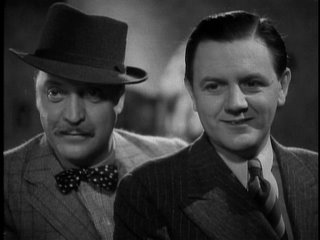
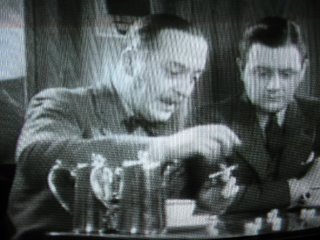
"England's on the brink," whispers Charters to Caldicott. "We must get in touch with London immediately." It's an early scene from Alfred Hitchcock's The Lady Vanishes, and this is talk loaded with all kinds of possibilities – after all it's 1938, with the spectre of war looming over Europe, and this is an espionage story involving coded messages and unlikely spies. Stranded in a train station somewhere in Germany with numerous other passengers, the two Brits talk furtively about the need for "news of the latest developments". A suspenseful 10 minutes or so later comes the kicker: the information they are so desperate for is the score from the Oval Test match.

As played by Basil Radford and Naunton Wayne in one of Hitchcock's most compact early films, Charters and Caldicott became so popular that they featured in a number of other movies in the 1940s and early 1950s, mostly comedies or thrillers set on trains. Each time they were the archetypal conservative Englishmen abroad: keeping their own counsel, perplexed by the manners and customs prevalent in other countries, perennially discussing their beloved sport, even using cubes of sugar to explain fielding positions to each other (and drawing frosty glances from fellow passengers who wish to use said cubes to sweeten their tea).


Nor was cricket a mere sidenote in these films: occasionally, it supplied an important plot turn. In The Lady Vanishes, for instance, the young heroine, trying to convince the authorities that an old lady has mysteriously disappeared, approaches Charters and Caldicott: surely they remember seeing dear Mrs Froy? But the two men don't want to risk the possibility that the train will be delayed – they have to get back to London in time for the final day's play, dash it – and so they deny any knowledge of a missing person, further complicating the plot.

Even in the 1930s, when cricket was still very much an English sport, there was something incongruous and mirth-inducing about the magnificent obsession of Charters and Caldicott – as indicated by their status as comic relief in film after film. On long train journeys through the Continent they would naturally suffer foreigners who barely knew of the game, let alone understood why it would rouse such passion. But even the other British characters in these movies regarded them with bemusement. ("I don't see how something like cricket can make you forget seeing people!" exclaims the heroine disdainfully. "Oh you don't, do you?" sulks Charters, "Well, there's obviously nothing more to be said.") They were misfits everywhere they went.

Whimsical though the idea might be, I can't shake the feeling that Charters and Caldicott would have been more at home in cricket-themed Indian movies – movies like Dev Anand's gloriously kitschy Awwal Number, Ashutosh Gowrikar's ambitious Lagaan (two films that have very little in common, notwithstanding that Aamir Khan finishes a crucial match with a sixer in each) or Nagesh Kukunoor's graceful Iqbal. There would of course be teething problems in such a leap across time and space; initially they would be very much the insular Englishmen – "oh I say, must we watch the Natives besmirch the good old game now?" – and Bollywood's cinematic idiom would be a mystery greater than any Hitchcock ever filmed. But nobler sentiments would eventually prevail.

They would instantly relate to the unselfconscious reverence shown to the game by Bollywood, appreciate how much hinges on the outcome of the match in Lagaan, and how much it matters to everyone watching. They would approve of Iqbal, a film that literalises the notion of cricket-as-religion – in scenes involving the little shrine where the protagonist puts up photos torn from magazines; Iqbal bowing his head and closing his eyes in prayer before beginning his bowling run-up; the unexpected second chance for salvation given to the embittered former cricketer played by Naseeruddin Shah.

One thing they wouldn't understand would be Indian cinema's persistent, self-conscious need to present cricket as a metaphor for Something Bigger: as in "A story above cricket", Iqbal's slightly pretentious catchphrase which forgets that sport is never just about bats and balls anyway; the reason it's so compelling in the first place is because it's grand human drama presented with such immediacy. But Charters and Caldicott never needed any such justification anyhow: they were the breathing antitheses to C L R James's famous line "What do they know of cricket who only cricket know?" The only thing they knew or cared about was cricket itself; it would never have occurred to them to use it as a symbol for, say, England keeping Germany at bay during the War (and what did those blasted Germans care about the game anyway?). Their love for the sport was pure and untrammeled; in spirit, in all the things that matter most, they were no different from the glaze-eyed masses watching in reverential silence as Aamir Khan takes guard with everything at stake.


On an Indian train, Charters and Caldicott would never have faced the ignominy of a blank stare when they asked someone for the latest score. In Bollywood, they would have fit right in.

Saturday, April 01, 2006

Poster women

Just a pointer to the Poster Women exhibition, a display of posters from the women’s movement in India going back to the 1970s: it’s being organised by Zubaan and it's on at Delhi’s Lalit Kala Akademi till April 5. You can also see it online here.

I was at the exhibition a few days ago, and Jaya Bhattacharji of Zubaan Books told me that more than one visitor has asked about the “artists” responsible for the images on display. “But these posters weren’t made by well-known artists,” she laughed. “They were put together by ordinary people who were moved by a cause, not driven by the desire to create art.”

She’s right — despite the setting, this isn’t meant to be a display of artwork. But as you walk around the gallery, taking in the posters (or more accurately, poster reproductions), it’s easy to see why so many visitors make the mistake of thinking it is. Some of the drawings and photo collages are understandably amateurish, but many are imaginative, powerful, even stylish and witty. One drawing portrays the rural woman as a modern-day, many-limbed Durga — the twist being that the hands are all occupied in various household tasks and the lady doesn’t look especially empowered. Another, felicitating International Women’s Day, has a woman stepping tentatively out of her hut as she prepares for her first job outside her home. A group of Army women, with only a banner draped around their naked bodies, protest rape in the armed forces. Miss Displaced, Miss Poverty and Miss Landless stand forlornly on a podium, with an empty space for Miss Girl Child, unable to attend because she's been murdered. There are embroidered bedsheets, news item collages, a chart showing perceptions of the “ideal woman” — as filtered through the male gaze.

The posters are categorised by the causes they depict — among them domestic violence, elderly people’s rights, disability, lesbian rights and displacement. Though they cover a large spectrum, the ones on display in Delhi in fact represent only a small fraction of the total number (around 1,500) that have been collected by Zubaan over the past year. “We networked around the country, contacted hundreds of groups,” says Bhattacharji. Around 200 groups responded, sending posters to Delhi, and Zubaan got their studio photographer to make reproductions. Looking at the replicas, it’s hard to believe the original posters were in anything but sparkling new condition. “Many of the posters were falling apart when they came to us,” says Bhattacharji. “Others had mildew on them — we had to spread them out over our office for two days to dry them, before they could even be touched!”

But while the process of collecting and preserving was difficult, it was fun too, full of little discoveries. Like the time when Urvashi Butalia, Zubaan director, who conceptualised this project, walked into the office to find that one of the submissions was a poster she herself had made years earlier.

As Bhattacharji points out, in addition to speaking volumes about the phases of the women’s movement in India, the exhibition says a lot about the evolution of the humble poster over the decades. For instance, crowded designs — marked by self-conscious attempts to fit as much as possible into a frame — have given way to simpler, more focused drawings. “Most of us tend not to attach much importance to posters,” she says. “They are used for a specific purpose, in a specific context, and once their shelflife is over they end up in some dingy corner, under a bed, or in the garbage — which is such a pity.”


(The exhibition will travel next to Bangalore and Chennai. Zubaan has published a book of posters and put together a CD documenting all the posters collected. More here.)