The original name for Harum-Scarum Saar, a collection of piquant short stories by the Tamil Dalit writer Bama, was "Kisumbukkaran", which roughly translates as "rebellious prankster". This appellation is explicitly used to describe a character in the title piece, a man renowned for his mischief-making, but it applies to many other people in the book as well; for a common thread in these stories is the refusal by some members of the lower-caste Dalit community to kowtow to their "masters", the upper-caste landlords.
Their rebellion isn't violent or overt in nature; the circumstances that they live in wouldn't permit anything so dramatic. Instead the societal order is overturned in subtle ways, through the use of irreverent speech and the accumulation of small acts of defiance. In one story, "Pongal", the son of a labourer simply refuses to accompany the rest of the family on an obligatory gift-bearing visit to the landlord. He counters tradition with hard logic: "If we visit him during Pongal, isn't it right that he also visit us with his family during Diwali or the New Year?" In "Chilli Powder" a lower-caste woman provokes the ire of a landlady by cutting grass from her fields. In another story a young Dalit coolly refuses to offer his seat to his father's employer in a bus and later addresses an upper-caste person as annachi, meaning big brother (perceived as an insult in this context, because it suggests a blood relationship between members of different castes).
Throughout, these rebellious pranksters use their words and actions to slowly erase the distinctions between themselves and their "betters", even as others in the community make noises about how different things were in the old days and how customs should be retained. (“Don’t say that, son!” says the father in the first story. “What will the landlord feel? They are people who have tasted good things, so they should continue to eat them. When have we ever tasted them? We should stick to the old ways...”)
The stories are all firmly in the slice-of-life vein. Most of them have no fixed structure, no definite beginning and end. The impression is of each tale flowing into the next, with an anonymous narrator relating little anecdotes, giving us glimpses into the lives of the Dalits. The writing is earthy and conversational (something the translation captures nicely), full of rhetorical questions ("I knew people were there in the well, otherwise would I have jumped?") and phraseology that isn’t grammatical in the strictest sense but which conveys the flavour of the setting.
Bama has a definite feel for the people she writes about (her own parents were labourers and she experienced this life firsthand as a child). She expertly captures the cadences of their speech without holding anything back – which means readers with delicate sensibilities must be warned that the language is strong, even cheerfully crass in places. But this, it can be argued, is imperative to a book where words themselves are repeatedly used as instruments of subversion, to shake up the established order. "When a donkey shits is there a difference between what it shits first and what it shits last?" asks one character, addressing the hypocrisies of the caste system. "Shit is shit. All men are just men." This is the book's central theme and Bama expresses it with humour and gentle realism. You'll feel like you're sitting amongst the Dalits, listening in on their stories, participating in their circumscribed rebellions.
[Did this for Tehelka. Despite my distaste for the ridiculously small word lengths given to book reviewing in most Indian publications, this was a rare instance where I enjoyed doing a consolidated 500-word review.]
[Long interview with Bama here.]
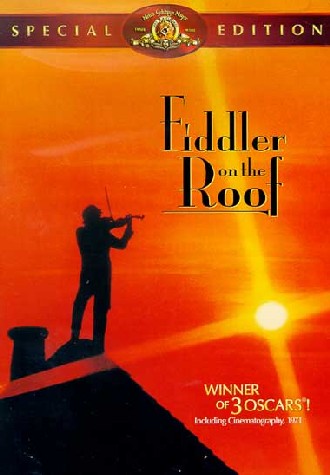
 The stocky peasant trudges to the centre of the frame, turns to face the camera and, twinkle firmly in eye, explains why life in his village is like being a fiddler on a roof: “Each of us is trying to scratch out a pleasant, simple tune without falling and breaking his neck.” What has helped them keep their balance for so many years? Tradition is the answer. “I don’t know how it got started,” he admits, “but every one of us knows who he is and what God expects from him.” Then he begins to sing.
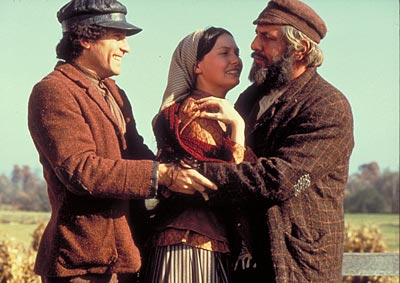
Norman Jewison’s Fiddler on the Roof centres on that word – tradition – and what it means to the inhabitants of a Jewish village in Ukraine circa 1910. Tevye (Chaim Topol) is a milkman whose chief aim is to settle his five daughters by finding them good (read: wealthy) husbands. The accepted way of doing this is to rely on the local matchmaker who visits each house at regular intervals with tips and suggestions. But unfortunately for the elders, the old ways are changing and the girls have ideas of their own. After the eldest timidly announces that she loves the penurious local tailor, the floodgates open: the next daughter brings a suitor of her own choice too, but doesn’t even ask for her father’s permission, merely his blessing; and most shockingly, the third elopes with a non-Jew, something even the large-hearted Tevye finds hard to countenance. At a wedding a young revolutionary urges men and women to dance together, a first for this village. Meanwhile, cultural upheavals are being supplemented by political stirrings in the outside world: around the country, vast pogroms are underway to drive Jews from their homes.
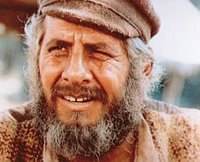 All this means that Fiddler on the Roof carries a necessary undercurrent of melancholy – the story is, after all, about a people coming to terms with the loss of their home, the dissolution of their identity and the younger generation’s disregard for the values they’ve always held dear. Some of the final scenes, such as the one of Tevye telling an old friend “we’ll be neighbours!” (because one family is moving to “Chicago, America” and the other to “New York, America”), are especially poignant. However, the dominant note almost throughout is that of exuberance. This is one of the most rousing musicals ever made; it derives most of its spirit from the screen personality of Topol, a bear of a man who never loses his warmth and vitality, even in times of great stress. Whether scratching his beard in perplexity at the ways of a changing world, crabbily questioning his God (“I know we are the Chosen People, but once in a while can’t you choose someone else?”) or exchanging banter with the local butcher, his performance is the beating heart of this film. (Hard to believe though it is, Topol was only 35 when he played the role.)
Naturally, he also features in some of its finest songs, including “If I were a Rich Man”, “Sunrise, Sunset” and “To Life”, as well as my personal favourite moments – the recurrent scenes where, on learning of a daughter being in love with an unsuitable man, he half-mutters, half-sings to himself (“Unheard of! Absurd!”), trying to balance practicality with his child’s happiness.
What kind of match would that be, with a poor tailor?
On the other hand, he's an honest, hard worker.
On the other hand, he has absolutely nothing. On the other hand,
Things could never get worse for him, they could only get better.
They gave each other a pledge – unheard of, absurd.
They gave each other a pledge – unthinkable.
But look at my daughter’s face – she loves him,
She wants him – and look at my daughter’s eyes, so hopeful.
 I like the way the camera closes in on Tevye and his private thoughts in each of hese scenes, and follows it up with a shot of the daughter seen from his perspective – she seems to be in the far distance (though in fact, in realist terms, she’s standing quite close to him all along) and the image becomes a visual representation of the vast generational and cultural gap that has opened up between them.
There's a tendency among some Indian viewers who aren’t too familiar with musicals from other countries to label any song-and-dance film as “Hindi movie-ish” or “inspired by Bollywood”, as if we have a patent of some sort on musical tradition. They should be pointed to this three-hour-long film, which has more musical interludes than Hum Aapke Hain Kaun but is firmly rooted in a very Jewish tradition of song and dance. Watching the events it depicts, one can’t help but think that despite (or perhaps because of) the large-scale displacement of Jewish communities in the early years of the 20th century, they continue to exert a strong cultural influence on our lives; their tradition has been among the building blocks of American cinema, theatre and television over the last century. Fiddler on the Roof is a film that operates within that tradition and comments on it at the same time. For all of Tevye’s fears that his way of life was fading, maybe his people had the last laugh after all.
(For the New Sunday Express)
[In which Humphrey Hawksley’s doomsday soap gives me the opportunity to shed my benevolent-reviewer skin for once and have some fun instead]
By chance, I happened to revisit a favourite film, Stanley Kubrick's Dr Strangelove, or How I Learned to Stop Worrying and Love the Bomb, just a few days before reading Humphrey Hawksley's "future history" novel The Third World War. Kubrick had begun shooting his movie (about the series of events that precipitate a nuclear holocaust during the Cold War) from a straight script before realising the premise was too horrifying for it to be treated as anything other than a black comedy.  If only Hawksley had taken the same approach. Instead he went and wrote a dead serious pulp thriller about the world's nations blowing each other to little bits. The result: The Third World War is as funny in places as Kubrick's doomsday satire, minus any of the comic intent.
In fairness, if you're among those who believe there is place in popular entertainment for a completely straight-faced treatment of nuclear war, you might appreciate Hawksley's book. Words like "page-turner", that dreaded reviewing cliché (not that we'll stop using it), were coined for this novel. Short sample: on page 1 the Indian prime minister's daughter is chatting on the phone with the US president's daughter. By page 5 the first terrorist attack has commenced and on page 11 a suicide plane crashes into the Indian Parliament, sending 476 MPs to that great legislative assembly in the sky. Page 19, the Pakistani president is assassinated and six flips later a North Korean missile attacks a US air base in Japan. This is a 514-page book. You just know the payoff is going to be earth-shattering (bad pun intended).
At breakneck speed (yes, another cliche), The Third World War zips around the globe to chronicle the political and military shenanigans of at least eight countries. The story takes place a few years from now (there are references to "the Vladimir Putin era" and such) and the protagonists are fictitious, bearing little resemblance to our current leaders. (It could be argued they bear little resemblance to anyone who lives outside the Muppet Show, but that's another matter.) There's the aged British PM who says, "I love Brunei's impenetrable humidity, its jellyfish and its billionaire sultan." There's the US president, the unsubtly named Jim West, whose national security advisor also happens to be his best friend. (They double-dated their future wives in college. Aw shucks.)
There's a whole gallery of such people, but unrecognisable though they are, not much has changed in the political equations between the countries they lead. The takeover of power by Bad Men in Pakistan and North Korea becomes the catalyst for worldwide disaster. The first nuking naturally sets off a chain reaction, with each country looking to protect its own interests...by blowing the world up.
Given the litany of leaders to pick from, Hawksley's choice of Indian PM Vasant Mehta as the book's moral centre is telling. There are definite pro-India leanings here throughout and it's the least devastated country at the story's end (which basically means it hasn't been nuked completely out of existence). India-love may partly be the result of the author's apparent fascination for Bollywood movies: very early on, we are told that the parents of the Indian PM and the Pakistani president played together as children (before the mela of Partition separated them, one supposes). Not long after this, the PM's daughter rips her shirt off to bandage a dying man's wounds. And Mehta himself is apparently indestructible, like some of the characters in Bollywood movies.
Being a well-travelled BBC correspondent, Hawksley naturally has a feel of the political pulse in many countries, and he uses this to his advantage. But his book trips over itself in its attempts to present the horrors of a time when "nuclear weapons stopped being a deterrent and became merely another weapon of war". Since the characters are rarely more than caricatures, beyond a point you stop trying to muster concern for them and start eagerly looking forward to the next nuclear attack instead. (More than once I found myself skipping pages and racing ahead to the next account of big-city devastation. The last few chapters are the equivalent of a morbid video game.)
Inevitably there's plenty of sermonising, and once every hundred pages or so Hawksley does manage to convey something of the insanity of a world headed for mutually assured destruction. But the book's pulp framework conflicts with and eventually overpowers its lofty intentions. Here, for instance, is our first encounter with the Indian PM after Delhi has been nuked: "The food (in the underground bunker) was becoming inedible and Vasant Mehta was feeling helpless and depressed."
Deep. And don’t miss the many solemn passages like this one, where the US president gets a free crash course in human psychology from his daughter:
You know why people hate us? It's because we offer this great brand name, and when things get difficult we turn around and say 'Yeah, but you didn't read the small print.' They don't hate us because we're rich. They hate us because we don't tell them the rules, and we don't tell them because there aren't any ...
(She moves on to an analogy involving HSBC, Citibank and farmers in Argentina and Nigeria, but by then you're flipping forward gleefully to see which gets bombed next, Tokyo or Pyongyang.)
You get the idea. Much like the terrorist plane that takes out the Indian Parliament in the opening chapter, this book moves fast and you can't tear your eyes away from it; but like the plane, it self-destructs.
– At the Ananda gymnasium early one morning I attended a session called “Full Moon Stretches” wherein an instructor twisted my hands and feet into numerous outlandish positions until I couldn’t feel them anymore. The Beatles’ Abbey Road was playing throughout, and there were eerie parallels between the lyrics and our convoluted movements. For instance, just when we were doing one of the “active exercises” (where the instructor actively “helps” the victim – in this case, by placing his knee at the small of my back and then pulling the rest of me towards him), I could hear “Come Together” playing in the background and Lennon was going:
He got Ono sideboard he one spinal cracker
He got feet down below his knee
For the first time in dozens of hearings of this enigmatic song, the words began to make perfect sense to me. By the time Ringo started on the (much more straightforward) “Octopus’s Garden” I was feeling like one of those forlorn beasts of the sea, with too many limbs to reasonably deal with. And some time later the instructor was grunting away, trying in vain to get a very large woman to adopt postures nature had never intended her to be in, and right on cue there’s John warbling “She’s So Heavy”.
I wonder if it was all planned.
– Hum Aapke Hain Kaun met Body Heat 2 in a surreal episode at one of the massage parlours, where a lady masseuse first performed an elaborate Aarti for me (because that’s how Ananda shows its guests they are special) and then proceeded to rub her hands all over my body for an hour. Needless to say, the Aarti was the embarrassing part. (It was done with one of those small plates with a diya and red powder on it, just like they show in the movies! I never thought such things could really happen. Am beginning to appreciate Vikram Chandra’s remark that even the most melodramatic Hindi films can reflect the realities of our lives.)
– Many quotable quotes were acquired in the course of my meetings with sadhus and gurus in Rishikesh, but one of my favourites came from this disgruntled teacher who admitted that he didn’t really care for most Yoga techniques despite actively practicing them. “See, the basic idea is to achieve Paramatman,” he said offhandedly, “and people can do this in many different ways. It’s the same thing as when a young boy wishes to achieve a young girl (sic). He tries various techniques: uses fragrant body powder, dresses up smartly, tries to leave a good impression by presenting a sensitive side of himself, says all the right things.”
“Likewise, the people here all try different techniques – bhakti yoga, asanas, pranayam, meditation – in order to achieve God. It’s exactly the same thing, really.”
(For a self-professed celibate, he certainly knew a lot.)
– Later another Yoga teacher, an incongruously soft-spoken young chap originally from Hyderabad, showed me SMSes he’d received from a student who lives in Paris. Apparently, after she went back home they continued distance therapy – he’d allot a time at which they’d both get into “the zone”, and he’d solve her problems from thousands of miles away. The gratitude-filled SMSes ran along the following lines:
“Wow guruji, I totally felt the warm waves of sensation just now!”
(Not making this up. And I fear it can only partly be explained by the bad English of French people.)
– “Foreigners are an undisciplined lot,” explained the secretary at one of the ashrams that accepted only Indian students. “They believe in free sex and alcohol. They kiss as freely as we do namaskar,” he said, making a puckering motion with his lips and then putting his hands together reverentially, to demonstrate both actions. “Their women stand arms akimbo, tch tch.” (He placed his hands on his hips.) “No respect for elders.”
At the Laxman jhula. This enterprising young monkey came up to me and snarled fiercely until I gave him what was left of the Snickers chocolate I was having for breakfast. Blatant extortion. However, he agreed to pose for this shot afterwards.
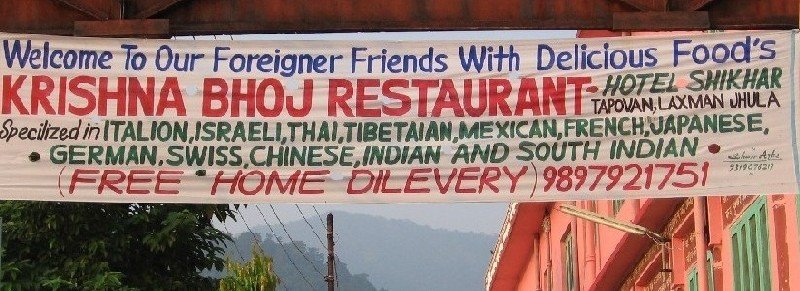
 A typical restaurant banner.

(click to enlarge)
To fully appreciate the claims made for “French”, “German” and “Swiss” food, you have to remember that Rishikesh is completely vegetarian. (This also clears the mystery of why I was eating chocolate for breakfast.) By “Thai” food they probably meant the paneer hakka noodles on the menu. There was also something called the “crispy paneer cheez sizzlar”, though I didn’t wait to find out what it was.

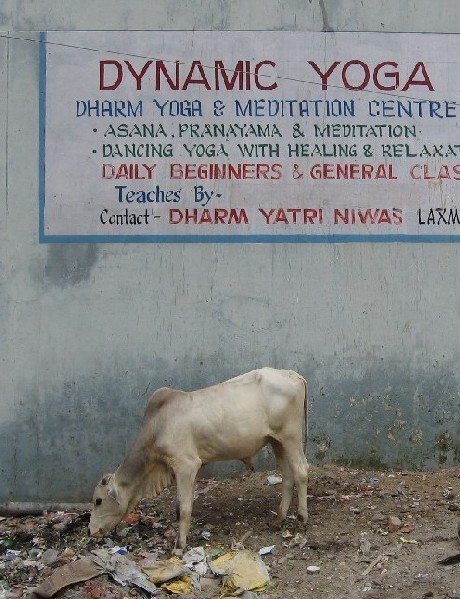
There are large signboards advertising Yoga classes nearly everywhere you go, most of them clustered together around the Ram jhula and Laxman jhula. (Since I was conditioned to look out for them for the story, my eyes lit up each time I saw the word “Yoga” anywhere.) Tourists flock to these boards in droves but the local cows are more nonchalant.
At the Ganga Beach Resort, where I stayed, a little swimming pool situated a couple of metres from the riverbank. Somewhat redundant if you ask me.

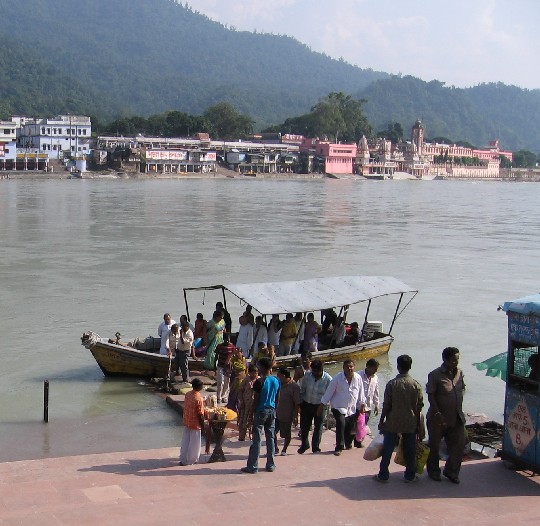
The ferry that takes you across the Ganga.
 The ride was very nice but I could have done without the dozens of co-passengers who kept throwing water indiscriminately at each other (and me), all the while chanting “Ganga Mata ki Jai!”
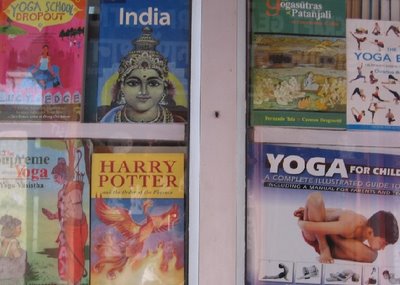
And even in Yoga-land, you can’t escape J K Rowling...
Hear ye! I’m off to the Ganges to strike flamingo-like poses and do penance for my many recent sins (such as writing good things about a film starring the evil Sanjay Dutt).
Actually, am going to Rishikesh on work for a few days (it’s partly a yoga-related story so there might be some posing anyway). The first 3-4 days will be quite routine with plenty of running about, fixing appointments and such, but I'll wind the trip up by spending a couple of relaxed days at this very nice Himalayan spa. Should help me hone my recently acquired talent for getting massaged, but this time without a photographer in attendance.
Probably won't have Net access (or time to get online) for most of the trip. Back on the 21st.
Mahendra Singh Dhoni in yesterday’s Times of India, talking about his new Suzuki bike:
“I’m delighted with it. It’s the fastest bike in the world. But I had to wait a long time because it reached my home in Ranchi very late.”
And further down:
“I’ll have to be careful with it. The road conditions there aren’t suited to fast driving.”
There’s a scene in Munnabhai MBBS that nicely captures the tone of that wonderful movie (and its even better sequel). Munna’s principled father, played by Sunil Dutt, has just discovered (in the most embarrassing circumstances) that his son was only pretending to be a successful doctor all these years – he’s really a wastrel, a small-time goon. This is the sort of premise that Hindi cinema loves getting its chomps into and true to form, there is high drama, betrayal, recrimination. The eyes of both father and son are brimming with tears when, suddenly, one of Munna’s sidekicks (sent by the irrepressible Circuit) bursts in and frantically shouts “Doctor, doctor, naye patient ke liye bed mangaana hai!” (or something to that effect. You get the drift). Naturally Munna doesn’t respond; the game is long over.
It’s a superb little moment that not only diffuses the scene’s tension but also acknowledges one of life’s more inconvenient truths: that despite the human tendency to romanticise drama and personal tragedy, these things never have the full stage to themselves; comedy is always peeking impishly from behind the curtain, waiting to join the players. We feel most self-important in our sadder moments, but step on the outside just briefly and one sees that, viewed from a wider perspective, there’s always something intrinsically funny about the situation. Writer-director Rajkumar Hirani’s achievement here (and in other scenes in the two Munnabhai films) is to convey this gently, without being either cynical or didactic about it. We laugh heartily when the sidekick appears and says his line, we giggle at his earnestly unconvincing act and at the confused look on his face when no one pays him any attention. But that doesn’t stop us from feeling the weight of the situation between Munna and his father. (Sunil Dutt looks even more distressed when we cut back to him, because the interjection is a reminder of his son’s many similar deceits over the years – and a reminder that others were in on the charade too.)
Good comedy is notoriously difficult to do on its own terms (nearly all writers and actors will tell you it’s tougher than good drama), but it takes special talent and guts to mix comedy with situations that have traditionally been treated as sacrosanct (a parent’s sense of betrayal, for instance). This is especially true of an Indian film intended for a mass audience, since ours is a society that has many sacred cows, gets self-righteous easily and doesn’t have a particularly developed sense of humour (at least not when it comes to laughing at yourself, which is where all humour begins).
 One of those sacred cows is Mahatma Gandhi (never mind all the talk about India having forgotten the man’s principles; that’s a different story) and Hirani’s decision to have an actor playing Gandhiji in Lagey Raho Munnabhai (even if only as a figment of Munna’s imagination) could so easily have gone wrong. Sure, depicting Gandhi onscreen isn’t as provocative as, say, showing (and hence quantifying) the suffering of Jesus, or drawing the Invisible Pink Unicorn. But if someone had told me beforehand that a Hindi film was going to have a drunken goon slurring “Hi, Bapu! How are you?” at Gandhiji, I would have been concerned for the safety of those associated with the film. However, Lagey Raho Munnabhai pulls it off, and pulls it off with such good taste that it’s hard to imagine anyone being offended. Just as importantly, it doesn’t hinder the movie’s comic tone at all: Hirani is naturally, and unselfconsciously, respectful towards his subject, which means he doesn’t have to put on a show of exaggerated reverence for the benefit of others.
In simple Crit-speak (and I know I’m hardly the first to be saying this), Lagey Raho Munnabhai is a must-watch. Though it incorporates elements from films as varied as IQ, Good Morning Vietnam and even Snow White and the Seven Dwarfs, it’s an original in all the ways that matter. It’s also more assured than the first film was, and that’s saying something. Special mention to Arshad Warsi, whose Circuit is better developed (and has more screen time) than in Munnabhai MBBS. (Hirani credits Warsi with adding elements to the character that weren’t in the original script and it shows onscreen: it isn’t often that one sees a performance created so well from the ground up.)
P.S. Was somewhat put off by Vidya Balan, who’s good to look at but way too affected for my taste. (At one point I became obsessed with counting the number of times she brushes her hair back [approx. 47], and ended up missing some of the dialogue.) She showed a lot of promise in Parineeta but she looks set at this point to become a one-dimensional actress - will have to wait and see her future roles, I guess.
Watching movies professionally, it’s easy to become jaded and immune to the immediate pleasures of a good film (whether those pleasures are escapist or intellectually stimulating). Even when there isn’t a review deadline looming, the old mind is constantly ticking over – mental notes must be made, bits of dialogue filed away for future reference – and one often gets distanced from the film itself. Paul Greengrass’s United 93 cut past all those barriers and reminded me of what the untrammeled movie-watching experience can be like. It was so gripping nearly all the way through that it was hardly possible to think consciously about the filmmaking process – about the use of handheld cameras or non-professional actors, for instance, both of which are extremely well suited to this film.
 The bare bones are that this is a superbly made docudrama about one of the four planes hijacked on 9/11 – the one that was meant to hit the Capitol but eventually crashed into a Somerset County field instead, due to passenger intervention. Drawing on information from the black box found at the crash site as well as phone calls made by the doomed passengers from the plane, United 93 recreates what happened onboard, as authentically as possible. (There is, unavoidably, some conjecture but it’s toned down.) Starting with Greengrass’s decision not to have recognisable faces in the cast, there are almost no cinematic flourishes of the sort that could so easily have turned this film into another summer thriller and offended millions of people who believe 9/11 mustn’t be cheapened by standard Hollywood treatment.
Though the scenes on board the flight are very well-handled, the film’s real strength is in its depiction of the on-ground events, specifically the growing confusion in the Federation Aviation Administration and in air control centres around the US early that morning. FAA manager Ben Sliney (playing himself) is headed for a high-level meeting when information comes in that American Airlines 11 may have been hijacked. (At this point, tragically, United 93 is still at Newark airport, waiting for takeoff clearance. With a few minutes here and there, and a clearer picture of what was going on, it might never have become airborne.) Sliney asks to be apprised of future developments, then goes into the meeting room, offhandedly mentions the possible hijacking to his colleagues; they small-talk for a while, try to recall the last time such an incident occurred over their airspace. At this stage, it’s all so routine. But soon, the traffic controllers tracking planes (represented by tiny green dots) on their computer screens lose contact with AA 11. The plane vanishes from the radar and a couple of minutes later there’s a news item on CNN about smoke billowing from one of the World Trade Centre towers…
In these scenes, and in others like them, we see the big achievement of United 93: it takes the most well known, widely chronicled and analysed world event of the past decade and convincingly depicts the way it unfolded in real time – the immediate effect it had on people who had to piece things together minute by minute and didn’t yet know they were seeing something momentous. In his review, Roger Ebert says that the movie’s success stems from its deliberate refusal to see The Big Picture. This is true enough in terms of the effectiveness of the director’s approach – the fact that he doesn’t underline the key moments, thus adding to the sense of veracity. But the success of the film does depend on the viewer’s knowledge of the big picture. If we didn’t know that this was 9/11, some of the scenes in the control room, for instance, might simply have been flat and ponderous (and “uncinematic”) instead of creating the frisson they do. This isn’t a documentary but it isn’t quite a feature film either.
 We usually expect the movies we watch to have a basic, identifiable structure. How strange then to find that United 93’s most powerful moments are those of complete chaos, scenes where the viewer doesn’t (and isn’t even expected to) understand everything that is transpiring. In the air control centres and the military command room, we repeatedly hear urgent, important-sounding phrases which suggest that meaningful action is about to be taken by people who know what they are doing. (“I want the coordinates on the location immediately”; “We need to get those birds off the ground, now.”) However, these words are unaccompanied by any action that might conceivably improve the situation. Like the protagonists in Waiting for Godot or Luis Bunuel’s The Discreet Charm of the Bourgeoisie, these people are impressively purposeful but headed nowhere.
It would be tempting to put all this chaos down to general ineptness, but the film shows us how even the most efficient, professionally managed systems can break down in the face of extraordinary events. One senses that the people in command know their jobs very well (and aviation control includes some of the highest-stress jobs in the world, involving a greater degree of responsibility than most of us can even fathom). Their faces reveal little, even under extreme duress, and this would be reassuring at most times. But now they’re facing a situation no one can reasonably be prepared for, and it’s terrifying to watch people in authority fumbling with inadequate information, disbelief and miscommunication, second-guessing each other, debating the chain of command – until Sliney finally makes the decision to shut down all traffic over US airspace.
In fact, it’s notable that the only time we see people acting with complete conviction is during United 93’s final moments, when the passengers call their families and repeat “I love you” over and over again; and simultaneously in the cockpit, the terrorists invoke the name of God with the same intensity and single-mindedness. These are moments that could so easily have been sensationalised, but they are depicted with as much integrity as possible – as is nearly everything else in this outstanding film.
Overheard at the screening
From man sitting nearby (who, to be fair, was quiet for most of the film): “Arre, what’s the point – these guys don’t even know what they’re doing!” (when the passengers storm the cockpit)
And while exiting, from a young boy: “Yeh Hindi film hoti toh end mein plane bach jaati.”
(Which is a fair enough remark, though he seemed quite disgruntled that the film didn’t end with an item-number song in the clouds.)
[Also see this fine review by Falstaff.]
Suggestions for the ATP:
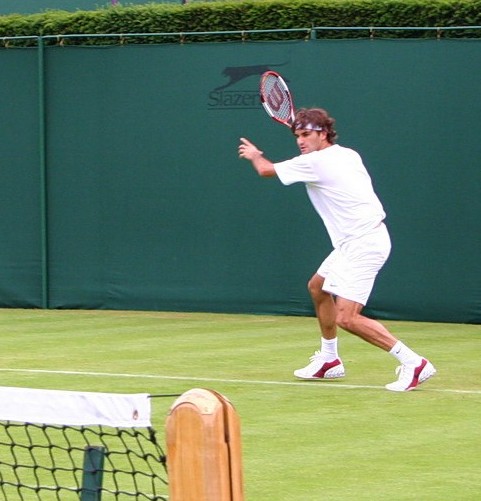
– Introduce a special Swiss Watch/Time Out rule for Roger Federer whereby he is required to win each match in under 1 hour 45 minutes, failing which it goes by default to the opponent.
(The players will, however, be required to play on past the 1:45 point. If Federer eventually takes more than 2 hrs 15 mins to seal the match he misses the next Grand Slam.)
– (Suggestion from Aishwarya) Make it mandatory for Federer to play on one leg. This can be done by simply folding the extra limb back at the knee, like some actors do when they are playing vertically challenged characters. It may sound cruel, but so is life. (Besides, in this case the time limit can be relaxed to 2 hours 30 minutes.)
– Each time Federer hits what is deemed by tennis professionals (namely the commentators and the opponent) to be “an impossible shot”, the point must be replayed – because everyone knows impossible shots don’t exist and this was clearly a trick of the light.
– The likes of Tiger Woods and Martina Navratilova must be prohibited from watching Federer matches so we don’t have to put up with all this post-match nonsense about an all-time great getting extra motivation because he knew other all-time greats were among the spectators. (Why this obsession with Greatness Clubs when the rest of us are content with aspiring to mediocrity?)
– Extend the newly instituted players’ challenge rule. Twice in each set, the opponent should be permitted to declare a Federer winner “out” regardless of where it was actually placed.
– Clone Rafael Nadal. Breed a race of indefatigable left-handed Spaniards, give them different names, nationalities and seedings and place them, like minefields, at various points in Federer’s path to a Grand Slam final. This would require mucking about with ethics on various levels but hey, it’s all about the Greater Good.
 (insert rant here) Federer’s winning has always been depressingly predictable (except against Nadal and how long will that last), but now even the trajectory of his matches has become dull. And this isn’t about the 6-2, 6-3, 6-0 wins but about the ones where the other guy actually gives him a fight. In the US Open final yesterday, Andy Roddick was doing so well in the second and third sets; he was arguably the better player for around an hour in the middle of the match, and if this had been a contest where one of the players wasn’t named Roger Federer, I would have expected it to go to a tense fifth set. But somewhere near the end of the third set that familiar sinking feeling surfaced – I just knew Federer would find a last-ditch way to seal the set with minimum effort, and then ride on that momentum and steamroll his way through the fourth. I went to sleep knowing I would wake up to find he had won the fourth set 6-0 or 6-1 and that’s exactly what happened. Never any doubt. Federer did something similar with Marcos Baghdatis in the Aus Open final earlier this year, and he’s done it with almost everyone else who’s had the temerity to give him a decent challenge.
Incidentally, David Foster Wallace recently wrote this beautiful eulogy to Roger Federer (link via Amit), which makes me wonder if Fed’s existence is better for literature than for men’s tennis.
P.S. Before Federer worshippers commence bombardment, let me clarify that on a level that goes beyond the desire for a good sporting contest, I do love watching the guy play. My feelings about him are most articulately summed up by an elegant phrase once used by an admiring English fan to Bradman as he walked off the ground after sealing another Ashes win: “You…you…you…bugger!”
Here’s a piece I wrote for Tehelka, “A berth in the planet’s soul” (no, that headline isn’t mine, but I like the intro they’ve given). It’s part of their series on how globalisation has affected people in different fields. I was asked to keep it personal and so I touched on some topics already addressed on this blog at various times in the past – including the disconnect often felt by urban Indians of my age-group, having been children in the pre-liberalisation era and adults after the economy opened up (and around the time our world began to shrink because of the Internet, cellphones etc).
Frankly I’m not too happy with the final piece (would have liked to do a longer, more measured essay – closer to 3,000 words maybe) but well, have set down my hat and there I must live etc. Here’s the link again.
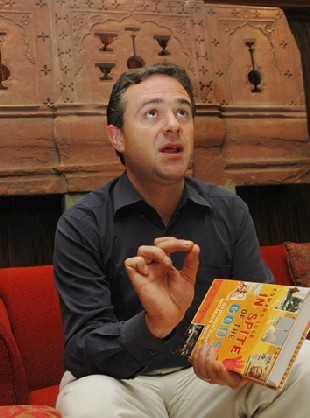
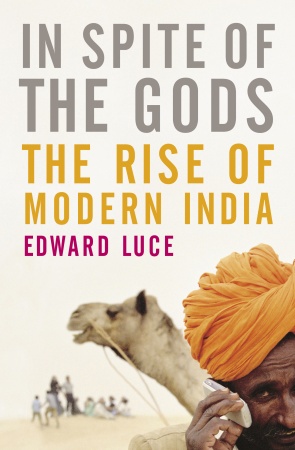
When a foreign correspondent spends five years living and working in a country and then writes a book about it, there's bound to be a measure of scepticism – murmurs, perhaps, about why an outsider with little emotional stake in the place should hold forth on its problems and the possible remedies. But Edward Luce's In Spite of the Gods: The Strange Rise of Modern India isn't that sort of book. It doesn't make overreaching judgements; it prefers to chronicle and to drop the sharp observation or two, which is often the best anyone can do with a country this vast and complex. Luce is respectful of the complexities, and of Amartya Sen's observation that "anything one might say about India, the opposite can also be shown to be true".
 He’s also quick to stress that India isn't just another pitstop in his itinerant career. He considers it a second home, and after all he's related to it by marriage; his wife Priya, a development economist, is half Bengali and half Gujarati. They first met as students in Oxford and were married in Delhi in 1994 – years before he came here in a professional capacity, as the South Asia bureau chief of the Financial Times.
The stated aim of In Spite of the Gods is to "provide an unsentimental evaluation of contemporary India against the backdrop of its widely expected ascent to great-power status in the 21st century". Without coming across as patronising, Luce discusses the many contradictions in India's society; the lopsided growth of the economy; the enduring legacies of leaders like Gandhi, Nehru and Ambedkar; the repercussions of the caste conflicts; the often-peculiar nature of Indian modernity in the new century; and the country's relations with China and the US, which he describes as a triangular dance that will be crucial to the world's future.
All this adds up to a welcome perspective by someone who cares about the country but can also look at it from a standpoint denied to those of us who have been on the inside for years, each with our own sets of prejudices and crosses – many of which are unconscious, some that have been handed down over generations. Luce’s writing here is understandably more friendly and personal than the many features he has written about India for the FT. There are amusing anecdotes, including one about Amar Singh’s Lodhi Estate bungalow, with a heavy stone ceiling that divides (“as in a Bond film”) to present a dazzling view of the terrace beyond. “There might be a little corruption here and there,” a beaming Singh tells the author later. “You cannot check everything.” Luce meets activists who have been battling corruption for years, records their near-surreal stories – being taken to the same dam by many different routes, for instance (because the authorities have built one and tucked away money for four).
Notably, however, the chapter on the nature of corruption in India’s government offices and courtrooms begins with an encounter with a man who has succeeded in getting work done in the face of the system’s flaws: V J Kurian, a senior IAS officer who heads the highways department in Kerala and who was briefly transferred to an isolated district as punishment for not accepting a bribe. Kurian’s integrity was largely responsible for the success of the new international airport at Cochin, but even he admits that there are little compromises that one has to make in this job: securing a business-class upgrade for another official, for instance. One of the book’s most telling passages has Luce taking his leave of Kurian and then very briefly wondering if he might ask him to arrange an upgrade for his flight back to Delhi. “But the moment passed.”
The book's title (perhaps partly directed at those who continue to think of India in principally spiritual – and exotic – terms) is inspired by Jawaharlal Nehru's thesis that the country's greatest strengths are not exclusively located in its religious traditions. Luce believes India's heterogeneity is central to its success as a democracy: "The long tradition of pluralism has given the country hundreds of years of practice at managing social conflicts without automatic resort to violence." This, he feels, is also one of the reasons why an increase in India's power in the coming decades would be in the world's larger interests. "Having dealt with diversity for centuries, India has a lot of experience in managing a multi-ethnic society," he says. "One of its great strengths is that – unlike China, say – it has never been an absolutist country. It has a lot to teach the world."
Among the things that worry him are the callousness of the metropolitan elite towards less privileged Indians, and the strange need for affirmation from other countries – all mixed up, of course, with proclamations of India's moral superiority to the rest of the world. "This simultaneous existence of superiority and inferiority complexes isn't peculiar to India, of course," he says, citing the British ambivalence towards the French; the surface condescension that conceals a layer of envy for their sophistication. "But it often acquires worrying proportions here."
None of this is unusual. Though it sounds contradictory, economic globalisation is usually accompanied by increasing ethnic nationalism. "As the world opens up and one feels familiar things slipping away, the need to cling to one's identity becomes even more imperative,” says Luce. “Often people overcompensate for this by becoming more partisan, even jingoistic about their own culture and values."
"India isn't on an autopilot to greatness," Luce writes at one point, "but it would take an incompetent pilot to crash the plane." I ask him what his worst-case scenario is for the country, say 30 years from now, and not counting something as disastrous as a nuclear conflict. "The further widening of inequality," he replies, "as the result of the government's inability to get infrastructure programmes going and to plug rural India into the economy. That would lead to greater migration to the cities, the alienation of the more efficient states from the Centre and – eventually – genuine political tensions about the nature of Indian federalism."
This is what he describes as “a reasonably plausible bad-case scenario”, though naturally he hopes none of it will come to pass. Luce is working now for the FT in Washington, DC, but he expects to live in India again sometime in the future; the country has clearly got under his skin. At his book launch he told of his first few weeks staying alone in a hotel in Delhi and how, when his wife joined him and the hotel staff realised he was married to an Indian, they began addressing him as "Mr Basu". "India takes hold of you very quickly," he laughs, and it's obvious that he doesn't mind being appropriated.
(Photo: Priyanka Parashar)
ABBA’s “Eagle” was playing when I switched on the car radio this morning. It’s a lovely song, an old favourite, and I hadn’t heard it in a long time. “At last,” I thought, “a good start to a morning drive to make up for that bullock-cart episode from yesterday.” But the song ended as all good things must, and the radio jockey came on, as all bad things do. She cleared her throat in that terror-inducing, schoolteacher-ish way the RJs on AIR-FM do whenever they are about to say something Very Important and Deeply Meaningful, and then she spoke the following sentences (this is 95 per cent accurate; I have an uncanny memory for these things):
I love that song, because it’s all about the eagle. There are so many things we can learn from this inspirational bird. I am now going to tell you some principles of the eagle.
First of all, the eagle flies alone, and he soars high in the air, far above all the other birds. He keeps his head high. He flies only with other eagles, never in a flock (sic). From this we learn to keep our own counsel and not to mingle with the lesser birds like the sparrow and the robin.
What an excellent metaphor for the caste system! I was all ears now. No question of changing the channel anyway because there was a Simon & Garfunkel song on.
(RJ returns, clears throat, sound of phlegm being displaced)
The second principle of the eagle is his great focus. When he sights his prey from afar, even if it is a small rodent, he never takes his eyes off it. From this we learn to be single-minded and purposeful in everything we do.
And after the next song:
The third principle of the eagle (ehm! ehm!) is this: test before you trust. When a male eagle wishes to mate with a female eagle, she swoops down and picks up a twig from the ground, and then flies up with the male hotly in pursuit. When she reaches a point high up in the air she drops the twig and the male has to fly down quickly to catch it. She does this repeatedly, and only when she has satisfied herself that he is reliable does she allow him to mate with her.
No wonder the population of these silly birds is decreasing, I’m thinking.
The twig (the RJ continues) stands for commitment. By this the eagle teaches us that we must be sincere and dedicated in all our relationships, both personal and professional.
And then I reached my destination and never found out what else we can learn from the eagle. But arguably the most important lesson of the day has been to stick with the new (radio jockey-free) channel 95 FM. (Except that they play Fanaa songs and "Hips Don't Lie" 40 times a day.)
I blogged once before about Karan Johar’s lovelorn and worshipful presentation of Shah Rukh Khan on screen. This was most obvious in the opening moments of Kabhi Alvida Na Kehna – the scene with SRK on the football field, scoring the winning goal. Johar took great care to shoot his Muse in such a way that his face would be hidden from audience view as long as possible; it was almost as if he couldn’t bear to share it with us. (When we finally got a front-on shot, we still couldn’t see SRK’s face because he had pulled his shirt up over it after scoring the goal!) Watching all this was a bit like encroaching on someone else’s private moments, and I felt genuinely uncomfortable. The eruption of the stadium crowd at the end was clearly a substitute for orgasm.
Or so I explained to a friend who angrily snapped back that I was being an over-analytical idiot as usual, and that this was in fact standard Hindi-movie treatment of its superstars – going back to the days where little weepy Master Mayur or Master Raju would leap off a bridge and a full-grown Amitabh would land on the train chugging beneath.
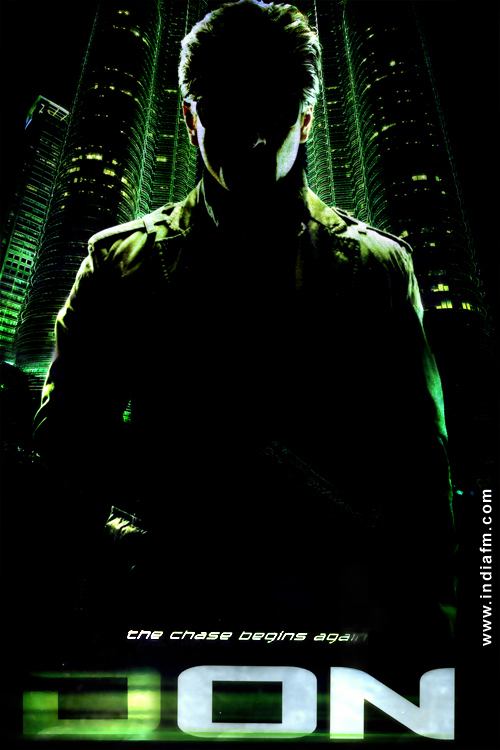
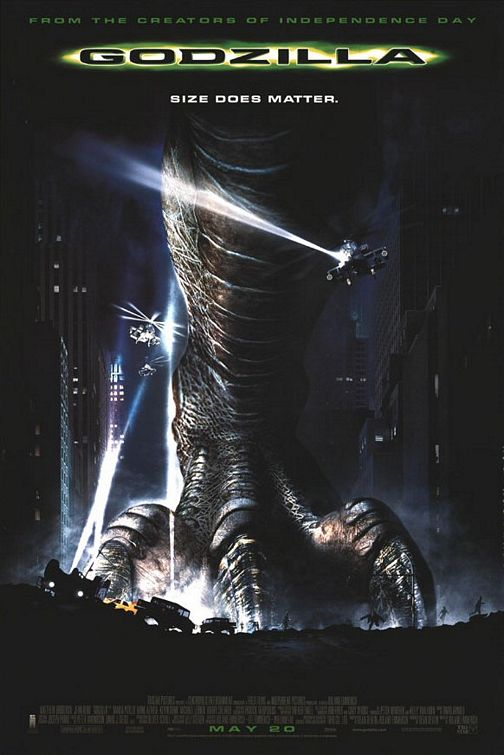
 Now, after watching the trailer for Farhan Akhtar’s Don remake with Shah Rukh in the lead role, I have to gloomily admit that maybe the symptom does extend beyond Karan Johar movies. “Teaser” might be a better word for this trailer, since the whole thing was built on the principle of gradually revealing parts of SRK’s (leather-clad) anatomy while keeping his face out of sight, or shadowed. It was like those multi-part Godzilla trailers where you caught tantalizing glimpses of a giant eye or foot or tail, but never the whole lizard at once.
 At any rate, the gleaming visuals, computer-generated effects and sleek black suits on display in this new Don seem to put it firmly in the Matrix/Mission Impossible league; it was hard to relate it in any way to the beloved 1970s Bachchan starrer. Until, that is, I heard the familiar strains of “Main Hoon Don” (even if in an unfamiliar remix format) playing in the background. Very briefly, all was right with the world.
Last year, when plans for the Don remake were announced, I had a minor argument about it with a friend. For some reason (the problems of music copyright perhaps), we had assumed that the remake would have completely different songs, even if their contexts remained the same. I was put off by the idea. He wasn’t. “What’s the big deal?” he said. “The story is the same. Don doesn’t have to be all about ‘Khaike Paan Banaraswaale’ or a couple of other songs, melodious though they are.”
But in a sense, of course it does. Commercial Hindi cinema of the 1970s was more about a pastiche of eye-popping scenes and vignettes (including song sequences) than about the coherent forward movement of a plot (which was the least important element in those films anyhow). When a mainstream Hindi movie has a great, or even reasonably good, soundtrack, it becomes nearly impossible to separate the film from its songs over a passage of time. Why should a remake with completely different music be considered a remake at all? And it’s not like there was anything so unique about the story in the first place.
When I first watched the original Don, as a child, the music didn’t figure very strongly on my radar – what mattered was watching Amitabh scowl, saunter, rage, goof and fight his way through the film. But many years elapsed before I saw the film a second time (on cable TV) and in the intervening period I heard the songs very often, so that they became representative of the film for me. Consequently, when I did see Don again, I was almost disappointed by the visuals that accompanied the songs: excellent as Amitabh was for much of the film, the vibrant voice in the title track was all too clearly Kishore Kumar’s, and the lip-synching was shoddy and unconvincing. When Helen gyrated in the “Yeh Mera Dil” number, I kept seeing Asha Bhonsle’s face (and Asha Bhonsle’s face atop a gyrating body doesn’t make for a pretty picture).
All this is a way of saying that sceptical though I am about the idea of a Don remake (or an Umrao Jaan remake for that matter), I’m glad they’re retaining the original soundtracks (assuming the tunes aren’t completely massacred). Modern-day Bollywood is so obsessed with showing off its glossiness, being better-looking and more stylish than movies from an earlier age, that music is sometimes the only remaining link between originals and their “tribute-remakes”. (However, there are some links we don’t need: please, please let the remake not feature an unbilled “surprise cameo” by Amitabh...)
Have started each of these, need to finish them in the next couple of days (all work-related *sigh*).
Elvis, Raja: Stories – M G Vassanji
 I’ve been a fan of this author’s gentle, elegiac writing ever since reading The In-Between World of Vikram Lall (a story about an Indian family living in Africa, but more particularly about the gradual moral decay of one man). Vassanji was born in Kenya, grew up in Tanzania and now resides in Canada, and ambivalence is central to much of his writing: what can we ever really know about ourselves, or about the people closest to us? There are twelve stories in this new collection; the only one I’ve read so far is “When She was Queen”, about a young man trying to uncover the truth behind an old rumour that his father once lost his mother to an African magnate in a poker game. The motif here is the narrator’s search for his identity, and a nice twist in the end makes the subject even murkier.
 The Janissary Tree – Jason Goodwin
Another entry in the historical detective story sub-genre, this is about a series of murders committed in Istanbul 1836. The case is being investigated by one Yashim Togalu, a eunuch; since few people take him very seriously, he has the advantage of snooping about without drawing much attention to himself. (More books may follow; having a eunuch play the lead in a regular detective series is an intriguing prospect, though I have to say Yashim's sex life can't possibly be less exciting than Poirot's or Miss Marple's.)
A couple of friends have strongly recommended this book and the premise is certainly interesting, but on the evidence of the first 50 pages I’m not sure; the writing is a bit stilted, with quite a few superfluous sentences/redundant observations (if a character says something that’s self-evidently surprising, there will invariably be a line saying “Yashim was surprised by this piece of information”). Maybe it’ll get better. Maybe I won’t hang around long enough to find out.
In Spite of the Gods: The Strange Rise of Modern India – Edward Luce
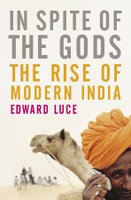 As the Financial Times’s south Asia bureau chief, Luce was based in Delhi between 2001 and 2005, and this is his attempt at “an unsentimental evaluation of contemporary India against the backdrop of its widely expected ascent to great-power status in the 21th century”. Topics covered include the schizophrenic nature of India’s economy, the rise of the lower castes, the repercussions of the continuing obsession with the Nehru-Gandhi dynasty, and the country’s relations with China and the US. I’ve read some of Luce’s longer features in the FT and he appears to have a decent understanding of some of the ground realities in the country, though he faces the foreign correspondent’s classic challenge: writing about a country for a readership that doesn’t know much about it, but without oversimplifying or exoticising.
Either way, the honest outsider’s perspective should be interesting. Will also interview Luce sometime in the next week.
Okay, too much photo-blogging happening I know, but couldn’t resist another silly pig. This is from that fitness story I mentioned earlier (it’s out in City Limits magazine now, with the new issue of Outlook). The photographer couldn’t persuade me to don a loincloth and climb into the mud-pit, but he did get this shot. (The “Ignore this person” T-shirt was pure chance.)
 On a more serious note, I enjoyed my trip to the Akhada for other reasons – it was quite an eye-opener to see how these wrestlers live, practice and work together in their mini-village just off the Ring Road. (Many of them have been around the world for international competitions but the lack of government patronage for their sport means they’re always struggling for opportunities - a painfully familiar story for anyone who follows the tribulations of sportsmen/athletes other than cricketers.) Their life here is a remarkable model of community living, very disciplined and rigorous (which doesn’t prevent them from having television sets and even CD players inside most of their huts!). Will blog about it in detail later.
[Photo: Rajesh Thakur for Outlook]
...ageing Andre is two sets up as I type this and (apologies to Macbeth) who would have thought the old man to have had so much leg left in him? Even the kindest predictions were allowing him a set at most in what was supposed to be a fairly straightforward win for Baghdatis. Most of the crowd, even Agassi’s biggest fans, probably assumed they’d be watching his last performance here, but now they realise that might not be the case and the atmosphere is amazing. Even Steffi G is bounding about the place on the big points. Super to watch.
(And in full disclosure, one reason for this filler post is that I don’t want the Yeti pic in the last one to occupy centre court.)
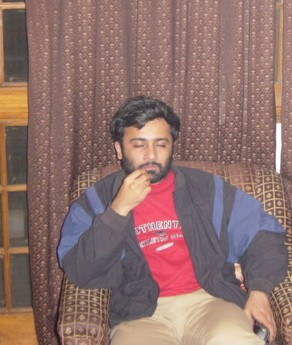
Amit's tagged me demanding I post a silly pig of myself. There are many such, but I don’t have most of them at mouseclick's reach – so here’s a readily available, doped-out one from back in the days when I used to spend hours on end pondering the secrets of the universe. (Naturally this meant there was no time to shave.) During one such meditation, a friend (I had friends then) took this photograph.
 It’s enough to scare away the likes of Gabbar Singh, Alan Moore and sundry other Yetis and hermits of hirsuteness, or so I like to tell myself. No?
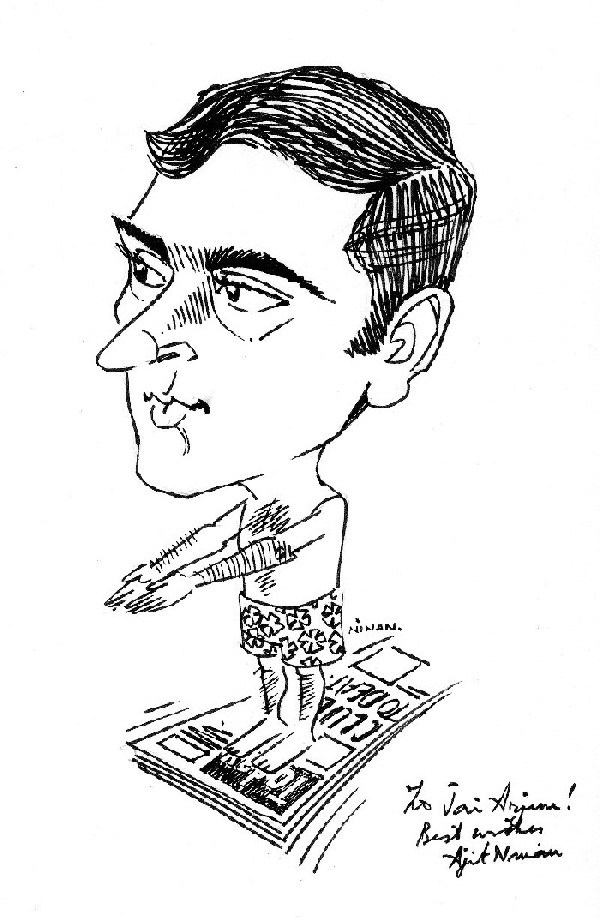
And as a bonus, here's a silly but nice caricature – it was done by the cartoonist Ajit Ninan, formerly of Target and India Today magazines. The copy of the afternoon paper Today (where I was working at the time) is supposed to be the diving board/launch pad for my journalistic career.
 (Click to enlarge)
 The original name for Harum-Scarum Saar, a collection of piquant short stories by the Tamil Dalit writer Bama, was "Kisumbukkaran", which roughly translates as "rebellious prankster". This appellation is explicitly used to describe a character in the title piece, a man renowned for his mischief-making, but it applies to many other people in the book as well; for a common thread in these stories is the refusal by some members of the lower-caste Dalit community to kowtow to their "masters", the upper-caste landlords.