Wednesday, March 29, 2006

Putting people into boxes: Amartya Sen on identity and choice

An excerpt from the prologue to Amartya Sen’s Identity and Violence: The Illusion of Destiny

Civilisational or religious partitioning of the world population yields a ‘solitarist’ approach to human identity, which sees human beings as members of exactly one group…This can be a good way of misunderstanding nearly everyone in the world. In our normal lives, we see ourselves as members of a variety of groups – we belong to all of them. The same person can be, without any contradiction: an American citizen, of Caribbean origin, with African ancestry, a Christian, a liberal, a woman, a vegetarian, a long-distance runner, a historian, a schoolteacher, a novelist, a feminist, a heterosexual, a believer in gay and lesbian rights, a theatre lover, an environmental activist, a tennis fan, a jazz musician, and someone who is deeply committed to the view that there are intelligent beings in outer space with whom it is extremely urgent to talk (preferably in English). Each of these collectivities, to all of which this person simultaneously belongs, gives her a particular identity. None of them can be taken to be the person’s only identity or singular membership category.
The essential plurality of human beings, and how the undermining of this plurality lies behind most of the world’s conflicts, are the central themes of this new book, which brings together nine of Sen’s lectures on these topics. Human beings, he points out, tend to be primarily defined in terms of their religious or civilisational identities, ignoring the numerous other factors that combine to make a person what he or she is. This results in the miniaturization of people and paves the ground for those with vested interests (rabble-rousing religious leaders, for instance) to foment tensions between groups – to encourage people to see themselves and others purely in terms of a singular identity.

In times of duress, such singular classification can have murderous effects, as we all well know. The essays in this book will strike a chord with anyone who has witnessed how even the best-intentioned people can, through an insidious brainwashing process, be made to see members of another community/religion/state/country as irreconcilably different from themselves, and hence a threat to their own worldview. From here, it’s a short step to the complete dehumanization of the Other – and it’s precisely on such ground that tragedies like the Holocaust, the genocide in Rwanda, the 1947 Partition riots and Gujarat 2002 have occurred. The Nazi guards and “Doctor Deaths” at the concentration camps could do what they did because they were no longer able to see the Jews as sentient human beings who were similar to themselves in many ways, regardless of differences in race.

Sen reminds us (though he doesn’t say it in so many words) that the world’s worst, most destructive conflicts occur between groups, not between individuals. Most of us don’t need to step outside our own neighborhoods (or even houses) to see the truth of this. In my own house my grandmother (still haunted by memories of friends and family being brutally killed in Partition riots) speaks of the Muslim community in general with loathing, even says things like “All this is happening only because there are so many Muslims in the world” (after the bomb blasts in London) – but she never seems even slightly awkward when interacting with Muslim friends/acquaintances who visit the house.

As he often does to great effect, Sen draws on personal experience to make his point. He reserves for the book’s very last chapter the story of his own first exposure to murder: as a child, during communal riots in 1944, he saw a wounded Muslim named Kader Mia staggering through the gates, asking for help. The man, a day laborer, had been knifed on his way to a nearby house where he was working, in a Hindu-majority colony; he died shortly afterwards.

The 11-year-old future Nobel Laureate was perplexed by the idea that a man could be murdered by people who probably didn’t know anything about him except for this crucial, all-subsuming fact: that he was a member of a particular community – hence the Enemy. “For a bewildered child, the violence of identity was extraordinarily hard to grasp,” he writes. “It is not particularly easy even for a still bewildered elderly adult.”

Sen also insists on a distinction between multiculturalism (the actual integration and mingling of different cultures) and what he calls plural mono-culturalism (the phenomenon of different cultures/communities existing in the same place – say Britain – but never interacting at all, simply “passing each other like ships in the night”).

The vocal defence of multiculturalism that we frequently hear these days is very often nothing more than a plea for plural monoculturalism. If a young girl in a conservative immigrant family wants to go out on a date with an English boy, that would certainly be a multicultural initiative. In contrast, the attempt by her guardians to stop her from doing this (a common occurrence) is hardly a multicultural move, since it seeks to keep the cultures sequestered.
In this context, he discusses the importance of young people being given freedom to choose between various identities, and to assign priorities to the various groups they belong to – and it’s here that the book enters slightly controversial waters. I imagine Sen’s reservations about the increase in faith-based schools in Britain will raise a few hackles.

[This] reflects a particular vision of Britain as a federation of communities, rather than as a collectivity of human beings living in Britain, with diverse differences, of which religious and community-based distinctions constitute only one part. It is unfair to children who have not yet had much opportunity of reasoning and choice to be put into rigid boxes and told: “That is your identity and this is all you’re going to get.”
People who are very religious (even if they are lucky enough to have so far escaped a situation where they are required to turn fanatical) will also feel queasy about some of the content. Sen is critical of the frequent employment of “moderate” religious voices to counter “extreme” religious voices – e.g. governments calling on moderate Muslim leaders to criticize violent acts in the name of Islam. The effect of this religion-centered political approach, he believes, has been to strengthen the voice of religious authorities, and to give them disproportionate power in contexts that should fall outside the ambit of religion.

But then, what’s a book by Amartya Sen if it doesn’t cause a few murmurs?

Since Identity and Violence: The Illusion of Destiny is a collection of discrete essays/speeches that have only been touched up in a minor way, there are quite a few repetitions in the text (as there were in Sen’s The Argumentative Indian, published last year). However, in my view the points that are repeated are the sort that need to be stressed anyway. I have to say though, I can’t share Sen's optimism about the possibility of attitudinal changes - I think too many people are too deeply attached to religion and community for there to be a meaningful change in the direction of tolerance in the foreseeable future.

Bah

Have had to say no to a weeklong trip to Ladakh for Outlook Traveller, because of other commitments. Third potentially interesting trip I’ve missed in the last two months, and that's not counting Pakistan. *Sighs heavily*

Tuesday, March 28, 2006

Redux

Scrap everything I said in that last post. Sentimental nonsense. Australia rules! Warnie's the best! Cricket lives! Woo hoo!

1996-2006: a cricketing odyssey, and closure?

[Note: very long and ponderous post, best read over two days. Consume Dispirin before commencing. I did, before and after writing it.]

An important anniversary went by early last month – marking exactly 10 years since I became a serious cricket follower. I didn’t care to make much of it then, but certain events in the last week or so have made me aware that the relationship might be on its last legs now. So now I want to talk a little about the journey.

One morning in February 1996, I’m not sure of the exact date, a little booklet arrived at the doorstep, folded within the newspaper (it was either the TOI or the HT, the only papers whose existence I knew of back then). It was a primer to the soon-to-begin World Cup with a very simple format: 12 double-spreads, each devoted to one of the participating countries, with pen-portraits of the squad members – brief 50-70 word profiles and ODI statistics.

Up to that point, I had only a nebulous sense of what was happening in the cricketing world, and of the basic rules of the sport; cricket had never figured too prominently on my personal radar. Also, as it happened there hadn’t been too much of a buzz in the recent past: India played astonishingly little international cricket in the one-and-a-half years leading up to WC-96 and their most recent home series, against New Zealand, had been largely washed out. (A statistic I enjoy parroting is that Sachin Tendulkar scored fewer Test runs in the calendar year 1995 than the English tailenders Angus Fraser and Devon Malcolm did – and not because he was out of form.)

But as 1996 dawned and I heard people in college discussing the various teams, favourites to win the tournament and so on, I felt interest growing in me. The booklet, and the layman-friendly way in which it presented all the things one needed to know about the teams and the players, was the final stepping stone to a world that so many people around me already inhabited.

Another thing that helped was this strange fascination I have for thinking about numbers (dates, running times of movies, telephone numbers, even licence plate numbers of random vehicles on the road) –turning them over in my head, playing with permutations and combinations. Flipping through the booklet, my eye went straight to the run aggregates and batting averages of the cricketers (like most rookie cricket fans, I didn’t care about the bowlers) and I started making mental comparisons, reading meaning into the statistics.

With all the artlessness of the amateur who doesn’t understand finer nuances, I was deeply struck by the fact that Navjot Sidhu had the highest average of any member of the Indian team – a little over 40 (Kambli was close behind, though with far fewer runs). In fact, this early impression was to lead to a mercifully brief phase where I constructed a whole romance around Sidhu being the most valuable, and most undervalued, member of the squad. (Incidentally Tendulkar and Mohammed Azharuddin both averaged 36 point something at that stage, for around 3,000 and 5,000 runs respectively.)

[I also remember being surprised by the entry for Australia’s Michael Bevan, which showed that he averaged 82.1 but had a highest score of only 78. Not knowing that “not outs” weren’t considered when computing averages, I didn’t see how this was possible, and decided it was a typo.]

Anyway, with the booklet constantly by my side, I settled down to World Cup 1996. By the time the tournament ended, two things had happened: one, I was a cricket fan for life (or so I thought then), and two, I realised that it didn’t matter much to me whether India won or lost. Sure, I was annoyed at the way that semi-final against Sri Lanka turned out, peeved (after the post-match deconstruction had begun) by Azharuddin’s decision to bat first. But I couldn’t begin to relate to the gloom that seemed to have descended over everyone I met after the match ended.

Coming at a time when I didn’t write much or articulate things about my worldview (even to myself), this would become a catalyst for self-analysis. Over time, it would help me come to terms with the fact that I wasn’t a patriot; that I didn’t understand why the concept should be so highly valued; that it was all right not to be obsessed with the idea of “my country”; that however much people would like to think of “positive, constructive patriotism” as something entirely distinct from nasty jingoism, the line between the two can become non-existent very quickly.

Of course, however lofty the idea of humanity taking precedence over patriotism might be in the context of general interactions between people, they can’t apply in the same way to sporting contests – where the whole idea is to produce a winner. To deal with this, I had to draw a distinction between my personal feelings about cricket on the one hand, and the public (or “official”) stance on the other. The official stance was that, well, of course the team is bigger than the individual and when there is a clear-cut case of individual goals conflicting with team goals, it has to be obvious which one to choose. But my private position was: what I’m really concerned with is the performances of my favourite players, everything else be damned.

This personal conundrum about teams vs individuals has stayed with me through the last 10 years. What enthralled me about cricket was not whether a particular team won or lost, but the little human dramas that were played out through the course of a match. I was fascinated with the minutiae; the bigger picture never seemed to matter that much. Where I was concerned, it were individuals that made the sport worth watching. Lara. S Waugh. Shane Warne. Wasim Akram. Aravinda De Silva. Andy Flower. A few years later, Adam Gilchrist.

And then of course there was Tendulkar, my obsession with whom began belatedly, a few months after WC96, with a gorgeous 85 he scored in a match against Sussex early in India’s tour of England. The next two years marked his finest times as a batsman (though they also included his sorry first stint as captain) – and as it happened, that period coincided with some serious troughs in my life. There were entire days, weeks, months during which Tendulkar’s innings were the only bright spots, quite irrespective of the result of the match.

Looking back, I don’t know why I ever assumed my interest in cricket would last forever. I probably thought the way it worked was that old heroes would keep getting replaced by new ones, and the show would go on indefinitely. I suppose that is how it works for most people. But after my first 3-4 seasons of following the sport (a time when I used to watch every single match that was on, get up religiously at 5.30 AM for every day of every Test played in Australia), there was a significant decline in the frequency of my cricket-watching. I started working full-time, got busy with other things; life was no longer as empty as it had been for extended periods between 1996-1998. Though I admired many of the younger cricketers (the ones who made their debuts in the past 4-5 years, or the ones, like Dravid, who became superstars in the past 4-5 years), I never had the time or inclination to turn them into personal heroes. Meanwhile, one by one, the early heroes retired: Aravinda, Akram, Steve Waugh. Lara continued to be the proverbial box of chocolates, Warne was out of the sport for a while.

And Tendulkar’s place in the scheme of things began to change too, starting with that famous 2001 series between India and Australia. In the first Test in Mumbai, he top-scored in each innings (with a 76 and a 65) as most others struggled. At that point in time, his combined Test average against Australia and South Africa (the two best teams in the world) was around 48. No one else in the Indian team came close to this; even Dravid, already acclaimed for his solidity in difficult situations, averaged less than 30 against those two countries. But that Mumbai Test marked the beginning of the end of SRT’s famous string of back-to-the-wall performances in lost causes. The next match was the famous one at Kolkata, with Laxman, Harbhajan and Dravid the heroes. Subsequently, as Sachin’s decline began, as injuries became more frequent, as Dravid and Sehwag became, respectively, India’s number one and number two Test batsmen, as India recorded famous victories under Ganguly’s captaincy without SRT playing the defining role in any of them, I became increasingly apathetic to Indian cricket. Watching India win had never been a point of attraction in itself, and watching others lead the team to victories held little charm for me.

It feels strange to know that cricket might not matter at all soon. But that doesn’t stop me from being curious: sometimes I wish I could peek 10 years into the future to see whether there will still be any residual feelings towards the game then. On one level, I hope there will.

[This was a very difficult post to write, and of course there's plenty I've had to leave out, but some of the things I’ve recently read have made it easier. Like this post by Rahul Bhatia, where he says “I could never be as emotional about India as I have been about Tendulkar.” It was quite startling to hear such a sentiment expressed by someone else (that too a professional cricket writer who is expected to be pragmatic about the game). Kadambari Murali wrote an impassioned personal piece in the Hindustan Times a few days ago, as did Nirmal Shekar (a long-time Tendulkar loyalist) in The Hindu. And another strange thing has been happening. With news of SRT’s latest injury (assuming there is one at all) and the realisation that the Tendulkar Era is coming to a conclusive end (in fact, might even have ended already without us having had time to prepare for it), people seem to be softening. In the last few days some friends/acquaintances who have been fiercely critical of him in the past have said things I never expected to hear from them.]

Monday, March 27, 2006

Hat on the cat, panties on the panther

Came across a marvelous new site while doing some research for my fortnightly blog column. This is the accurately named Stuff on My Cat, which asks people to send in pictures of their beloved kitties with various items arranged on them (food, clothes, toys, gadgets, anything will do). This sounds like a juvenile idea but it works surprisingly well. I worship cats and wouldn’t normally like them to be inconvenienced in any way, or turned into playthings for inferior beings, but this is entertaining stuff. They are such dignified, haughty creatures who value their space and privacy, and it’s fun to see some of the surly expressions on view in these photographs. As long as it’s tastefully done, I guess.

Here’s the link.


In other news, I’m going to have to stop using the T9 dictionary facility on my cellphone. I can live with “movies” being substituted by “mother”, but did you know that when you’re trying to spell “panther”, the default option provided is “panties”? No? Well it is, and it can cause much misunderstanding and embarrassment when you’re hurriedly sending someone an SMS to say you’ve bought The Pink Panther. Back to manual spelling now.

Saturday, March 25, 2006

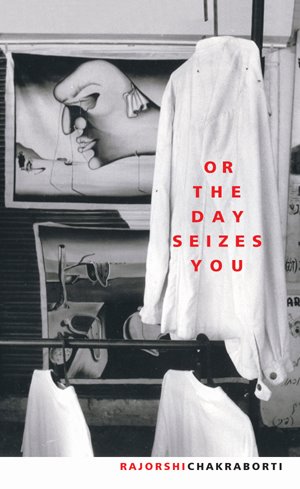
A conversation with Rajorshi Chakraborti

I’d been wanting to speak with Rajorshi Chakraborti ever since I finished his novel Or the Day Seizes You (which I wrote about here). But since he's in the UK currently and a plan to visit Delhi fell through, the discussion had to be done via email. Normally I prefer face-to-face interviews (even though it means more work for me, in terms of writing out the profile etc) – it gives you an immediate sense of the person you're talking to, allows for free-flowing questions that follow the natural course of the discussion, rather than a pre-formatted template. But in this case Raj's responses to the sketchy questionnaire I sent him were so detailed that it almost didn't matter. Here's more or less the full transcript of the conversation (though I hesitate to use that word since my own contribution to it was so frugal).

[Note: this discussion is best read after you've finished the book. If not, read the review for an idea of the book's content.]

------

Rajorshi Chakraborti was born in Calcutta, but spent some of his childhood in Bombay. In 1994, when he was 16, he moved to Victoria, Canada on a scholarship. He moved to England in 1996 and completed his BA in English Lit. from the University of Hull. Since 1999 he's been moving between Calcutta, London and Edinburgh, juggling various jobs alongside his writing.

I believe you won the Philip Larkin prize after graduating from Hull University. When did you start writing poetry? Have any of your poems been published?

Misleading as it is, the Philip Larkin Prize was actually for 'best final year essay by an undergraduate', so that didn't have anything to do with poetry per se. I did write poems as an adolescent which were (regrettably) published quite frequently in the teen/youth pages of newspapers in Bombay and Cal. One of them even won a Times of India-sponsored national poetry competition in '93, but they were all juvenile pieces whose only lasting value is that I'll never write like that again. But seriously, I have no talent for poetry even though there are a few poets I enjoy enormously, and return to over and over.

So it's safe to say you're more comfortable with prose now.

I decided at about 18 that prose is where my real interests, as well whatever little ability I might have, lie. Since then, I haven't written another poem, nor have any occurred to me. This was also the time when I fell in love with the novel form. I wrote two dreadful novels rapidly that year one after another, utterly imitative of everyone I admired at the time -- the usual suspects for an impressionable late adolescent, Garcia Marquez, Camus, Kundera -- and a whole bunch of stories. Again, their only value is that I got those particular mistakes out of my system forever.

For the next six years, however, I didn't write a word of fiction, even though the longing to write burned as steadily as before. I just had no stories compelling enough to tell. Instead, and the Ph.d was a very useful alibi for this, I read voraciously, like a starving autodidact, everything from Cervantes through Balzac and Flaubert, Musil and Mann all the way to the most recent African and American stuff. Whatever interesting writers I could find from each region, Central Europe, Latin America, Australia, and of course India. Somewhere during those years, I also began a similarly prolonged love affair with selected genres and phases of the history of cinema. I was very lucky to be in Edinburgh for most of this time, where both the facilities and the company to share some of these discoveries are most congenial.

Recently, I briefly returned to attempting short stories but none of my efforts satisfied me. Perhaps I'm coming up against another of my limitations, but for now I realise that though my novels are quite episodic, I do enjoy composing larger works, in which each of the sections sets off multiple resonances with others, and I can include a lot more overall. Of course, this might well be a question of not possessing sufficient skill at compressing my themes.

The surrealistic narrative of your book is fascinating, and not the sort of thing one is accustomed to seeing in Indian writing in English. It's much more subtle than, say, magic realism, which often lends itself to excess and can go badly wrong in the hands of over-indulgent authors. In contrast, your book requires a careful reading to realise that all is not as it seems – that this isn't a strictly logical narrative. Did you intend it to be that way in the beginning? Or did you start off constructing a straightforward story about this character, Niladri, and then find that the story lent itself to a fragmented, unchronological narrative?

No, I only ever thought of him in that 'fragmented, unchronological' way. In fact, I carried a few episodes and images in my head for a long time before I saw they could form part of the same novel, because they were about a similar sort of character. And then each chapter, in the unfolding of its reactions and details, surprised me as it occurred to me, because I had no pre-formed template for the characters at all. I suppose the only vague pointer I had about Niladri was that he is a man whose first instinct is to run in the face of anything unpredictable and challenging. At some point the title showed up to help me along, though Saul Bellow's own masterly novella, Seize the Day, has always seemed to me to ironically hint at the opposite, that whatever you (fail to) do, ultimately it's the power of happenings and of being itself that will seize you.

But apart from being cowardly, I also found other incidents occurring to me where he is brutal, such as towards his neighbour, or single-mindedly unscrupulous, as he is in his job. Yet, at other junctures, all he wants to do is abdicate, opt out from all responsibilities, as father, son, even as a human being and a citizen using his heart and his interpretive powers to empathise, understand and then enter in some way everything that is happening around him. Yet, despite these failings, I never thought of him as hopeless, or utterly rotten. So, fragmented, multiple, contradictory, yes, that's how I saw him from the beginning. I was, and wanted to be, constantly surprised, as much as the next reader would be.

As for the surrealism, I was glad you emphasised this aspect. First of all, I simply love the world of dreams, their density of unexpected surprises, the momentum of events and transformations, and finally their whole atmosphere where all limits are stretched and angles askew. Perhaps additionally my style emerges out of my love of cinema, as well as from an addiction to implausible anecdotes. But I love telling stories through situations and images, especially those that seem powerful and evocative enough to suggest many possible readings. Apart from being hauntingly beautiful and compellingly readable in their own right, I love those images and situations in the works of other writers that I think of as 'radioactive', i.e. endlessly generative of new readings. impossible to nail down to a single interpretation.

What ideology of insect is Gregor Samsa? What is Joseph K being tried for? How do we understand the accumulation of events in The Music of Chance or The Unconsoled? And yet, despite the mystery, page after page flashes past as we read, gliding forward upon what Kundera wonderfully describes in Kafka as the "beauty of perpetual astonishment", and "the poetics of surprise". In my own small way, these things are what I strive for in my work as well.

Who have your influences been – in literature and film (if any), or in other art forms?

Well, from what I've described above, some idols would be fairly obvious to guess, without attempting for a moment to compare myself with any of these names. Kafka, Paul Auster, the surrealist in Ishiguro, Orson Welles, Hitchcock, Buster Keaton, the settings and rhythms of film noir, the angles, lighting and mood of expressionist silent cinema. But there are so many other artists I admire for different things, some of which I would love to incorporate into my work, other aspects that I can admire as an observer while knowing my talents could never stretch to covering them. Joyce, Saul Bellow, Philip Roth, some of Rushdie's novels, Borges, Fellini, Satyajit Ray, Werner Herzog, Jean Vigo, Aleksandr Rodchenko, Truffaut, the music of Erik Satie. There's also this great tradition of rambling, anecdotal, vividly drawn comedy that I'm very fond of, that includes R K Narayan and Anita Desai from India, Cervantes, Chekhov, and Laurence Sterne, but is particularly rich for some reason in Czech literature and film, ranging from Kafka's Amerika to Jaroslav Hasek and Bohumil Hrabal, and the films of someone like Jiri Menzel.

The book's cover, with its use of Dali paintings that deal with the world of dreams, is very apt – how did that come about? Were you involved in the design process at all?

My editor asked for my ideas about the cover, and I emailed them about a dozen different visual possibilities that seemed to me to express something of the atmosphere of the novel. Based on these suggestions, I suppose their design dept. went to work. They got back to me a while later with three ideas, and I picked this one immediately. Its juxtapositions seemed to me wonderfully evocative of the mood of the book, and yet the image is opaque and mysterious, almost begging a story unto itself. So yes, there was a level of collaboration. But the design was someone else's original idea, and I'm delighted with it.

Slightly tedious question. You've been away from India a long time. Themes of dislocation/being adrift often figure in the work of non-resident Indian writers, and it's visible (albeit in a significantly different form) in Niladri's story as well: his constant running away from things, not seeming to belong anywhere. Does any of this draw from your own experiences?

About the autobiographical aspect, I can honestly say that almost all the actual details of the story are fictional, but a lot of the feelings fuelling or arising from those moments are derived from personal experience. And even with those feelings - grief, loneliness, being haunted by your losses - you often take them in a different direction in the story from how you would or may have reacted personally. A fairly obvious point, but one I suppose may be restated. Your characters become experimental selves, as it were, choosing numerous roads not taken by you. You also spread out different autobiographical details among different characters.

As for the abiding sense of dislocation/being adrift, I think it's clear I didn't want to write about those sensations within the context of cultural displacement, which is a well-travelled path in world fiction, and especially in much Indian English writing of the past so many years. I have nothing against such novels, but other writers can depict such situations with much more sensitivity and acuteness than me -- the immigrant torn between individuality and community, tradition and desire, for instance. If I'm permitted to sound pretentious for a little longer, what I did discover in the course of writing the story was that it could be a perspective into exploring the predicaments and limitations of contemporary Indian masculinity, within rapidly changing circumstances. And since middle-class urban life is the only world I know somewhat from the inside in India, I should further qualify that as middle-class, contemporary, urban Indian masculinity.

As the definition of individuality is thrown open here, because of various new social conditions, straining against the boundaries of family, tradition, and gender, and old certainties about fixed roles which were getting pretty threadbare and hypocritical for many of us anyway, begin to seem absolutely inadequate, how will the hitherto enthroned Indian male respond to the new imperatives of interpretation and self-reorientation? When his wife refuses to remain in a marriage where she has absolutely nothing in common with him, for example, and begins a relationship with someone else? The frequency of such newer forms of self-exploration by women, among others, is only going to increase. More and more young Indians, of both genders, will spend years abroad, as students as well as professionally. How do they cope with the challenges of isolation, unfamiliarity, the excitement but also the anxiety of discovering and renegotiating themselves? I try to introduce these questions somewhat, but never from a position of superiority or judgement. I'm part of the same journey, the same questions.

Alongside this, of course, there is the much-discussed opening up of our economy and its multiple implications and possibilities. How will we as citizens respond creatively to those new interpretive challenges, as well as acknowledge our new responsibilities? At a time when present-day corporate capitalism is a beast regarded with great suspicion by many globally for its inability to address issues of widening inequality and ecological devastation, we as a middle class, weary of shoddy goods and the permit Raj, are bringing three hundred million enthusiastic new capitalists to the waning party. What does Nilu's professional unscrupulousness mean in this regard, and what about his obdurate refusal to empathise with the victims of the impending riots, or even to interpret such events beyond the narrowest and most self-centred of horizons?

The book's structure is so unconventional – jumping from one unconnected incident to another, ending abruptly; did you face any resistance from your editor/publisher? Was there much reworking from your original draft?

My editor, V K Karthika, was actually very appreciative of both the form of the book and the texture of its incidents. If there was any reworking suggested (and incorporated), it was to do with the overtly political content of certain passages, which she thought clogged and burdened the text unnecessarily. I note from your review that you too had problems digesting some of these, so perhaps that is a challenge for my next book, a more harmonious integration of political preoccupations within the story and the characters.

Thursday, March 23, 2006

Shorts: Shooting Water, Jaipur Nama, DBC Pierre, John Schlesinger

Reading has been on the wane for various reasons in the last 2-3 weeks – have been busy with a lot of things, including working on the type of feature story I’m not too good at: the type that requires scheduling and juggling multiple interviews, collecting a huge number of inputs, making sense of the scribblings in my notepad and creating a structured 3000-word article out of the mess. It can be a royal pain. During this time I’ve read more in bits and pieces than in a sustained, concentrated way. And because I’ve had to do a few snippety (250-300 word) reviews for different publications there’s been a lot of simultaneous-reading too. So here are some brief (by my standards) notes on some of the books encountered/enjoyed/thrown with great force:

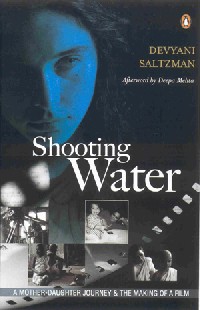
Shooting Water: I approached Devyani Saltzman’s account of the personal and professional travails that accompanied the filming of Water, directed by her mother Deepa Mehta, with much raising of eyebrows. The book seemed all too conveniently timed, given that the film is just readying for release in India (having premiered in Canada recently). It was promoted as “a mother-daughter journey” and “a personal account”. Surely there had to be an element of contrivance behind such a project?

But as I sank into the book (fortified with that healthy dose of skepticism) it soon became obvious that this wasn’t something hurriedly put together as a marketing gimmick. Saltzman writes with genuine feeling and candour about her early life: about how, as an 11-year-old, she had to choose between her parents when they got divorced; and about the repercussions of that choice on her relationship with her mother. This is the heart of the story. While Shooting Water does narrate the long and tortuous history of Mehta’s film (including its initial scrapping in 2000 after agitations by the Hindu right-wing, death threats to Mehta and political intervention, and its subsequent revival years later), the moviemaking process is really the catalyst for the development of the relationship between Saltzman and Mehta, and for Saltzman’s growth as a person. It also lays the ground for the author’s discovery of her home country, which she hadn’t visited for many years.

This is an unusual structure: a personal story set against the background of a very public controversy that many of us have become familiar with over the past few years. To a large extent its success owes to Saltzman’s writing, which is poised and lucid. She records events matter-of-factly, doesn’t veer from the focus of the story and doesn’t resort to name-dropping for the sake of it: the likes of Shabana Azmi and Nandita Das (who were to play the film’s protagonists in its first avatar), and later John Abraham, Lisa Ray and Seema Biswas, feature alright, but they stay firmly in the sidelines. I got the feeling that Shooting Water would have been written, and written well, even if it hadn’t involved the making of a high-profile movie. (Whether it would have been published is of course another matter.)

Jaipur Nama: Gilles Tillotson says his latest is “intended less as a work of scholarship, more as an entertainment”. I thought Jaipur Nama was a good mix of both. It fulfils the requirements of a good history: its account of the growth of one of India’s most popular cities from the early 1700s (when it was founded by Maharaja Sawai Jai Singh II) onwards is well-researched and comprehensive. But it’s also a perceptively witty book that knows how to poke gentle fun at the many quirks of history. Tillotson has spent decades visiting and writing about India, so it would be churlish to refer to him as an outsider - he knows more about many aspects of our history and architecture than most Indians do. But his approach is a pleasingly irreverent one, especially in the descriptions of rituals, political infighting and court intrigues (don’t miss the ludicrous episode of the Pregnancy Committee, formed to confirm an heir to Jaipur’s throne in the early 1800s!). This makes Jaipur Nama more readable than many other treatises in its genre.

At his talk during the Jaipur Heritage Festival earlier this year, which I attended part of, Tillotson bemoaned the fact that myths often come to be accepted as truths. In this book he does what he can to question accepted wisdom (like the belief that Jaipur’s famous pink wash was only introduced in 1876 to celebrate the visit of the Prince of Wales) – even if, as he himself says, it’s futile. “Some things are too deeply entrenched in the popular imagination to ever be removed.” Jaipur Nama is a noteworthy new look at a city about which much has already been written - and entrenched in the imagination.

Ludmila’s Broken English: Couldn’t trudge past the first 40 pages of D B C Pierre’s latest, his follow-up to the Booker-winning Vernon God Little. Maybe it’s because I wasn’t up to concentrating very hard, but the writing was too convoluted for my liking. Story involves conjoined twins who are separated after 33 years being joined at the abdomen, and whose paths will eventually cross with that of a Russian girl trying to save her family from starvation. (Warning: that synopsis makes it sound more accessible than it actually is.) Maybe I’ll get back to it someday and discover it’s the great book I've been searching for all my life. But can’t deal with it right now.

Conversations with John Schlesinger: I can’t say I regretted reading this, but it was a bit of a disappointment– it slipped out of my mind faster than I would have liked. Schlesinger, the British director who made such films as Billy Liar, Darling, Midnight Cowboy, Sunday Bloody Sunday, Marathon Man and The Day of the Locust, is one of those artists it’s difficult to have a very strong opinion about. He had a solid body of work and there are certain things he was undeniably good at (directing actors, for instance, or working with writers to augment an existing script), but he can’t really be regarded as an auteur – as the sort of director who controlled all (or most) aspects of a production, or imposed his own unique vision on a film. But at the same time, you can’t call his movies workmanlike – there’s more to them than that.

This book is a collection of conversations between Schlesinger and his nephew, the writer Ian Buruma, and if you’ve seen any of Schlesinger’s films you’ll undoubtedly find parts of it interesting. Specific points of interest are the director’s recollections of his experience as a gay man in 1940s and 1950s England, and his musings on the differences between American and British acting styles (there is an extended discussion about the famous Dustin Hoffman-Laurence Olivier friction on the sets of Marathon Man).


(To be continued, or not)

Sunday, March 19, 2006

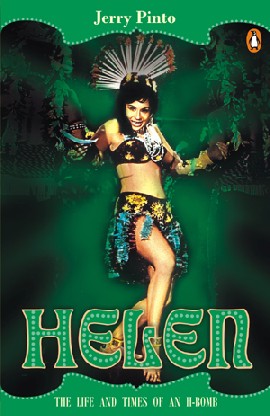
The face that launched a thousand gyrations

I miss the films of the seventies…When I watch an item number now, so much more glossy, so much better choreographed, the women with bodies honed to reptilian perfection and dressed in much better clothes, the men all gloss and muscle, I miss the old dances in which Helen performed…The item numbers of the ’00s take themselves very seriously. In the moue that is the standard sexualized challenge on every female dancer’s face, I do not find the laughing invitation to naughtiness that I remember in Helen’s. You would not dare laugh at – no, not even with - these women…They’re never out of step but they’re not having fun.
(from Helen: The Life and Times of an H-Bomb)

Jerry Pinto’s Helen: The Life and Times of an H-Bomb is enjoyable on many counts, starting with the author’s infectious enthusiasm for Hindi movies of the past - familiar to those of us who have read his columns and articles on the subject. Pinto is precise, passionate and insightful, which is very welcome given the general lack of intelligent personal writing on Bollywood.

He is also ambivalent about the films, which is something any mainstream Hindi-movie buff can understand. Those of us who grew up on Bollywood (even those who eventually grew out of it) still struggle to come to terms with the experience; with the influence it had on us during those vital formative years. We enjoy making fun of all the kitsch ourselves, but we bristle when someone else does it (especially if it’s someone who hasn’t grown up with those films and never had a personal compact with them). We get defensive about things that are difficult to defend, we don’t find it convenient to accept that while growing up we took these movies quite seriously – that we didn’t merely give them our approval on the grounds that they were kitschy (which is now the preferred approach to Hindi movies of the 1970s and 1980s). Consequently, while this book is a fine examination of Helen’s screen persona and the role she played in the peculiar moral universe defined by Bollywood, it works at another level too.

Pinto makes it clear early on that this isn’t a biography of Helen (he never even succeeded in speaking to her, though he tried) – the subtitle “The Life and Times of an H-Bomb” is slightly misleading. What the book is, is a well-researched, intensive study of a dancing career that spanned over three decades and over 500 films (though Helen herself claimed the figure was closer to 1,000!), and which tells us a lot about the way Bollywood functioned during that time.

It is, for example, a reminder of how shamelessly, cheerfully racist (and sexist) Hindi cinema has been over the decades. Some of the specifics are quite shocking if you don’t have a strong memory of films from the 1960s and 1970s. As Pinto notes:

“Contrasting the white woman and the black or tribal man was a way of maintaining an ambiguity about the lust lives of Indians. As Aryans (our way of distancing ourselves from the more uncomfortable term ‘brown’), Indians could be seen as representing a civilised mid-point between the lust of primitives and the degenerate liberation of white people.”
(As an aside: anyone remember those buffoons who played “Chinese” soldiers in films made around the time of the 1962 war? The ones who would run around screaming “Chin choo chou chou chou chou”?)

During Helen’s heyday in the 1960s, her principal function was to represent the depravity of the Anglo-Indian/Catholic/westernised woman – she served as a contrast to the chaste heroine and, on occasion, a marker of the hero’s descent into vice. Within this broad role, there were other functions she performed (as White Goddess, as Moll, as Skeleton in the Closet, even as Second Lead being wooed by the bumbling comedian), and Pinto illuminates them all by providing synopses of (and commentary on) dozens of films from the 1950s to the 1980s.

Even independently of what they tell us about Helen’s career, these descriptions are worth the price of admission. They are brilliantly tongue-in-cheek and make for an entertaining journey down memory lane for the movie buff. I love the way a simple exclamation mark is used, for instance, while describing a film where Moushumi Chatterjee plays a feminist(!) while Shabana Azmi is the traditional Indian doormat(!). And while there are too many examples to quote here, I can’t resist setting one down:

[In Aap Beeti] rich boy Ranjit (Shashi Kapoor) falls in love with poor girl Geeta (Hema Malini). At one point he brings ‘Rita darling’ (Helen) to the shoe store at which Geeta works. Rita is wearing a hat and very little blouse and very little skirt. Ranjit then tells Geeta that Rita darling and he are getting married on Sunday.

“Is this your girlfriend?” Rita asks, an odd question for a fiancée.

“I’m a rich man’s son so poor women always try to befriend me,” he says.

“Where do we go for a honeymoon?” asks Rita, mistress of the non sequitur, stroking his arm.

“From Liverpool to swimming pool, wherever you want,” he replies, to her strange delight. Geeta stalks off in a rage – she has already expressed her disbelief in his love in a song on a surreal set populated by humongous shoes and sandals in primary colours.
Pinto succeeds in showing why Hindi cinema needed a Helen figure to validate its beliefs and principles (“she almost always failed, which was perhaps the secret of her success. In failing she kept the moral universe intact”), but he never really provides an understanding of why this particular performer was so successful for so long, while many other wannabe vamps fell by the wayside. This is perhaps inevitable, for beyond a point star quality is analysis-resistant. It’s possible to say that Helen had an expressive face, that her abhinaya was more deeply felt than that of most other dancers. It’s possible to point out also that she somehow managed to do the silliest things in the most tasteless contexts without coming across as vulgar herself. But it isn’t possible to precisely define how all this adds up to make one of Hindi cinema’s most enduring screen personae. That secret must remain hidden between the performer and the audience.

The book's description of Helen’s transition from cabaret dancer to Hindi-film legend without ever having been a star (no one ever went to see a film specifically because she was in it) is noteworthy too – it shows the strange ways in which the celebrity machinery works. In fact, the belated conferring of respectability on Helen (with the lifetime achievement Filmfare award, her progression to a maternal figure in recent movies and even her brief self-referential dances in films like Mohabbatein) says some interesting things about Bollywood's relationship with its own past.

Helen: The Life and Times of an H-Bomb is a very personal work; in places it reads almost like a movie-buff’s private journal, and the film book it most reminds me of is Peter Conrad’s excellent The Hitchcock Murders. What’s common to the two books is that neither of them is too concerned with making definite, structured arguments or belaboring a point – they are freewheeling, conversational and fuelled entirely by the author’s childlike enthusiasm for his subject. Conrad, with seeming randomness, suddenly picks up an aspect of Hitchcock’s work that he finds interesting and then elaborates on it by examining scenes from different movies. Pinto’s approach is slightly more structured (each chapter has subheads, examining a different aspect of Helen’s roles), but the overall effect of his book is similar. You feel like you’re part of an intense coffee-shop conversation. About Bollywood Gold.

Saturday, March 18, 2006

Spoiler-wocky

Can’t resist reading an article that begins thusly:
Beware the Spoilerfinks, my son!
The pix that wreck, the blurbs that pillage!
Beware the cover art and shun
The ruinous menu spillage!

That’s the prelude to this entertaining piece by Jim Emerson about DVD packaging that can spoil a movie’s surprises. Also, don’t miss this nostalgic aside:
“… one of the Great Mysteries of Cinema that we've now lost…For most of the first century of the existence of motion pictures the average moviegoer could not own a film. It was an evanescent experience, like a dream you can't fully remember. You could only rent it as it flashed before your eyes…”

Read the full story. And (spoiler alert) here’s a DVD spoiler list.

Thursday, March 16, 2006

Catholic conspiracy?

So I need to find the most accurate way to describe “maulvi” (it’s for something I was writing, don’t ask what) and I go to Dictionary.com, type the word and hit Search.

And this is what it says:
No entry found for “maulvi”

Did you mean “maul vi”?
Intrigued, I click on “maul vi”. And then this is what it says:
No entry found for “maul vi”

Did you mean “Paul VI”?
Hmm.

Wednesday, March 15, 2006

Beware the Idiots of March

Briefly – very briefly – considered writing a profound and complex short story about Holi-revellers, titled “The Dyeds of March” and incorporating such high-falutin' phrases as “What thou wouldst highly, that wouldst thou holily”. But I don’t have the time or (more relevantly) imagination. So here’s some kindly advice instead for those celebrating the festival. Since it’s clearly too much to expect that you don’t impose your own idea of “fun” on the unwilling (heck, the species has been doing that throughout its existence, why should it stop now), I’ll stick to the more important stuff: try not to blind anyone else with toxic colours, don’t use the occasion as a pretext for eve-teasing, and don’t get drunk and swerve your Sumos into other people’s vehicles (or into other people) at 140 km/hr (I was driving late last night amidst a sea of bhang-drunk-drivers and pedestrians – this is one of those times on Delhi’s roads when you really don’t feel like your life is in your own hands).

But who am I kidding, we’ll read all about it in tomorrow’s papers anyway, as we do each year.

Monday, March 13, 2006

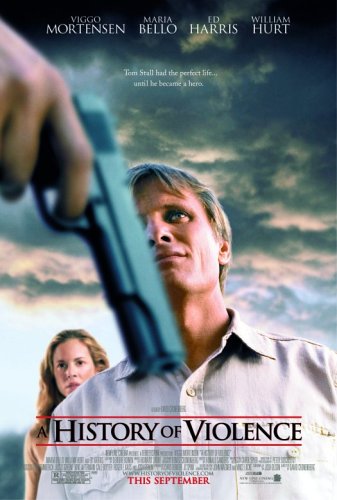
Cronenberg's A History of Violence

Desensitisation to violence, anyone? I’m talking about movie audiences laughing with much gusto at violent scenes. It’s understandable to an extent I suppose when the violence is actually played for laughs (though I’m not too comfortable with that sort of thing anyway). And stretching it a bit, I could even see why some people giggled at the scene in Pulp Fiction where Marcellus Wallace shoots his rapist in the genitals. Tarantino didn’t give that scene a humorous treatment at all, but I imagine there might have been Beavises and Buttheads in the audience going “Whoa, right in the nads! Heh heh. Heh.”

But when there’s nothing inherently funny about either the premise of a scene or its execution? When th
e violence is intended to make you flinch, horrify you, make you see what terrible things guns are? I was at David Cronenberg’s A History of Violence yesterday. Onscreen, people were being shot at close range, there were brief shots of twitching bodies and blood-spattered heads – and large portions of the crowd in a surprisingly crowded PVR hall were roaring with laughter. It wasn’t nervous laughter, the sort that helps dissipate tension, it was full-throated and full-bellied.

In fact you might even say they were laughing their guts out, which would be an apt expression to use while discussing some of Cronenberg’s earlier films. He has a well-documented interest in the interior workings of both the human mind and the human body, and the latter has taken a gruesomely literal form in films like Shivers (a.k.a. Orgy of the Blood Parasites), Videodrome and eXistenz. This isn’t a director known for abiding by the niceties of commercial filmmaking, which require that certain things – like the internal organs of human bodies – not be depicted on screen.

A History of Violence is relatively mainstream by Cronenberg’s standards, which is one reason it’s made it to Delhi’s multiplexes at all. But it’s still an unsettling film, with more than one scene that will make you shift uncomfortably in your seat.

(Obligatory SPOILER ALERT here. In my view the revelation in question isn’t a crucial one, and it occurs less than two-thirds of the way through anyway. But many people don’t like having key plot elements revealed, and I like to discuss them at length.)

This is the story of Tom Stall (Viggo Mortensen), a peace-loving family man running a diner in a small Indiana town, who becomes a local hero when he puts out two thugs during a hold-up. But this incident soon leads to Tom’s own violent past catching up with him: it turns out that he was a mobster named Joey Cusack in Philadelphia 20 years earlier, before he reformed and settled down to live the American Dream.

At the heart of this story is a simple question: even with the best intentions, can a man ever really shrug off his past life and settle into a completely new persona? But there’s nothing straightforward or simple about the film’s treatment of this subject. In the first 15-20 minutes we meet Tom and his family, we see that he is a good husband, a good father and a good employer, well-liked by everyone around him. Given all this, when we do find out about the person he once was, how much does it really matter? When his wife is horrified at the thought that the name she and her children have been living with for 20 years is a “false” one – that it wasn’t passed down over the generations but simply chosen, randomly, one day – is she justified? Or is she overreacting (given that she never knew Joey Cusack in the first place; that for all practical purposes the only man she ever knew was Tom Stall)? On the other hand, could there be some truth to the assertion, made by a figure from Tom’s past, that “he’s still the same man, the same Joey – he hasn’t changed”.

A History of Violence isn’t a completely satisfying film – it goes slightly astray in its final 20-25 minutes (with some silliness involving William Hurt in a campy performance that got him an Oscar nomination as supporting actor). But even this last bit begins with a scene that I loved – a shot of Tom/Joey making the long drive to Philadelphia where you get the sense that he is traveling back into his own past, traveling along a route he hasn’t been on in 20 years.

One of the things that’s fascinating about the film’s structure is the gradual escalation of violence within the Stall household as the story progresses. Initially, Tom’s teenage son is a passive victim when he is bullied at high school. But after watching his dad’s heroism he hits back at his own tormentors with such viciousness that we wonder if we are witnessing the uncoiling of a suppressed genetic impulse. (Crucially, we never learn much about Tom’s early life, about how he became a killer, and what led him to change his ways.) Shortly afterwards, there is a confrontation between father and son that the film’s idyllic first 15 minutes never prepared us for – raised voices, culminating in Tom smacking his son across his face (Cronenberg shoots scenes of violence in such a way that it seems aimed at the viewer – which is one reason I was so taken aback by the PVR crowd’s reaction). Later, there’s a disturbing scene where an argument between Tom and his wife ends in brutal sex – with the barest hint that she is aroused by this new side to her husband.

This continuing shift in the film’s tone is very relevant to what the story has to say about our buried natures coming to the surface when circumstances allow them to. At the film’s end, when Tom returns home, his wife and children are sitting stiffly at the dinner table. Eventually his little daughter gets up and lays out the cutlery for him (out of context, this would have been a “cho chweet” moment). The family is whole again but one senses they will never be the same – they’ve been stained not just by the violence of Tom’s past but by knowledge of their own primitive impulses. At this point one isn’t even sure whether it’s a good idea to have all those knives and forks around.

Some links:

An interview with Cronenberg where he says he intended the film partly as an allegory for the Bush administration’s policy of violence

Jim Emerson on the use of doors as a visual motif in the film

And an interesting conversation between Cronenberg and Salman Rushdie.

Sunday, March 12, 2006

Johannesburg ODI!

Okay, I don’t normally do “Live” blogging – but IS ANYONE ELSE WATCHING THIS AUSTRALIA-SOUTH AFRICA MATCH? As I type this, Herschelle Gibbs is just out, having taken SA to 299 for 4 in 31.5 overs, chasing Australia’s world record 434. That dismissal might just spoil the party for SA (I’m not predicting anything) but whatever the result there will almost certainly be over 800 runs scored in a single day. I don’t usually get excited about batsmen-vs-batsmen contests on disgracefully flat pitches, but this is bloody special.

Anyway, this has to be among the best one-day series ever - possibly the best if your criterion is that the scoreline be tied 2-2 after four matches and the decider be a match with all the drama of a Lagaan.

(And while on cricket, got up this morning and switched the TV on just in time to see Lara out first ball at Auckland. Like I said to Chandrahas on the phone later in the day, the man’s initial movement as he shapes up to play a ball can be so graceful to watch it can make your day – even when he ends up losing his wicket.)

Friday, March 10, 2006

Thoughts on introversion

Do you feel the need to spend a certain amount of time alone each day? Do you find it hard to understand how some people can move from one social engagement to another without taking any time off in between to “recharge”? If so, you might want to read this excellent article about introverts, written by Jonathan Rauch in 2003. (Thanks to Amit for pointing me towards it.)

And if you don’t relate to the above - well, that’s all the more reason for you to read the piece, which is largely about the hegemony exercised by extroverts over introverts.

Extroverts dominate social life, so they tend to set expectations. In our extrovertist society, being outgoing is considered normal and therefore desirable, a mark of happiness, confidence, leadership. Extroverts are seen as bighearted, vibrant, warm, empathetic. “People person” is a compliment. Introverts are described with words like “guarded”, “loner”, “reserved”, “taciturn”, “self-contained”, “private”— narrow, ungenerous words, words that suggest emotional parsimony and smallness of personality. Female introverts, I suspect, must suffer especially ... a man can still sometimes get away with being what they used to call a strong and silent type; introverted women, lacking that alternative, are even more likely than men to be perceived as timid, withdrawn, haughty.

There’s much in the piece that I can strongly identify with. I often feel stressed out when there are a number of social obligations to be met in the course of a single day, even if most of them are inherently pleasant: say, going for a movie at 12, then meeting a friend for coffee at 3, sitting with guests at home in the evening, and then going out for a party at 9. You get the idea: even if there’s adequate time between the engagements so that they can all be done without things getting too rushed, I’ll still be completely drained when the day is finally over -- and I probably won’t want to do anything the next day that requires too much effort.

I’m not completely sure about the distinction Rauch makes between being introverted and being shy (possibly because I’m both myself), but his point that being introverted isn’t the same as being misanthropic is a vital one. Shyness being mistaken for arrogance is something that commonly afflicts our species.

Read the
full piece and also this interview with Rauch. (Warning: some of it is tongue-in-cheek so try not to get too put off by assertions about introverts being “more intelligent, more reflective, more independent, more level-headed, more refined, and more sensitive” than extroverts. Though, uh, I’d like to think most of that is true as well!)

P.S. Enjoyed this line: “Many actors are introverts, and many introverts, when socialising, feel like actors.”

Thursday, March 09, 2006

Capote review

In November 1959 the state of Kansas was shaken by news of the murder of the Clutters, a family of four living in a lonesome hamlet called Holcomb. Many worlds away, in Manhattan, novelist Truman Capote was soaking in the recent success of Breakfast at Tiffany's. The book had added to Capote's reputation and he was now a high-profile member of New York's upper-crust literary circles, a raconteur with a talent for becoming the central point of any room he was in. He was at a stage in his career where he could simply call up The New Yorker's editor William Shawn – a mentor to some of the finest young writers of the age – and inform him that he wished to travel to Kansas to research for his next article. This is in fact what Truman did, for the Clutter murder story had ignited something in him.

What that something was and what effect it would have on his life and career is the subject of Bennett Miller's Capote, a stunning portrayal of the writer as parasite, feeding off the tragedies of others, and of the loss of humanity in the pursuit of art. Capote covers six years in the author's life – the time that went into the creation of In Cold Blood, his "non-fiction novel" which broke new ground by marrying journalism with literary fiction. This book would seal his reputation as one of America's leading writers – but it would exact a heavy toll too, beginning a downward spiral that would end with his death (of a drug overdose) in 1984. He would never publish another novel.

Capote begins more or less with Truman traveling to Kansas accompanied by his childhood friend Harper Lee (a year away from achieving fame herself with the publication of To Kill a Mockingbird). They visit local residents, make notes, get themselves invited to dinner by the agent investigating the Clutter killings. Throughout, there is little sign of emotion on Truman's face – not even when he lifts the lid off one of the coffins in the funeral home and peers inside. His eyes merely dart about as he registers details and commits them to his memory ("I have 94 per cent recall value," he often boasts; he can recite the contents of an entire magazine page after having read it once).

Even so, at this stage Truman's actions aren't indicative of anything more than an author being slightly over-meticulous in his spadework. But this soon changes: the two murderers are caught and Truman finds himself becoming increasingly interested in one of them, Perry Smith, a tortured young man whose childhood closely resembled Truman's own.


Over a series of meetings they form a strange bond. Truman wins Perry's trust, helps the two men find lawyers to appeal their case. Their execution is stayed once, then again. This suits Truman – he has decided to develop the article into a full-length book and he needs Perry alive for as long as possible so he can get the full story. Later, the situation will be reversed: for In Cold Blood to get its dramatic ending, it will become necessary that the two killers be executed. For all that he has, in his own way, become attached to Perry, Truman becomes a nervous wreck at the thought that he might not get the death penalty after all.

People who knew the real Capote have hailed Philip Seymour Hoffman's imitation of the man's effete, affected charm and his ability to be an urbane New Yorker and an excited little boy all at once. But the imitation, splendid though it is, is almost secondary: this performance is entirely convincing on its own terms, even if you have no idea who Truman Capote was. Hoffman paints a picture of growing obsession but does it with incredible subtlety, without resorting to any of the usual acting tricks that go with that emotion. For the most part Truman's face is a blank mask as he absorbs the details that he can use in his writing. The first glimpse of vulnerability we see from him comes when William Shawn praises the first two chapters of his manuscript. The same deep-rooted need to be appreciated and admired also comes across in the intensity with which he reads excerpts from his novel out to a large audience in an auditorium (a scene that is chillingly intercut with shots of Perry looking out of his cell window as another inmate is taken away to be executed).

Special mention must also be made of Catherine Keener as Harper Lee; her performance provides an emotional and moral grounding to a story that has such an unlikable man as its protagonist. Watching her, it's easy to imagine that this is the woman who wrote the most graceful of books, the woman who created Atticus Finch. By default, as a close friend and confidant of Truman, she also gives us a perspective on him that the film doesn't otherwise provide.

Capote is a film that is as still on the surface as the desolate Kansas plains themselves. Except for a brief recreation of the murders near the end (arguably necessary to remind us not to feel too sympathetic towards Perry), there is scarcely even a raised voice to be heard. But there is violence beneath the film's surface: the violence that comes from the clash between literature and life, from a man pursuing his art so relentlessly that it's possible for us to see two murderers as his victims, and to wonder whether "In Cold Blood" might have been an apt title for more than one reason.

This is also a film that's more than the sum of its parts: when it's over, what you remember is the overall impact rather than specific scenes. But the final moments, the scene of Perry's hanging, with Capote forcing himself to watch the execution (is this his pathetic stab at atonement?), stay with you. Tears slide down the author's cheeks and you can't help wonder: is he crying for the young man whom he felt such a connection with and whose trust he repeatedly abused for his own gain? Or are the tears for himself, for his knowledge of what he's become, for the price he's paid to produce that one book?

P.S. Do try to read In Cold Blood before watching Capote.

(Also, a review by Falstaff who responded similarly to the film – even using the psalm "For what shall it profit a man if he shall gain the whole world, and lose his own soul" as an epigraph. I applied that one to the Anakin/Vader story in Star Wars: Revenge of the Sith last year!)


Monday, March 06, 2006

Notes on EU film fest, and Kolya

Have been going for some of the screenings at the ongoing European Union Film Festival (schedule here if you’re a Delhiite: it’s on till Friday) and most of it has been good. For starters, the Siri Fort Auditorium authorities have been a lot more polite and pragmatic than on past occasions (some of my earlier rants here and here). They aren’t doing silly things like not allowing cellphones in – the guards simply instruct everyone to turn the volume down, and astonishingly it appears to have worked: in the four screenings I’ve been to so far, only once have I heard a phone ringing in the hall, and even that was cut off almost immediately.

At the festival inauguration on Friday a profoundly bearded Vinod Khanna, looking like a yeti in a smart suit, made a short, impromptu speech about his days as a film student: “I’ve never learnt as much about other countries as when I was watching movies from around the world in the early 1960s.” Barbara Gräftner and Andrea Nürnberger, the director and lead actress respectively of the opening film My Russia were also present and quite thrilled to see how appreciative the crowd was. I sometimes scoff at much-too-earnest film festival types waiting around for hours outside auditoria discussing films in the most portentous ways, but these events can be very charming in small doses. I enjoy the bonhomie, the small-scaleness of things, and the fact that most of it is free or nominally priced (just a couple of days earlier I’d had to back out of a multiplex screening where tickets had already been booked online – which meant Rs 300 thrown away. It didn’t make me happy). There are no tedious preludes to the screening of any of these films, no long-winded commercials. One of the staff members simply comes up to the stage at exactly the right time, makes a quick and tentative introduction (invariably mispronouncing names) and then the screening begins, just like that.

Of course, there will always be little annoyances: an old man will definitely start snoring loudly in the row behind you exactly 10 minutes after the film has begun, and at every second screening a scruffy, sweat-soaked creature will turn to you and ask meaningfully, “Bhai saab, iss film mein koi scenes hain?” These things are as inevitable as the loud boor on the flight demanding a whisky with soda every 15 minutes. But you learn to take these things in your stride.

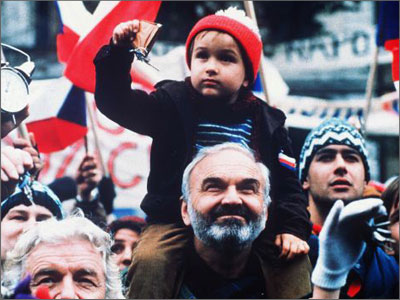
Kolya


It helps when the films are good. I loved Kolya, which won the foreign-language film Oscar in 1997. Had heard of it before (in part because of an apocryphal story from that time, about Shah Rukh Khan being woken up and told that his film Koyla had won an Oscar!) but I wasn’t prepared for something so powerful and moving. It’s set in Russia-occupied Prague in 1988 and the central character is a middle-aged lothario named Louka, a professional cellist who agrees to a temporary “marriage of convenience” with a Russian lady seeking Czech citizenship – Louka, struggling under the weight of numerous debts and holding down two jobs, goes along with it because he badly needs the money. But then the woman rushes off with her lover and Louka, who’s a bit of a misanthrope, finds himself in charge of her five-year-old son Kolya. The story is about the development of the relationship between him and the boy, and how the initially unwelcome responsibility reveals a side to his character even he was unaware of.

Storywise and themewise this is well-trodden territory, but Kolya’s handling of it is brilliant throughout. This is a film that has many balls in the air at once – it has things to say about the parent-child relationship, about how we define/restrict ourselves by our nationalities, about how terrifying the world can seem to a small child – but it never strikes a wrong note or loses its focus. There is gentle, perceptive humour in the way Louka (previously one-trackminded when it came to women) asks one of his sexual companions for help in telling Kolya a bedtime story on the phone; and in the boy’s interaction with Russian soldiers manning tanks out on the street. And the ending, which might have been embarrassingly mawkish in many other hands, is handled with restraint, sensitivity and even optimism – there is a strong sense of having seen a character evolve. (The film never brings the politics of the time and place into the forefront but one of the last shots also seems to point to the birth of a new country.)


Other films seen: La Femme de Gilles (the tone of which reminded me of some of Claude Chabrol’s work) and Mike Leigh’s Topsy Turvy, which I’ll blog about later if time.

Favourite quote from Oscar ceremony so far

“Looking at all the tuxedos here tonight, it feels like we’re watching the film all over again.”
(from one of the producers of March of the Penguins, which won for best documentary feature)

Also enjoyed Meryl Streep and Lily Tomlin’s take-off on the “naturalised” overlapping conversations in Robert Altman’s films (before they presented him with the lifetime achievement trophy).

Sunday, March 05, 2006

The divorced woman as easy prey

(Originally wrote this for the Blank Noise Project blogathon – I’d been told the post didn’t necessarily have to be on street harassment. Oh well, it can sit here now.)

I was nine when my parents separated and my mother and I moved into a new flat. My relationship with my mom had always been very candid, and so it was that even at that early age I developed an understanding of the perceptions many men had about divorced women: that they were available, desperate for any form of companionship – and even fundamentally loose-charactered (it being a major step in our society for a woman to leave her husband’s home, and therefore indicative that she was unconventional in her thinking = not a sweet, submissive Bharatiya naari = Westernised = unprincipled).

One of the first friends my mother made in the new colony was this slightly sad-faced lady (I’m not sure if she was like that from the very beginning or if I’ve ascribed those qualities to her retrospectively) who I’ll call Ritika aunty. She would often visit, sometimes with her husband Rajiv, and mum and I would occasionally go across to their place as well. I can’t recall what I thought of him back then – my memory is so clouded by what happened later – but I probably thought he was an okay sort: the adult male figures in my life up to that point hadn’t exactly been paragons of normalcy, and compared to them most uncles would have seemed okay-sorts.

Ritika and Rajiv seemed the picture of a “normal” couple – well-settled, living in a decent-sized house with two small children and one large dog. Which is why it’s easy to imagine how shaken my mother was when one day – a year or so into our acquaintance with them – Rajiv called her up late one evening and, after initially asking if his wife was around, started making overtures. The kind of talk that begins with “What do you do all day, it must get very dull” and progresses with surprising swiftness to “Is the kid asleep? Should I come over?”

The first thing mum did was to tell me about it. The second thing (and this is something not many women would have had the courage to do) was to call Ritika aunty over and give her the whole story as calmly and straightforwardly as possible. I think it’s equally creditable (given how women in Indian society are conditioned to be fiercely loyal to their husbands just to maintain appearances, “family honour” etc) that Ritika accepted the story without fuss, admitting that she had long suspected Rajiv was up to all sorts of things behind her back, but had resigned herself to it. I imagine she confronted him about it later, and of course that was the end of any contact between him and us. They’re still very much together, though I don’t know what sort of a relationship it must be.

The incident had a major effect on my mother. She no longer felt as free or as comfortable talking with her friends’ husbands as she had before – even with the ones she had known for many years and genuinely believed to be decent men. This most relaxed, unselfconscious of women started feeling the need to measure everything she said at get-togethers. She told me once that she didn’t know anymore whether to laugh at a risqué joke told by a male friend, even if it was in his wife’s presence – because if another such incident ever occurred she might be accused of having brought it on herself by being over-familiar. As tactfully as possible, she made it clear to her closest friends that she was more comfortable when they visited alone rather than with their husbands. Inevitably, the strings of some of those friendships were loosened as a result. And all because of one stupid episode.

I’d like to think things have changed since those days in terms of how men look at a divorced/separated woman – or in terms of people being more accepting of independent women in general. But every once in a while I’m reminded they haven’t. A friend who recently got divorced told me about how she’d been getting strange, scarily persistent phone calls and SMSes from male acquaintances: come-ons based on the assumption that she must now be lonely or insecure. These included guys who were themselves married or in relationships, and who had never been anything more than pleasantly cordial to her when she was married. And I’m talking here about a woman with a thriving career, financial security and parents who were supportive of her all the way through. I can only imagine what it must be like for others who aren’t as lucky. It makes it easier to understand why thousands of women in this country persist in sticking on in bad marriages.

P.S. I still see Ritika aunty around the colony sometimes, looking tired and careworn, usually leading a big dog listlessly around. (It’s almost always a different dog – none of their pets lives very long because this isn’t a family of animal-lovers, they just keep getting dogs to fill the empty spaces in their lives.) She even drops in briefly once every few months but the friendship between her and my mum has never been the same since.

Saturday, March 04, 2006

A stray Oscar thought

Newspaper sub-editors everywhere must be probing the deepest recesses of their minds (and oh boy, there are some deep recesses in there) for headline and caption possibilities in case Philip Seymour Hoffman and Felicity Huffman win best actor and best actress respectively at the Oscars tomorrow (they’re both front-runners). “Huffing and PHoffing their way to the awards” perhaps. No? But then I’m out of practice – it’s been many long years since I famously captioned a lingerie picture in Today newspaper “Wah wah black slip”.

And some utterly useless trivia: if Hoffman and Huffman do win, it will be the first time the names of the winning actor and actress will be separated by just one syllable. That bit isn’t surprising, but in the 78-year history of the awards only four times have the surnames even begun with the same letter (the first instance was William Holden and Audrey Hepburn in 1953, the most recent was Kevin Spacey and Hilary Swank in 1999).

I told you it was useless trivia.

Friday, March 03, 2006

Blank Noise Project blogathon

If there’s something you’d like to write (share an experience, express an opinion) about street harassment or sexual harassment in general, do participate in this blogathon hosted by the Blank Noise Project. The date for posting: March 7.

Wednesday, March 01, 2006

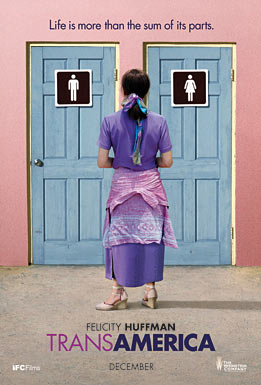
Transamerica review

Felicity Huffman’s performance in Transamerica has already been praised to the skies, but it’s worth looking again at how difficult a role this must have been. We’ve seen actors playing people who masquerade as members of the opposite sex (eg Dustin Hoffman in Tootsie), we’ve even seen actors actually playing members of the opposite sex (eg Linda Hunt, who won a best supporting actress Oscar for her performance as a man in The Year of Living Dangerously). Both types of performances are demanding enough, but in a sense they require just one degree (albeit one huge degree) of separation between the character and the performer’s real self – and the characters being portrayed are “complete men” or “complete women”.

What Huffman has to do here is more complex, more layered and it must have been personally disturbing. She plays a character whose “body is a work-in-progress” – a man (Steven) who has always felt like a woman, wanted to be a woman, and who is now halfway through the process of transforming himself into a woman (Bree). At the point where the film begins, most of the hormonal changes have been set into motion and all that’s left is the final surgery – which means Huffman doesn’t have the actors’ luxury of playing the part in drag; of hiding behind a mask. She has to be herself physically (more or less: make-up is used to make her face seem less feminine and allow us to imagine what Steven must have looked like as a man) – but at the same time she has to convey male habits and tics accumulated over decades, plus the awkwardness of a transition period where all those tics must be unlearnt. The more conventional decision would have been to have a male actor play this role (it would, among other things, allow the actor greater scope for showing off in the more obvious ways). But Huffman does a better job than I can imagine any other performer (of either sex) doing. She carries the film from beginning to end.

Transamerica is engrossing all the way through, but a bit uneven. For much of its duration it’s a nicely paced road movie, built on the gradual development of a key relationship. Then it sinks briefly into The Addams Family territory, but comes gasping to the surface just in time to provide an ending that is neither too maudlin nor a cop-out. The film is hampered slightly by the inscrutability of the other main character – the 17-year-old son Bree never knew she had, a delinquent named Toby whom she bails out of jail and takes on a cross-country trip from New York to Los Angeles (he doesn’t know who she is). Toby is hard to get a fix on, and I’m not sure whether the fault lies in the script or in Kevin Zegers’ strange, two-dimensional performance. You sense he’s a little boy at heart, a kid who’s had to grow up too soon - during the drive with Bree he seems to enjoys the chance to drop his defences. But when the more street-wise side to his character emerges, it seem at odds with that other personality – almost too conniving.

The introduction of Bree’s crazy family - the mother in particular a shrill, overbearing caricature – also poses a bit of a problem. One understands the point the film is trying to make here: that compared to these people, the transsexual is the one who’s normal, living a life of dignity, relatively sure of her place in the world. But in another sense, by showing us that Steven/Bree came from this background in the first place, the film can also be read as suggesting that his leanings are the result of a troubled childhood.

Ultimately, however, Transamerica succeeds in showing how harmful it is to expect people to stay in their pre-defined roles for all time – to never step out of their little compartments or grow into other roles. It’s a theme that shows up in a minor key through the film – as in the scene where Toby is surprised, almost offended, to see an American Indian (Graham Greene in a neat cameo) wearing a cowboy hat. (“Keeps the sun out of my eyes better than a band and two eagle feathers would,” the Indian explains with Clint Eastwood-like taciturnity.) And of course it permeates the film through Huffman’s performance, which helps us see Bree not as a deviant but as someone we can immediately relate to.

One thing I haven’t mentioned is how funny the film is in its own quiet way – especially in the running joke involving Bree’s efforts to correct Toby’s grammar (“Hustling is degrading, not degradable!”) and in the (admittedly clichéd) depiction of Middle America’s White Trash. Also, though there is no prolonged nudity, there are a couple of brief scenes (including one with a prosthetic) that are quite graphic and disturbing – and I find it interesting that the film is being released (presumably uncensored) in multiplexes in Delhi. I went for a preview screening where few others were present but I wouldn’t mind being a fly on the wall at a regular show with lots of clueless college kids in attendance!